The Noh Mask Murder by Akimitsu Takagi

Translated by Jesse Kirkwood

My 20 Books of Summer reading is off to a good start with this 1949 Japanese locked room mystery, now available from Pushkin Press in a new English translation. Thanks to Pushkin, I’ve been able to try several Japanese classic crime authors over the last few years, including Seishi Yokomizo, Yukito Ayatsuji and Soji Shimada. The Noh Mask Murder is the first book I’ve read by Akimitsu Takagi and I thoroughly enjoyed it.

The novel opens with a discussion between Koichi Yanagi, a chemist who has recently returned to Japan after serving in Burma during the war, and his old school friend, Akimitsu Takagi (yes, the author himself, who appears as a character in his own novel – just like Anthony Horowitz in his Horowitz and Hawthorne series). Akimitsu explains to Koichi that he wants to write a new kind of detective novel, one based on a mystery he has solved for himself in real life:

‘I’d tackle some fiendish real-life mystery, then set down precisely how I solved it in the form of a novel. My readers would be provided with the exact same evidence as the author. They’d be able to follow the detective-narrator’s train of thought, assess the appropriateness of his actions – and even come up with their own alternatives. But I don’t imagine an opportunity like that will ever present itself…’

His opportunity comes sooner than he had imagined when Koichi stumbles upon a mystery at the Chizui family mansion, where he has been staying since returning from the war. The head of the household, Professor Chizui, who was once a friend of Koichi’s, died ten years earlier and the house is now inhabited by his two children and the family of his younger brother, Tajiro. The first sign that something is wrong within the Chizui mansion comes when an eerie figure wearing a sinister Noh mask is seen at one of the windows. Soon after this, Tajiro is found dead inside a locked room, with a smell of jasmine in the air and a Noh mask lying on the floor beside him. Akimitsu Takagi joins Koichi at the house to investigate the murder, but when they discover that someone has called the undertaker to order three coffins, it seems that there’s going to be more than just one murder to investigate!

The mystery is a fascinating one and although some time is spent discussing the mechanisms of how the locked room murder took place, the story never becomes too bogged down by the puzzle aspect; the focus is on the characters, their relationships and their motives. I did find the structure slightly confusing at times as we know we’re reading a book within a book written by Akimitsu Takagi (as both character and author), but within that there’s a journal written by Koichi and a long letter written by Hiroyuki Ishikari, the public prosecutor, so the narrative is sometimes three layers deep. There are some clever twists towards the end, however, which might not have worked if it had been structured differently.

Apart from the mystery, I found it interesting to learn about the different types of mask used in Japanese theatre and how although the Noh mask, which represents a demon, cannot change expression the actors can still use it to show various emotions by tilting the mask up and down and by the clever use of lighting. With the story being set in the post-war period, it’s also interesting to hear the characters reflect on the irony of being so concerned with the death of one person after living through a war in which millions died. If you kill a man in peacetime you’re considered a murderer, says Tajiro’s son, Rintaro, but if you kill a man on the battlefield you’re given a medal.

I really enjoyed The Noh Mask Murder, then, but be warned – in the prologue, where Takagi is discussing his plans for a detective novel, he casually spoils the solution of Agatha Christie’s The Murder of Roger Ackroyd. Not a problem for me as I’ve already read it, but I wish authors wouldn’t do that!

Thanks to Pushkin Vertigo for providing a copy of this book for review via NetGalley.

This is book 1/20 of my 20 Books of Summer 2024.

The Fox Wife by Yangsze Choo

The famous scholar Ji Yun, who was obsessed with foxes, said: Humans and things are different species, and foxes lie between humans and things; darkness and light take different paths, and foxes lie in between darkness and light.

Like Yangsze Choo’s previous two novels, The Ghost Bride and The Night Tiger, The Fox Wife is a fascinating blend of history, fantasy and folklore. It takes as its premise the idea that fox spirits, who play a large role in Chinese and Japanese mythology, really exist and can take on the appearance of human beings.

Beginning in Manchuria in the winter of 1908, one thread of the novel follows Bao, an elderly private detective who has been called in to investigate the death of a young woman. The woman’s body was found frozen in the doorway of a restaurant and people are already starting to whisper that she was lured to her death by foxes. Ever since he visited a shrine to a fox god as a child, Bao has been blessed, or maybe cursed, with the ability to detect truth from lies. Now, he hopes he can use that gift to find out what happened to the woman found dead in the cold.

In chapters that alternate with Bao’s, we meet Snow, or Ah San, a white fox spirit who is searching for the man she blames for the death of her daughter two years earlier. Snow has taken the form of a human woman and joined the household of a Chinese medicine seller. In her position as maid, she is able to accompany the family on a trip to Japan where she hopes for an opportunity to take her revenge.

At first, the two threads of the novel are very separate; Bao’s story is written in the third person and focuses on his investigations, with some flashbacks to his childhood; Snow’s narrative is in first person, giving it a more intimate feel. Eventually, their paths begin to converge, producing some interesting plot twists and revelations. We also find that there’s not just one fox in this story, but who are the others and what is their relationship with Snow? It takes a long time for everything to unfold and for a while in the middle of the book I thought it was starting to drag, but the pace does pick up again towards the end.

My knowledge of Chinese folklore is sadly very limited, so I enjoyed learning more about the significance of fox spirits, their characteristics and powers, and some of the myths and folktales that have been told about them. With the novel being set partly in Japan as well as in China, we also see how similar myths and legends about foxes cross over into Japanese culture. It’s all very fascinating, and whenever my attention was starting to wane due to the slow, meandering plot, there would be another passage about foxes that would grab my interest again.

I had mixed feelings about The Fox Wife, then, but I’m pleased to have had the opportunity to learn something new! It’s definitely worth considering this one – and Yangsze Choo’s others – if you have any interest in Chinese myth.

Thanks to Quercus Books for providing a copy of this book for review via NetGalley.

Book 6/50 for the Historical Fiction Reading Challenge 2024

Silence by Shūsaku Endō

Translated by William Johnston

One of my resolutions for 2024 is to read more historical fiction in translation and where better to start than with a book for the Japanese Literature Challenge (hosted by Dolce Bellezza throughout January and February).

First published in Japanese in 1966 and in English in 1969, Shūsaku Endō’s Silence is set in the 17th century and tells the story of a Portuguese Jesuit priest, Sebastian Rodrigues, who travels to Japan to investigate claims that his old mentor, Father Ferreira, has committed apostasy – in other words, renounced his faith. Rodrigues and his friend Francisco Garrpe, another priest, can’t believe that their teacher would do such a thing. Certain that there must be some mistake, the two set out from Lisbon on the long journey to Japan, where they hope to learn what has really happened to Ferreira.

Rodrigues and Garrpe reach Japan in 1639 and quickly discover that the local Christian communities are being persecuted and forced to hide their religion from the authorities. Anyone the officials suspect of being a Christian is told to trample on an image of Christ, known as a fumie, and if they refuse they are imprisoned and tortured by being suspended upside down over a pit. On his arrival in Japan, Rodrigues goes into hiding with the other Christians, carrying out his missionary work and helping them to worship in secret, but he knows it’s only a matter of time before he is caught and has his own faith put to the test.

Silence is both beautifully written and beautifully translated. From beginning to end, I was completely immersed in another time and place; there’s no jarringly modern language to pull the reader out of the story and everything feels authentic and real. I was intrigued by Endō’s decision to write the novel from the perspective of Rodrigues (first in the form of letters written by the priest and then in the third person) rather than the Japanese Christians and it was interesting to see how Endō viewed his country, its people and its customs through the eyes of a stranger.

I am not a particularly religious person but you don’t need to be to be able to appreciate this novel. I was very moved by the internal struggles Rodrigues faces as he begins to question why God is remaining silent in the midst of so much torture and persecution and whether renouncing his faith, under certain circumstances, could actually be the right thing to do if it helps alleviate the suffering of others. As you can imagine, it’s quite a bleak story, but I loved it and although it’s only been a few days since I finished it, I don’t think it’s a book I’ll ever forget. I would like to try more of Endō’s work and am pleased to see that some of his other novels are also available in English translations.

I read this book for the Japanese Literature Challenge 17 and the Historical Fiction Reading Challenge.

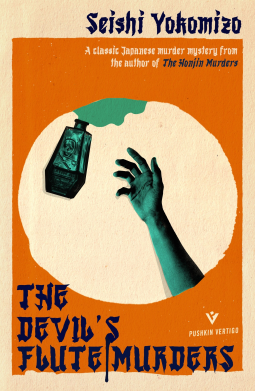
The Devil’s Flute Murders by Seishi Yokomizo (tr. Jim Rion)

The Devil’s Flute Murders, first published in Japanese in 1953, is the fifth of Seishi Yokomizo’s detective novels to be made available in new English translations by Pushkin Press. I’ve now read all five of them and enjoyed some more than others; I think this is one of the best, along with The Inugami Curse and The Honjin Murders.

In this book, set in 1947, Yokomizo’s dishevelled, nervous, stammering detective, Kosuke Kindaichi, is approached by a young woman who wants him to investigate the disappearance of her father, Hidesuke Tsubaki. Tsubaki, who had been a viscount until the recent abolition of the Japanese aristocracy, was found dead in the woods several weeks after leaving his family home, but although his daughter Mineko was the one to identify the body, she now has reason to believe he isn’t dead at all. There have been sightings of a man closely resembling Tsubaki in the grounds of the family estate and sounds of the haunting flute playing for which he was famous in his lifetime.

That evening, Kindaichi is invited to a séance at the Tsubaki home, which has been arranged by the viscount’s widow in the hope of discovering whether her husband is alive or dead. At the end of the event, a recording of Tsubaki’s final composition, The Devil Comes and Plays His Flute, begins to play by itself – and next morning, Kindaichi hears the news that another family member has been found dead in a locked room during the night. Who is responsible for the murder? Is the viscount’s ghost really haunting the family estate? And what is the meaning of the strange symbol found at the scene of the crime?

Yokomizo’s plots are always clever and fascinating and don’t rely quite as heavily on complex puzzle-solving as some of the books I’ve read by other Japanese classic crime authors. Understanding the relationships between the characters, their family secrets and their personalities and motives is just as important as working out how the crimes were committed. I guessed who the culprit was but didn’t know why they did it – I’m not sure if it would have been possible to know until the backstory of each character was revealed, but maybe I missed some clues.

Something else I like about this series is the insight the books offer into life in Japan during the post-WWII years. In The Devil’s Flute Murders the shadow cast by the war is particularly strong. There are mentions of food shortages, problems with electricity supplies and overcrowded, unreliable public transport. The new constitution drafted by the Allies during the occupation of Japan is the reason why Tsubaki and other members of the nobility have lost their titles, while bombed out houses and damage from fire has led to Tsubaki’s extended family all coming to live on the former viscount’s estate, bringing them together in one place for the events of the novel to play out.

This is the first book in the series to be translated by Jim Rion (the others have been translated by Louise Heal Kawai, Bryan Karetnyk and Yumiko Yamazaki). I think all of the translators have done a good job and I haven’t noticed any real differences in quality or readability between the different translations. My only problem with this one came when Kindaichi’s investigations take him from the Tsubaki home in Tokyo to Awaji Island near Kobe in the west and I found the way Rion chooses to write the western accent slightly odd and jarring. Of course, I appreciate how difficult it must be to capture nuances of accent and dialect in a translation!

I’m already looking forward to the next Kindaichi mystery, The Little Sparrow Murders, which is due to be published next May and sounds just as intriguing as the others.

Thanks to Pushkin Vertigo for providing a copy of this book for review via NetGalley.

Kwaidan: Stories and Studies of Strange Things by Lafcadio Hearn

The next book I’ve read for this year’s R.I.P. XVII event is a fascinating and unusual collection of Japanese short stories, first published in 1904. The writer and translator Lafcadio Hearn was born in Greece and raised in Ireland, before later settling in Japan where he began to collect Japanese legends and folktales which he translated into English. Kwaidan: Stories and Studies of Strange Things contains seventeen of these tales, as well as three essays on insects – one on butterflies, one on mosquitoes and one on ants. These mainly focus on the role of the insects in Japanese and Chinese mythology, art, drama and poetry and are full of intriguing little snippets of information.

The other seventeen pieces are a mixture of ghost stories, fairy tales and strange anecdotes, some of which Hearn translated from old Japanese texts and others which he heard on his travels through Japan and attempted to put into words himself. For example, in his introduction, Hearn states that the story of Yuki-onna, in which a beautiful young woman in white appears to two woodcutters during a snowstorm, was told to him by a farmer in Musashi Province. Although the Yuki-onna character dates back centuries, Hearn’s account is based on this verbal version and not translated from any other source.

The creepier stories in the book are the ones that explore the different kinds of ghosts and monsters that appear in Japanese myth, such as the ‘faceless ghosts’ or noppera-bō, the human-like goblins called rokurokubi with detachable floating heads and the corpse-eating spirits known as the jikininki or ‘hungry ghosts’. These are interspersed with more traditional ghost stories, involving spirits returning after death to look for a loved one or to search for a lost possession. There’s also a great story recounting the legend of Hoichi the Earless, a blind musician who is tricked into playing his biwa (lute) for an audience of ghosts in a cemetery every night. If you want to know what happens to his ears, you’ll have to read the story!

Not all of the stories are particularly spooky, though – some are just, as the title suggests, ‘studies of strange things’. Of a Mirror and a Bell is an account of the legend of the Mugen-Kane bell which was made by melting down old bronze mirrors. Hearn then goes on to explore the Japanese concept of nazoraeru, where one item can be used as a substitute for another, to bring about magical results. There’s also a very short but beautiful story about a pair of oshidori, or Mandarin ducks, and another I enjoyed is The Dream of Akinosuke, about a man who falls asleep and dreams that he is the ruler of his own island province. This story incorporates both butterflies and ants, which makes the insect essays at the end of the book feel more relevant!

Some of the stories are too short or incomplete to be very satisfying, but the collection as a whole is fascinating and I would recommend it to anyone with an interest in Japanese culture and folklore. There’s also a Japanese film version from 1965, also titled Kwaidan, which I haven’t seen, but it seems to be very highly acclaimed and received an Oscar nomination for Best Foreign Language Film.

Have you read this or any other book of Japanese ghost stories?

Book #4 read for R.I.P. XVII

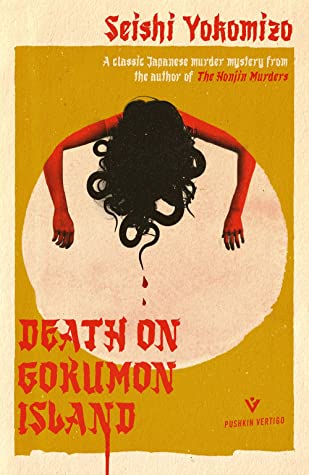
Death on Gokumon Island by Seishi Yokomizo (Trans. Louise Heal Kawai)

The second book I’ve read from my 20 Books of Summer list is this 1948 Japanese mystery novel, now available in an English translation. This is the fourth book in Yokomizo’s Kosuke Kindaichi series to be published in English by Pushkin Press, but actually the second in original publication order. It works as a standalone, with a few references to Kindaichi’s first case, The Honjin Murders, so you could easily start with this one if you wanted to.

Death on Gokumon Island is set in 1946, just after the end of the Second World War, and nearly ten years after the events of The Honjin Murders. Kosuke Kindaichi is on his way to the strangely named Gokumon – or ‘Hell’s Gate’ – Island to deliver the sad news of his army friend Chimata Kito’s death. Kindaichi knows this will be a difficult task, but what really worries him is a prediction made by the dying man that his three half-sisters, who all live on the island in the family home, are going to be murdered.

Arriving on Gokumon Island, Kindaichi gets to know the members of the Kito household, including Chimata’s father who is said to be mad and kept locked up behind bars, as well as another rival branch of the family who live nearby and would benefit from deaths in the main Kito family. The scene is set for a classic murder mystery – and it’s not long before the first murder does take place. Kindaichi begins to investigate, but the islanders are suspicious of newcomers and are reluctant to answer questions.

I struggled to get into this book at first; I felt that we were being introduced to a lot of characters all at once and it was difficult to distinguish between them. I’ve found that with all of the Japanese mysteries I’ve read the authors seem to be more concerned with puzzle-solving than with character development, although Yokomizo is better in that respect than some of the others. After a few chapters I had settled into the story and began to enjoy it. It was good to see more of Kosuke Kindaichi than we did in The Village of Eight Graves; he’s quite endearing with his nervous stammer and head-scratching and the way he makes mistakes and isn’t afraid to admit to them.

Louise Heal Kawai’s translation is clear and easy to read (she also did the translation for The Honjin Murders, although not Eight Graves, which was translated by Bryan Karetnyk). I’m sure Japanese must be a difficult language to translate into English and I do wonder if any nuance is lost along the way, but I was impressed by the way she managed to capture the meaning of the wordplay, poetry and haikus that form part of the plot. I felt I was learning quite a lot about Japanese culture, as well as post-war life in a country that had been on the losing side.

This book has been compared with Agatha Christie’s And Then There Were None, but I don’t think they have much in common other than that they are both mysteries set on islands. This is a very different sort of island, for a start – unlike Christie’s, it’s inhabited, with a fishing community, a mayor, doctors, priests and barbers (to name just some of the characters we meet) – and although there may be a few similarities in the way the murders are carried out, the solution is completely different. It’s a solution I didn’t manage to guess at all; I was convinced I had picked up on an important clue halfway through but it turned out to be a red herring!

Now I need to find time to read The Inugami Curse, the other Yokomizo book currently available in English.

Thanks to Pushkin Vertigo for providing a copy of this book for review via NetGalley.

This is book 2/20 from my 20 Books of Summer list.

The Village of Eight Graves by Seishi Yokomizo – trans. Bryan Karetnyk

Over the last few years I have discovered several Japanese crime authors – including Soji Shimada and Yukito Ayatsuji – thanks to Pushkin Press making them available in English translations, but the one who has impressed me the most is Seishi Yokomizo. I really enjoyed The Honjin Murders, one of his many books to feature the detective Kosuke Kindaichi; I didn’t like The Village of Eight Graves, another from the same series, quite as much, but it’s still an entertaining read.

First published in 1950, the novel is set in the small Japanese village of Eight Graves where, centuries earlier, eight samurai were brutally murdered, bringing down a curse upon the village and giving it its sinister-sounding name. In the 1920s the curse struck again when a village leader went on a violent killing spree. Now, twenty-five years later, our narrator Tatsuya Terada, a young man who has been raised in Kobe by his mother and stepfather, is informed by a lawyer that his real father was the man responsible for those terrible murders. It seems that Tatsuya is now the heir to the family estate and must return to Eight Graves to claim his inheritance – but before he has even left Kobe he receives an anonymous letter warning him to stay away.

On his arrival in Eight Graves, Tatsuya finds that most of the other villagers are hostile and unwelcoming, believing that his presence will bring bad luck and tragedy to the village yet again. And so, when more murders begin to take place, suspicion immediately falls on Tatsuya – but as he is our narrator, we know that he is innocent. Or is he? Kosuke Kindaichi is called in to investigate, but at the same time Tatsuya is carrying out investigations of his own to find the real culprit and clear his own name.

Unlike in The Honjin Murders, where the untidy and unassuming Kindaichi plays a big role in the story, in this book we hardly see him at all. Almost as soon as he arrives in Eight Graves he disappears into the background again. We know that he is working on solving the mystery, but we don’t actually watch him doing it because we stick exclusively with Tatsuya’s narration and he and Kindaichi have very little interaction until nearer the end of the book. This makes this one less of a detective novel and more of a thriller or adventure novel, as Tatsuya explores the village alone looking for clues and stumbling into danger.

Yokomizo creates a wonderful atmosphere in this book with Tatsuya’s investigations leading him into networks of tunnels, caves with stalactites, and underground lakes and caverns. The legend of the eight murdered samurai is also incorporated into the story, along with a search for hidden treasure said to be buried somewhere within the village and a rivalry between two branches of Tatsuya’s family: the ‘House of the East’ and the ‘House of the West’. It’s an entertaining novel and there’s always something happening – but I did think the parts where Tatsuya is wandering around in the caves and tunnels became a little bit tedious. The absence of Kosuke Kindaichi for most of the book was also disappointing and I think I would have preferred a more conventional detective novel with the focus on solving the mystery rather than on treasure hunting.

Still, this book was fun to read and I loved the setting. Now I need to read the other Yokomizo novel currently available in English: The Inugami Curse.

Thanks to Pushkin Vertigo for providing a copy of this book for review via NetGalley.