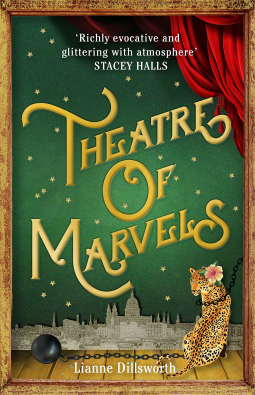
Theatre of Marvels by Lianne Dillsworth

When the audience take their seats at Crillick’s Variety Theatre looking forward to an evening of entertainment featuring the Great Amazonia, a ‘savage queen’ captured in Africa, little do they know the act is a fraud. The ‘Great Amazonia’ is actually Zillah, a young mixed-race Londoner who has never been to Africa in her life. Zillah can see nothing wrong with what she is doing; she enjoys being the headline act, she’s being paid for her work and she’s making some powerful new friends, among them Vincent, Viscount Woodward, who is setting her up as his mistress. It’s not until she meets Lucien Winters, an African merchant and former slave, that she begins to question her actions and wonder whether there is a better life she could be leading.

Then, her manager Marcus Crillick unveils a new act – the ‘Leopard Lady’ – and Zillah’s eyes are opened to the full extent of Crillick’s cruelty and the way she and others are being exploited for financial gain. When the Leopard Lady goes missing, Zillah becomes convinced that she is being held captive somewhere and sets out to search for her – a search that will take her across Victorian London, from the bustling dockyards to the slums of St Giles and the elegant parlours of the upper classes. Meanwhile Zillah must choose between Vincent and Lucien and decide how she wants her future to unfold.

I enjoyed Theatre of Marvels, although it did seem very similiar at first to Elizabeth Macneal’s Circus of Wonders, another novel about the exploitation of ‘circus attractions’. However, this one is written from a very different perspective, allowing Lianne Dillsworth to explore different themes such as racial and class inequality and slavery. The thousands of black and mixed race people who lived in Victorian London are often ignored in fiction set in that period, but Dillsworth gives them a voice here through the characters of Zillah, Lucien and others. Zillah is a particularly interesting heroine as she is clearly struggling with her identity throughout the novel, feeling that she doesn’t truly fit in with one community or the other and trying to decide who she is and what she wants.

Although I felt that some of the characters, particularly the villain Marcus Crillick and Zillah’s friend and rival Ellen, were too thinly drawn, there were others I found much more interesting. I was intrigued by Vincent Woodward, as there were times when I thought he must genuinely care about Zillah, but I doubted from the beginning that he would have the courage to defy convention and commit to a future with her. I could only see their relationship ending unhappily. On the other hand, Lucien seemed to have a deeper understanding of Zillah and much more personal integrity, yet I never really managed to warm to him. However, I thought I had predicted how the story would end and was taken by surprise because it wasn’t quite what I’d expected!

While I would have liked to have seen more of the Leopard Lady and to have heard some of her story from her own point of view, I did enjoy getting to know Zillah. This was an absorbing and surprisingly quick read and I’ll be looking out for more books from Lianne Dillsworth.

Theatre of Marvels is published in the UK on Thursday 28th April 2022. Thanks to Hutchinson Heinemann for providing a copy of this book for review via NetGalley.

This is book 19/50 read for the Historical Fiction Reading Challenge 2022.
This is also my contribution to Reading the Theatre 2022 hosted by Lory of Entering the Enchanted Castle.

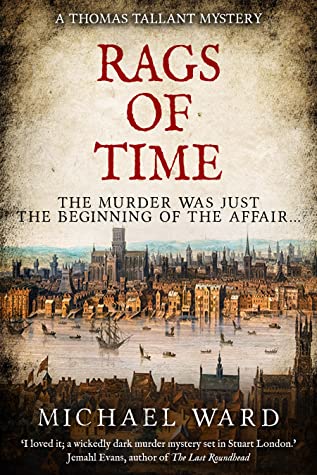
Rags of Time by Michael Ward

I love a good historical mystery, so I’m pleased to have had the opportunity to read Rags of Time, the first in a new series set in the 17th century during the final years of the reign of Charles I. Based on how much I enjoyed this book, I will certainly be looking out for the next one.

The story begins in 1639 with Tom Tallant, a young spice merchant, returning to London from India only to find that he has become implicated in a murder investigation. Wool merchant Sir Joseph Venell has been found dead in a meadow near his home in Kensington and it seems that Tom is the main suspect. Then another murder takes place, this time in the Tallant household, casting further suspicion on Tom. In order to clear his name, Tom must try to identify the real murderer – and for that he will need the help of Elizabeth Seymour, an intelligent and unusual young woman with an interest in astronomy and an addiction to gambling.

“The murder was just the beginning of the affair”, it says on the front cover of the book, and that is quite true because although Rags of Time at first appears to be a straightforward murder mystery, it soon becomes apparent that the murder is only one aspect of the story and for a while takes second place to an equally fascinating subplot involving a printing press and the distribution of seditious pamphlets. Remember that this is all taking place during an eventful and turbulent period of history, a time of tension between King and Parliament and unrest on the streets:

‘Each day and week we suffer treasonable talk on the street, attacks on our churches, seditious street-preachers, scandalous pamphlets on every corner and finally this…mutinous gangs of Apprentice Boys!’

I loved the recreation of 17th century London; there’s such a strong sense of time and place (without becoming overly descriptive) and with so much going on it’s the perfect backdrop for Tom’s adventures. Yet one of my favourite parts of the story relates to something taking place overseas – the ‘tulip mania’ sweeping Amsterdam in the 1630s and the notion of windhandel, or ‘trading in promises’.

As for the mystery itself, once everything starts to come together towards the end of the book, there are plenty of twists and turns and when the solution was revealed I was completely taken by surprise! I think there were probably a few clues but I didn’t pick up on them and didn’t guess either the culprit or how and why the murders were carried out. Although most of the focus of the novel is on Tom, I was pleased to see that Elizabeth also contributes to the solving of the mystery; I wasn’t sure I would like her at first and it took me a little while to warm to her, but I think she’s a character with a lot of potential, as is Tom himself. I hope to meet them both again soon!

Thanks to the author for providing a copy of this book for review.

Book 4/50 read for the Historical Fiction Reading Challenge.

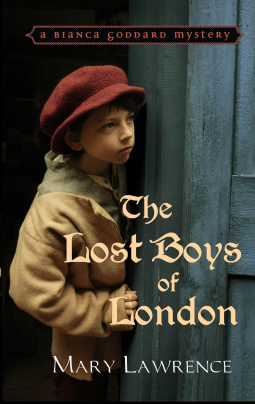
The Lost Boys of London by Mary Lawrence

This is the fifth book in a series of historical mysteries set in the Tudor period and featuring the character of alchemist’s daughter Bianca Goddard. I don’t think it’s essential to read all of the books in the series in order; I started with the fourth one, The Alchemist of Lost Souls, and had no problems in picking up the threads of the story and following the plot.

As The Lost Boys of London opens, Bianca’s husband John is away fighting in Scotland for Henry VIII, leaving Bianca in London, devoting her time to preparing herbal remedies in her ‘room of Medicinals and Physickes’. In the past, Bianca’s skills as a herbalist have led to her assisting Constable Patch with his investigations, and having played a part in solving several previous mysteries, her help is required again when a young boy is found hanging from the exterior wall of a church.

Finding a rosary wrapped around the boy’s neck marked with a set of initials, it seems there could be a religious motive for the murder, and this appears to be confirmed when a second boy is found under similar circumstances at another church. Bianca is determined to do whatever she can to find the murderer before he or she kills again – and she has a personal reason for wanting to do so as quickly as possible. Her own young friend, Fisk, who is about the same age as the other boys, has gone missing and Bianca is afraid that he could become the next victim.

I enjoyed this book more than The Alchemist of Lost Souls. I thought the mystery was stronger and more interesting, with its exploration of topics such as religious conflict, the rivalries between the clergy of various churches, and child poverty in Tudor London. Also, although the previous book included some magical realism elements, which didn’t entirely work for me, there didn’t seem to be anything like that in this one and I thought that was a good decision as the plot was strong enough without it. As well as following Bianca’s investigations in London, there are some chapters describing John’s adventures as a reluctant soldier in the Scottish borders during the war known as the ‘Rough Wooing’ and this added some variety to the novel, taking us away from London now and then to see what was going on elsewhere.

Sometimes the language used is not right for the setting (English houses don’t have ‘stoops’, for example) and I found that a bit distracting, but otherwise the atmosphere is convincing enough and it’s always interesting to read about the lives of ordinary, working-class people in the Tudor period as a change from all of the books dealing with the royal court. Oh, and I love Bianca’s cat, Hobs!

This is apparently the final book in the Bianca Goddard series. I received a copy for review via NetGalley.

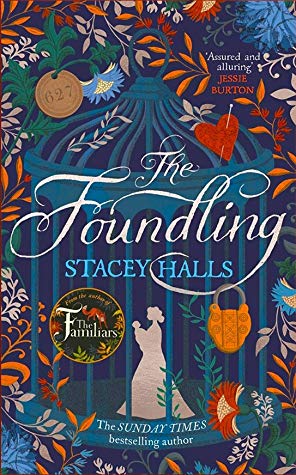
The Foundling by Stacey Halls

Stacey Halls’ new novel, The Foundling, begins on a cold November evening in 1747 with Bess Bright about to make a very difficult decision, one no new mother should ever have to face. She has brought her illegitimate baby daughter, Clara – less than a day old – to London’s Foundling Hospital and is planning to leave her there. Aware that, as an impoverished shrimp seller, she has little to offer her daughter but hunger and hardship, she is sure Clara will have a happier childhood at the Foundling, where at least she will be fed, clothed and educated. As she walks away from the hospital, leaving her baby behind, Bess consoles herself with the knowledge that it needn’t be forever; she has left a token – half of a heart made from whalebone – as proof of identity if she is ever in a position to bring Clara home again.

After six years of working hard and saving every penny she can, Bess returns to the hospital to collect her child, dreading being told that Clara has died of some childhood illness. Nothing can prepare her for the shock she receives when she enters the Foundling and is informed that her daughter has already been claimed – by someone who gave her name as Bess Bright and knew about the whalebone token. Bess is horrified. What has happened to Clara? Who has taken her little girl and what have they done with her?

I was very impressed with The Foundling, my first Stacey Halls novel. Although there wasn’t as much mystery as I would have liked and some of my biggest questions were answered a lot earlier than I’d expected, I was still kept in suspense wondering whether there would be a happy ending for Bess and her daughter or whether fate would have something else in store. I liked Bess and loved the descriptions of the London in which she lived and worked, from her lodgings in Black and White Court, where the alleys are ‘choked by coal smoke’, to the lively fish markets of Billingsgate where she and her father sell their shrimps.

However, this is not just Bess Bright’s story. It’s also the story of another woman, Alexandra Callard, a widow who is leading a very different sort of life in another part of London. Apart from attending church, Alexandra hasn’t left her elegant townhouse for years and neither has her little girl, Charlotte. Just the thought of going outside and walking along the street fills her with fear and she’s convinced that her child will be safer indoors too. Then one day, a friend persuades her to employ a nursemaid to help with Charlotte and the arrival of a new face in the household poses a threat to the secure little bubble Alexandra has built around herself.

I didn’t like Alexandra as much as Bess, but bringing a second narrator into the story – especially one who lived in such a different world – added variety and the chance to see things from another perspective. Unlike Bess, Alexandra doesn’t have to worry about money and has everything she needs within the four walls of her luxurious home, but due to her mental health problems her life is still not very happy. We eventually find out what has caused her agoraphobia and I did have a lot of sympathy, but I still found her a cold and rather selfish person.

As well as the two contrasting views of Georgian London, The Foundling explores several other interesting issues, particularly what it means to be a mother and what sort of environment is the most suitable in which to raise a happy, healthy child. The way the book ended was probably the best outcome, but I think there were at least two other possible endings and either could have been used to make a valid point. Having enjoyed this so much, I will have to read Stacey Halls’ previous book, The Familiars, about the Pendle Witch Trials.

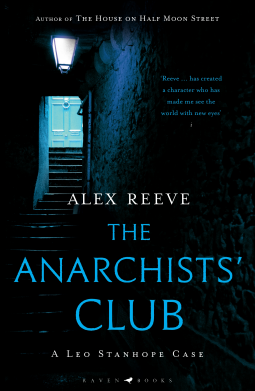
The Anarchists’ Club by Alex Reeve

One of the first books I read this year was Alex Reeve’s The House on Half Moon Street, the first in a new mystery series set in Victorian London. I enjoyed it and couldn’t wait to meet its hero, Leo Stanhope, again. Now that I’ve read the second book, The Anarchists’ Club, I’m pleased to say that I enjoyed this one just as much as the first. If you’re wondering whether it’s necessary to read the series in order, I don’t think it’s essential…you will have a better understanding of Leo and his background if you do, but otherwise both books work well as standalone mysteries.

Catching up with Leo again at the beginning of The Anarchists’ Club, it seems that not much has changed in his life. He is still renting a room above a pharmacy, still working as a hospital porter, still meeting his only friend Jacob for an occasional game of chess. One day he is helping out in the pharmacy when a woman comes in to buy some bromide. Lacking the money to pay, she asks for credit, but Leo refuses, telling her she will have to speak to the owner. It’s only a brief interaction but one which Leo will remember forever, because a few days later he receives a visit from the police. The woman, Dora Hannigan, has been murdered and a scrap of paper with Leo’s name and address on it has been found on her body.

Among the suspects is John Thackery, a man Leo knew many years ago – when he was quite literally a different person. If John makes his former identity known, the whole new life Leo has built for himself could be destroyed, so he agrees to give John an alibi in return for his silence. Has Leo done the right thing or is he allowing a murderer to walk free? The only way to be sure is to investigate the murder himself…

Leo’s investigations lead him to, as the title of the book suggests, a club of ‘anarchists and socialists’ with whom the dead woman had become involved. I was slightly disappointed that we don’t find out as much about these people and their work as I’d expected; although the division between the rich and poor in society is one of the book’s main themes, the mystery itself doesn’t really have much to do with any of that. As with the first novel, the most interesting aspect of the story is the character of Leo himself. Although he is known as Leo Stanhope now, he grew up as Lottie Pritchard before deciding as a teenager that he could no longer continue living as a woman and denying who he really was. Being transgender in the 19th century is not easy and a few words from someone who knows the truth – someone like John Thackery – could ruin everything for him. For Leo, though, being true to himself is worth the risk and the danger. As I am not transgender myself and, as far as I know, Alex Reeve isn’t either, I can’t really say whether the portrayal of Leo and his thoughts and feelings is accurate or not, but it does feel believable to me.

The books are narrated by Leo in the first person and I find him a very likeable character. For obvious reasons, he tries not to attract too much attention to himself and has a quiet, unassuming nature. In this second novel, I loved his relationship with Aiden and Ciara, Dora Hannigan’s children, whom he befriends and tries to look after once it becomes obvious that nobody else is going to. This is particularly touching because there are so few people in Leo’s life whom he still cares about or who care about him, having become estranged from his parents and sister after making the decision to leave his life as Lottie behind.

I was also pleased to meet Rosie Flowers, the pie maker, again; I said earlier that Jacob is Leo’s only friend, but that’s not quite true because although Rosie and Leo exasperate each other at times, they formed a close bond during their investigation of the previous mystery and work together to try to solve this one as well. I’m hoping to see them both again in future books; I haven’t seen any news of a third Leo Stanhope mystery yet, but I will certainly be looking out for it.

Thanks to Raven Books for providing a copy of this book for review via NetGalley.

This is book #3 read for this year’s R.I.P. event.

The Canary Keeper by Clare Carson

Clare Carson has previously written a trilogy of thrillers (the Sam Coyle trilogy) set in contemporary Orkney. I haven’t read those, but the title and cover of her new novel, The Canary Keeper, caught my attention and when I investigated I found that this one is a historical crime novel, still set in Orkney but during the Victorian period. I love a good Victorian mystery, so of course I had to give it a try.

The story begins in London in 1855, with the body of Tobias Skaill being found dumped in the Thames. Witnesses report seeing the body thrown from a canoe – surely the work of an Esquimaux! The suspect has disappeared without trace, but it seems he may have had an accomplice: Birdie Quinn, a young Irishwoman who was seen walking in the area at the time. We, the reader, know that Birdie is innocent; she had only met Tobias for the first time the day before when he had tried to give her a message. Her presence by the river that night was a coincidence and she has certainly never had any dealings with Esquimaux. But how can she prove her innocence?

Birdie knows that when the law catches up with her, she will hang, so she turns for help to Solomon, a policeman with whom she was recently in a relationship before they went their separate ways. Solomon advises her to get away from London for a while – and with evidence linking the dead man with the Orkney Islands off the north-east coast of Scotland, that is where Birdie decides to head. Can she uncover the truth surrounding Tobias Skaill’s death and identify his killer in time to clear her own name?

The Canary Keeper explores so many interesting ideas and topics. First, there is Orkney itself and the many traditions, myths and beliefs that are unique to those islands and their people. Then there is the famous Arctic expedition led by Captain John Franklin in search of the North-West Passage, ending in tragedy when both ships, HMS Erebus and HMS Terror, are lost. The Franklin Expedition takes place just a few years before the events of The Canary Keeper and as Birdie begins to investigate she find several surprising links between the doomed expedition and the murder of Tobias Skaill. The fur trade also plays a part in the story and, in the London sections of the book, we learn about some of the trade guilds and livery companies of the period.

Clare Carson also creates some interesting characters, at least on the surface. I found Birdie quite a likeable heroine and I enjoyed her scenes with Solomon, hoping that they might decide to give each other a second chance. There’s also Morag, whose unconventional lifestyle leads to her being labelled a witch, and the widowed Margaret Skaill who is determined to keep her husband’s shipping business going despite her inability to read and write. And yet, none of these characters ever came fully to life for me; there was a disappointing flatness throughout the novel, which I blame on the fact that it is written in third person present tense, probably my least favourite way for a novel to be written. I often find that it puts a distance between the reader and the characters and makes it difficult to engage on an emotional level, although maybe that’s just me.

There’s also a paranormal aspect to the novel, with Birdie experiencing visions and flashbacks, but I didn’t feel that these scenes added anything to the story. This could have been a fascinating book – and at times it was – but it wasn’t really for me.

This is book 10/20 of my 20 Books of Summer.

Thanks to Head of Zeus for providing a copy of this book for review via NetGalley.

The Confessions of Frannie Langton by Sara Collins

In the author’s note that opens The Confessions of Frannie Langton, Sara Collins remembers reading books like Wuthering Heights and Jane Eyre on the small Caribbean island where she grew up and asking the questions: “Why couldn’t a Jamaican former slave be the star of her own gothic romance? Why couldn’t she be complicated, ambiguous, complex? Why had no one like that ever had a love story like those?’ Frannie Langton is Collins’ attempt to redress the balance and give that Jamaican former slave her very own story in which to star.

The novel opens in 1826 with Frannie – or the ‘Mulatta Murderess’, as she has become known – awaiting trial at London’s Old Bailey for the murders of her employers, George and Marguerite Benham. Frannie, who had been a maid in the Benham household, had been found lying in bed, covered in blood, beside Marguerite’s dead body. She has no idea how she came to be there and is sure she couldn’t possibly have killed her beloved mistress, yet all the evidence suggests that she is guilty. While she waits for her fate to be decided, Frannie looks back on her life and recalls the sequence of events that have led her to this point.

Frannie remembers her childhood, growing up on the Langtons’ sugar plantation in Jamaica (ironically called ‘Paradise’) and describes the circumstances that meant she received an education that would usually be denied to a slave. Later, when Mr Langton returns to England, he takes Frannie with him and she looks forward to new experiences and new opportunities. On their arrival in London, however, she is handed over to the Benhams to become a servant in their home and finds that life is not much better here than it was on the plantation. The one bright spot in her life is her relationship with ‘Madame’ (Mrs Benham), but as we already know from the opening chapter of the book, that relationship will end in tragedy.

The Confessions of Frannie Langton is Sara Collins’ first novel and I’m sure it’s going to be a big success for her. It has been given a beautiful front cover, which stands out even amongst the many other beautiful covers that are around at the moment and the book has already been getting lots of very positive reviews since its publication last week. I didn’t love it as much as most other people seem to have done, but that’s probably because it wasn’t really what I’d expected. I thought the crime element would have been a more important part of the story, but the murder and the trial are confined mainly to the final few chapters, and I’m not sure I would agree with the description of the book as a gothic novel either, although I suppose it would depend on what you consider gothic to mean.

I did find Frannie an interesting and engaging heroine with a strong narrative voice and although there were some parts of her story that I felt I’d read many times before (bearing in mind that I do read a lot of historical novels set in the 19th century), Frannie’s background and unusual circumstances mean that we are seeing things from a slightly different angle. Having one white parent and one black, Frannie never really fits in with the other slaves on the plantation – especially when she is given an education and an enviable position as house slave – but she knows she will never be accepted by most white people either. As you can imagine, she experiences a lot of cruelty and prejudice in her life and this is quite a sad story at times – and also quite disturbing, particularly the descriptions of the ‘scientific experiments’ and research carried out by Frannie’s two masters, Langton and Benham.

Sara Collins writes beautifully and I was struck by sentences like “A man writes to separate himself from the common history. A woman writes to try to join it…” and “A good scientist merely searches for the answer to the question posed, but the one whose name history will record reaches for the questions no one has even thought to ask”. And of course, as a fellow book lover, I appreciated Frannie’s love of literature and her determination to read all the books she could get her hands on. But was Frannie really responsible for the deaths of George and Marguerite Benham? You will need to read her confessions to find out…

Thanks to Penguin/Viking Books for providing a review copy of The Confessions of Frannie Langton and for inviting me to take part in their blog tour.