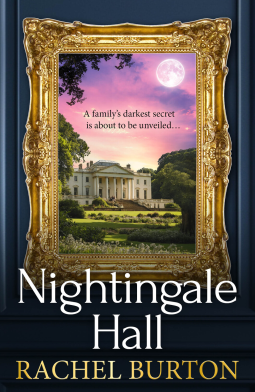
Nightingale Hall by Rachel Burton

I loved Rachel Burton’s The Strawberry House, which I read earlier this year, so I was looking forward to reading her new book, Nightingale Hall. Like the previous novel, this one features a house at the heart of the story.

The book begins in 1969 with a party being held at Nightingale Hall, home of the baronet Sir Charles Nightingale, to celebrate the moon landing. During the evening, Sir Charles unveils a special painting, Moonlight on Nightingale, which he had commissioned from the artist Lex Cooper for the occasion.

In 2019, art gallery assistant Rosie Lopez has recently lost her beloved grandmother, Lauren, who had been closer to her than her own mother. Beginning to sort through Lauren’s possessions in her London flat, she finds a postcard tucked inside a book. The postcard depicts a painting of a full moon rising above a large stately home. When Rosie shows it to her mother and to Claire, the manager of the art gallery, they claim never to have seen either the postcard or the painting before, but Rosie is sure they’re lying. Convinced that there must be some connection between the painting and her own family, Rosie decides to find out more.

This is a dual timeline novel, moving between Rosie in the present day and Lauren in the 1960s. Although the more interesting parts of the story happen in the 1960s sections, I found I was more invested in Rosie’s chapters, maybe because she narrates hers in the first person whereas Lauren doesn’t. I also found Rosie a very easy character to like and had a lot of sympathy for her as she tries to deal with the loss of her grandmother despite the lack of support she receives from her mother, something Rosie doesn’t quite understand. Luckily, Rosie has several good friends who help her through her grief and it was nice to see her move forward with her life, gaining the confidence to work on her own art and develop her stationery business.

The two timelines weave together very well and I enjoyed seeing the characters in both periods celebrating the moon landings 50 years apart. However, the mystery element of the book is slightly disappointing and the secrets Rosie uncovers regarding Nightingale Hall, the painting and Lex Cooper are not very shocking or surprising. I also expected the Hall itself to play a bigger part in the story. The focus is much more on relationships, romance and the various ways in which decisions made in the past can affect the future.

Of the two Rachel Burton books I read, I definitely preferred The Strawberry House as I found the plot more interesting and the setting stronger, but this one was enjoyable enough, if not entirely satisfying. I need to find time to try some of her earlier novels, which also sound interesting.

Thanks to Boldwood Books for providing a copy of this book for review via NetGalley.
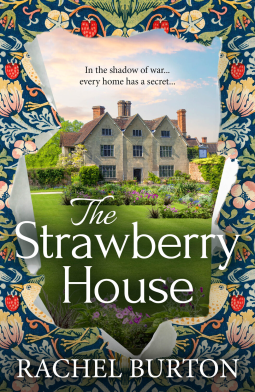
The Strawberry House by Rachel Burton

It’s February 1952 and journalist Henry Aldridge is planning an article on the recent death of King George VI when his editor approaches him with a completely different assignment. He wants Henry to report on the restoration of Montagu Manor, a country house near Oxford that was partially destroyed by fire in the summer of 1938 and later requisitioned by the army after the outbreak of war. Henry reluctantly accepts the job, but doesn’t admit that he himself had been a guest at the house during that fateful summer.

In 1938, Montagu Manor was home to Sir Philip Kerrigan, his wife and four children. It was the son, Anthony, who invited Henry to spend the summer with them, relaxing, fishing in the river and contemplating their next steps, having both recently graduated from Oxford University. Henry, the son of a factory owner, is expected to go into the family business, but what he really wants to do is become a newspaper reporter, something he knows his father will never agree to. When he meets Anthony’s sister, Camilla, he discovers that she is in a similar position – she desperately wants to attend Oxford and study for a degree like her brother, but Sir Philip has refused, believing a woman’s duty is to marry and have children. Camilla is determined that she will never marry, but when she and Henry fall in love she begins to reconsider.

The 1952 thread of the novel tells us that something went wrong between Henry and Camilla and they haven’t seen each other since the year of the fire, but we won’t find out what happened until much later in the book. And there are other questions to be answered too. What caused the fire and what was the significance of the unfinished painting that went missing during it? Who exactly were the Kensington Circle, the group of artists staying at the house at the same time as Henry? By moving backwards and forwards between 1952 and 1938, the answers begin to emerge.

I really enjoyed The Strawberry House. I seem to have read a lot of historical novels about English country houses with secrets and at first I thought this one was going to be very similar. What set it apart, though, is how much I liked and cared about the characters, particularly Henry, who seemed like a genuinely nice person torn between following his own heart and trying to keep everyone else happy. I was also fond of his photographer friend, Frank, and Camilla’s little sister, Cassie, who has a talent for writing. Because I was so invested in the characters and their lives, it made me more eager to see how everything would unfold as the truth about the summer of 1938 started to become clear.

In case you’re wondering, the title of the book is inspired by Strawberry Thief, a beautiful design by William Morris. Morris and the Arts and Crafts Movement are referenced throughout the book and the fictional Montagu Manor is located close to Morris’s home, Kelmscott Manor in Oxfordshire. Although this is the first Rachel Burton novel I’ve read, many of her others seem to have a house at the heart of the story and I’ll look forward to exploring more of them.

Thanks to Boldwood Books for providing a copy of this book for review via NetGalley.