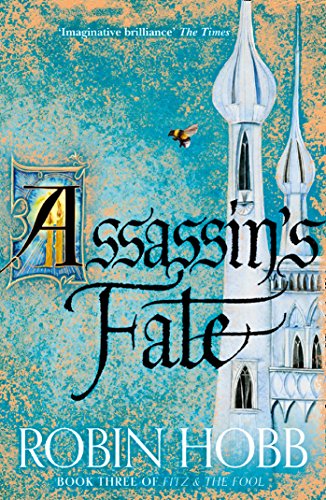
Assassin’s Fate by Robin Hobb

It’s been almost nine years since I decided to read Assassin’s Apprentice, the first book in Robin Hobb’s sixteen-volume fantasy sequence following the adventures of FitzChivalry Farseer, his friend the Fool, and the people of Bingtown and the Rain Wilds. Not being a big reader of fantasy, I wasn’t sure what to expect, but I trusted the opinions of the fellow bloggers who had recommended it – and I loved it! I went on to read the other books in the individual trilogies and quartets that make up the sequence: the Farseer Trilogy, the Liveship Traders Trilogy, the Tawny Man Trilogy, the Rain Wild Chronicles and, finally, the Fitz and the Fool Trilogy. Assassin’s Fate is the final book in this final trilogy, bringing the entire series to a close.

Naturally, I can’t really discuss the last of sixteen books without spoiling certain aspects of the fifteen previous ones, so be warned! If you haven’t read any of these books yet, I strongly recommend starting at the beginning, with Assassin’s Apprentice – and I hope you’ll enjoy your journey through Robin Hobb’s world as much as I did. This particular novel, though, hasn’t become a favourite and even now, more than a week after I finished it I can’t really decide how I felt about it.

Assassin’s Fate picks up the story from the previous book, Fool’s Quest, with Fitz and his companions heading for the distant city of Clerres in pursuit of the people who have captured his young daughter, Bee. As well as Fitz, the party consists of the Fool, in his female guise of Amber, the trainee assassin Spark, Chade’s illegitimate son Lant, and the stableboy, Per. Fitz is convinced that Bee is dead and their mission is one of vengeance only, but Amber senses that she is still alive. Either way, now that they have embarked on their journey, they need to reach Clerres as quickly as possible and passage has been arranged on the liveship Paragon.

The story of Fitz’s journey alternates with chapters narrated by Bee as she describes her ordeal at the hands of her captors, led by the evil Dwalia. I’ve had mixed feelings about Bee throughout this trilogy – on the one hand, I like her as a character and I can see that her viewpoint allows us to witness things that Fitz does not and so fills in the gaps in the story; on the other, having spent the Farseer and Tawny Man trilogies solely inside Fitz’s head, I would have preferred to continue like that. I often find that I start to lose interest slightly when a long series or saga begins to move on to the next generation and the older characters I have grown to love start to take a back seat. In this book, the earlier Bee chapters felt drawn out and repetitive, although later on, when she and her captors arrived in Clerres, I found her story much more compelling.

A bigger problem for me was the amount of time spent on characters from the Liveship Traders and Rain Wilds novels. As this is the book that wraps up the whole sequence, it’s understandable that Hobb would want to give us a chance to say our farewells to the characters from those books as well as the Farseer ones, but I felt that they came to dominate the story too much. I was happy to see Paragon again and his captains Althea and Brashen, but I had no interest in their son Boy-O or in Kennitson of the Pirate Isles. Instead, I would have preferred more interactions between Fitz and the Fool (not Amber, as I shared Fitz’s dislike of her), more communication with Verity, which was hinted at in the previous book but not followed through, and while we were saying our goodbyes to various characters, I would have liked a better send-off for Chade.

I probably sound as though I didn’t enjoy this book much at all, but that’s not true! I did find plenty of things to like, such as the dramatic scenes within the walls of Clerres, the roles of Nighteyes and Motley the crow, and the final few chapters which, despite not being quite the ending to Fitz’s story I would have chosen, still made me cry. I’m just slightly disappointed that so much of this final novel was devoted to characters and storylines I didn’t feel very invested in. I’m sure people who loved the Liveship and Rain Wilds books more than I did will feel much more satisfied with it.

I’m not sure whether any of Robin Hobb’s other books appeal to me (she has also written as Megan Lindholm) but I’m pleased to have read these ones as overall, apart from a few that have been less successful, I’ve thoroughly enjoyed them.
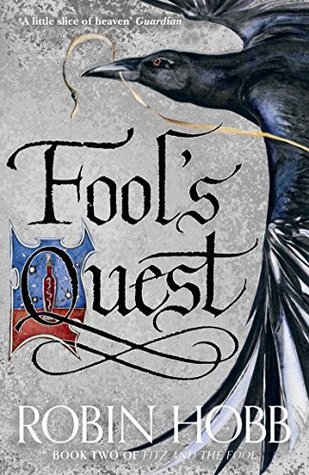
Fool’s Quest by Robin Hobb

Although I don’t read a lot of fantasy, I do love Robin Hobb’s books and would count her as one of my favourite authors. I’ve now read fifteen of her novels, all from the various trilogies and quartets that make up the larger sequence known as the Realm of the Elderlings. After this book, I’ll only have one more to read and then I’ll be finished.

Fool’s Quest is the second book in the final trilogy, Fitz and the Fool. If you’re new to Hobb, I think it’s quite obvious that you won’t want to start here – and I certainly wouldn’t recommend it! Begin with Assassin’s Apprentice instead and then continue from there. There may be spoilers in the rest of this post that you would prefer to avoid, so keep reading at your own risk!

Anyway, Fool’s Quest opens with FitzChivalry Farseer back at Buckkeep Castle, helping to heal the Fool, having unintentionally stabbed his old friend at the end of the previous book, Fool’s Assassin. Unknown to Fitz, in his absence a group of mysterious and menacing strangers have attacked his country estate of Withywoods and abducted his young daughter, Bee. It will be a while before Fitz receives this devastating news, but meanwhile another momentous event takes place in his life – something which I had been hoping would happen for a very long time!

The story moves forward at a very slow pace while we’re waiting for Fitz to discover what has happened to Bee – and even once he becomes aware, he still doesn’t set off in pursuit immediately but waits until he has gathered more information and made his preparations. This is a change from the more impetuous young Fitz we knew in the earlier books (and slightly frustrating for the reader) but at the same time, the slow pace didn’t bother me and I was never bored. While Fitz is at Buckkeep, Hobb continues to develop his relationships with long-standing characters such as Chade, Kettricken, Dutiful and Nettle, as well as introducing some new ones, including Chade’s latest apprentice assassin, Spark, and Motley the talking crow! We don’t hear as much from Bee herself as we did in the previous book – only a few chapters are written from her perspective, but what we do hear gives us an idea of the nature of her abductors and the plans they have for her.

Later in the novel, strong connections with the other trilogies and quartets in the sequence begin to emerge and I understood why other Hobb readers had recommended not skipping the Liveship Traders and Rain Wild Chronicles books. I was so glad that I’d read all of those books; not only do they add to an understanding of the world Hobb has created (particularly the role of dragons), but being reacquainted with characters like Malta and Reyn Khuprus or Rapskal the dragon keeper would have meant nothing to me. And as well as the appearances from the Liveship and Rain Wild characters, I was delighted to see Fitz reconnect with a long-departed character from the earlier Farseer novels.

By the end of the book, Fitz and the Fool are on their way to far-off Clerres in search of Bee and her captors and although I’m sure Robin Hobb could have brought us to this point in half the number of pages, I enjoyed every minute of this slowly-unfolding story. Once I’ve finished my 20 Books of Summer reading I’m looking forward to moving on to Assassin’s Fate and finding out what Hobb has in store next for Fitz and his friends.

This is book 12/20 from my 20 Books of Summer list.

Fool’s Assassin by Robin Hobb

Almost exactly seven years after I picked up Assassin’s Apprentice, the first in Robin Hobb’s sixteen-novel Realm of the Elderlings sequence, here I am embarking on the final trilogy, Fitz and the Fool, which begins with Fool’s Assassin. Before I start to discuss this book, I should warn you that if you’re new to Robin Hobb, there may be things in my review that will spoil the earlier novels for you; before reading Fool’s Assassin, I think it’s essential to have at least read The Farseer Trilogy and The Tawny Man Trilogy as they deal with the same characters and storylines. The other books – The Liveship Traders and The Rain Wild Chronicles – add to the world-building and I would still recommend reading them in their correct places within the sequence, but it’s probably not completely necessary.

Anyway, back to Fool’s Assassin! After persevering through the four novels that make up The Rain Wild Chronicles, none of which I particularly enjoyed, it was such a relief to be back in the company of FitzChivalry Farseer; like being reacquainted with an old friend after a long absence.

The book begins with Fitz, now happily married to his beloved Molly, living on his country estate of Withywoods. Known to his servants and neighbours as the humble Tom Badgerlock, Fitz is keeping his distance from the dangers of Buckkeep Castle but his gift for the powerful magic known as the Skill still links him to his old mentor Chade and others within the castle walls. To his disappointment, there is no word at all from his dearest friend, the Fool, who departed at the end of Fool’s Fate – or is there? When a mysterious stranger attempting to bring him a message during the Winterfest celebrations is pursued from Withywoods before she can speak to him, Fitz is left wondering what the message contained. However, it is only after the arrival of another very unusual young woman called Bee that Fitz finds himself reluctantly drawn back into the intrigue that surrounds the Farseer throne and the affairs of the wider world of the Six Duchies.

Fool’s Assassin has a slower pace than some of the other books about Fitz; there is not a lot of action until almost the end, and instead we spend most of the novel with Fitz and his household at Withywoods. It’s a reflective, introspective story in which Fitz is looking back on the events of his past and trying to move forward, while enjoying his peaceful new life as a husband and father. This peaceful life doesn’t last forever, of course, so eventually there are more personal traumas for Fitz to deal with – and despite the largely domestic setting and the slowness of the plot to develop, I was never bored for a moment. As I said, most of the action in the novel occurs in the final few chapters, along with a revelation about one of the characters; I’m not sure whether this was supposed to come as a surprise to the reader, but I had guessed the truth much earlier in the novel and found it frustrating that Fitz had apparently been completely oblivious to it!

Although the previous books have been written only from Fitz’s perspective, this one introduces a second viewpoint character who, in the second half of the book, comes to dominate the story at times. I wasn’t sure how I felt about this at first and I think my personal preference would have been to continue with Fitz as the sole narrator, but I did like and sympathise with this second character and I can see the value of having someone who can offer insights that Fitz cannot and show us what is happening when Fitz is not physically there. It would have been nice to have seen more of the characters at Buckkeep, such as Kettricken and Dutiful, and certainly more of the Fool – Hobb really keeps us waiting and wondering when he will make his appearance – but I did like the way the long departed Nighteyes is able to play a role in the story, as I hadn’t expected to hear from him again.

The book ends on a huge cliffhanger and although I really need to concentrate on other books at the moment, I think it’s very likely that I will be drawn to the second novel, Fool’s Quest, very soon. One of the advantages of waiting until a whole trilogy is available instead of reading the books as they are published!

This is book 6/20 of my 20 Books of Summer 2021

Blood of Dragons by Robin Hobb

This is the fourth and final book in Robin Hobb’s Rain Wild Chronicles quartet and I can honestly say I don’t think I’ve ever been so pleased to come to the end of a series! Why have I persevered with it through four long books that I wasn’t particularly enjoying? Well, the series is part of the sixteen-volume Realm of the Elderlings sequence. I loved the first nine books (The Farseer, Liveship Traders and Tawny Man trilogies) and intend to read the last three, so didn’t feel that I could leave out these four in case I missed out on any details or plot points that turned out to be important later. Anyway, they’re not that bad – they’re just not as good as the earlier books I read by Hobb.

Blood of Dragons continues the story from the previous book, City of Dragons, with our band of young keepers and their dragons beginning to make their way into the deserted Elderling city of Kelsingra. Abandoned by the Elderlings in the aftermath of an earthquake many generations earlier, Kelsingra has been left in ruins but still holds magic within its stones. As the dragons replenish their strength and energy in the enormous hot baths, the keepers search for the source of the legendary Silver, the mysterious substance the dragons desperately need if they are ever to regain their full powers. Meanwhile, Tintaglia, the magnificent blue queen dragon, is trying to return home after being wounded in an attack by Chalcedean dragon-hunters – while in faraway Chalced itself, Selden Vestrit has found himself imprisoned by the Duke, who believes that Elderling blood is the next best thing to the dragon blood he needs to prolong his life.

As the last of the Rain Wild Chronicles, I thought this book brought the series to a satisfactory conclusion and I didn’t feel that anything significant had been left unresolved. Although these four novels seem very separate from the rest of the sequence (only a few shared characters with The Liveship Traders and hardly any overlap at all with the Farseer and Tawny Man books), I’m still pleased that I read them as they have added to the overall world-building and helped me to understand more about the relationship between dragons and Elderlings. I was particularly intrigued by the role of the Silver as a sort of life-force with magical properties; I’ve been remembering other references to silver in the earlier Hobb trilogies and trying to work out how all of this relates to the Skill. It was also interesting to see Rapskal taking on more and more of the characteristics of his long-ago counterpart Tellator as he spends more time immersing himself in Kelsingra’s memory stones.

Despite enjoying the magical elements of the story, however, I again struggled to really engage with any of the characters, something which has been a problem for me in all four novels. I became quite fond of a few of them (such as Alise, Sedric and Leftrin), but I felt that too much time was spent on the love triangle between Thymara, Rapskal and Tats, and on trying to sort all of the characters into romantic pairings, even the dragons. I did love the way Hest’s story ended, though! After a short break while I read other books, I will be ready to embark on the final trilogy, which begins with Fool’s Assassin, and am very much looking forward to rejoining Fitz and the Fool at last.

City of Dragons by Robin Hobb

This third novel in Robin Hobb’s Rain Wild Chronicles is my favourite of the series so far – although it doesn’t really have a lot of competition, as I was disappointed with the previous two books. If you’re new to Robin Hobb, don’t start with the Rain Wild quartet; they are part of a larger sequence and not only are they not as good as the earlier books, they also fall towards the end of the sequence. You need to begin with the Farseer Trilogy, the Liveship Traders Trilogy and the Tawny Man Trilogy, all of which are excellent!

Anyway, getting back to City of Dragons, it continues the story where the previous novel, Dragon Haven, left off: with our band of stunted, poorly formed dragons and their human keepers within reach of the fabled Elderling city of Kelsingra at last. Separated from the city by the swollen, fast-flowing waters of the Rain Wild River, the group need to make their way across – but only one of the dragons, Heeby, has successfully learned to fly. The magical properties of Kelsingra could restore the dragons to their former glory, but first they need to find a way to get there…

I think the fact that I enjoyed this book more than the first two in the series is mainly due to the wonderful, atmospheric descriptions of Kelsingra. Although most of the dragons and keepers are stranded on the opposite banks of the river, a few of the characters do manage to make trips back and forth to explore the abandoned city. Different characters hope for different things from Kelsingra. Historian Alise Finbok tries to leave the buildings and treasures untouched, determined to make a careful record of everything she finds before word of the discovery begins to spread and traders and scavengers from Bingtown descend upon the city. Rapskal and Thymara, however, part Elderling now themselves, know that Kelsingra is not quite the dead, empty place it may at first appear, and they are able to connect with the memories it holds in a way that Alise cannot:

“Some of the streets she [Thymara] ran through were dark and deserted. But then she would turn a corner and suddenly be confronted by torchlight and merrymakers, a city in the midst of some sort of holiday. She had shrieked the first time, and then she recognized them for what they were. Ghosts and phantoms, Elderling memories stored in the stone of the buildings she passed.”

Although the Kelsingra sections of the book interested me most, the action moves away from the city now and then so that we can catch up with some of the other characters and subplots from earlier in the series: Alise’s estranged husband, Hest, waiting in vain for Sedric to return to Bingtown with dragon parts to cure the invalid Duke of Chalced; Leftrin, captain of the liveship Tarman, who is heading back to Cassarick to claim the keepers’ payment for the expedition; and Malta and Reyn Khuprus, expecting the birth of their first child at any moment. There’s a lot going on in this novel and the way the various storylines begin to converge towards the end sets things up nicely for the fourth and final book, Blood of Dragons, which I hope to read soon.

This is book 6/20 of my 20 Books of Summer.

Dragon Haven by Robin Hobb

This is the second book in Robin Hobb’s Rain Wild Chronicles series, part of a larger sequence of fantasy novels set in a world known as the Realm of the Elderlings. I have been reading through the sequence in order of publication, beginning with the Farseer Trilogy and then moving on to the Liveship Traders Trilogy and the Tawny Man Trilogy. I started the Rain Wild Chronicles (a quartet rather than a trilogy) earlier this year and so far, after loving all of those previous series, I am quite disappointed with this one. In comparison with the others, I think these books feel less mature and less emotionally powerful, and although they are good enough for me to want to persevere and read all four, I am looking forward to being finished with them so I can start the final trilogy, Fitz and the Fool.

This second Rain Wild novel picks up the story exactly where the previous one ended, which is not surprising as I’m sure I read somewhere that they were originally supposed to be two halves of one long book. At the end of Dragon Keeper, we left our group of dragons and their keepers making the long and difficult journey up the Rain Wild River in search of Kelsingra, the legendary Elderling city now lost in the mists of time. In Dragon Haven the journey continues, with our characters facing a new set of trials and challenges. Who will survive and who will not? Will the dragons ever grow strong enough to fend for themselves? And will they ever find Kelsingra?

To start with the positives, I found myself enjoying the storyline following Sedric and the little copper dragon, Relpda. This surprised me because, based on the first book, Sedric was not a character I had imagined ever liking, but he undergoes a transformation in this book, largely due to the bond he forms with Relpda. And he is not the only one who changes as a result of spending time with the dragons. Without wanting to spoil too much for anyone who hasn’t got this far in the series yet, we learn a lot in this book about the connections between dragons and Elderlings – and are introduced to the intriguing idea that if dragons are coming back into the world, why not Elderlings too? I also enjoyed seeing Leftrin’s liveship, Tarman, take on more personality of his own.

Mainly, though, this book is concerned with the romantic relationships between the various characters and I have to admit, none of this interested me very much, particularly where the teenage dragon keepers were concerned. I didn’t really care whether Jerd was sleeping with Greft and whether Thymara would choose Tats or Rapskal or resist being forced to choose at all. And although I was pleased with the way Alise’s story played out, I found it quite predictable which meant I didn’t become as emotionally invested as I would have liked.

The book does end on a bit of a cliffhanger which has left me feeling more enthusiastic about reading the third book, City of Dragons. I’m hoping it will concentrate more on the dragons, Elderlings and Kelsingra rather than on trying to pair off every character regardless of whether it feels necessary or natural. I will also be interested to see, when I finally move on to Fitz and the Fool, whether I’ll be glad I read the Rain Wild novels or whether I could have missed them out.

Dragon Keeper by Robin Hobb

Over the last few years, I’ve read and loved Robin Hobb’s Farseer Trilogy, Liveship Traders Trilogy and Tawny Man Trilogy, but I have to admit that I wasn’t particularly looking forward to reading Dragon Keeper, the first in her four-book Rain Wild Chronicles series. Although I found the dragon storylines in the earlier trilogies quite enjoyable, I wasn’t sure that I really wanted to read a series in which the dragons would be the main focus – and also, after coming to the end of the Tawny Man books, I just wanted to continue Fitz’s story rather than have to get used to a whole new set of characters. It was tempting to go straight to Hobb’s final and most recent trilogy, Fitz and the Fool, but I knew I should keep reading in order of publication as the books do all form part of one larger sequence and it’s possible that things could happen in the Rain Wild series that I need to know before returning to Fitz.

Anyway, Dragon Keeper picks up the story that was set into motion at the end of the Liveship Traders. Guided by the dragon Tintaglia, a group of sea serpents have made the long journey up the Rain Wild River to the shores of Cassarick, where they have formed the cocoons where they will await their transformation into dragons. When the day of the hatching finally arrives, the people of the Rain Wilds – among them eleven-year-old Thymara and her father – gather round to witness this historic moment: the moment that will mark the return of dragons to the world for the first time in generations.

The dragons that emerge from the cocoons, however, are weak and malformed due to the inappropriate conditions they had lived in as serpents and the difficult circumstances surrounding their cocooning process. These creatures are unlikely ever to fly like their ancestors and can barely even manage to feed themselves. It seems that their only hope of survival is to make their way to Kelsingra, the ancient city of the Elderlings, but if they are to get there safely they will need some human help. Thymara, born with claws and scales – a more extreme example of the mutations that affect many of the Rain Wild people – is chosen to be part of a team of dragon keepers who will escort the dragons to their legendary homeland.

And there’s not really much more to the plot than that. There’s a sense that, with this first in the series, Hobb is setting things up for the three that will follow and the story is just beginning to get started when the book comes to an end. I liked it enough to want to continue, but it is certainly my least favourite of Hobb’s books so far. Maybe because so many of the dragon keepers are children (they are seen as more dispensable, not having families who rely on them), it felt almost as though this book was aimed at younger readers than the others.

There were several characters who intrigued me, though, and I’ll look forward to seeing how their storylines develop in the next book. One of these is Alise Kincarron, a young woman from Bingtown who looks destined for spinsterhood before entering into a loveless marriage with a local trader, Hest Finbok. The dragons hold a special fascination for Alise and the chance to accompany them on the journey to Kelsingra is both a dream come true and a way to escape from her husband. Hest has no interest in the dragons himself, so asks Alise’s childhood friend Sedric to chaperone her – but we, the reader, know something about Sedric that Alise doesn’t and that makes us think of him more as a villain than a friend.

As a setting, I prefer the Six Duchies of the Farseer and Tawny Man trilogies, but I did enjoy the descriptions in this book of Trehaug, the city built in the treetops above the Rain Wild River. We did visit Trehaug and the Rain Wilds at several points throughout the Liveship Traders trilogy, but they lose some of their mysterious aura in this book as we learn much more about them and the people who live there. In case you’re wondering, we do meet some of the Liveship characters again (I was particularly pleased to see Paragon) but their appearances are very brief and the focus is definitely on Thymara, Alise and the other new characters. And the dragons, of course! Part of the story is told from the perspective of Sintara, a blue dragon who is not quite as weak and stunted as some of the others, and it was interesting to see things from her point of view now and then.

Although I couldn’t quite love this book, I did find it a relatively quick and easy read, in comparison to some of Hobb’s others which are usually much longer and more emotionally demanding. I’ll continue the series soon with the second book, Dragon Haven.