Classics Spin Review: That Lady by Kate O’Brien

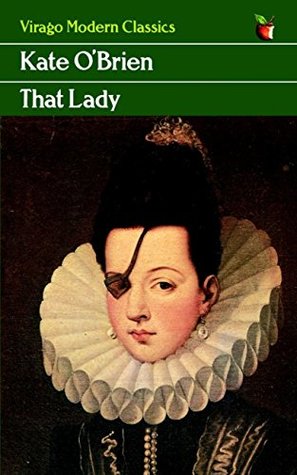
Kate O’Brien’s novel from 1946, That Lady, was the book chosen for me in the recent Classics Club Spin. I had never read anything by Kate O’Brien before and had only added this one to my Classics Club list because I remembered reading some very positive reviews by Lisa and Kay and because I liked the portrait on the front cover of the Virago Modern Classics edition. The portrait shows Ana de Mendoza, Princess of Eboli and Duchess of Pastrana, and Ana’s life is the subject of the novel.

That Lady opens in 1576, with Ana a widow of thirty-six. Following the death of her husband Ruy Gomez de Silva, one of King Philip II of Spain’s closest advisers, Ana and her children have continued to live on Ruy’s lands in Pastrana in the region of Castile. If you know nothing about Ana, as I didn’t before reading this book, you’ll be pleased to know that O’Brien gives plenty of detail on Ana’s background, explaining how she came to be married to Ruy Gomez at the age of thirteen, how she lost her eye fighting a duel with a page in her father’s household, and the origins of her close relationship with Philip II.

Early in the novel, Philip visits Ana at the Palace of Pastrana and asks her to consider coming back to Madrid. He gives several reasons why she should return, but it is clear that he misses Ana and her children and wants them living nearer to him. Ana is reluctant, but within a year she is back in Madrid and here she begins an affair with Antonio Perez, Philip’s ambitious secretary of state. Needless to say, this was not what the king had intended, and when Ana’s affair becomes public – and, worse still, leads to her becoming implicated in a murder case – she finds that Philip is not such a good friend after all.

That Lady is an unusual novel and at first I wasn’t sure whether I was going to like it. The pace is slow and although there is a lot happening, most of it happens off the page; major events including the defeat of the Spanish Armada are covered in a few brief sentences, while dramas which directly affect Ana, such as the murder mentioned above and the circumstances which lead to it, are only referred to in conversation afterwards. The lack of action makes this much more of a character driven novel, which I’m usually quite happy with, but I also struggled to understand and warm to Ana as a character during the first half of the novel.

Somewhere in the middle of the book, though, I began to find Ana’s story much more compelling. I understood why her relationship with Antonio was so important to her, despite the disapproval of Philip and the public – because it was her own choice, something she was doing because she wanted to, and not because she had been pushed into it by her father, by her husband or by the king. I admired her for sticking to her principles and I was impressed by the loyalty she inspired in her young daughter, Anichu, and her servant, Bernardina. Ana also finds herself struggling to reconcile her actions with her religious beliefs and this is another of the novel’s themes, which develops through conversations with her friend, Cardinal Quiroga of Toledo.

I found it intriguing that in her foreword to That Lady, O’Brien states that this is not a historical novel, but an ‘invention’ based on the story of Ana de Mendoza and Philip II, in which the outline of historical events is real but the words, thoughts and emotions of the characters are imaginary. I think I know what she was trying to say, but surely any historical novel contains an element of invention, otherwise it wouldn’t be a novel. Anyway, I was able to learn a huge amount from this book, not just about Ana, Philip and Antonio, but also about the political situation in Spain in the late sixteenth century. Most of this was new to me and the amount of detail made it quite a slow read, but an interesting one too.

I was left wanting to know more about the real woman, so I looked her up online and found a selection of portraits of Ana, with her distinctive silk eye patch (although it seems there could be a less dramatic explanation for the loss of her eye than the duelling story). I couldn’t find any other novels about Ana, but if you know of any, please let me know. And if you’ve read this book, I would love to hear what you thought of it – and whether you would recommend anything else by Kate O’Brien.

This is book 8/50 from my second Classics Club list.
Court of Lions by Jane Johnson

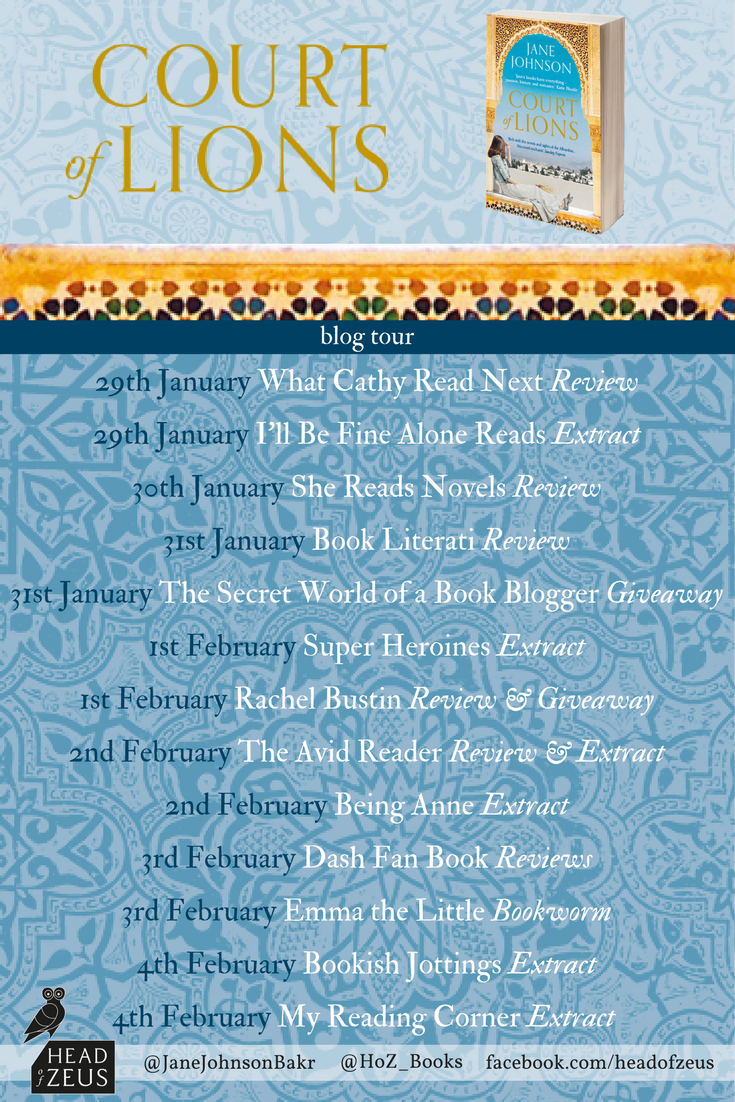
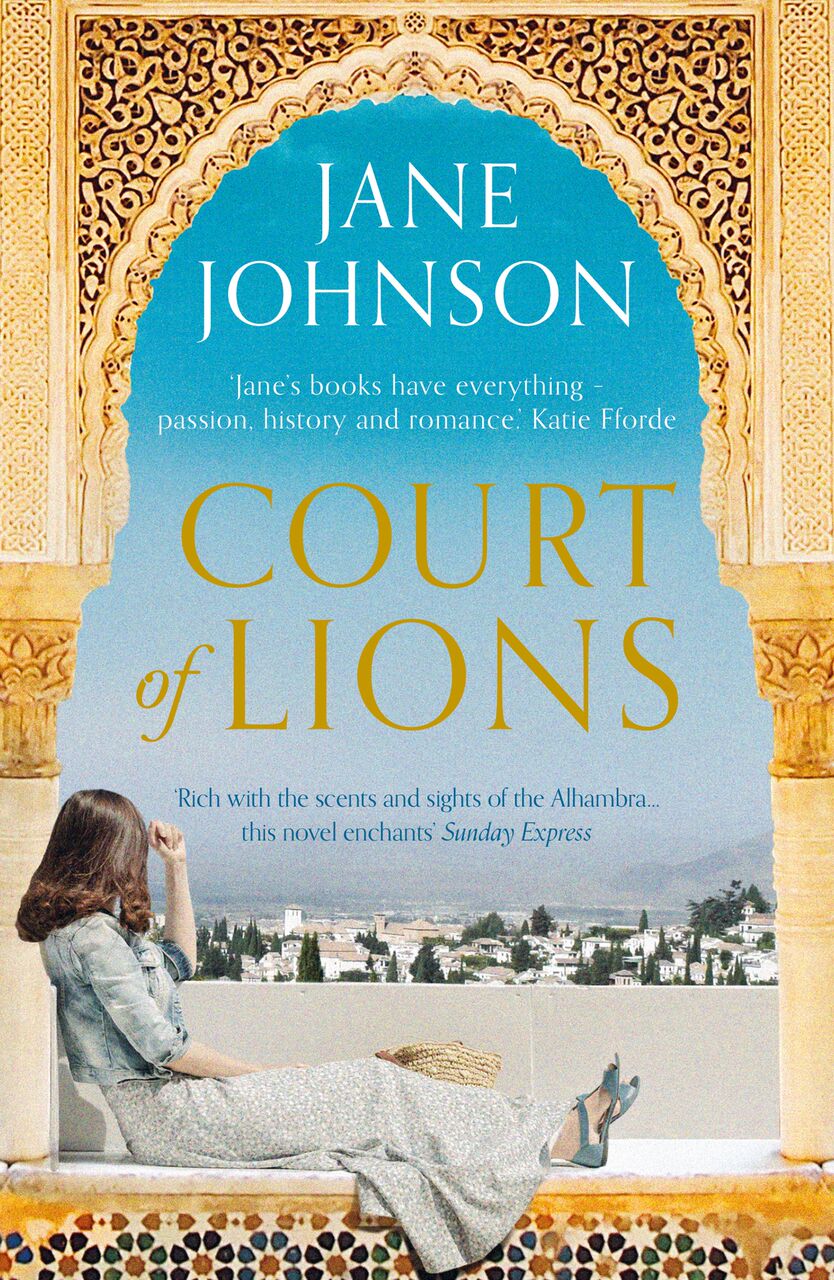
The Court of the Lions is part of the Alhambra, the magnificent palace and fortress in the Spanish city of Granada which forms the setting for Jane Johnson’s latest novel. Having read and enjoyed one of her previous books (The Sultan’s Wife, set in 17th century Morocco), I’m pleased to have had the opportunity to read Court of Lions as part of a blog tour organised by publisher Head of Zeus. You can see the schedule for the other stops on the tour at the end of this post.

Court of Lions is a novel set in two different time periods. First, in the present day, we meet Kate Fordham, who has fled from a troubled marriage in England and is working in a bar in Granada, hoping she has done enough to prevent her husband from finding her. One day, exploring the gardens of the Alhambra, she discovers a scrap of paper pushed into a crack in a wall. Written on it is a message in an unfamiliar language and although Kate is unable to translate it, she senses that it could be important. And she is right, because her discovery leads her to form new relationships and to find the strength she needs to move on.

Alternating with Kate’s story is another story, set in the late 15th century and introducing us to Abu Abdullah Mohammed, the last Sultan of the Emirate of Granada, given the name Boabdil by the Spanish, but referred to in the novel as Momo. We get to know Momo from the point of view of a fictional character, Blessings, a slave child brought from Morocco to be his companion. Growing up together at the Alhambra, Momo and Blessings become close friends – and a loyal friend is what Momo desperately needs as he prepares to face the challenges which await him: a struggle for the throne against his own father and uncle, and war with Catholic Spain, led by King Ferdinand and Queen Isabella.

I found the 15th century storyline completely fascinating and compelling. I have read a little bit about the fall of Granada before, but not from this perspective, so most of it was new to me. The sequence of events leading up to the surrender of the city is described in just the right amount of detail and left me wanting to explore the period further, which is something all good historical fiction should do. Momo’s personal life, his marriage and the fates of his children are also given some attention, all seen through the eyes of Blessings – who is not exactly an unbiased observer as it quickly becomes clear that what he feels for the young Sultan is more than just friendship. Blessings himself is also an interesting character and although I don’t want to say too much here, there are revelations later in the book which answered some of the questions I had about him.

The modern day sections of the novel were slightly less successful. I did like Kate and enjoyed watching as she made new friends in Granada and learned about their culture and lifestyle, but I found the storyline involving her disastrous marriage very melodramatic (again I don’t want to give too much away). Although some of the threads linking the two time periods together are a bit too coincidental to be convincing, I liked the fact that the two share common themes such as religious conflict, prejudice and tolerance – things which were relevant in Momo’s day and are still just as relevant in ours.

The descriptions of Spain and the Alhambra itself are beautifully written. One of my aims for 2018 is to read more fiction set in countries other than my own so I have taken a step towards achieving that aim by reading Court of Lions. Thanks to Head of Zeus for providing a copy for review.

The Muse by Jessie Burton

This is Jessie Burton’s second novel, following her very successful debut, The Miniaturist. I had one or two problems with The Miniaturist and didn’t fall in love with it the way so many other people seemed to, but I did like it enough to be interested in reading more of her work.

The Muse is split between two different time periods. In 1967, we meet Odelle Bastien, a twenty-six-year-old woman from Trinidad who is looking for work in London. As she settles into her new job as a typist at the Skelton Institute, a prestigious art gallery, Odelle strikes up an unusual friendship with her employer, the glamorous and secretive Marjorie Quick, who encourages her to follow her ambition of becoming a writer. At a party one night Odelle is introduced to Lawrie Scott, who shows her a painting he has inherited from his mother. A few days later he brings it to the Skelton where it causes a great deal of excitement; it seems that Lawrie’s painting could be a lost masterpiece.

To discover the origins of the painting, we have to go back to Spain in 1936 where Austrian art dealer Harold Schloss and his English wife, Sarah, are living in a rented finca – a country house – in a village near Malaga. The couple’s daughter, nineteen-year-old Olive, has ambitions of her own but is keeping her talents hidden knowing that they wouldn’t be appreciated by her father. When local painter and political activist Isaac Robles and his sister Teresa come into her life, Olive has some big decisions to make; this could finally be her chance to follow her dreams.

What is the truth behind the painting once owned by Lawrie Scott’s mother? What really happened to the artist Isaac Robles, whose final fate is unknown? And is Marjorie Quick really who she claims to be? Like The Miniaturist, The Muse has an element of mystery, but unlike the previous book, it is grounded entirely in reality with no hints of the supernatural. I thought the writing style felt quite different too, especially as this one is written in the past tense instead of the present tense of The Miniaturist. In fact, I would almost go so far as to say that they could have been written by two different authors, which is not necessarily a bad thing as it’s good to see authors trying something new.

I found both threads of the novel interesting to read. In the 1960s, Odelle gives us some insights into what it’s like to be an immigrant from the Caribbean living in Britain and what it’s like to be black in a predominantly white community. However, I couldn’t help thinking that Odelle herself feels almost superfluous to the story; it’s Lawrie who owns the painting and Marjorie Quick who is connected in some way with the events of 1930s Spain. Usually in this type of novel, the modern day (or relatively modern, in the case of this book) narrator has some kind of personal link with the historical characters, but Odelle doesn’t, which seemed a bit strange to me.

The 1930s storyline is where most of the real action takes place. With Spain on the brink of civil war at that time, Spanish politics form a large part of the story – not just as a backdrop, but with a real significance to the lives of the Schloss and Robles families. A lot of care has obviously gone into creating the Spanish setting – the descriptions feel detailed and vivid – but again, my problem was with the characters. None of them came fully to life for me and I struggled to understand their motives and the decisions they made.

Although there were some aspects of the novel I liked – such as the mystery surrounding Marjorie Quick and the exploration of the struggles faced by women in the worlds of art and literature in years gone by – I think of Jessie Burton’s two novels I probably preferred The Miniaturist.

Who would be a queen?

I certainly wouldn’t, based on the stories of the two 16th century queens I’ve been reading about recently!

The Last Queen The first of our two queens is Juana of Castile, also known as Juana la Loca (‘the mad’), whose life is retold in fictional form in The Last Queen by C.W. Gortner. I think most of us will have heard of Juana’s younger sister, Katherine of Aragon, the first wife of Henry VIII who was divorced so that the King could marry Anne Boleyn, breaking away from Rome in the process. Juana’s story is less well known (outside Spain, at least) and less often covered in historical fiction, but just as interesting and tragic.

Juana is the third of five children born to Queen Isabella and King Ferdinand of Spain, whose joint rule has brought together the two Spanish kingdoms of Castile and Aragon. The King and Queen have arranged marriages for all of their children, in the hope of forming political alliances, and Juana finds herself married against her will to Philip, Duke of Burgundy, son of the Holy Roman Emperor. Despite her initial feelings, Juana quickly falls in love with her new husband – but her happiness doesn’t last long. The deaths of her elder brother and sister leave Juana as her parents’ heir and her relationship with Philip changes as a result.

Influenced by the scheming Archbishop Besançon, Philip sets his sights on taking the throne of Spain for himself and Juana finds herself betrayed and accused of insanity. Even as she discovers that the very people she should be able to trust want only to bully and manipulate her, she remains determined to fight for her throne and her country.

This is the first of C.W. Gortner’s books I’ve read and I will definitely consider reading more. I thoroughly enjoyed this moving and dramatic novel which took me through a period of Spanish history of which I previously knew almost nothing. There’s some beautiful descriptive writing which brings each of the various settings to life, from Granada during the Conquest of 1492 to the extravagance of the French court.

Gortner is a male author, if you’re wondering, and he writes very convincingly from the perspective of a young woman in this novel. Whether or not Juana actually suffered from mental illness is debatable; the point of view taken in this book is that the ‘madness’ developed as a result of years of stress and suffering – and branding her mad was a convenient way for her enemies to prevent her from ruling. I don’t know enough about her to say whether this is likely or not, but I did love Gortner’s portrayal of Juana and wished she could have had a little more happiness in her life.

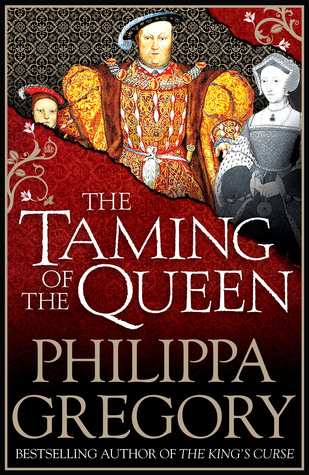
The Taming of the Queen Our second queen is Katherine Parr, sixth and final wife to Henry VIII, whose story is told in The Taming of the Queen by Philippa Gregory. I hadn’t really intended to read this book as I find Katherine one of the less interesting wives and, having read several other fictional accounts of her life (including Queen’s Gambit by Elizabeth Fremantle and The Secret Keeper by Sandra Byrd), I didn’t imagine this one would have anything new to add. When I saw it in the New Books section of the library, however, I couldn’t resist reading it – and I’m pleased I did as I found it to be one of Gregory’s better Tudor court novels.

Katherine Parr (or Kateryn as her name is spelled in this book) could be seen as one of Henry’s luckier wives, outliving the King and managing to avoid both divorce and beheading, but this doesn’t mean that she was happy or that she didn’t fear for her life at times. By this stage of his life Henry is, shall we say, past his prime: Gregory describes (sometimes in too much detail!) his gluttony at banquets, his bodily functions and the smell of his ulcerated leg. Add to this his temper, unpredictable behaviour and obsession with his third wife, Jane Seymour, and you can see how difficult things are for poor Kateryn, especially as she has been forced to give up her secret love for Thomas Seymour.

Kateryn finds some comfort in getting to know her new stepchildren – Mary, Elizabeth and Edward – and restoring them to their places at court, and also in religious study. She welcomes preachers to her rooms (including Anne Askew, who was later burned at the stake) and as a result of this narrowly escapes death herself; she debates religious reform with her ladies and sometimes with the King himself; and she writes several books, becoming the first Queen of England to publish under her own name.

Kateryn is an intelligent and mature woman who has already been widowed twice before her marriage to Henry and she is able to tolerate her situation and handle the King’s whims in a way that a younger, less experienced girl may not have done. I liked her, but I felt that there were times when Gregory attributed words and actions to her that didn’t feel consistent with the way her character was being portrayed. This made me think that maybe she is more comfortable writing from the perspective of younger, livelier narrators.

This is an entertaining read and if you’ve never read about Katherine Parr before, it provides a good overview of her life and of the final years of Henry’s reign (events such as the sinking of the Mary Rose are covered in dramatic detail). I did prefer Elizabeth Fremantle’s Queen’s Gambit, though, and would recommend that book ahead of this one.

Have you read any other novels about Juana of Castile or Katherine Parr? Which are your favourites?

Don Quixote by Miguel de Cervantes

Don Quixote Reading Don Quixote has been a year-long project for me in 2014. After reading Clarissa over a twelve month period as part of a readalong in 2012 and then War and Peace in 2013 I decided to tackle another of the very long, intimidating classics on my Classics Club list, this time on my own. Now that I’ve finished I don’t know why I had ever been intimidated by it. Yes, it’s long (over 1,000 pages in most editions) and old (originally published in two parts in 1605 and 1615) and a translation, but I didn’t find it difficult to read at all. It’s fun and imaginative and entertaining – and I loved it.

Don Quixote is the story of a gentleman of La Mancha who has spent so many years reading books of chivalry and romance that he has come to believe the tales they tell are true. Inspired by the heroes of his favourite books, he decides to become a knight errant and go out into the world in search of adventures. Renaming himself Don Quixote and his horse Rocinante, he convinces a neighbouring peasant, Sancho Panza, to join him as his squire. With Sancho at his side, Don Quixote sets out to right wrongs, fight duels and rescue damsels in distress, in the hope that his valiant deeds will win him the love of the beautiful (and largely imaginary) Dulcinea del Toboso.

As Don Quixote and Sancho travel across Spain they have one adventure after another, each one headed with a long and intriguing chapter title such as “Of the strange adventure which befell the valiant Don Quixote with the bold Knight of the Mirrors” or “Which deals with the adventure of the enchanted head, together with other trivial matters which cannot be left untold”. As you read on, however, it soon becomes obvious that these ‘adventures’ are not quite as amazing as they sound and usually have a logical explanation.

Many people, even without reading the book, will have heard of the famous ‘tilting at windmills’ episode. There are many, many other similar episodes in the novel but this one appears near the beginning which is probably why it’s the best known. If you’re not familiar with it, on approaching some windmills in a field Don Quixote becomes convinced they are giants and attacks them with his sword:

“What giants?” said Sancho Panza.

“Those thou seest there,” answered his master, “with the long arms, and some have them nearly two leagues long.”

“Look, your worship,” said Sancho; “what we see there are not giants but windmills, and what seem to be their arms are the sails that, turned by the wind, make the millstone go.”

“It is easy to see,” replied Don Quixote, “that thou art not used to this business of adventures; those are giants; and if thou art afraid, away with thee out of this and betake thyself to prayer while I engage them in fierce and unequal combat.”

This is a pattern that is repeated over and over again throughout the novel: Don Quixote mistakes inns for castles and flocks of sheep for armies – and even when Sancho points out the truth he still insists that he is right. The castles and the armies must have been enchanted by great wizards, he says, so that they appear to be inns and sheep. As the story progresses, Don Quixote’s fame spreads and he is thought of as insane and Sancho as an idiot. The response of some of the people they meet can be very cruel and it’s quite sad to see how Don Quixote and Sancho are ridiculed, scorned and made the target of elaborate practical jokes. I wouldn’t describe this as a sad book, though; in fact, it’s a very funny one. The humour doesn’t always work (being four hundred years old and in translation, maybe that’s not surprising) but at times it’s hilarious!

As well as the adventures and the humour, there are lots of songs, poems and ballads interspersed with the prose. There are also lots of stories-within-stories – almost everyone they meet on their journey has a long and tragic story of their own to tell – and many of these have no relevance to the rest of the novel. For example, a lot of time is devoted to the tale of a Christian who was held captive by Moors in Algiers and has escaped back to Spain – nothing to do with Don Quixote, but apparently based on Cervantes’ own experiences. This is why the novel is so long and why you need to have some patience with it! Reading this book over a period of several months was the perfect strategy for me as the episodic nature of the story meant that I could leave it for a few weeks and still get straight back into it when I picked it up again. Breaking it up into small sections kept it feeling fresh and interesting so that I never felt bored or overwhelmed.

A quick note on the translation now. There have been many English translations of Don Quixote over the years but not really having any idea which to choose, I started reading the 1885 John Ormsby translation (in the public domain so free to download from Project Gutenberg and other websites) and I found it perfectly readable so decided just to stick with it. I wouldn’t necessarily recommend that translation to everyone as it does use some archaic terms and feels ‘old’ but that’s what I prefer when I’m reading an old book so it wasn’t a problem for me. Whichever may be closest to the literal translation, Ormsby’s description of Don Quixote as “Knight of the Rueful Countenance” just sounds better to me than, for example, Edith Grossman’s “Knight of the Sorrowful Face”. It’s a matter of personal taste, though, so it’s probably a good idea to look at a few different translations and find one that suits you before you embark on such a long novel!

Much as I enjoyed this book it did sometimes feel as if I was never going to finish it, so I was pleased to reach the end. I’m going to miss Don Quixote and Sancho, though, after spending so much time with them this year!

Wolves in Winter by Lisa Hilton

Wolves in Winter Beginning in 1492, Wolves in Winter is the story of Mura Benito, the young daughter of a bookseller from Toledo. Even at the age of five, Mura knows she is not like other children. With her mixture of Moorish blood (from her father) and Nordic blood (from her mother) and her pale, androgynous appearance, she has always looked different. She has also grown up listening to her father read to her from his books and possesses a wealth of arcane knowledge which would be unknown to most little girls.

When Mura’s father is arrested by the Inquisition, he leaves his daughter in the care of his friend, Adara, but Mura is eventually sold into slavery and finds herself taken to Florence where she becomes a maid in the household of Piero de’ Medici. Here she continues her education under the eye of the great scholar Marsilio Ficino, learns the arts of healing and fortune telling with the help of the wise woman Margherita, and makes a special friend called Cecco who shows her the sights of Florence. However, Mura’s life is soon to undergo another big change: the downfall of the Medici, the rise to power of the monk Savonarola and the threat of war with the French mean that these are uncertain times in Florence. Fate will take Mura next to Forli and the home of the Countess Caterina Sforza, known as the Lioness of the Romagna.

I picked up Wolves in Winter while browsing the shelves in the library and was intrigued by the promise on the cover of “poison, alchemy and intrigue in the court of the Medici”. I had never heard of either the book or the author but thought I would take it home and give it a try. I did enjoy some aspects of the novel – it’s an entertaining, imaginative story set against a fascinating historical backdrop – but it wasn’t as good as it could have been or as I’d hoped it might be. The positives first: I loved the atmosphere and the richness of Lisa Hilton’s writing (I particularly liked the way she used colour in her descriptions) and the various settings were vividly described. In 350 pages we move from a Spanish bookshop to a Florentine palazzo, from the camp of a travelling circus troupe to a castle under siege!

It was the fictional story of Mura that I had a few problems with. First, she narrates in the first person and although she does age over the course of the novel, she never feels significantly different from the child she is at the beginning. Then there are the supernatural elements of the book – for example, Mura believes she has the ability to communicate with wolves and that she has the gift of the Sight. I just don’t feel that this added very much to the story. Renaissance Italy is always an interesting setting anyway and you would expect any novel featuring both the Medici and the Borgias to be full of intrigue and drama. Add Caterina Sforza, a fascinating character (and one I haven’t read about until now), and there should already have been enough material here to tell a compelling story without the addition of the ‘magical’ elements.

Mura herself is an unusual heroine; I liked her, but I think her strangeness made her a difficult character to fully engage with. I did appreciate, though, that Lisa Hilton was trying to do something a bit different here and that this was not supposed to be your average heroine or your average historical novel! Another way in which Mura’s story is unusual is that it doesn’t involve a lot of romance – she does have a romantic interest but it only forms one small part of the novel. There’s a good reason for this, which I won’t explain here but which will be revealed if you read the book.

Wolves in Winter was an enjoyable, easy read but it lacked the sort of depth I prefer in historical fiction. This edition of the book includes a preview of the author’s next novel, The Stolen Queen, which is about Isabelle of Angoulême. It looks promising but I’m not sure I’ll be reading any more by this author.

The Lions of Al-Rassan by Guy Gavriel Kay

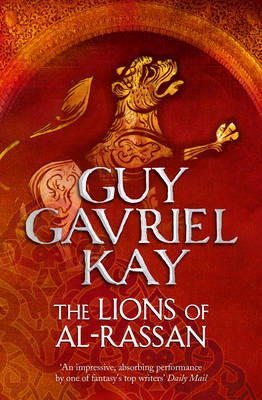
The Lions of Al-Rassan Guy Gavriel Kay is only a recent discovery for me, but after reading Tigana in June I knew I wanted to read more of his work. Leander of The Idle Woman mentioned that she had been wanting to re-read The Lions of Al-Rassan, one of her favourite books, so we decided it would be interesting to read it at the same time and exchange our thoughts on it.

I should start by saying that although Kay is known as a fantasy author, this book has few, if any, elements that I would describe as ‘fantasy’ and is much closer to historical fiction. The story is set in a fictitious world very similar to medieval Spain. In the north, we have the sun-worshipping Jaddites – brave warriors and horsemen. The Jaddite lands have become divided and weakened over the years due to rivalries between their three kings but they still hope to one day ride south and reconquer the rest of the peninsula. In the south is Al-Rassan, the land of the Asharites, who worship the stars and who value poetry, music and beauty. After the death of their last Khalif, Al-Rassan has also become divided and is not as strong as it once was. Caught between the two are the wandering Kindath people, who pray to the two moons that shine in the sky, one blue and one white. Even with my very limited (almost non-existent) knowledge of Spanish history I could immediately see that the Jaddites represented Christians, the Asharites Muslims and the Kindath Jews.

As tension builds between the Jaddites and the Asharites and war begins to look inevitable, there are big consequences for the novel’s three central characters. One of these is Rodrigo Belmonte, Captain to a Jaddite king and one of the Jaddites’ greatest soldiers. When Rodrigo is exiled by his king he and his company find themselves in the Asharite city of Ragosa. Here he meets another great man, Ammar ibn Khairan, an Asharite who is also in exile, and the two form an instant connection. Our third protagonist is a woman, Jehane bet Ishak, a Kindath physician who joins Rodrigo’s company and becomes close to both men. With the peninsula heading rapidly towards conflict, will the bonds between Rodrigo, Ammar and Jehane be able to survive?

Now that I’ve read two of Guy Gavriel Kay’s novels, it’s hard to say which I liked best because both were such great books. I think I found Tigana more fun to read (simply because I read fantasy so rarely these days and it was something a bit different for me to read a book with magic and wizards) but I found the writing in The Lions of Al-Rassan more powerful and the characters more fully developed. Ammar, Rodrigo and Jehane are all characters that I could love and admire, and considering their very different backgrounds and cultures, it’s quite an achievement that Kay could make it possible to identify with and care about all three of them.

Although this novel is set in a fictional land, the parallels with a real period of history made me feel that I was gaining a better understanding of medieval Spain. But as well as the history, there’s also a lot of drama and excitement throughout the novel: among other things, there are battles, assassination attempts (both successful and unsuccessful), and a masked Carnival. What I really loved about this book, though, was the portrayal of the three main characters and the relationships between them. It’s not as simple as Jehane being in love with both men (or them being in love with her) and having to choose between them; although there is a romantic aspect, the relationships are much deeper and more complex than that and encompass not just love but also friendship, loyalty and trust.

There’s a growing sense of sadness too as you start to approach the end of the book and wonder whether all three of Ammar, Jehane and Rodrigo will survive the coming conflict and how they will cope if they find themselves on opposite sides. The final chapter was one of the most tense and emotional I’ve read for some time, though I thought it would have been even more effective without the epilogue that followed (I was pleased to see that Leander felt the same as I was wondering whether I was the only person who would rather not have had the loose ends tied up).

I’m excited about the prospect of working my way through the rest of Kay’s books, but I’m sure I’ll want to re-read this one at some point too – preferably after I’ve had a chance to read up on Spanish history! If you would like to see what Leander thought of The Lions of Al-Rassan, you can read her post here.