Another Classics Club Spin!

The Classics Club

It’s time for another Classics Club Spin!

Here are the rules:

* List any twenty books you have left to read from your Classics Club list.
* Number them from 1 to 20.
* Next Monday a number will be chosen.
* This is the book you need to read in May and June!

And here is my Spin List:

Five books I’ve been looking forward to reading:

1. Frenchman’s Creek by Daphne du Maurier
2. Captain Blood by Rafael Sabatini
3. The Heir of Redclyffe by Charlotte M. Yonge
4. Excellent Women by Barbara Pym
5. Family Roundabout by Richmal Crompton

Five books from the 20th century:

6. Cold Comfort Farm by Stella Gibbons
7. The Remains of the Day by Kazuo Ishiguro
8. East of Eden by John Steinbeck
9. The Age of Innocence by Edith Wharton
10. The Midwich Cuckoos by John Wyndham

Five long Victorian books:

11. Vanity Fair by William Makepeace Thackeray
12. David Copperfield by Charles Dickens
13. Shirley by Charlotte Bronte
14. The Mill on the Floss by George Eliot
15. Wives and Daughters by Elizabeth Gaskell

Five picked completely at random:

16. The Betrothed by Alessandro Manzoni
17. Around the World in Eighty Days by Jules Verne
18. The Charterhouse of Parma by Stendhal
19. The Heart of Midlothian by Sir Walter Scott
20. The Time Machine by H.G. Wells

Now I have to wait until Monday to find out what I’ll be reading…

Classics Club May Meme

classicsclubI haven’t participated in the last few monthly memes from the Classics Club but I thought I would join in this month as it’s a nice, easy question to answer.

Tell us about the classic book(s) you’re reading this month. You can post about what you’re looking forward to reading in May, or post thoughts-in-progress on your current read(s).

Before I start to discuss this month’s books, I should probably mention the three books from my Classics Club list that I read in March and April and still haven’t found time to write about yet! They are:

Doctor Zhivago by Boris Pasternak
The Last Chronicle of Barset by Anthony Trollope
The Ladies’ Paradise by Emile Zola

I’ve been behind with my reviews all year, but I hope to post my thoughts on these three in the next couple of weeks.

This month I’m planning to read these:

Far from the Madding Crowd

Far from the Madding Crowd by Thomas Hardy

I received a beautiful Penguin English Library edition of this book in a giveaway from Heavenali last year and feel bad that I haven’t had a chance to read it yet. This will definitely be the next classic I read and I’ll probably start it this weekend. I’ve only read a few of Thomas Hardy’s books but I loved them and am really looking forward to reading more of his work.

Twenty Years After

Twenty Years After by Alexandre Dumas

I re-read The Three Musketeers recently and mentioned that I want to continue with the other books in the Musketeers series. Twenty Years After is the second one and I can’t wait to read it as I’ve loved everything else I’ve read by Dumas. This is a very long book, though, so I might not finish it before the end of the month.

And those are my plans for May! I also need to read this month’s section of War and Peace (Book 2, Parts 3 and 4) for the readalong I’m taking part in.

Are there any classics you’re looking forward to reading this month?

Aurora Floyd by Mary Elizabeth Braddon

Aurora Floyd When I decided to take part in the recent Classics Club Spin I was delighted when the book chosen for me was Aurora Floyd. I have read two of Mary Elizabeth Braddon’s other books – Lady Audley’s Secret and The Doctor’s Wife – and loved them both, so I had high hopes for this one.

Aurora Floyd, like Lady Audley’s Secret, is a Victorian sensation novel which means you can expect a story filled with mystery, murder and family secrets. Aurora Floyd is a young woman who lost her mother at an early age and was raised by her father, a rich banker. We are told that the lack of a feminine influence has led to Aurora having some unsuitable and unconventional hobbies, including an obsession with dogs and horse racing. It’s this interest in horses that causes Aurora to become involved in a scandal that her father does his best to cover up.

Time passes and Aurora attracts the attentions of two very different men: the handsome, proud Cornishman Talbot Bulstrode and the loyal, loving Yorkshire squire John Mellish (one of my favourite characters). She marries one of them but it’s not long before the secrets of Aurora’s troubled past come back to haunt her. Of course I’m not going to tell you what Aurora’s secret is, and if you really don’t want to know I would also advise not reading the blurb on the back of the Oxford World’s Classics edition. It’s not all that hard to guess, admittedly, but it’s completely unnecessary for the publisher to spoil the story for people in my opinion! Even after the truth about Aurora’s past starts to become obvious, though, there are still more mysteries to be solved and plenty of suspense right until the end of the book.

I’ve mentioned that I liked John Mellish; I also loved Aurora’s uncle, Samuel Prodder, and there are some great villains too, including the governess, Mrs Powell, who is jealous of Aurora, and Steven Hargraves, who is looking for revenge after losing his position as groom for kicking Aurora’s dog. As I’ve already said, Aurora is not a typical Victorian heroine, especially in contrast to the novel’s other main female character, her cousin Lucy, who is portrayed as gentle, feminine and obedient. But while Lucy is presented as the 19th century ideal and Aurora as ‘unwomanly’, the author never sounds disapproving or judgmental of Aurora and she is by far the more interesting and engaging of the two. At first, to maintain the aura of mystery and secrecy surrounding her, we are not allowed into Aurora’s head; everything we learn about her is through either the authorial voice (Braddon, like many Victorian authors, has a habit of talking directly to the reader) or through the eyes of Talbot Bulstrode, John Mellish and various other characters. Later, after her secrets start to be revealed, we get to know her better.

In some ways Aurora Floyd is definitely a product of its time – attitudes towards class, for example, and the offensive terms used to describe Hargraves, who has what we would probably call learning difficulties today – but in other ways, Braddon’s views feel refreshingly modern. I also liked the fact that while many authors would have ended the novel with the heroine’s marriage, in Aurora Floyd the marriage takes place less than a third of the way through the book, when the story is only just beginning rather than ending:

Yet, after all, does the business of the real life drama always end upon the altar-steps? Must the play needs be over when the hero and heroine have signed their names in the register? Does man cease to be, to do, and to suffer when he gets married? And is it necessary that the novelist, after devoting three volumes to the description of a courtship of six weeks duration, should reserve for himself only half a page in which to tell us the events of two-thirds of a lifetime?

It has been a few years since I last read anything by Mary Elizabeth Braddon and I had forgotten how much I like her writing. I still prefer Wilkie Collins’ sensation novels, but Braddon’s are not far behind. I didn’t find Aurora Floyd as exciting and gripping as Lady Audley’s Secret but I think I liked the characters better in this one and am grateful to the Classics Spin for selecting such an enjoyable book for me!

The Classics Spin!

The Classics Club

When this new Classics Club game was announced a few days ago I wasn’t sure whether I wanted to join in or not, but in the end I couldn’t resist. Here are the rules:

  • Pick twenty books that you’ve got left to read from your Classics Club List.
  • Try to challenge yourself: list five you are dreading/hesitant to read, five you can’t WAIT to read, five you are neutral about, and five free choice (favorite author, rereads, ancients — whatever you choose.)
  • Post that list, numbered 1-20, on your blog by next Monday.
  • Monday morning, we’ll announce a number from 1-20. Go to the list of twenty books you posted, and select the book that corresponds to the number we announce.
  • The challenge is to read that book by April 1

And here is my list:

Five books I’m looking forward to reading:

1. The Heir of Redclyffe by Charlotte M. Yonge
2. Far from the Madding Crowd by Thomas Hardy
3. Captain Blood by Rafael Sabatini
4. Twenty Years After by Alexandre Dumas
5. Frenchman’s Creek by Daphne du Maurier

Five books I’ve been hesitant to read:

6. The Odyssey by Homer
7. The Idiot by Fyodor Dostoevsky
8. A Tale of Two Cities by Charles Dickens
9. East of Eden by John Steinbeck
10. Washington Square by Henry James

Five Victorian books

11. The Mill on the Floss by George Eliot
12. Wives and Daughters by Elizabeth Gaskell
13. Vanity Fair by William Makepeace Thackeray
14. Aurora Floyd by Mary Elizabeth Braddon
15. Around the World in Eighty Days by Jules Verne

Five from the twentieth century:

16. The Painted Veil by W Somerset Maugham
17. The House of Mirth by Edith Wharton
18. Excellent Women by Barbara Pym
19. Wide Sargasso Sea by Jean Rhys
20. Cold Comfort Farm by Stella Gibbons

Now I just have to wait for Monday to find out which book I’ll be reading!

UPDATE: Monday 18th February 2013

So the number has been announced and I will be reading…

#14 – Aurora Floyd by Mary Elizabeth Braddon!

I’m very happy with this as it’s a book I’ve been wanting to read for a long time and as I loved the other two Braddon books I’ve read (Lady Audley’s Secret and The Doctor’s Wife) I’m expecting to enjoy this one too.

Classics Club Readathon

classics-club-readathon-january-2013

Today I’m taking part in the first ever Classics Club Readathon. The readathon starts at 8am EST, which is 1pm here, though I think I will probably have to miss the first few hours and start later in the afternoon. When I signed up for this last month I expected to have plenty of time to read today, but I now have some other commitments so I might not be able to get as much reading done as I had hoped.

I’m currently in the middle of reading The Small House at Allington by Anthony Trollope so I’m going to concentrate on finishing that before I start anything else. If I do finish it, I’ll be choosing another book from my Classics Club list to read next.

To avoid overwhelming you with extra posts I’ll be updating this post throughout the readathon.

The Small House at Allington Update 8.30pm – I’ve read another 8 chapters of The Small House at Allington and am still hoping to finish the book before the end of the readathon. I’m enjoying this one a lot more than the previous Barsetshire novel, Framley Parsonage, despite some very frustrating characters!

Update 9.00am – It’s Sunday morning, I’ve had some sleep and there are still 4 hours of the readathon to go. I am still reading The Small House at Allington and have 7 more chapters to read.

Final Update 12.30pm – I finished The Small House at Allington this morning and with the readathon almost over, I decided not to start another book. I’m quite happy with what I’ve achieved and I think immersing myself in the story for long periods enabled me to enjoy it more than I would have done if I had dragged it out over a few weeks. My thoughts on the book will follow soon!

Memories of A Christmas Carol: a Classics Club meme

The Classics Club monthly meme question for December asks us for our thoughts and memories of A Christmas Carol by Charles Dickens:

What is your favorite memory of Dickens’ A Christmas Carol? Have you ever read it? If not, will you? Why should others read it rather than relying on the film adaptations?

A Christmas Carol I was given a copy of A Christmas Carol as a Christmas present when I was a child, though I don’t know exactly how old I was. I can’t remember who gave it to me either, but I suspect it was probably an aunt or uncle. I remember taking the book with me to my grandmother’s a few days after Christmas and reading those famous opening lines for the first time:

Marley was dead, to begin with. There is no doubt whatever about that.

The last time I re-read the book was in 2009, shortly after I started blogging, and it was still a pleasure to read – both the story itself and this particular edition. It’s a beautiful hardback book with colour illustrations and black and white line drawings by Arthur Rackham. Reading a book that looks and feels beautiful can really enhance the experience! Rackham’s twelve colour plates, originally published in 1915, can be seen here. I’ve always liked the one of Bob Cratchit sliding down the icy street.

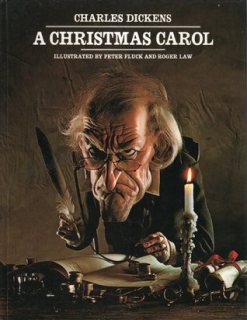
I received a different edition of the book a few years later from another family member (again I’ve forgotten who it was). I’m not sure where I’ve put this one, though I know I must still have it somewhere. After a lot of searching online – which wasn’t easy, as there are literally hundreds of different versions of A Christmas Carol and I couldn’t recall the names of either the illustrators or the publisher – I managed to find a picture of the front cover for you:

A Christmas Carol - Peter Fluck and Roger Law This edition, which I’ve discovered was published by Viking, was illustrated by Peter Fluck and Roger Law (who were also the creators of Spitting Image) with pictures of grotesque puppet-like caricatures, like the one of Scrooge pictured on the cover.

There have been so many adaptations of A Christmas Carol, but although the story and the sentiment might be the same, if you only watch them instead of reading the novel you will be missing out on so much. As I said in my 2009 post on the book, even if you already know the story it’s still worth reading it for the richness and humour of Dickens’ writing and for his wonderful descriptions and imagery.

You can see how other Classics Club members responded to this month’s meme here.

Have a great Christmas and I’ll be back later in the week with my Best Books of 2012!

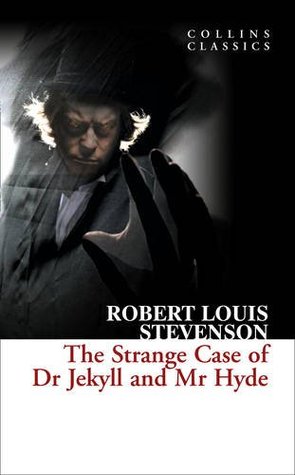
The Strange Case of Dr Jekyll and Mr Hyde by Robert Louis Stevenson

The problem with reading The Strange Case of Dr Jekyll and Mr Hyde in the 21st century is that most of us probably already know what the story involves. Even without having read it or seen any of the film versions, everyone knows what is meant by a ‘Jekyll and Hyde personality’. And this completely takes away the suspense and air of mystery that the story relies on so heavily. I’m sure the original Victorian readership would have found the connection between Dr Jekyll and Mr Hyde much more shocking! So is there still any point in reading it? Yes, I thought there was, because although I knew what the ultimate revelation would be, I didn’t know all the details of the plot or how the conclusion would be reached.

We first see Dr Henry Jekyll and Edward Hyde through the eyes of Jekyll’s friend and lawyer, Mr Utterson, who becomes concerned when he discovers that Jekyll has made a new will leaving everything to Mr Hyde. All Mr Utterson knows about Hyde is that he’s a sinister and brutal man responsible for some cruel and unprovoked acts of violence. The first half of the book follows the lawyer’s attempts to learn more about Hyde and his relationship with Jekyll. It’s only as we approach the end of the story that we hear from Dr Jekyll himself, in the form of a letter addressed to Mr Utterson, and the truth is finally revealed.

The story is cleverly structured so that if you had no idea what was coming, you would be kept wondering, knowing only as much as Mr Utterson knows, and it’s disappointing that for most modern readers the surprise has been spoiled. The part of the story I found the most interesting was the final chapter, after the secret has been uncovered and Jekyll gives his own explanation of what happened and his views on the good and the evil aspects of human nature. We can really feel his desperation as his own dark side grows stronger and things begin to spiral out of his control.

The edition I read contained just the novella The Strange Case of Dr Jekyll and Mr Hyde; other editions include a selection of other Stevenson short stories. Jekyll and Hyde on its own was only 88 pages long and if I’d realised how short it was I would have made time to read it earlier. This was one of my choices for RIP VII, and I would recommend it to other RIP participants who would like to read an important piece of classic Victorian fiction without committing to a full-length novel. I can’t say that I loved it and it’s not something I would want to read again, but I’m glad I’ve read it once and can see why it has become a part of popular culture.