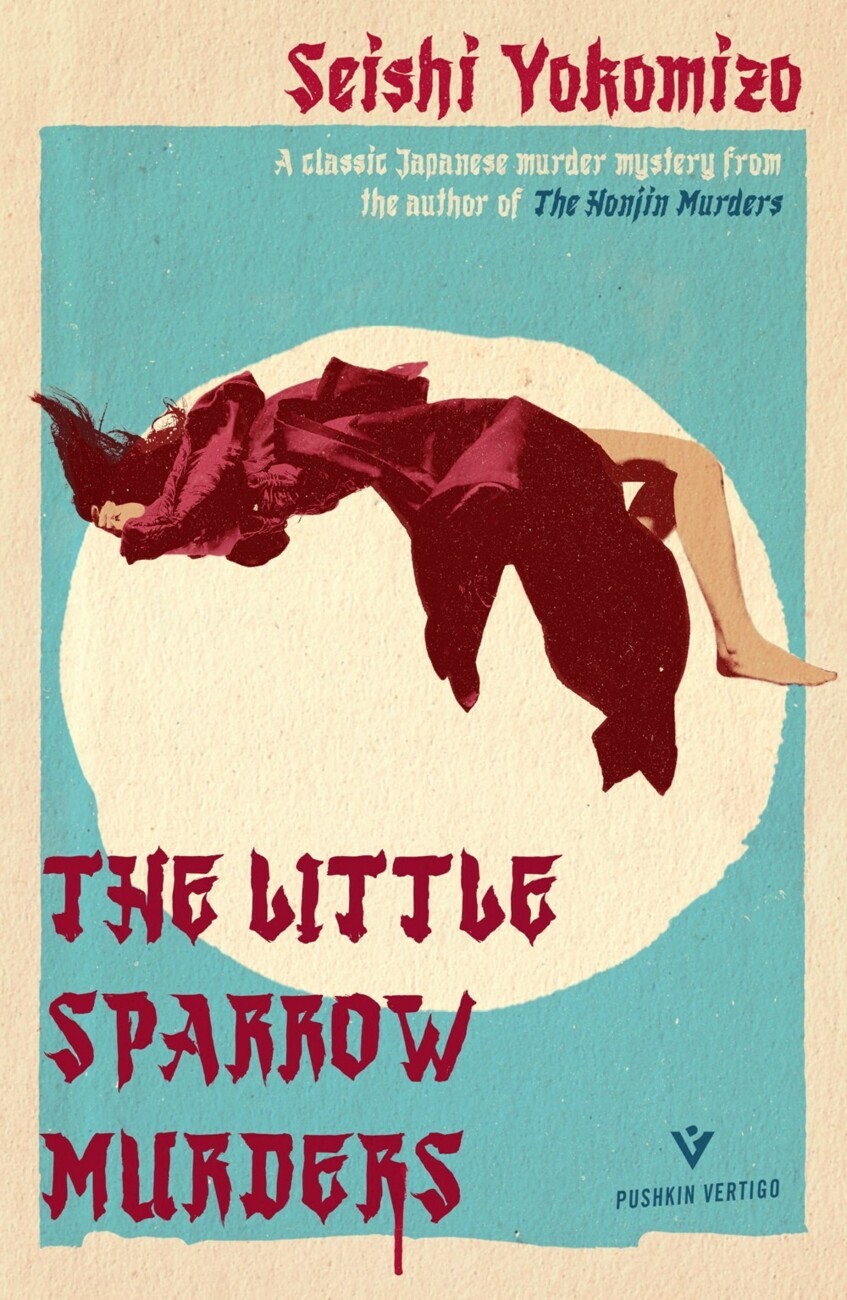
The Little Sparrow Murders by Seishi Yokomizo

Translated by Bryan Karetnyk

I’ve read all five of Seishi Yokomizo’s Kosuke Kindaichi mysteries that have previously been published by Pushkin Press in new English translations. This is the sixth, with another due later this year, and I decided to read it for the Japanese Literature Challenge being hosted this month and next by Dolce Bellezza.

The Little Sparrow Murders was originally published in Japanese in 1959 and is set a few years earlier in the village of Onikobe in Okayama Prefecture. Private detective Kosuke Kindaichi is taking a break from crime-solving and has decided to travel to Okayama to visit his old friend, Inspector Isokawa, at the prefectural police headquarters. Isokawa gives him the address of a nearby inn to stay at, run by Rika Aoike, a widowed friend. Although Kindaichi had been hoping to relax and avoid any mysteries for a while, he finds himself drawn into one when he learns that Rika’s husband, Genjiro, was murdered twenty years earlier – and the killer was never found.

As Kindaichi hears more about the events before and after Genjiro’s death and gets to know some of the people involved, another murder takes place, coinciding with the disappearance of the village chieftain and a sighting of a mysterious old woman on a mountain path. It seems that Kindaichi’s relaxing break is over before it even started. He and Isokawa begin to investigate, convinced that the key to the present day mystery lies in determining what really happened to Rika’s husband all those years ago.

Having read a lot of older Japanese crime novels over the last few years, thanks mainly to Pushkin who are doing a wonderful job with their new translations, I’ve found that many of them – most notably the ones I’ve read by Yukito Ayatsuji and Soji Shimada – are more concerned with solving seemingly impossible crimes and complex puzzles than with characters and motives. Yokomizo, I think, usually finds a better balance between the two; although his books still have intricate plots, the focus is often not so much on working out how the murders were committed, but rather on why they were committed and who could have had a reason for doing so. The impossible crime books can sometimes be fun as well, but I personally prefer the more character-driven ones. In this particular novel, the murders take place out in the open, not in locked rooms, and there’s almost no discussion of alibis, timings or similar things that can sometimes bog down a plot.

One thing I loved about The Little Sparrow Murders is that Yokomizo builds the story around a children’s rhyme – a device that Agatha Christie also often used. The killer in this novel is inspired by a temari song (a song sung by children in Japan while bouncing colourful embroidered temari balls). It begins “In the trees in the garden behind our house, Three little sparrows came to stay” and goes on to describe three young women from different families, who were “all of them sent away” – in other words, murdered. The deaths in the book correspond to the rhyme, which adds some extra interest to the mystery. I hadn’t heard of temari songs or balls before so, as always, a Yokomizo novel has contributed to my knowledge of Japanese culture.

This is one of my favourite Yokomizo novels so far, along with The Honjin Murders and The Inugami Curse, but I did have one problem with it – trying to keep track of the huge number of characters! There are five families in the book and it’s not easy to remember which family each character belongs to and how they’re connected to people in the other families. If you’re reading the ebook version (or maybe even if you’re not), I recommend taking the time to draw some family trees using the character list at the front of the book before you start, then you can easily refer to them as you read. I would have been lost otherwise, I think.

I’m now looking forward to the next Yokomizo book, Murder at the Black Cat Café, coming in September. Pushkin Vertigo also have another Ayatsuji novel, The Clock House Murders, on the way, as well as others by authors I haven’t tried yet, so 2025 should be a good year if you’re a fan of Japanese mysteries!

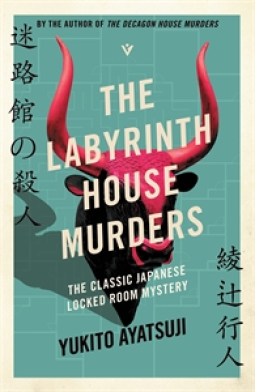
The Labyrinth House Murders by Yukito Ayatsuji

Translated by Ho-Ling Wong

This is a good example of why it’s often worth giving an author a second chance. I was disappointed with Ayatsuji’s The Decagon House Murders, finding the characters very wooden and the plot a poor imitation of And Then There Were None, so I had decided to stick with Japanese crime authors more to my taste, such as Seishi Yokomizo. Then I read lots of glowing reviews of The Mill House Murders, the second in Ayatsuji’s series to be released in a new English translation, so when I saw the third one, The Labyrinth House Murders, on NetGalley I decided to give him another try.

The Labyrinth House, we are told, is the work of the same architect who designed the Decagon House and the Mill House. As its name suggests, the house contains a labyrinth of passageways with the rooms arranged around the edges, so that to get from one room to another it’s necessary to enter the maze. The design is inspired by the Minotaur myth and all of the rooms are named after characters associated with the myth. This very unusual house is the home of the mystery writer Miyagaki Yōtarō.

Miyagaki is in poor health but, as the novel opens, he is preparing for his sixtieth birthday and has invited a group of friends and colleagues to celebrate with him at the Labyrinth House. These include four younger crime authors whom Miyagaki has mentored, a literary critic, his editor Utayama and his wife – and a friend, Shimada Kiyoshi, who is the series detective. As the guests assemble at the house, they are greeted by Miyagaki’s secretary, who gives them the shocking news that their host has committed suicide, leaving them a recorded message to listen to. The recording instructs them not to leave the house or call the police for five days and in the meantime the four authors must each use the time to write a detective story. The four stories will be judged by the other guests and the winner will inherit part of Miyagaki’s fortune.

This book was much more fun than The Decagon House Murders. Although the plot is obviously very contrived, that didn’t bother me and I found it easy enough to just suspend disbelief and accept the premise. Once the story writing competition begins, murders start to take place (in very imaginative ways) and I was completely gripped until the end. My only real criticism is that one of the clues to the solution is something that only a man would think was plausible; Ayatsuji should maybe have discussed it with a woman first before basing a key plot point around it. Sorry to be vague!

I loved the setting of the Labyrinth House and the way so many aspects of the Minotaur myth are worked into the plot. A map of the house is included to help the reader appreciate the layout of the rooms and the labyrinth (and this is where I wished I had a physical copy of the book instead of the ebook). The house has an eerie, unsettling atmosphere and I worried for the characters every time one of them went wandering off on their own! Being originally published in 1988, there are also lots of little details that set the book in that period: the way everyone smokes indoors; the word processors the authors use with floppy disks to save their work; the landline telephones that can so easily (in crime novels, anyway) become cut off from the outside world.

The characters have a bit more depth than the ones in The Decagon House, although I’m finding that characterisation doesn’t seem to be a strong point in any of the older Japanese crime novels I’ve read. Most of the book is written from Utayama’s perspective, although Shimada is the one who does the detective work – and, thankfully, explains some of his deductions to Utayama as he goes along so that the reader can follow what’s happening. And did I manage to solve the mystery? Well, no, I didn’t, but Ayatsuji conceals an important piece of information from us until the end of the book, so I don’t really consider this a fair play mystery anyway. There are also multiple plot twists and a story-within-a-story structure, just to make things even more difficult!

I’m pleased to see that the next book in the series, The Clock House Murders, is being published by Pushkin next year and also pleased that they’re sticking with Ho-Ling Wong as translator, as he’s done such a great job with this one. Meanwhile, I’ll go back and read The Mill House Murders, in the hope that for some reason it was only The Decagon House I didn’t connect with.

Thanks to Pushkin Vertigo for providing a copy of this book for review via NetGalley.

This is my sixth and final book for this year’s RIP XIX challenge.

The Black Lake by Hella S. Haasse – #WITMonth

Translated by Ina Rilke

Since reading Hella S. Haasse’s In a Dark Wood Wandering, I’ve been looking forward to reading more of her books. This one, The Black Lake, is on both my Classics Club list and 20 Books of Summer list and is also perfect for this year’s Women in Translation Month. Always good when one book counts towards multiple projects!

First published in 1948 as Oeroeg, this book is considered a Dutch classic and is apparently often taught in Dutch schools. Now that I’ve read it, I can see why it would be a popular choice with schoolteachers; it’s a short novella (under 140 pages in my edition so doesn’t take long to read), is written from the perspective of a young protagonist, and deals with the subject of colonialism in Indonesia, formerly the Dutch East Indies.

Our unnamed narrator is the son of a Dutch planter and his wife and grows up on their tea plantation in Preanger (now Priangan), West Java. As a child, he forms a close friendship with Oeroeg, the son of his father’s estate manager, and soon the two are inseparable. The narrator becomes vaguely aware that his parents and their servants disapprove of his attachment to a ‘native boy’, but with the innocence of childhood he has no idea why. However, when Oeroeg’s family is struck by tragedy, his father feels a sense of duty to the boy and reluctantly allows the friendship to continue. It’s only when he and Oeroeg start to attend school that the narrator begins to understand that their lives will never be able to follow the same path and that society has different expectations for each of them. During World War II, he leaves to serve in the Dutch army and on his return he finds that neither Oeroeg nor Indonesia are the same as when he went away.

The Black Lake is a beautifully written book, with lovely, vivid descriptions of the island of Java – the mountains, the rivers and the black lake of the title, Telaga Hideung, where one of the story’s pivotal scenes takes place. Ina Rilke’s English translation flows smoothly and is easy to read, while keeping in place some Dutch words and terms which can be looked up in the glossary at the back of the book if needed.

With the whole story being told from the perspective of a boy from a white Dutch colonial family, it’s both interesting and limiting. If Haasse was writing this book today, I think she would be expected to include the perspective of the oppressed people as well as the colonists – or maybe not write it at all and leave the story for an Indonesian author to tell. But in the context of the 1940s, when it was published, it gives some fascinating insights into the colonial mindset and I’m sure Haasse will have drawn on some of her own experiences and views (she was born in Indonesia herself and spent most of her first twenty years there).

Although I found this a powerful book, it’s not really one that I can say I ‘enjoyed’. The writing style was too dreamlike and distancing for me to fully engage with and the narrator’s story left me with a feeling of sadness. He’s naive, oblivious and looks back on his earlier years with what seems to be a fond nostalgia for an idyllic childhood, with a lack of understanding that, for Oeroeg, it was hardly idyllic at all. Oeroeg is the centre of the narrator’s life, yet there’s no indication that Oeroeg feels the same way or places much value on their friendship. Oeroeg proves to be the most socially and politically aware of the two and eventually the narrator is in the uncomfortable position of having stayed the same while everyone and everything around him has changed.

Of the two Haasse books I’ve read, I preferred the much longer In a Dark Wood Wandering, but am glad I read this one as well. If you’ve read any of her other books which are available in English translations, I’d love to hear your thoughts.

This is book 19/20 of my 20 Books of Summer 2024.

This is also book 45/50 from my second Classics Club list

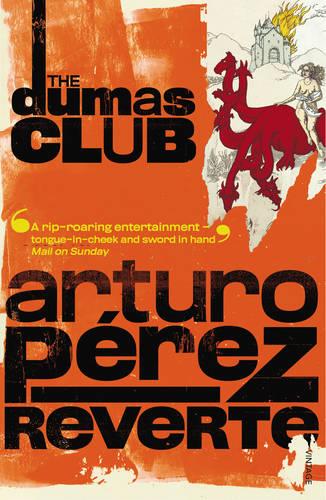
The Dumas Club by Arturo Pérez-Reverte

Translated by Sonia Soto

For Spanish and Portuguese Lit Month, hosted by Stu of Winstonsdad’s Blog, I decided to read a book that sounded perfect for me. A bibliomystery set in the world of antiquarian booksellers, paying tribute to Alexandre Dumas, whose novels I love. What could go wrong?

The Dumas Club (or The Club Dumas – it has appeared under both titles) was originally published in Spanish in 1993 and translated into English three years later by Sonia Soto. You may have watched the 1999 film adaptation The Ninth Gate, starring Johnny Depp; I don’t think I’ve seen it, but apparently it’s very different from the book and completely removes the Dumas connection, which seems strange but maybe they thought there was too much going on and couldn’t include everything.

Lucas Corso is a ‘book detective’ who hunts down rare or valuable books on behalf of his clients. Corso has found that unscrupulous dealers and collectors are prepared to pay large sums of money for the books and don’t really care whether the methods he has used to get hold of them are particularly legal or ethical. In The Dumas Club, we follow Corso as he travels across Europe on two separate missions. The first concerns an early draft of a chapter from Alexandre Dumas’ The Three Musketeers. The chapter, titled Anjou Wine, appears to be written at least partly in Dumas’ own handwriting and Corso’s job is to prove its authenticity.

His second task is more complex and involves a very different kind of book: The Book of the Nine Doors of the Kingdom of Shadows, published by Aristide Torchia in 1666. This rare and sinister book is thought to contain the key to summoning the Devil and Torchia was burned at the stake shortly after its publication. Only one copy is thought to have survived. Corso’s client, Varo Borja, owns a copy of the book which he believes may be a forgery and he wants Corso to examine two other copies, one in Portugal and one in France, to determine which is genuine and which are fakes.

Setting out on his journey, Corso begins to encounter some mysterious strangers who remind him of characters from books. For example, he is pursued by a man with a scar who resembles Rochefort, the ‘Man from Meung’, from The Three Musketeers and he also crosses paths with a young woman who introduces herself as Irene Adler after the character from the Sherlock Holmes stories. Corso is unsure whether these people are interested in The Anjou Wine, The Nine Doors or both, so he must try to keep the manuscripts out of their hands until he has solved the two mysteries.

The Dumas Club is an unusual novel and there were lots of things I liked about it. As a Dumas fan, I enjoyed all the references to The Three Musketeers and other titles; it’s not really essential to be familiar with Dumas, but you’ll definitely get more out of the book if you are. Pérez-Reverte includes a lot of unnecessary information, though, such as a full bibliography of all Dumas’ works inserted into the middle of a chapter. This info-dumping continues throughout the book, as well as lots of long digressions into printing and binding techniques and discussions of first editions, illustrations and rare collections. Some of it is quite fascinating and I think people who love books as physical objects more than for the words they contain will find it particularly interesting, but it doesn’t make for a very quick or easy read.

Although I enjoyed following the Anjou Wine thread of the story, Corso’s second mission revolving around The Nine Doors and the occult was of less interest to me and reminded me too much of The Da Vinci Code. It didn’t help that I didn’t like Lucas Corso at all and found most of the other characters equally unpleasant. Still, the ending is clever and we are given answers to both of the mysteries, so I think my feelings about this book are probably slightly more positive than negative. I have another of Pérez-Reverte’s novels on my TBR – Captain Alatriste – and wonder if I would get on better with that one.

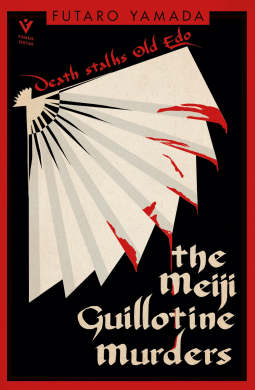
The Meiji Guillotine Murders by Futaro Yamada

Translated by Bryan Karetnyk

It’s 1869 and Japan has entered the Meiji era. The Tokugawa shogunate has fallen and the Emperor Meiji has been restored to the throne. After centuries of isolation, Japan is finally opening up to foreign trade and undergoing social, industrial and military reform. In Tokyo, a group of corrupt rasotsu (policemen) have found ways to exploit this period of change and upheaval for their own gain. With the arrival of two Chief Inspectors from the Imperial Prosecuting Office, Kawaji and Kazuki, it seems that the rasotsu will be forced to mend their ways – although the two men have other things to occupy their time as well as dealing with corruption.

With a number of bizarre murders taking place around Tokyo, Kazuki and Kawaji (based on a real person who is considered the founder of Japan’s modern police system) engage in a friendly competition to see who can solve the crimes first. A separate chapter is devoted to each case, which at first seem to be unrelated, making the book feel almost like a collection of short stories. There are five cases for the two detectives to solve, with the help of Esmeralda, a young Frenchwoman from a family of executioners whom Kazuki has brought to Japan along with that most deadly of French weapons: the guillotine. Despite the title, the guillotine is not necessarily used to carry out all of the murders in the book, but it represents the changes that Japan is experiencing as the country becomes exposed to modern, western influence. It also provides a reason for Esmeralda’s presence in Tokyo, which is important as she has a significant role to play in the solving of the mysteries.

The Meiji Guillotine Murders was first published in 1979 and is one of several Japanese crime novels that have recently been made available in English by Pushkin Press. However, although I’ve loved some of the others, I didn’t enjoy this one quite as much. Bryan Karetnyk’s translation is clear and readable (I’m already familiar with his work through some of his other translated novels), but I had problems with other aspects of the book. I struggled with the number of characters, particularly as so few of them have clearly defined personalities and with more and more of them being introduced with each new case the detectives investigate. My lack of engagement with the characters made it difficult for me to concentrate on following the plot, which is important as all of the separate cases are quite complex and you do need to be paying attention! I persevered and was rewarded with the final section of the book where, after some surprising twists and turns, everything is tied together perfectly.

I did like the historical setting of the book and felt I was learning a lot about Japan during the Meiji era. At times it seemed more like historical fiction than a murder mystery, which was fine with me, but I think someone picking the book up expecting a more traditional crime novel may be surprised by the amount of historical detail. It’s an interesting, unusual book, and although I’m not sure whether I would read any more by Yamada, I do hope more of them are translated into English for those readers who loved this one. I’m enjoying discovering Japanese crime authors through Pushkin and so far my favourites have been Seishi Yokomizo and Akimitsu Takagi.

Thanks to Pushkin Vertigo for providing a copy of this book for review via NetGalley.

This is book 7/20 of my 20 Books of Summer 2024.

Book 24/50 for the Historical Fiction Reading Challenge 2024

The Noh Mask Murder by Akimitsu Takagi

Translated by Jesse Kirkwood

My 20 Books of Summer reading is off to a good start with this 1949 Japanese locked room mystery, now available from Pushkin Press in a new English translation. Thanks to Pushkin, I’ve been able to try several Japanese classic crime authors over the last few years, including Seishi Yokomizo, Yukito Ayatsuji and Soji Shimada. The Noh Mask Murder is the first book I’ve read by Akimitsu Takagi and I thoroughly enjoyed it.

The novel opens with a discussion between Koichi Yanagi, a chemist who has recently returned to Japan after serving in Burma during the war, and his old school friend, Akimitsu Takagi (yes, the author himself, who appears as a character in his own novel – just like Anthony Horowitz in his Horowitz and Hawthorne series). Akimitsu explains to Koichi that he wants to write a new kind of detective novel, one based on a mystery he has solved for himself in real life:

‘I’d tackle some fiendish real-life mystery, then set down precisely how I solved it in the form of a novel. My readers would be provided with the exact same evidence as the author. They’d be able to follow the detective-narrator’s train of thought, assess the appropriateness of his actions – and even come up with their own alternatives. But I don’t imagine an opportunity like that will ever present itself…’

His opportunity comes sooner than he had imagined when Koichi stumbles upon a mystery at the Chizui family mansion, where he has been staying since returning from the war. The head of the household, Professor Chizui, who was once a friend of Koichi’s, died ten years earlier and the house is now inhabited by his two children and the family of his younger brother, Tajiro. The first sign that something is wrong within the Chizui mansion comes when an eerie figure wearing a sinister Noh mask is seen at one of the windows. Soon after this, Tajiro is found dead inside a locked room, with a smell of jasmine in the air and a Noh mask lying on the floor beside him. Akimitsu Takagi joins Koichi at the house to investigate the murder, but when they discover that someone has called the undertaker to order three coffins, it seems that there’s going to be more than just one murder to investigate!

The mystery is a fascinating one and although some time is spent discussing the mechanisms of how the locked room murder took place, the story never becomes too bogged down by the puzzle aspect; the focus is on the characters, their relationships and their motives. I did find the structure slightly confusing at times as we know we’re reading a book within a book written by Akimitsu Takagi (as both character and author), but within that there’s a journal written by Koichi and a long letter written by Hiroyuki Ishikari, the public prosecutor, so the narrative is sometimes three layers deep. There are some clever twists towards the end, however, which might not have worked if it had been structured differently.

Apart from the mystery, I found it interesting to learn about the different types of mask used in Japanese theatre and how although the Noh mask, which represents a demon, cannot change expression the actors can still use it to show various emotions by tilting the mask up and down and by the clever use of lighting. With the story being set in the post-war period, it’s also interesting to hear the characters reflect on the irony of being so concerned with the death of one person after living through a war in which millions died. If you kill a man in peacetime you’re considered a murderer, says Tajiro’s son, Rintaro, but if you kill a man on the battlefield you’re given a medal.

I really enjoyed The Noh Mask Murder, then, but be warned – in the prologue, where Takagi is discussing his plans for a detective novel, he casually spoils the solution of Agatha Christie’s The Murder of Roger Ackroyd. Not a problem for me as I’ve already read it, but I wish authors wouldn’t do that!

Thanks to Pushkin Vertigo for providing a copy of this book for review via NetGalley.

This is book 1/20 of my 20 Books of Summer 2024.

Count Luna by Alexander Lernet-Holenia

Translated by Jane B. Greene

What a strange book this is! I enjoyed it, but I’m not sure I fully understood everything the author was trying to say. It’s the first book I’ve read by Alexander Lernet-Holenia and I’m definitely now interested in reading more.

Count Luna was first published in German in 1955 (Lernet-Holenia was an Austrian author) and appeared in an English translation by Jane B. Greene a year later. It has recently been published in a new edition by Penguin Classics.

The novel begins with Alexander Jessiersky, an Austrian aristocrat, entering the Catacombs of Praetextatus in Rome, apparently in search of two French priests believed to have vanished somewhere in the underground passageways. When Jessiersky himself also fails to emerge from the catacombs, his disappearance is reported to the police, who link him with a series of incidents which occurred in Austria and are still under investigation. The rest of the book is presented as an account of Jessiersky’s life leading up to the disappearance, based on reports by the Italian and Austrian authorities.

We learn that at the start of World War II, Jessiersky is the head of a large Viennese transport company. When the company tries to purchase some land belonging to Count Luna, who refuses to sell, the board of directors come up with a plan to confiscate the land and have Luna sent to a Nazi concentration camp. Jessiersky himself is not involved in this, but does nothing to prevent it from happening – and so, when the war is over, he begins to worry that Luna has survived the camp and is coming back to take his revenge.

On one level, Count Luna could be described as a psychological thriller; told mainly from Jessiersky’s perspective, there’s a growing sense of paranoia and fear as he becomes convinced that Count Luna is following him around Vienna, watching from the shadows, breaking into his house and even trying to poison his children. Whether any of these things are true or only exist in Jessiersky’s imagination I’ll leave you to discover for yourself. The atmosphere becomes very dark and the feeling of tension increases as the novel heads towards its conclusion and Jessiersky enters the catacombs – and from this point the story becomes quite bizarre and even more nightmarish.

At 160 pages, Count Luna is a short novel, but took longer than I expected to read as there are some long, detailed digressions into subjects such as the lineage of the Jessiersky family, which need some concentration from the reader (and don’t really add a lot to the story as a whole). Apart from the references to the war, it felt more like a book written in the 19th century than one written in the 1950s. The war is a crucial part of the story, however, and I’ve seen reviews suggesting that Lernet-Holenia was drawing parallels between Jessiersky’s guilt over Luna’s fate and Austria’s own post-war guilt, which does make a lot of sense. I also think the name Luna (the moon) is no coincidence, as Jessiersky discovers that trying to escape from Luna – and therefore from his guilt – is as useless as trying to escape from the moon.

Although I didn’t love this book as much as I thought I was going to at the beginning, I did find it completely fascinating and it left me with a lot to think about.

Thanks to Penguin Classics for providing a copy of this book for review via NetGalley.