The Boleyn King by Laura Andersen

The Boleyn King We all know what happened to Anne Boleyn: having failed to give Henry VIII the son and heir he needed, the King turned his attentions to Jane Seymour and Anne was beheaded, leaving behind her only child, the future Elizabeth I. But what if Anne had given birth to a living son? What if that son grew up to become King of England? Laura Andersen takes that idea as her starting point for The Boleyn King and weaves a whole alternative history around it.

At the beginning of the novel, King Henry IX, better known as William (the fictional son of Anne and Henry), is approaching his eighteenth birthday. His uncle, Lord Rochford, has been acting as Lord Protector for the last few years but William is now almost ready to begin ruling in his own right. Rochford is a clever, ruthless man and he has not done a bad job of ruling the kingdom, but as William prepares to take over there are still several problems and potential conflicts to be dealt with.

First, there’s the threat posed by the Lady Mary, William’s half-sister, who many of England’s Catholics would prefer to see on the throne. Then there’s the prospect of war with France. Most worrying of all for William is news of a document known as The Penitent’s Confession which claims to throw William’s paternity into doubt and which, if it falls into the wrong hands, could lose him his throne.

Amidst all of this drama and danger, there are only three people whom William feels he can trust: his other sister, Elizabeth, and two more fictional characters, Dominic Courtenay and Minuette Wyatt. Dominic is his best friend and William has come to rely on his honesty and advice, while Minuette, the daughter of one of Anne Boleyn’s ladies, has been raised as a royal ward and is very close to William. Elizabeth, Dominic and Minuette are the people William turns to for help in ensuring the security of the kingdom – and locating the Confession before his enemies find it first.

The Boleyn King is part alternate history, part mystery and part romance. It was the history part that I enjoyed the most; the book raises some fascinating questions and although these weren’t explored in a lot of depth, it’s still very intriguing to think about all the different ways in which just one small change (the birth of one boy) could affect the future of England, Europe and maybe even the entire world. If there really had been a Henry IX, that must mean there would have been no Edward VI. Does that also mean that Lady Jane Grey would never have briefly taken the throne and then lost her life and that Mary would never have become Queen either? What if Henry IX had children of his own? Would the outcomes of wars have been changed? What about the implications for religion, culture, art, literature and exploration? The possibilities are endless.

The mystery storyline, which begins with the death of a friend of Minuette’s and ends with the search for the hidden document, was quite enjoyable too, but the romantic aspect of the book was of less interest to me. Elizabeth, as she apparently was in real life, is in love with Robert Dudley, while both William and Dominic develop feelings for the same woman – who happens to be Minuette. Their love triangle is not resolved in this book but as this is the first in a trilogy, I expect it will continue to play a big part in the next two books.

There was a lot to like about The Boleyn King, but I did have one big problem with it. William, Elizabeth, Minuette and Dominic could have been modern day teenagers – they never felt to me like people who could really have lived during the Tudor era. The way they spoke, the way they thought and the way they behaved just wasn’t right and there was no real sense of the time period. When I read historical fiction I like to feel completely immersed in another time and place but that never happened with this book.

The next two in the trilogy are The Boleyn Deceit and The Boleyn Reckoning. While I would be interested to know how the story develops, I’m not sure if I enjoyed this book enough to want to read two more. Maybe I’ll change my mind if I come across them in the library but at the moment I’m not planning to continue.

The White Princess by Philippa Gregory

The White Princess - Philippa Gregory The White Princess is the fifth book in Philippa Gregory’s Cousins’ War series. The Cousins’ War is another name for the Wars of the Roses, a series of 15th century conflicts between the House of York and the House of Lancaster, two rival branches of the English royal family. This novel is set at the end of the period, just after Henry Tudor has defeated Richard III at the Battle of Bosworth and has been crowned Henry VII. Our narrator is Henry’s wife, Elizabeth of York, a niece of Richard III and daughter of another former king, Edward IV. The novel takes us through the early years of Elizabeth’s marriage to Henry (an alliance which was supposed to unite the houses of York and Lancaster), the births of their children and the plots and conspiracies that troubled Henry’s reign.

The Wars of the Roses is a period filled with mysteries and controversies and every author or historian seems to have their own set of opinions and theories. The most intriguing of these mysteries is of course the question of what happened to Elizabeth of York’s two younger brothers who disappeared from the Tower of London never to be seen again. Were they murdered and if so who by? Or did one of them manage to escape? Henry VII was unable to prove that the two princes were dead, so the possibility that they could have survived gave rise to a series of Yorkist rebellions. In The White Princess we focus on one of these uprisings, centred around a pretender known as Perkin Warbeck who claims to be the younger of the princes, Richard, Duke of York. Is he really who he says he is and if so, must Elizabeth choose between her husband and her brother?

While I’m not a particularly big fan of Philippa Gregory’s writing and I think there are much better historical fiction authors out there (and much better Wars of the Roses novels – The Sunne in Splendour by Sharon Penman is my top recommendation) I have quite enjoyed following this series and learning more about the women of the period. This one, though, was disappointing and the weakest of the series, in my opinion. It felt repetitive and unnecessarily long and I just didn’t find Elizabeth a very engaging narrator.

The story is based around two theories that you may or may not find plausible. The first is the idea that Elizabeth was in love with Richard III, her uncle, and that they were romantically involved. As far as I know, there is no historical evidence for this but Gregory is not the only author to have suggested it and I suppose it did add an extra layer to her portrayal of Elizabeth and Henry’s marriage. Then there’s the Perkin Warbeck story, which dominates the second half of the novel. I have read about Perkin Warbeck before and am familiar with the arguments for and against him being the lost prince; the theory Gregory describes here seems very unlikely to me, but this is fiction after all!

Something I think Philippa Gregory is very good at is making a complex period of history easy to understand. Even with no previous knowledge you would probably be able to follow what is happening in this novel without too many problems. Sometimes, though, I think she goes too far in her attempts to clarify things for the reader. For example, when Elizabeth is talking to her sister Cecily about their half brother she refers to him as “Thomas Grey, Mother’s boy” which just sounds silly, doesn’t it?

My biggest problem with this book, though, was the portrayal of the main characters. Elizabeth had such an interesting life and yet she comes across in The White Princess as boring. She doesn’t have the strength, intelligence and spirit of the other women who have been featured in the series – Elizabeth Woodville (The White Queen), Margaret Beaufort (The Red Queen), Jacquetta Woodville (The Lady of the Rivers) and even Anne Neville (The Kingmaker’s Daughter). The portrayal of Henry VII is very negative, which makes it difficult later in the book when we are expected to accept that Elizabeth is starting to love him. I don’t see how anyone could have loved the cruel, petty, vindictive Henry described in this book – especially after something he and his mother do to Elizabeth at the beginning of the novel, which I won’t go into here!

I think maybe I should have skipped this book and gone straight to the latest one, The King’s Curse, which sounds more intriguing and seems to be getting better reviews than this one. It’s about Margaret Pole, Elizabeth’s cousin, an historical figure I know nothing about. I’m looking forward to reading it eventually despite my problems with this one.

For more Wars of the Roses recommendations see My Journey Through Time: The Wars of the Roses and for more on Elizabeth of York and Henry VII see The Tudors – Part I.

The May Bride by Suzannah Dunn

The May Bride One day in May 1536, Jane Seymour became Henry VIII’s third wife – but she is not the only May bride in Suzannah Dunn’s new novel. The other is Katherine Filliol, the wife of Jane’s elder brother, Edward. Jane is only fifteen when Edward first brings Katherine to Wolf Hall, the Seymour family home, and she is instantly captivated by her beautiful new sister-in-law. Jane and Katherine become close friends – or so Jane thinks, but gradually she discovers that Katherine has been keeping secrets from her and that her marriage to Edward may not be as perfect as it first appeared.

I had my doubts about this book before I started reading it because I had tried to read another of Dunn’s books a few years ago, The Confession of Katherine Howard, and didn’t get very far with it before giving up, not having connected with the writing style or the characters at all. I wondered if I would have the same experience with this book, but luckily that didn’t happen; I found this one much more enjoyable and easier to get into.

I’ve read a lot of novels set during the Tudor period, but this one is slightly different, for several reasons. First, it is a very domestic story, being set almost entirely at Wolf Hall with only the final, shortest section of the book covering Jane’s time at court as lady-in-waiting to Katherine of Aragon and Anne Boleyn. Until that last section there are so few mentions of politics, court intrigues or famous people of the period (apart from the Seymours themselves) that it could almost have been a story about any other wealthy Tudor family going about their daily lives.

I also found it intriguing that although Jane is the most famous Seymour and the one who is narrating, this novel is actually about Katherine Filliol as much as it is about Jane. I didn’t know anything about Katherine before reading the book and although Suzannah Dunn admits in her author’s note that there is very little historical information available on Katherine (and no record of what eventually happened to her) I still appreciated the fact that she had chosen to focus on a little-known character who is not usually the subject of historical fiction.

Finally, this book is written in a style that feels very modern and there is no real attempt to use language appropriate to the period. This is something that usually irritates me, but in this case I think it actually worked quite well once I got used to it. Because this is a family drama, with the emphasis on exploring the relationships between Katherine, Jane and the other Seymours, the fresh and contemporary feel made it easy to identify with the characters. I thought Jane’s brothers, Edward and Thomas, with their very different personalities, were particularly well drawn.

Compared with some of Henry VIII’s other wives, Jane Seymour as queen is often portrayed as quiet and uninteresting but here the young Jane comes to life as a loyal and loving person who is able to see the best in everyone. Unfortunately I didn’t share her fascination with Katherine, but I suppose that’s because I was able to pick up on clues and nuances that wouldn’t have been obvious to an innocent fifteen-year-old girl who is dazzled and enchanted by her new friend.

Although I maybe haven’t learned as much about Jane as I would have done from a more conventional historical novel, I did enjoy reading about her early life and the experiences that shaped the woman and queen she would become.

I received a copy of this book for review from the publisher via NetGalley

A Dangerous Inheritance by Alison Weir

A Dangerous Inheritance The disappearance of the ‘Princes in the Tower’ (twelve-year-old Edward V of England and his younger brother Richard, Duke of York) remains a mystery to this day. Some believe that they were murdered by their uncle, Richard III, some suspect Henry VII or the Duke of Buckingham, and others prefer to think that one or both of the Princes managed to escape. My fascination with this mystery leads me to want to read everything I can find about it, even books like this one, written by an author whose views on the subject are entirely different from mine.

Alison Weir is an author of both historical fiction and non-fiction and A Dangerous Inheritance is one of her works of fiction. I had enjoyed a previous novel of hers, Innocent Traitor, which told the story of Lady Jane Grey, so I thought I would try this one despite knowing that Weir does not like Richard III at all and I was unlikely to agree with any conclusions she might come to.

Actually, this novel is only partly about Richard and the Princes; at least half of the book is set eighty years later and follows the story of Katherine Grey, the younger sister of the ‘nine-day queen’, Lady Jane Grey. After Jane’s very brief reign as Queen of England comes to an end when she is deposed by Mary I and beheaded, Katherine herself moves one step closer to the throne. To her disappointment, Mary is followed by Elizabeth I, who refuses to acknowledge Katherine as her heir and treats her badly. When Katherine marries the man she loves against Elizabeth’s wishes, she finds herself imprisoned in the Tower of London.

Katherine Grey’s story alternates with the story of another Katherine – Katherine Plantagenet (referred to as Kate to avoid confusion), an illegitimate daughter of Richard III. Kate loves her father and refuses to believe that he had any involvement in the disappearance of the two young princes. After Richard is defeated at Bosworth in 1485 and Henry Tudor takes his place on the throne, Kate’s loyalty to her father and her determination to clear his name could be considered treason. Several generations later, Katherine Grey discovers some letters written by Kate, learns of Kate’s connection with the princes and decides to continue investigating the mystery from within the Tower.

On the subject of the princes, I do find it fascinating that different authors and historians can begin with the same facts and come to entirely different conclusions! As nothing has ever been proven either way regarding the disappearance of the princes and the other controversies surrounding Richard III, I’m happy for it to remain a mystery. Having read quite a lot on the subject over the last few years, I personally find the pro-Richard viewpoint much more convincing than the anti-Richard one, but I can accept that we’ll probably never know the truth and that everyone is entitled to their own opinion.

For Alison Weir, although she states in her author’s note that she likes to keep an open mind, there is clearly no mystery: Richard was guilty of everything. As I was familiar with her views before beginning the book, I suppose I shouldn’t really complain! I was disappointed, though, that the main source Katherine uses in her investigations appears to be Thomas More (who was only seven years old at the time of Bosworth, is thought to have relied upon Richard’s enemy, Archbishop Morton, as his own primary source, and wrote his histories during the Tudor period, when it was obviously to his advantage to please the Tudor monarchs by discrediting their predecessors). However, as Weir explains in the author’s note, she could only use sources that would have been available to Katherine in the mid 16th century.

I did like the fact that this was a dual time period novel where both time periods were historical, rather than one being set in the present day, though I did sometimes feel that I was reading two separate stories that didn’t really belong in the same book. Apart from the fact that both main characters were Katherines and both suffered from being close to the throne, there was very little to link the two. It’s only in the final 100 pages of this 500-page book that Katherine Grey begins to investigate the mystery of the princes and parallels start to be drawn between the two storylines – some of them of a paranormal nature, which you may or may not appreciate!

Of the two, I enjoyed the Katherine Grey storyline the most. I found Katherine a much more engaging character, which is probably not surprising as she narrates in the first person while Kate doesn’t. Also, there is almost no historical information available on Kate Plantagenet, which meant that her sections of the book were largely fictional. I couldn’t help feeling that Katherine Grey’s life story would have been interesting enough to form the basis of a whole novel on its own without the addition of a second, imaginary storyline and without squeezing the Princes in the Tower into the same book as well.

Have you read anything about the Princes in the Tower? Who do you think was responsible for their disappearance?

The Tudors: A Very Short Introduction by John Guy

The Tudors Just a short post today to discuss a very short book!

The Tudors: A Very Short Introduction is part of a series of books which offer, as the title suggests, a very short introduction to a wide variety of different topics. Looking at the list of other titles available (and there are hundreds of them) you can choose from subjects as diverse as Folk Music, Feminism or Contemporary Art; Chinese Literature, Biblical Archaeology or American Politics. This one is devoted to the Tudors although, admittedly, I probably didn’t really need a short introduction to them, having recently read Peter Ackroyd’s much longer book on the same subject! I had the opportunity to receive a review copy, though, and was curious to see what the series was like.

In this book, historian John Guy takes us through the reigns of each Tudor monarch – Henry VII, Henry VIII, Edward VI, Lady Jane Grey, Mary I and Elizabeth I. All of the basic facts are here, presented in a format that is easy to follow and understand. There are also some illustrations, genealogical tables, a chronology and a list of suggested further reading. As I already have quite a good knowledge of the Tudor period, very little of the information in this book was new to me, but for those readers who don’t know much about the Tudors this will be an excellent starting point.

While this was not as interesting or compelling as Ackroyd’s book (and I know it’s not fair to compare the two as they are clearly aimed at different readers and have different purposes) I did enjoy reading this Very Short Introduction and would consider trying another one. As well as being short (just over 100 pages), these books are also very small and would be the perfect size to take with you on a train or bus journey or to fit into a bag or pocket so that you could dip into it when you have a few spare moments to read. And if you don’t feel like actually reading it from cover to cover, it would be a good reference book to keep on your shelf for times when you might want to quickly look up some dates or facts.

You can find a full list of all the Very Short Introductions on the Oxford University Press website.

The Nine Day Queen by Ella March Chase

The Nine Day Queen When King Edward VI dies unmarried and childless in 1553, there are several claimants to the throne. One of these is Lady Jane Grey, who has Tudor blood through her mother, Frances Brandon, a niece of Henry VIII’s. Finding herself at the centre of a plot by her parents and the Duke of Northumberland (the father of her husband, Guildford Dudley), Jane becomes Queen of England…but only for nine days. Deposed by Edward’s Catholic half-sister, Queen Mary, Jane is imprisoned in the Tower of London and eventually beheaded. The story of Jane’s short reign and tragic fate forms part of this historical fiction novel by Ella March Chase, but this is not just Jane’s story – it’s also the story of her two younger sisters, Katherine and Mary.

On the same day that Jane married Guildford Dudley, Katherine was married to Henry Herbert, son of the Earl of Pembroke, but after Jane’s downfall the Herberts want to break their ties with the Grey family, so Katherine and Henry’s marriage is annulled. Later, Katherine falls in love with Edward Seymour but their secret romance incurs the wrath of the new queen, Elizabeth I, and Katherine finds that her own life could be in danger. Although the youngest Grey sister, Mary, is not such a central part of her parents’ plotting (possibly because she suffers from what sounds like a severe form of spinal curvature), she is still affected by Jane’s death and Katherine’s misfortunes. This fictional account of the Grey sisters is a great introduction to Mary and Katherine for those of us who know very little about them!

I had a good idea of what I could expect from The Nine Day Queen, having read another book last year by this author, The Virgin Queen’s Daughter, which I enjoyed. I knew it wouldn’t be a particularly ‘literary’ historical novel (you can probably guess that from the cover, though it’s not always fair to make assumptions) but not as light and fluffy as some. I can’t really say much about the accuracy of the book as I’ve only read one other novel about Lady Jane Grey (Innocent Traitor by Alison Weir) and no non-fiction beyond the few brief paragraphs she is usually given in books about the Tudors. As far as I could tell the story does stick to the basic facts, with some obvious inventions, as you would expect in a book that is fiction rather than non-fiction – and the author does use her Author’s Note at the end to explain where she has deviated away from the known facts.

The sisters are given such different personalities – Jane is sensible, studious and a devout Protestant, Katherine warm, compassionate and pretty, and Mary outspoken and impulsive – and with each girl narrating her own chapters of the book, the opportunity was there for the author to develop a different narrative voice and style for each of them. I was disappointed that she didn’t make the most of this opportunity and the voices of the three girls were very similar, so much so that there were times when I found it hard to tell who was narrating the chapter I was reading and had to look back at the chapter heading to remind myself.

I did like the fact that the story was told from the perspective of all three Grey sisters, though, and I was surprised to find that Jane’s death comes not near the end of the book as you might expect, but in the middle. The focus is then on Katherine and Mary for the remainder of the novel and I thought this was good because while Jane’s story is well known, the other two sisters have been largely forgotten by history and it was nice to have an opportunity to learn more about them both. Another thing that was surprising was the portrayal of the two queens, Mary I and Elizabeth I. In a reversal of what you would usually expect, Mary is portrayed as kind and considerate whereas Elizabeth comes across as spiteful and vindictive. They both felt more like caricatures than realistic characters to me, but it was interesting to see such a different perspective!

Are there any other books anyone can recommend on Lady Jane Grey and her sisters, either fiction or non-fiction? I’ve just received a copy of the new Elizabeth Fremantle novel, Sisters of Treason, from Netgalley so will be interested to see how that one compares.

Note: This book has also been published under the title Three Maids for a Crown.

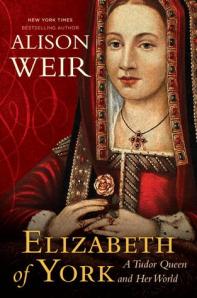
Elizabeth of York: A Tudor Queen and Her World by Alison Weir

Elizabeth of York Elizabeth of York’s story is a fascinating one. As the eldest daughter of King Edward IV and Elizabeth Woodville (the alternate spelling of Wydeville is used in this book), Elizabeth lived during one of the most turbulent periods of English history, the Wars of the Roses. She was the sister of the two young princes who it is believed may have been murdered in the Tower of London, she married the first Tudor king, Henry VII, who defeated her uncle Richard III at the Battle of Bosworth, and she was also mother to another king, Henry VIII. Despite all of this, Elizabeth is not usually given as much attention as other figures of the period. This new biography, Elizabeth of York: A Tudor Queen and Her World, explores Elizabeth’s life and her historical significance.

Alison Weir is an author of both historical fiction and non-fiction. Although I have read one of her novels, Innocent Traitor, this is the first of her biographies I’ve read and I was very impressed. The book is written in a style that I found engaging and easy to read but it’s also a very thorough, long and detailed account of Elizabeth’s life. An incredible amount of research must have gone into the writing of this book and it contains an absolute wealth of information…I read it on my Kindle and was constantly bookmarking interesting facts and passages.

As well as taking us, in chronological order, through Elizabeth’s entire life from her birth to her death and its aftermath, we are also given lots of details on the social history of the period and what life was like for people who lived during that time: what they ate and drank, the clothes they wore, and the way children were treated and expected to behave. There are lists of dishes served at banquets, descriptions of the duties of ladies-in-waiting and even an appendix giving a full description of every known portrait of Elizabeth. Sometimes there’s too much detail (I didn’t really feel the need to know the names of the nurses of each of Elizabeth’s younger sisters, for example, and the lists of her privy purse expenses and all the gifts she bought and received were a bit overwhelming) but it all helps to build up a full and vivid picture of Elizabeth’s world.

Less is known about Elizabeth than other Tudor figures, so there are times when the focus of the book switches to important political events, conspiracies and other things taking place in the wider world, rather than on Elizabeth herself. The only drawback here is that with so few primary sources remaining to give us information on Elizabeth’s life, Weir can only assume what Elizabeth may have thought or how she felt. This is not really the author’s fault but it would have been interesting to know Elizabeth’s true thoughts on some of these issues, such as the pretenders to the throne who appeared during Henry VII’s reign claiming to be Elizabeth’s lost brothers.

Much as I enjoyed this book, I did have a problem with the portrayal of Richard III. I was aware before I started reading that Alison Weir has a negative opinion of Richard and believes him guilty of all the crimes that he has been accused of, but I still thought there was too much speculation and personal bias in her discussions of him. In the absence of any real evidence, we are told that ‘maybe Elizabeth hated him’ and ‘maybe Cecily was furious with him’, for example. These are not really historical facts, are they? The opinions of other authors and historians who take a more sympathetic view of Richard are dismissed as ‘wishful theories evolved by revisionists’. Anyway, this is just a small criticism of what is otherwise a wonderfully entertaining and informative book. For anyone interested in learning more about this important but often forgotten Tudor queen and her world, I would highly recommend reading Elizabeth of York. It really is a fascinating period of history and Elizabeth deserves to be remembered!

I received a copy of this book for review via Netgalley.