Philippa Carr’s Daughters of England, Volumes 1-3

The Daughters of England Philippa Carr is one of the pseudonyms of the author also known as Jean Plaidy, Victoria Holt and others. As Victoria Holt she wrote gothic romance/suspense novels, as Jean Plaidy she wrote more serious historical fiction and it seems that her Philippa Carr books are somewhere between the two. The Daughters of England is a long series of twenty novels following successive generations of one family from the sixteenth century to the twentieth, where the narrator of each book is the daughter of the narrator from the previous one. The series was originally published between 1972 and 1995 but has now been released in ebook format by Open Road Media and I received the first three volumes from the publisher through Netgalley in the form of a 3-in-1 book, which is why I’ve waited until I’ve finished all three before writing my review.

The Miracle at St Bruno’s is where it all begins. Our narrator is Damask Farland, the daughter of a rich lawyer, who grows up in Tudor England during the reigns of Henry VIII, Edward VI and Queen Mary I, a time of political and religious change. The story revolves around Damask’s relationship with Bruno, a boy from the neighbouring St Bruno’s Abbey who believes he must be a miracle child because he was found as a baby in the Abbey’s Christmas crib.

This was a good introduction to the series and an excellent portrayal of what life was like during this time period. While Damask and her family may have been secure and prosperous during the reign of one monarch, as soon as the next one came to the throne with his or her different religious views, their safety was no longer guaranteed. I did find the plot very predictable and could see every ‘surprising’ revelation and dramatic twist coming a mile away, but maybe I’ve just read too many of this type of book!

Book Two, The Lion Triumphant, is the story of Damask’s daughter, Cat Kingsman, and is an exciting historical adventure novel. The setting this time is Elizabethan England and with the country preparing to defend itself against the Spanish Armada, England’s brave sailors are the heroes of the day. One of these sailors, Jake Pennlyon, captain of the Rampant Lion, is determined to make Cat his wife. Cat does everything in her power to convince him that she will never marry him, but when she is captured and taken aboard a Spanish galleon bound for Tenerife she finds herself at the mercy of Don Felipe, the Governor of the Canary Islands, who has sworn revenge against Jake and the woman he loves.

This was a great story and my favourite of the three books, though I actually felt guilty for enjoying it so much because the ‘hero’ is such a violent, arrogant man. Despite the female protagonists and the focus on history from a woman’s perspective, these really aren’t good books from a feminist point of view. Even by sixteenth century standards I’m not sure Jake’s behaviour (and Colum Casvellyn’s in the next volume) would have been considered acceptable! Still, at least Jake does have some redeeming qualities, unlike Colum…

The third book in the series, The Witch from the Sea, is narrated by Cat’s daughter, Linnet. With the Armada defeated and the Elizabethan era coming to an end, Linnet’s father is planning to set up a trading company with a friend, Fennimore Landor. It is expected that Linnet will marry Fennimore…until the night she is abducted by local squire Colum Casvellyn. Colum is a character who makes Jake Pennlyon seem like a saint, yet Linnet is attracted to him and eventually agrees to marry him.

Settling into Colum’s home, Castle Paling in Cornwall, Linnet gradually discovers exactly how her husband has made his fortune and is horrified by what she learns. Life at the castle becomes even more difficult for Linnet after a beautiful woman is found shipwrecked on the shore nearby and becomes part of the household. It will be left to Linnet’s daughter, Tamsyn, to solve the mysteries of Castle Paling and uncover the truth about the ‘witch from the sea’.

This book has a darker, more gothic feel than the first two, with descriptions of the castle and its haunted towers, shipwrecks, ghost stories, and the mysterious Halloween appearances and disappearances of the ‘witch’ Maria. It’s also a sad story at times, as we have to say goodbye to some of the characters who have been around for two or three books. Not as good as The Lion Triumphant, but I still enjoyed this one.

My verdict on the Daughters of England series:

These books will be too melodramatic and romance-based to appeal to everyone (especially if you can’t deal with the chauvinistic male characters and the way the women react to them), but I found them to be interesting, entertaining historical fiction novels and there’s no doubt that Philippa Carr has a good knowledge of the time periods she is writing about. While all three of these books focus on fictional characters and their personal stories, they have a strong historical background covering all the major events of the sixteenth and early seventeeth centuries. I had fun reading these three novels, particularly The Lion Triumphant, though I suspect I would probably have enjoyed them more when I was younger and just starting to get into historical fiction.

I would definitely like to continue with the series – but not immediately as even with their different settings the books do all seem to be very similar and reading three in such a short space of time was a bit too much for me. I’ll probably wait a while before picking up the fourth one, Saraband for Two Sisters.
Queen’s Gambit by Elizabeth Fremantle

Queen's Gambit So many novels have been written about the six wives of Henry VIII I wasn’t sure if I really wanted to read another one. Queen’s Gambit seemed to be getting such good reviews, though, so I thought I would give it a chance. I was intrigued by the comparisons to both Philippa Gregory and Hilary Mantel, two very different authors, (though now that I’ve read it, I can tell you I found it more similar to the former than the latter) and I also liked the fact that, at least with this edition, the publisher has avoided the usual front cover image of a ‘headless/faceless woman in a pretty dress’ which most recent Tudor court novels seem to have.

Queen’s Gambit tells the story of Katherine Parr. If you’re familiar with the rhyme used to remember the fates of Henry VIII’s six wives (Divorced, beheaded, died; divorced, beheaded, survived), Katherine Parr was the sixth and final wife – the one who ‘survived’. While Katherine’s story may not have been covered in historical fiction as often as some of the other wives, particularly Anne Boleyn, I have read about her before so already knew the basic facts about her life.

Katherine comes to the court of Henry VIII after her husband Lord Latimer dies leaving her a widow for the second time at the age of thirty-one. Soon after her arrival, she falls in love with Thomas Seymour, one of the brothers of the late queen, Jane Seymour. However, Katherine has also caught the eye of the King, who plans to make her his sixth wife. By this stage of his life, Henry is no longer the handsome prince he once was: he has grown fat, he’s suffering from an ulcerated leg, and added to the fact that his previous wives have met such unhappy fates, Katherine has no desire to marry him. She doesn’t dare defy the King’s wishes and accepts his proposal of marriage, but during the years that follow she is unable to forget Thomas Seymour, even after he is sent away from court on a diplomatic mission. Meanwhile, life at court is growing increasingly dangerous for Katherine and as she becomes more deeply involved in the reformed religion she realises that she needs to be very careful if she’s going to survive.

This story is told from two very different perspectives: one is Katherine’s and the other is Dorothy Fownten’s. Katherine is a dignified, mature and intelligent person which makes her easy to like and sympathise with as she learns to cope with life in the treacherous, unpredictable Tudor court, never being sure who can and cannot be trusted, and knowing that two of her predecessors have already lost their heads. Dorothy, known as Dot, is Katherine’s maid and while Katherine moves in the innermost circles at court, Dot is on the outside and can take a more observant and unbiased view of things. I liked both women but I found Dot a more engaging character. Having read a few books about Katherine now, I don’t think she’s really a great subject for historical fiction – there are a lot of other queens’ lives that are much more dramatic and interesting to read about – so some of my favourite parts of the book were actually those that concentrated on Dot’s personal story rather than Katherine’s. When I read the author’s note at the end I was surprised to discover that there really was a maid of that name who served Katherine Parr, though the way she is portrayed in the book is largely fictional.

Another character I enjoyed reading about was Dr Robert Huicke, the King’s physician who becomes a good friend of Katherine’s. Through Huicke we also meet Nicholas Udall, the playwright most famous for writing one of the first English comedies, Ralph Roister Doister. Huicke’s relationship with Udall, as well as his friendship with Katherine, adds another interesting angle to the story.

As I mentioned at the start of this post, I thought this book felt more like a Philippa Gregory novel than a Hilary Mantel and I don’t think the comparisons with Wolf Hall are justified, but I did still enjoy it. Queen’s Gambit is apparently the first in a Tudor trilogy – the second one will explore the lives of Lady Jane Grey’s two sisters, Catherine and Mary, and the third is going to be set in the Elizabethan court. I’m looking forward to reading both.

I received a copy of this book through Netgalley for review.

Historical Fiction Virtual Book Tour: The Chalice by Nancy Bilyeau

The Chalice Today I’m taking part in a blog tour for Nancy Bilyeau’s new novel, The Chalice. This is the second in a series of historical thrillers set in the Tudor period and featuring Joanna Stafford, a former novice nun. Last year I read the first book, The Crown, and since then have been eagerly awaiting more of Joanna’s adventures.

In the previous book, the dissolution of the monasteries by Henry VIII meant that Joanna was forced to leave Dartford Priory before she had the opportunity to finish her period as a novice and become a full nun. It’s now 1538 and Joanna has had to rejoin the secular world where she is hoping to lead a peaceful life raising her cousin’s little boy, Arthur, and establishing her own tapestry business. But when she learns of a prophecy in which she plays an important role, she becomes caught up in a plot to overthrow the King and restore the Catholic religion in England.

Although this is the second Joanna Stafford book I don’t think it’s completely necessary to have read the previous novel before this one, but readers of The Crown will enjoy learning more about Joanna’s background and her past as both the daughter of one of Katherine of Aragon’s ladies and as a novice Dominican nun. Joanna is a great narrator, so easy to like and to sympathise with as she struggles to reconcile all the different sides of her character: her faith and her religious beliefs, her loyalty to her friends and her powerful connections as a member of the Stafford family. As she learns more about the prophecy and the international plot surrounding it, she has some difficult choices to make. How should she interpret what she has heard? And once she has listened to the prophecy is it her responsibility to ensure it is fulfilled whatever the cost?

Because Joanna is a Stafford and the niece of the late Duke of Buckingham, it’s believable that despite the life she has tried to choose for herself, she will inevitably come into contact with rich and powerful people, both close to the King and in opposition to him. In these dangerous times, filled with political intrigue and rebellion, Joanna (and the reader) is never quite sure who can and cannot be trusted, and this adds a lot of drama and suspense to Joanna’s story. Among the real historical people she encounters are her cousins Henry and Gertrude Courtenay (the Marquess and Marchioness of Exeter), the young Catherine Howard, and her old adversary Stephen Gardiner. She also meets the nun and prophet Sister Elizabeth Barton and a few other fascinating historical figures who I won’t name here so as not to spoil the surprise.

Joanna’s two love interests from The Crown are back again too – the former friar, Brother Edmund Somerville, and the constable, Geoffrey Scovill – and her relationships with both of these men are developed further in this book. I do enjoy Joanna’s interactions with Edmund and Geoffrey, who are both great characters, but the romantic aspect of the book never becomes too dominant and is well balanced by the mystery/thriller aspects.

Another area in which I think Nancy Bilyeau really excels is in the way she captures the atmosphere of Tudor England, with all its sights, sounds and smells. She also does a good job of portraying the political and religious tensions of the period, especially what it was like for the nuns and monks whose religious houses had been destroyed or closed down and who were now facing the difficulties of either building a new life for themselves or secretly trying to continue to lead their religious lives in any way they can.

I did find this book a bit confusing at first because unlike the previous book, in which Joanna’s mission was clear – to search for the legendary crown of Athelstan – this time I found it harder to follow what was happening and exactly what Joanna was expected to do. Once I got into the story, though, and the plot began to take shape, it had all the excitement and the page turning qualities I remembered from The Crown. I hope there will be more Joanna Stafford books, but if not I will still be looking forward to any future novels from Nancy Bilyeau.

The Chalice Tour Banner FINAL

I am the first stop on this blog tour – for more reviews, interviews, guest posts and giveaways see the tour schedule.

The Forgotten Queen by D.L. Bogdan

The Forgotten Queen Of all the royal women of the Tudor period, one we tend not to hear much about is Margaret, the elder sister of King Henry VIII and grandmother of Mary, Queen of Scots. And yet Margaret was not only a princess of England, but she also became a queen at the age of thirteen when she married King James IV of Scotland. In this historical fiction novel aptly titled The Forgotten Queen, D.L. Bogdan tells Margaret Tudor’s story.

James IV is much older than Margaret and given that this was a marriage made for political reasons, she is fortunate that James proves to be a kind and gentle husband – although not a very faithful one. In time Margaret comes to love him and is devastated when he is killed at the Battle of Flodden in 1513. Their young son succeeds to the throne and is crowned James V, but as he is not yet old enough to reign on his own, Scotland is ruled by a series of regents. Margaret marries again, this time to a man of her own choice, but as she learns more about her second husband – Archibald Douglas, the Earl of Angus – she begins to wonder if she has made a terrible mistake.

With her ties to both England and Scotland, it’s inevitable that eventually Margaret will have to choose between the country of her birth and her adopted country and must decide where her allegiances lie. It’s often unclear to the reader and even to Margaret herself what her true loyalties are, but the one thing that is obvious is that she wants whatever is best for the young James V, who is in a vulnerable position at the mercy of the various advisors, regents and noblemen who surround him. And while she fights to secure her son’s throne, Margaret never forgets her father Henry VII’s dream that through her Scotland and England could one day be united.

I knew absolutely nothing about Margaret Tudor before reading this book so, for me, she really is ‘the forgotten Queen’. It made a nice change to read a book set during the Tudor period that chooses to focus on somebody other than Henry VIII and his six wives and I did learn a lot about Margaret’s life. Unfortunately though, Margaret herself comes across as a very unsympathetic character: immature, selfish and stubborn. She makes some very bad decisions, often failing to take advice from other people, and she expects more from her friends than she is prepared to give in return. However, there were still times when I could feel some compassion for her, as she did seem to have a very difficult and tragic life. Only two of her children survived past infancy – James and her daughter with Angus, Margaret Douglas – and her second and third marriages were both very unhappy (although having said that, I felt that Margaret did nothing to make them any happier).

In addition to learning about Margaret’s life I enjoyed learning more about this period of Scottish history in general, for example the aftermath of Flodden, but I found the author’s attempt at handling Scottish dialect very irritating. To indicate that a character is Scottish she substitutes the words ‘dinna’ and ‘canna’ for don’t and can’t but doesn’t make any real effort to use any other Scottish words. This made the dialogue feel very unconvincing and artificial. Also, as the book covers such a long period of time, it would have been helpful if dates had been provided in the chapter headings or whenever the story jumps forward by a few years. It was hard to tell how much time had passed between one chapter and the next, or sometimes even between one paragraph and the next. Just a small thing but it would have made the story so much easier to follow!

This was a fairly light read, as you can probably tell from the title and cover. I think if I had been looking for a more in-depth book about Margaret Tudor I would have been disappointed, but as an introduction to her story it was enjoyable enough and has left me wanting to know more about this forgotten queen.

The Queen’s Promise by Lyn Andrews

The Queens Promise Everyone knows that Anne Boleyn was one of the six wives of Henry VIII, but did you know that before her marriage to the King, Anne was secretly betrothed to another Henry – Henry Percy, son and heir of the 5th Earl of Northumberland? The Queen’s Promise is the story of Anne and Henry’s relationship.

When you try a new author for the first time you can never be quite sure what to expect. Until I read The Queen’s Promise I was unfamiliar with Lyn Andrews’ work, but after doing some research I discovered that she has written many bestselling family sagas which, although they have obviously been very successful, don’t look like books that would appeal to me. The Queen’s Promise seems to be a new genre for Andrews; I think this is her first historical fiction novel and based on this one, I hope she writes more. I’ll admit that when I first started to read it I thought it would be just another Tudor court romance – an impression not helped by the title and cover of the novel which do absolutely nothing to set the book apart from others of this type – but I was pleased to find that although there was certainly a romantic aspect to the story, it also had a detailed and well-researched historical background with almost as much attention given to the history and politics of the period as to the romance between Anne and Henry Percy.

Anne’s marriage to Henry VIII and the events leading to her death have been well documented in both fiction and non-fiction. However, in this novel there is actually more focus on Henry Percy than there is on Anne, which was the right choice in my opinion. Anne is such a popular subject for historical fiction and there’s not much that can be said about her that hasn’t been said before, but Henry Percy, on the other hand, is a historical figure who is less well known and Andrews does go into quite a lot of depth on not just his relationship with Anne, but also his life before and after Anne.

As so much of Henry’s life was spent in Northumberland, we are given a lot of information about the Border Reivers, who raided both sides of the English/Scottish border, and Henry’s role as Lord Warden of the Marches. Life in the borders was wild and dangerous in those days and it was not easy to maintain law and order there. We see how difficult it was to keep the peace between Northumberland’s feuding families and protect the people from outlaws while always being aware that there could be an attack from the Scottish side of the border at any time. I’m always looking out for books set in Northumberland as I’m from the North East myself and it was interesting to read about so many places I know – Alnwick, Hexham, Prudhoe, Warkworth – and to have the chance to add to my knowledge of the region’s history.

I really liked the way Henry Percy is portrayed as being refreshingly different to most of the other young men at the Tudor court – loyal, sincere and honest, but also quiet, cultured and sensitive, qualities which sadly make him a disappointment to his father, the Earl. It’s not a happy story for Henry – he also has to fight a recurring illness and to come to terms with being forced into a loveless marriage to Mary Talbot, the Earl of Shrewsbury’s daughter – and of course it isn’t a happy story for Anne either. I did like the young Anne we meet in the earlier chapters of the book, though after she begins her rise to becoming Queen she becomes much harder and a less sympathetic character.

Much of Henry’s and Anne’s story is seen through the eyes of Henry’s friend and squire, Will Chatton, who joins Henry’s household as a boy of eleven and later becomes a successful merchant. Will and his family are purely fictitious characters but they add another interesting angle to the story. As well as allowing us to observe Henry and Anne from a third perspective, the inclusion of the Chatton family gives us the chance to explore another side of Tudor society, away from life at court.

I enjoyed this book, after my initial concerns had proved to be unfounded. It was interesting, very readable and the focus on Henry Percy makes it slightly different from other Anne Boleyn-based historical fiction. It also raises the intriguing question of whether, if Anne and Henry had been allowed to be together as they wished, what impact would this have had on the future of the royal family and the whole course of history?

Wolf Hall by Hilary Mantel

Wolf Hall The year is 1500 and in the London suburb of Putney, young Thomas Cromwell lies on the ground being kicked by his father, who is drunk. Thomas recovers from the beating this time, but he knows he needs to get away from Putney before it happens again and so he runs away to sea. After returning to England several years later, Cromwell enters the service of the Lord Chancellor, Cardinal Wolsey, and begins to play an increasingly important political role. Wolf Hall follows Cromwell as he rises in power to become Henry VIII’s chief minister and helps to negotiate the King’s divorce from Katherine of Aragon and his marriage to Anne Boleyn.

This is one of those books I have thought about reading many times over the last few years but have never got around to actually doing it despite its popularity and Booker Prize success. Joining a readalong in the summer gave me the motivation to read it at last and although I didn’t keep up with the readalong schedule after the first couple of weeks I did still finish the book and am pleased to be able to say that I enjoyed it.

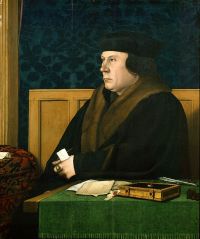
I didn’t know much about Cromwell before reading this book, but he has appeared as a secondary character in other historical novels I’ve read and he has always been portrayed very negatively – ruthless, cold and calculating. The famous portrait by Hans Holbein (shown below) does nothing to dispel this image! And so it was good to read a novel that showed Cromwell not as a villain (if anyone is portrayed as a villain in this book it’s actually Thomas More) but as an intelligent, charismatic, complex human being with both positive and negative qualities. Something that really comes across strongly is how well Cromwell has done to rise above his unhappy childhood and humble origins as the son of a blacksmith to become a confident, accomplished man people turn to for advice and leadership – one of the most powerful men in England. But while it was fascinating to read about the important historical events of the period and the political machinations that were going on behind the scenes, I also loved reading about Cromwell’s life at home. As well as his wife and children, Cromwell’s household expands over the years to include an assortment of other family members, servants, wards and employees and in Cromwell’s interactions with all of these people we see another side of his character: a kinder, more compassionate side.

Thomas CromwellMantel’s writing is descriptive without being flowery and she really brings her Tudor world to life. Every little piece of information she gives us, however trivial it may seem, helps to slowly build a full and vivid picture of daily 16th century life – what people ate, how they dressed, the books they read and the games they played. To say the book was well-researched would be an understatement – I couldn’t believe how incredibly detailed it was! As someone who has read a lot of Tudor novels I’m already familiar with this period and many of the historical figures who appear in Wolf Hall and I found this to be an advantage, as Mantel assumes the reader has at least some knowledge of the period. If it’s been a while since you’ve read anything about the Tudors, it might be a good idea to remind yourself of some of the historical facts surrounding Henry VIII’s divorce, marriage to Anne Boleyn and the resulting separation from Rome before you start reading.

Before I read this book I had heard a lot about Mantel’s excessive use of pronouns – specifically, the word ‘he’ being used without making it clear who ‘he’ was. I quickly discovered that it was usually safe to assume that ‘he’ was Cromwell but ‘he’ was also frequently used to refer to two or three other people who were taking part in the same conversation, which could sometimes cause confusion. The dialogue itself is modern enough to be easy to understand without feeling too inappropriate, though sometimes Mantel uses quotation marks to indicate speech and sometimes she doesn’t, leaving you to decide whether a character is speaking or just thinking. As I’m not usually a fan of experimental or quirky writing styles this was one of the reasons I had resisted reading this book for such a long time, but it actually didn’t bother me as much as I thought it might. It didn’t stop me from enjoying the book and I wish I hadn’t let it put me off.

I’m now looking forward to reading Bring up the Bodies, hopefully before the final book in the trilogy is released!

The Queen’s Confidante by Karen Harper

One of the things I like about Karen Harper’s books is the fact that although she writes about a period of history that has been covered many times before – the Tudor and Elizabethan era – she manages to find new and original ways to approach the subject. The first book I read by Harper, The Queen’s Governess, told the story of Kat Ashley, who was governess to Elizabeth I and an important part of the Queen’s life, but who is usually reduced to just a brief mention in other historical novels. Her next book, Shakespeare’s Mistress, was the story of Anne Whateley (probably a fictitious character) and her relationship with William Shakespeare. This latest novel, The Queen’s Confidante, is set in 1501 and follows the adventures of a young woman with her own candle making business who becomes embroiled in two historical mysteries.

Her name is Varina Westcott and she’s a candlemaker who specialises in making angel-shaped candles for funerals and who also has a talent for carving wax likenesses of real people. When Queen Elizabeth of York, wife to Henry VII, hears about Varina she secretly commissions her to make effigies of her dead children and also of her two younger brothers, the Princes in the Tower, who it is rumoured were murdered by Richard III. Elizabeth has always wanted to learn the truth behind the disappearance of her brothers, but if she delves too deeply into the mystery will she discover something she would rather not know?

Meanwhile, Elizabeth and Henry’s eldest son, Prince Arthur, has just married the Spanish princess, Catherine of Aragon. When Arthur dies suddenly of a mysterious illness, Elizabeth asks Varina to investigate on her behalf. Varina has lost a child of her own so she understands the Queen’s suffering and agrees to help. She is joined in her investigations by Nick Sutton, a courtier whose family fought against Henry VII at the Battle of Bosworth and who is now trying to prove his loyalty to the new King.

The story is told in two alternating narratives, Varina’s and the Queen’s, though Varina’s forms the largest part of the book. I could see why it was necessary to have the Queen narrate some of the story because it allowed us to see things from another viewpoint and filled in some information that Varina did not have access to, but I think I would have preferred to stay with Varina for the whole book as I thought her character was better written than Elizabeth’s. I particularly enjoyed learning about Varina’s work as a candlemaker in the early 1500s. As a woman, Varina is not allowed to join the Worshipful Guild of Wax Chandlers and although she owns her own business, she is at the mercy of decisions made by men – she is even prevented from selling her beautiful angel candles until the guild members decide how to price and distribute them. Yet another example of how frustrating and difficult it must have been for a woman trying to make an independent living for herself in the 16th century!

The theory Harper suggests which explains the mystery of the Princes in the Tower was satisfactory enough. Considering nobody knows what actually happened or who was responsible for the disappearances, I found it no less believable than any other I’ve read. But the book’s other mystery, the death of Prince Arthur, is something I don’t know as much about – I’ve never given any thought to whether he could have been murdered and have always assumed he died of natural causes. Nothing I read in this book did anything to convince me that Arthur really had been murdered, though it was interesting to read Karen Harper’s comments on this in her author’s note.

I’ve enjoyed all three of the books I’ve read by Harper, but this one is my least favourite. I just found it too hard to accept the idea of the Queen of England asking a candlemaker to act as an undercover detective. Also, as someone who believes Richard III has been unfairly treated by history, I didn’t like the fact that he and his supporters are viewed as villains by most of the characters in the story and this meant I enjoyed the book less than I might otherwise have done. I admit that I’m biased though, and this probably wouldn’t be a problem at all for readers less familiar with the period than I am and who haven’t already formed their own opinions of the historical figures involved!

Note: The US title of this book is Mistress of Mourning.