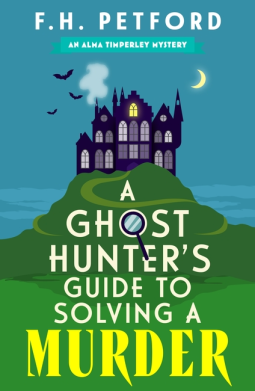
A Ghost Hunter’s Guide to Solving a Murder by F. H. Petford

Twenty-two-year-old Alma Timperley is stunned when she learns that her Aunt Gladys has died, leaving her hotel in Cornwall to Alma in her will. The news comes as a particular surprise as Alma didn’t even know that Gladys existed in the first place! Still, she accompanies her lawyer, James Nascent, to Falmouth on the Cornish coast to inspect her inheritance and likes what she sees. The Timperley Spiritualist Hotel overlooks the town below and has a very special clientele. The people who come to stay are hoping to make contact with loved ones beyond the grave and their reservation fee includes three sessions with one of the hotel’s two mediums, George Weaver and Valentine Wragge.

Alma has always believed she has psychic abilities herself, so she’s intrigued and decides to immediately take ownership of the hotel. She soon finds that she has more than ghosts to worry about, however, because it’s 1914 and war has recently broken out with Germany. Why has a book written in German been hidden inside a cooking pot in the hotel kitchen? And who turned on a light in the tower, guiding an enemy Zeppelin in from the shore? Is someone in the hotel spying for the Germans?

This is the first book in a planned series of novels starring Alma Timperley and based on this one I’ll definitely be looking out for more. It wasn’t really what I’d expected, though; the title and cover gave me the impression this would be a humorous cosy mystery set in a haunted house, but it’s actually something very different. There’s no ghost hunting (unless you count mediums trying to contact spirits) and there’s not really a mystery either. The identity of the German spy – referred to as Excalibur – is revealed to the reader very early in the book and although Alma and the police don’t know who it is, I would have preferred to be kept in suspense as well, wondering who it was.

Despite the book not really being as advertised – which is a shame, as it seems to have resulted in the book receiving worse reviews than it deserves – I still enjoyed it. I particularly loved the Cornish setting: Petford does a great job of bringing Falmouth to life, with its bay and harbour and local landmarks such as Pendennis Castle, which played a part in the town’s defences during the war, and the King’s Pipe, a chimney used to burn tobacco illegally smuggled into the country. We also learn a lot about PK Porthcurno, once the world’s largest telegraph station where many cables from overseas came ashore and now a museum open to the public.

I think this book has a lot to offer, as long as you approach it as historical fiction about German spies in the First World War and not a ghost story or a detective novel. It covered some aspects of the war I hadn’t read much about before and it held my interest from beginning to end. I liked Alma and her friends and hope to meet them again soon.

Thanks to Hodder & Stoughton for providing a copy of this book for review via NetGalley.

Book 4 for RIP XX

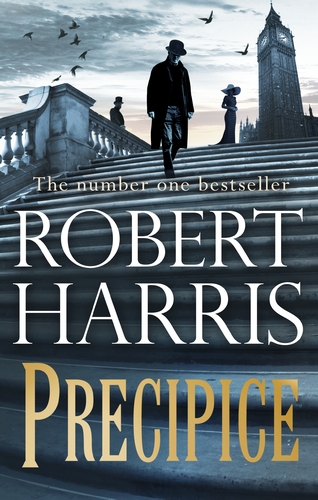
Precipice by Robert Harris

Robert Harris became a must-read author for me after reading and loving An Officer and a Spy, the Cicero trilogy and Conclave, but some of his more recent books have left me feeling slightly disappointed. His new one, Precipice, sounded promising, but would it be a return to form?

The novel opens in London in the summer of 1914 and introduces us to Venetia Stanley, a twenty-six-year-old woman from a wealthy, aristocratic family. Venetia is growing bored with the aimlessness of her days and the spoiled, shallow group of friends, known as the Coterie, that she has fallen in with, so when Herbert Henry Asquith begins an affair with her she sees it as a welcome escape. Not only is Asquith more than twice her age, he is also the Prime Minister and Venetia finds it flattering that he seems to value her opinion on politics and includes her in discussions on important matters of state.

Asquith is currently preoccupied with the situation in Ireland where the Nationalists are campaigning for Home Rule, but soon he has an even bigger problem to deal with as tensions begin to escalate in Europe and it looks increasingly possible that Britain could be pulled into a war. At this crucial moment in British history, it seems that the security of the nation is being put at risk – several confidential documents giving details of the government’s military and diplomatic plans have been found by members of the public and handed to the police. Only a small number of high-ranking government ministers have access to this information so, unlikely as it seems, one of them must be responsible for the leaks. Detective Sergeant Paul Deemer is given the task of investigating and it’s not long before he makes a shocking discovery.

Although I’ve read many novels set during WWI, they’ve usually dealt with ordinary people rather than politicians and certainly haven’t been written from the perspective of the Prime Minister. I knew nothing about H.H. Asquith’s private life, what he was like as a person or how he was viewed by his friends, colleagues and the public, so I learned a lot from this book. Harris draws on Asquith’s published letters to Venetia Stanley as one of his main sources and quotes from them extensively throughout the novel (Venetia’s letters to Asquith were apparently destroyed, so Harris uses his imagination to recreate them).

The impression I got of Asquith from this book, as a politician, was of a generally well-meaning man who was competent enough as a peacetime Prime Minister (apart from where the challenge of Ireland was concerned) but definitely not the right person to lead the country through a war. His overly cautious approach in the early stages was very frustrating to watch; it’s likely that the outbreak of war was inevitable and nothing he could have done would have averted it, but he didn’t seem to grasp the seriousness of the situation at all and refused to commit Britain one way or the other when he was being pressed from all sides to take decisive action. Even when war did break out, it seemed to be of less importance to him than his relationship with Venetia and again it was frustrating to see him sitting composing letters to her during cabinet meetings and plotting ways to escape from political duties to go and visit her. Although the general public weren’t supposed to know about the affair, it was an open secret amongst their family members and I couldn’t help feeling sorry for Margot, Asquith’s wife.

The thriller element of the novel is weaker and although I was never bored, the book never quite became unputdownable either. There’s no real mystery surrounding the security breaches because both we and Paul Deemer know from very early on who is responsible, but it’s still interesting to see how Deemer approaches the situation and there’s an entertaining section where he goes undercover in Wales in search of more information. There’s also a small twist towards the end of the book, which I hadn’t really seen coming, although it had started to occur to me that something wasn’t quite right!

Precipice is definitely more historical fiction than thriller, which may or may not appeal depending on your personal taste. Although it hasn’t become one of my absolute favourites by Robert Harris, I really enjoyed it for the fascinating insights into Asquith and his government.

Thanks to Hutchinson Heinemann for providing a copy of this book for review via NetGalley.

Book 42/50 for the Historical Fiction Reading Challenge 2024

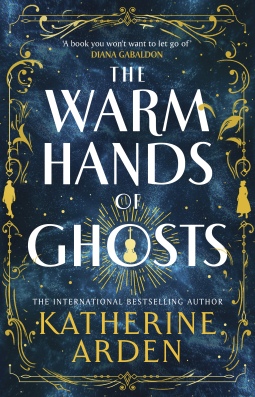
The Warm Hands of Ghosts by Katherine Arden

I loved Katherine Arden’s Winternight Trilogy, set in medieval Russia and drawing on elements of Russian history, folklore and fairytales. I’ve been waiting for her to write another adult novel for five years and my patience has finally been rewarded with The Warm Hands of Ghosts. Taking us to the battlefields of the First World War, this is very different in terms of setting, atmosphere and scope, but I’m pleased to say that it’s another great book.

Laura Iven has been serving as a military nurse in Belgium but in January 1918, when the novel begins, she is back at home in Halifax, Canada, having been wounded and discharged. It has not been a happy homecoming for her, as not only has she left behind a brother, Freddie, still fighting on the front line, but soon after her return to Halifax a ship exploded in the harbour, destroying part of the city and killing her parents. When Laura receives a box containing Freddie’s belongings and a note telling her that he is missing in action, she is reluctant to believe that he has also died and decides to return to Belgium as a volunteer at a private hospital where she can search for more information on his disappearance.

A second thread of the novel is set several months earlier and follows Freddie, who awakens on the battlefield to find himself wounded and alone with an enemy soldier – a German, Hans Winter, who is also badly injured. Lost in no man’s land, together they try to make their way to a place of safety, knowing that depending on whom they encounter first, one or both of them could be shot as either an enemy or deserter. It’s here that they first meet Faland, a fiddler who seems to offer them a way of escape. When Laura arrives at the hospital a few months later and hears tales of the mysterious musician who can give soldiers the gift of oblivion – if they are prepared to pay a price for it – she begins to wonder whether this is what has happened to her brother.

As I said above, this book is quite different from the Winternight Trilogy and I wouldn’t really describe it as fantasy – although it does contain some elements of the supernatural, mainly surrounding the appearances of Faland the fiddler. I don’t want to say too much about him but as Katherine Arden explains in her author’s note, if he reminds you of Woland from Bulgakov’s The Master and Margarita it’s not a coincidence! Faland is one representation of evil in the novel; the vast horror of the battlefield is another and the tired, desperate soldiers face a difficult choice between the two.

I found the opening chapters set in Halifax very interesting as I previously knew so little about life on the Canadian homefront during the First World War. This is the first time I’ve read about the explosion of the Mont Blanc and the massive loss of life it caused (nearly two thousand people were killed and thousands more injured). In Flanders, meanwhile, the details of the Battle of Passchendaele and its aftermath and the conditions faced by nurses and patients in the field hospitals are equally interesting to read about.

This is not my favourite Katherine Arden book – I preferred the characters in the Russian trilogy and the more magical setting – but I still enjoyed it very much.

Thanks to Century for providing a copy of this book for review via NetGalley.

Book 8/50 for the Historical Fiction Reading Challenge 2024

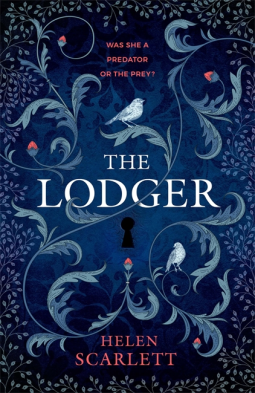
The Lodger by Helen Scarlett

It’s 1919 and Grace Armstrong, like many other young women, is mourning the loss of her fiancé and brother in the Great War. She has done her best to move on – having served as a VAD nurse during the war, she is now pursuing a career as a journalist with the London periodical Nursing World – but she is still haunted by the thought that her fiancé Robert, reported missing in action at the Somme, could still be alive. Meanwhile her mother, struggling to cope with the death of Grace’s brother Edward, is under sedation in a nursing home. It’s a difficult time for the Armstrong family – and is about to get worse when their lodger, Elizabeth Smith, is found drowned in the River Thames.

Elizabeth had lodged with the family for eight years and she and Grace had become good friends. Unable to accept the verdict from the police that Elizabeth had committed suicide, Grace is determined to find out what really happened. The only person who is prepared to help her is Tom Monaghan, who fought with Edward in France, but as they begin to investigate Elizabeth’s death, they make some shocking discoveries about Grace’s friend.

This is Helen Scarlett’s second novel; I haven’t read her first, The Deception of Harriet Fleet, but both are standalones so that didn’t matter at all. I will probably look for that earlier book now, as I did enjoy this one. It’s a slow-paced novel, but I still found it quite gripping, mainly because of the vivid portrayal of a world emerging from war, with people attempting to move forward while still struggling with the trauma of the recent past. Nobody in the novel has come out of the war unscathed; we meet men left damaged both physically and mentally by the horrors of the trenches, families grieving for the deaths of loved ones – and perhaps worst of all, people like Grace who are unable to grieve properly without knowing whether their loved one is dead or alive. Grace sees Robert everywhere – in the street, on the bus, in her dreams – and feels that she’ll never be able to rebuild her life until she knows the truth.

I found the mystery element of the book less successful. The story of Elizabeth’s past seemed too far-fetched to be very convincing and as more and more of her secrets were uncovered I felt that the plot was in danger of becoming much too complicated. There’s also a romance for Grace which was predictable but satisfying, although I would have liked to have seen her spend more time with her love interest; that would have helped me to become more invested in their relationship.

Despite the few negative points I’ve mentioned, The Lodger is an atmospheric and moving novel and the image it evokes of a London in the aftermath of war is one that will stay with me.

Thanks to Quercus for providing a copy of this book for review via NetGalley.

This is book 9/50 read for the 2023 Historical Fiction Reading Challenge.

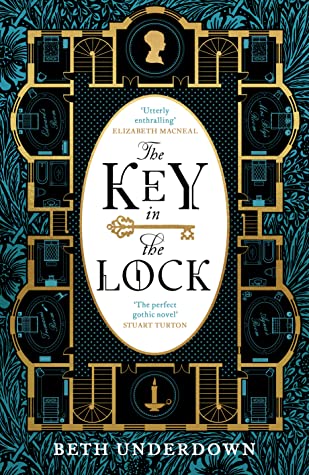
The Key in the Lock by Beth Underdown

The Key in the Lock is Beth Underdown’s second novel. Her first, The Witchfinder’s Sister, was a fascinating historical novel set during the Manningtree witch trials of 1645; this new book sounded very different, but I still wanted to give it a try.

The novel opens in 1918, with Ivy Boscawen trying to come to terms with the death of her son, Tim, shot dead in the trenches of the Western Front. Ivy is desperate to know exactly what happened to Tim, but after speaking to some of his fellow soldiers what she discovers about her son’s death makes her feel even more distressed. Worse still, the loss of Tim triggers memories of another boy, William Tremain, who died thirty years earlier in a fire at the Great House in Polneath, Cornwall. Ivy, whose father was the Polneath doctor at the time, has been haunted by William’s tragic death ever since and has never been able to shake off her feelings of guilt about her actions in the aftermath of the fire.

With Ivy as the narrator, the novel moves back and forth in time between 1918 and 1888, gradually shedding light on the mysteries surrounding both deaths. Family secrets are uncovered, wills are read, inquests are held, clandestine meetings take place and identities are revealed – yet this is not really the exciting, suspenseful Gothic novel I had been hoping for. It moves along at a very slow pace and although I was enjoying it enough to want to read on to the end, I never felt fully engaged with either the plot or the characters.

There is an advantage to the slow pace, however, which is that it gives the reader a chance to try to solve some of the mysteries and guess some of the secrets before Ivy does. It’s a complex story, with lots of pieces that only begin to fall into place towards the end and there were points where I felt confused, particularly as the two timelines often seem to merge together. A chapter heading may indicate that we are in 1918, but after a few paragraphs Ivy starts to remember the events of 1888 again and it’s not always clear which period we are reading about. Also, the ‘key in the lock’ of the title turns out to be several keys to several locks in several doors and I struggled to keep track of the significance of them all.

I did like the atmosphere Beth Underdown creates and the attention to period detail; I never felt that the language or attitudes were too modern. She also writes very convincingly about Ivy’s grief for her lost son, her sense of guilt over what happened at the Great House, and the terrible misunderstandings and assumptions that have persisted for thirty years. It’s a very sad story, where lives are taken too early, acts of kindness go unappreciated until it’s almost too late and wicked deeds go unpunished for too long. An interesting read, but with a tighter focus I think it could have been a much better book.

Thanks to Pigeonhole for the opportunity to read this book.

This is book 1/50 read for the Historical Fiction Reading Challenge 2022.

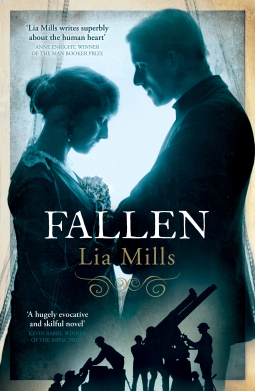
Fallen by Lia Mills

Liam Crilly is one of the ‘fallen’ – one of the many young men to be killed in action on the battlefields of World War I. When the tragic news reaches his family in Dublin, they each try to come to terms, in their different ways, with the terrible loss they have suffered. For his twin sister, Katie, losing Liam is like losing a part of herself and now all she has left of him are memories and the letters he sent home from the Western Front. Denied the chance to continue her education at university because her parents don’t believe it’s necessary, Katie finds solace in assisting Dorothy (Dote) Colcough, a friend and scholar, with the research for a new book she is writing.

Through Dote, Katie meets Hubie Wilson, an army officer who had fought with Liam in France and is now recovering at home after losing a hand. Katie is desperate to learn anything she can about Liam’s last days and Hubie is pleased to have found someone who is willing to listen to him talk about his traumatic experiences. Then, just as a relationship is beginning to form between the two of them, another violent conflict breaks out: the Easter Rising of 1916. Now, Katie’s priority is to keep her friends and family safe as armed insurrectionists take to the streets of Dublin with the aim of establishing an Irish Republic.

We actually learn very little about the Easter Rising itself – what lead to it, the politics behind it, how it ended or what the outcome was – and as this is not a subject I know much about myself, I was left feeling a bit lost and confused. However, I think that was probably intentional; the focus of the book is on the ordinary people of Dublin and how they coped with the violence going on around them in the city. Written from Katie’s point of view, she has a limited knowledge of what is happening behind the scenes, but describes to the reader the things she can see and hear for herself: the gunshots, the roadblocks, the looting of shops, the smashed windows and the fires burning in the streets. I couldn’t help thinking that she seems to move very easily from one part of the city to another, considering how dangerous it was supposed to be, but otherwise these sections of the novel feel vivid and real.

The personal side of the story was of less interest to me, which I think is because of the choice of Katie as narrator. I just didn’t find her a particularly engaging character; she’s a woman in her twenties, but her narrative voice makes her seem much younger – and I wasn’t really convinced by the romance with Hubie either. Some of the other characters appealed to me more, such as Liam’s grieving fiancée, Isobel, who feels shut out by the Crilly family after Liam’s death, and Katie’s new friends Dote and May, two unconventional women who are trying to live their lives the way they want to live them. I was sorry we didn’t spend more time with these characters, as I think their stories would have interested me more than Katie’s!

Fallen was selected as the One Dublin One Book choice for 2016, an initiative which encourages people to read a book connected with the Irish capital every April. I’m obviously very late with this one, but I can see why it was chosen, for the unusual perspective it offers on such an important event in Dublin and Ireland’s history.

Book 50/50 read for the 2021 Historical Fiction Reading Challenge.

Historical Musings #55: Lest we forget

Welcome to my monthly post on all things historical fiction. As tomorrow is Remembrance Sunday, I thought it would be appropriate to devote this month’s post to historical novels which explore the impact and legacy of the First World War. I’ve always found this an interesting and moving period to read about and have come across books which cover almost every aspect of the war you can think of.

I’ve read books about wartime nurses (The Daughters of Mars by Thomas Keneally and The Poppy Field by Deborah Carr), the horrors of life in the trenches (The Lie by Helen Dunmore) and men left suffering from shell shock (Dead Man’s Embers by Mari Strachan), what it means to be a conscientious objector (The Absolutist by John Boyne and If You Go Away by Adele Parks), the class and social changes that came about because of the war (The Last Summer by Judith Kinghorn and The Summer Before the War by Helen Simonson), and even the bravery of the horses that served in the war (War Horse by Michael Morpurgo).

I’ve also discovered family sagas which are set at least partly during the war (Post of Honour by RF Delderfield and The Daughter of Hardie by Anne Melville), historical mysteries set during or just after the war (The Return of Captain John Emmett and The Strange Fate of Kitty Easton by Elizabeth Speller) and fictional accounts of real people and their wartime experiences (Mr Mac and Me by Esther Freud and Zennor in Darkness by Helen Dunmore).

A good range of books there, I think, and although I can’t say that I loved all of them, I do think they all have something to offer and provide some insights into different aspects of the war. One thing I can say for certain is that reading about the war has helped me to appreciate the courage and resilience faced by both those on the front line and those left behind at home.

Now it’s your turn. Which books set during World War I would you recommend?