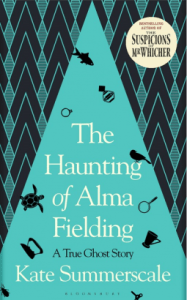
The Haunting of Alma Fielding by Kate Summerscale

I’ve had mixed experiences with Kate Summerscale’s books so far: I loved The Suspicions of Mr Whicher, liked The Wicked Boy and gave up on Mrs Robinson’s Disgrace after a few chapters. I didn’t know what to expect from The Haunting of Alma Fielding, then, but I hoped it would be another good one!

Like Summerscale’s others, this is a non-fiction book based on a true story, in this case the story of an ordinary thirty-four-year-old woman, Alma Fielding, who becomes the centre of paranormal activity in her London home. The book follows Nandor Fodor of the International Institute for Psychical Research as he investigates Alma’s claims, desperately hoping that this time – after being disappointed by a long line of frauds – he has finally come across a genuine haunting.

At first, having witnessed for himself the smashed glasses, spinning teacups, moving furniture and broken eggs, Fodor is convinced that a poltergeist is at work in the Fielding household. The more he learns about Alma’s abilities, which include producing live animals out of thin air and transporting herself from one area of London to another, the more intrigued he becomes…until, eventually, he begins to have doubts. Is this a real paranormal phenomenon he is investigating or is Alma haunted by something very different?

I found some parts of this book fascinating. Although I was sure Alma must have been involved in some sort of elaborate hoax and that there must have been logical explanations for the things she claimed were happening to her, I didn’t know exactly what she was doing or how she was doing it. I was amazed to see the lengths Alma went to in her efforts to prove that her psychic abilities were real and the lengths Fodor and the other ghost hunters went to in their efforts to verify them. Some of the methods they used to investigate Alma’s claims were quite harmless, such as conducting word association tests, but others were intrusive and cruel, and although I didn’t like Alma it made me uncomfortable to read about the way she was treated – particularly as Fodor believed that her powers were the products of various traumas she had suffered earlier in life.

At times, Summerscale widens the scope of the book to put Alma’s story into historical context, to discuss the influence of novels and films of that period, and to look at some of the other things going on in society at that time. The ‘haunting’ and the investigation took place in 1938, when the world was on the brink of war and Summerscale suggests that people were turning to spiritualism as a distraction:

The ghosts of Britain, meanwhile, were livelier than ever. Almost a thousand people had written to the Pictorial to describe their encounters with wraiths and revenants, while other papers reported on a spirit vandalising a house in Stornoway in the Outer Hebrides, and on a white-draped figure seen gliding through the Hawker aircraft factory in Kingston upon Thames. The nation’s phantoms were distractions from anxiety, expressions of anxiety, symptoms of a nervous age.

However, although I found plenty of things to interest me in this book, I did have some problems with it. I felt that it became very repetitive, with endless descriptions of Alma’s various manifestations and detailed accounts of the researchers’ experiments. I thought Summerscale also devoted too much time to anecdotes about other alleged psychics and spiritualists, which didn’t really have much to do with Alma. It seemed that Alma’s story on its own wasn’t really enough to fill a whole book, so a lot of padding was needed.

I didn’t like this book as much as Mr Whicher or The Wicked Boy, but Kate Summerscale does pick intriguing topics and I’ll look forward to seeing what she writes about next.

Six Degrees of Separation: From Shuggie Bain to A House of Pomegranates

It’s the first Saturday of the month which means it’s time for another Six Degrees of Separation, hosted by Kate of Books are my Favourite and Best. The idea is that Kate chooses a book to use as a starting point and then we have to link it to six other books of our choice to form a chain. A book doesn’t have to be connected to all of the others on the list – only to the one next to it in the chain.

This month we are starting with Shuggie Bain by Douglas Stuart, winner of the 2020 Booker Prize. I haven’t read it and I’m not planning to, but this is what it’s about:

It is 1981. Glasgow is dying and good families must grift to survive. Agnes Bain has always expected more from life. She dreams of greater things: a house with its own front door and a life bought and paid for outright (like her perfect, but false, teeth). But Agnes is abandoned by her philandering husband, and soon she and her three children find themselves trapped in a decimated mining town. As she descends deeper into drink, the children try their best to save her, yet one by one they must abandon her to save themselves. It is her son Shuggie who holds out hope the longest.

Shuggie is different. Fastidious and fussy, he shares his mother’s sense of snobbish propriety. The miners’ children pick on him and adults condemn him as no’ right. But Shuggie believes that if he tries his hardest, he can be normal like the other boys and help his mother escape this hopeless place.

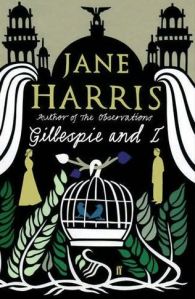
It can be difficult to know where to start with a chain when you haven’t read the first book and have no interest in reading it, but the word that jumped out at me in the blurb was Glasgow, so I will begin by linking to another book set in Glasgow – Gillespie and I by Jane Harris (1). The novel is narrated by Harriet Baxter, an elderly woman looking back on her relationship with the artist Ned Gillespie, whom she met while visiting the International Exhibition in Glasgow in the 1880s. The 19th century setting and clever plot twists reminded me of the Victorian sensation novels I love by authors such as Wilkie Collins, so it’s no surprise that I loved this book too.

The Gabriel Hounds by Mary Stewart (2) also features a character whose name is Harriet – or ‘Lady Harriet’ as she prefers to call herself. Lady Harriet is a fascinating character who lives in the palace of Dar Ibrahim near Beirut and models herself on the legendary Lady Hester Stanhope, wearing male Arab dress and living in seclusion with only her servants and saluki hounds for company. I always enjoy Mary Stewart’s suspense novels and I think this is a particularly good one!

Hounds are dogs, of course, so this leads me straight to The Dog Stars by Peter Heller (3). This post-apocalyptic novel set in Colorado several years after a flu pandemic kills most of the world’s population was not my usual sort of book at all, but I found it much more interesting than I’d expected. I certainly wouldn’t want to read it now, though! What seemed like pure science fiction a few years ago feels uncomfortably close to reality now.

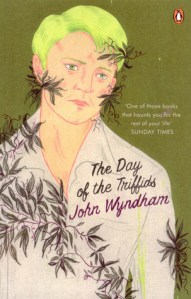
Another post-apocalyptic novel I found surprisingly enjoyable, if unsettling, was The Day of the Triffids by John Wyndham (4). In this book, it’s not a pandemic that brings an end to the world as we know it, but a meteor shower which leaves almost everyone blind, followed by an invasion of triffids – giant killer plants with long, stinging arms.

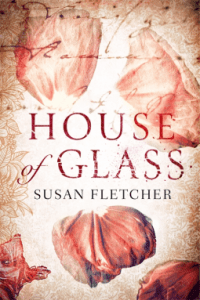
Susan Fletcher’s House of Glass (5) is the next book in my chain and is also a book about plants – nice normal plants this time, you’ll be pleased to hear! Our heroine, Clara, is an amateur botanist who is offered a job working in the gardens of Shadowbrook, a large estate which appears to be haunted. Although the book seems to be a typical ghost story at first, it turns out to be something slightly different. An impressive and beautifully written novel.

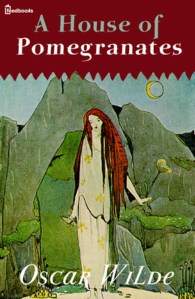
My final link this month is to another book with ‘house of’ in the title: A House of Pomegranates (6), a collection of fairy tales by Oscar Wilde. There are four stories in the book and although each one has a moral and a message, they are also very entertaining! Like many fairy tales, they are quite dark in places, but I think they’re suitable for both children and adults. I must get round to reading Oscar Wilde’s other similar collection, The Happy Prince and Other Tales, which has been on my TBR since reading this one back in 2011.

And that’s my chain for April! My links have included Glasgow, the name Harriet, dogs, the end of the world, plants and ‘house of’ titles.

In May, we’ll be starting with Beezus and Ramona by Beverly Cleary.

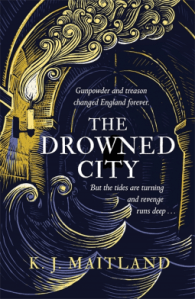
The Drowned City by KJ Maitland

I had already been drawn to The Drowned City, the first in a new series of historical mysteries set in the 17th century, before it dawned on me that KJ Maitland was Karen Maitland, an author whose books I’ve enjoyed in the past. All the more reason to want to read it, then!

In January 1606, exactly a year after the execution of the conspirators who tried to blow up Parliament in the failed Gunpowder Plot, a towering wave sweeps up the Bristol Channel, leaving a scene of devastation. Whole families are drowned, buildings are swept away and farmland is destroyed. As the survivors try to come to terms with what has happened, rumours begin to arise. Some say the wave was summoned by witches, others that it was God’s way of taking revenge for the executions. The King’s most trusted adviser, Charles FitzAlan, fears that it’s all part of another Catholic conspiracy and decides to send someone to Bristol to investigate. Luckily, he knows just the man for the job…

That man is Daniel Pursglove, currently languishing in Newgate Prison awaiting what seems to be certain death. Daniel’s particular background and skills have brought him to FitzAlan’s attention and when he is offered his freedom in return for carrying out some investigations in Bristol, he jumps at the chance. Arriving in the city, Daniel begins his search for the missing Catholic conspirator known as Spero Pettingar, but almost immediately finds himself caught up in another mystery – a series of murders. Are they all part of the same plot or is something else going on in the flooded city?

Like Maitland’s earlier novels, this is a dark and atmospheric story with an interesting historical setting. I’ve never read anything about the Bristol Channel Floods of 1607 (or 1606; Maitland uses the old Julian calendar rather than the Gregorian), so that was something completely new for me. The descriptions of the devastated city in the aftermath of the wave are vivid and even quite eerie and almost otherworldly. It’s always refreshing to read historical novels with a setting other than London, and the flooded Bristol, in a superstitious age when natural disasters were often attributed to witchcraft or messages from heaven, was the perfect choice for this particular story.

Although there a few real historical characters in the book, notably Robert Cecil, most are fictional. Daniel Pursglove, the central character in this and presumably the rest of the series, intrigued me as we know so little about him at first. What is his background? How did he come to be a prisoner? What are the special talents that make him so suitable for this task? As the story unfolds, so does our understanding of Daniel and gradually some of our questions are answered. I’m sure we’ll be learning more about him in future books.

Where this book was less successful, in my opinion, was with the mystery element; once Daniel arrives in Bristol the plot takes off in so many different directions I kept forgetting what his original purpose was in going there. Had it been shorter and more tightly focused, I think I would have enjoyed it much more; instead, I found myself struggling to keep track of what was happening at times. Still, this is a promising start to a new series and I’m definitely interested in reading the second book.

Thanks to Headline for providing a review copy of this book via NetGalley.

Book 16/50 read for the 2021 Historical Fiction Reading Challenge