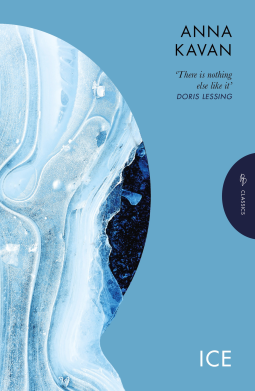
 This is a strange book and I’m not sure I’ll be able to describe it adequately! It’s probably not something I would normally have chosen to read, but this new edition from Pushkin Press caught my eye and as I’ve enjoyed other books from their Classics range, I decided to try it.
Ice was first published in 1967, the last of Anna Kavan’s books to be published before her death a year later. It follows an unnamed narrator who has developed an obsession with a pale young woman with silver-white hair. The girl is also unnamed and described as delicate, glass-like and under the control of her sinister husband, who later becomes known as ‘the Warden’. Our narrator pursues her from place to place, hoping to rescue her from the Warden, occasionally catching up with her and then losing her again. There’s not much more to the plot than that – Christopher Priest in his foreword to this edition calls the novel ‘virtually plotless’ – but the book still has multiple layers that make it an interesting and worthwhile read.
First, there’s the setting. The narrator’s pursuit of the white-haired girl takes place against a backdrop of apocalyptic scenes as the planet rapidly becomes engulfed by ice. I’ve seen this referred to as an allegory of Anna Kavan’s own addiction to heroin, although I don’t know enough about her to comment on that. It could also be seen as a warning of climate change, more relevant than ever today, of course. Either way, there are some beautiful descriptive passages as Kavan writes about the coldness, the glittering snow and the giant walls of ice closing in on the girl, the narrator and the world.
Another notable thing about the novel is the way the reader (and the narrator himself) can never be quite sure of the boundaries between reality and a dreamlike or hallucinatory state. Sometimes the girl will appear seemingly from nowhere, just out of reach or about to be enclosed by the ice – only to disappear again just as suddenly, leaving us wondering whether she was ever really there at all. These shifts in reality occur repeatedly throughout the book, which is very unsettling! The Warden also never feels entirely real, but is always there as a threatening, oppressive presence; the narrator sees himself as trying to free the girl from the other man’s control, but his own infatuation with her gradually begins to feel just as disturbing.
In the foreword, Priest describes the book as ‘slipstream’, which Wikipedia defines as ‘speculative fiction that blends together science fiction, fantasy, and literary fiction, or otherwise does not remain within conventional boundaries of genre and narrative’. It’s certainly not a conventional novel and I have to be honest and say that I didn’t enjoy it as much as I’d hoped to – after the first few appearances and disappearances of the girl, I began to find it repetitive – but it’s also a unique and powerful one. The cold, icy imagery will stay with me for a long time.
Thanks to Pushkin Press Classics for providing a copy of this book for review via NetGalley.
 She Reads Novels
I have heard very good things about it in Spanish, I am intrigued now even more!
It’s a fascinating book. I didn’t love it, but it was beautifully written and I would definitely recommend it.
I’ve read this a couple of times now, and although it’s strange I do love her writing. If you’ve the inclination to try more of her writing, Sleep has its House is good too.
I would like to try more of her books as I did love her writing, so I’ll definitely consider that one. Thanks!
If I’d known about this book in my 20s–back when I was really into reading lots of classics–I might have tried it, especially because of that apocalyptic setting. But now I need more than beautiful writing to keep me reading a book. I like real characters… and a plot! So I probably won’t be giving this one a try. But I loved hearing your thoughts on it. 😀
I need more than beautiful writing too and would definitely have liked more plot! It’s an interesting book, but felt directionless.
I read this book last year… it was rather horrifying in parts, but I persevered after finding out that much of the book was a reflection on the author’s own suffering (she had a troubled relationship with her mother and husband). Through that lens, it was easy to see Ice as an illustration of someone who was traumatized and codependent. Good to see a new edition of it being published.
My video review is here: https://youtu.be/IXQPeVW93Ao?si=1zPQETcVT6hMouuR
Thanks for sharing your review, Marian. I don’t know much about Anna Kavan, but that explanation makes sense.