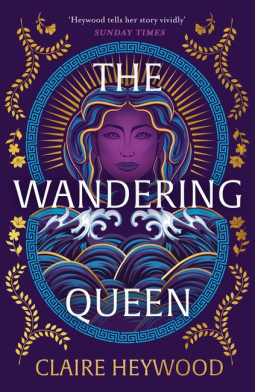
 Dido, Queen of Carthage, also known as Elissa, is a character who has always interested me, particularly since I had the chance to visit Carthage myself during a trip to Tunisia in 2004. The most famous depiction of Dido is obviously in Virgil’s epic poem, the Aeneid, but in this new retelling, Claire Heywood brings her to the forefront of the story and gives her a voice of her own.
The Wandering Queen begins in Tyre with the young Elissa being summoned by her father, the King of Tyre, who believes he is dying and is composing his will. Elissa has a close relationship with her father, who has instilled in her the qualities he considers important in a future queen – fairness, honesty and a desire to see justice done. His son, Pygmalion, Elissa’s half-brother, is still just a young child, so the king decrees that Elissa and Pygmalion will succeed him as joint rulers. Not everyone at court is pleased about that, however, and when the king dies and the will is read, Elissa is shocked to find that her name is not even mentioned – a new will has been forged and Pygmalion will rule alone.
At first, Elissa tries to guide her brother, but the influence of the men around him is too strong. As the years go by and both Elissa and her husband Zakarbaal find themselves targets of Pygmalion’s cruelty, Elissa decides that the only option left open to her is to flee Tyre altogether and start a new life somewhere else. The story of her time in Tyre alternates throughout the novel with the story of the older Elissa, now known as Dido, as she settles in Carthage and encounters a Trojan called Aeneas whose ship has been blown off course by a storm…
This is the first book I’ve read by Claire Heywood and I was very impressed. It’s well written and Heywood made me really care about the characters and connect with them on a personal level, something that doesn’t always happen when I read mythology retellings. I also liked the way she keeps this a very human story, not introducing supernatural elements or having gods and goddesses intervening and controlling Dido’s fate. It reminded me of Babylonia by Costanza Casati, which is written in a similar way and which I also enjoyed.
I think I would have preferred a chronological format, but having said that, the way the two storylines were intertwined worked well, with the use of Dido’s two names helping to distinguish between the young Elissa and the queen she would become. The portrayal of Aeneas is fair and balanced; he is shown as having some good qualities, which explains why Dido falls in love with him, but there are also signs from the beginning that their romance is probably doomed (such as Aeneas’s account of abandoning his wife, Creusa, during the fall of Troy, his growing sense of pride causing him to become increasingly dissatisfied with taking second place to Dido in the hierarchy of Carthage, and his talk of wanting to visit Italy).
There are two different endings to Dido’s story suggested by the two main sources, Virgil and Justinus, but the way Claire Heywood chooses to end her story here is not quite the same as either of those. I won’t say any more about that as I wouldn’t want to spoil it! In her author’s note, Heywood also explains some of the other choices she made in the book, including using the name Zakarbaal for Elissa’s husband rather than the usual Sychaeus or Acerbus and moving the setting back to the Late Bronze Age to make the timelines work.
I really enjoyed The Wandering Queen and will have to look for Claire Heywood’s previous two books. Also, if anyone can recommend any other retellings of Dido’s story, I would love to hear about them.
Thanks to Hodder & Stoughton for providing a copy of this book for review via NetGalley.
 She Reads Novels
I’m waiting for a copy of this for my birthday next week. I had to read “Dido et Aeneas” for GCSE Latin!
I hope you like it – and happy birthday for next week!
Thank you!
Oh great, Dido has such a rich story of her own and this sounds an interesting interpretation!
Her story is fascinating! I only knew the basic outline of it and found it particularly interesting to read about her early life in Tyre.
I’d love to see Carthage one day. Tunisia, too. How cool that you got to visit both! And this novel sounds really good….and a story that I’m not too familiar with.
Carthage was a fascinating place to visit. And yes, this is a great book – one of my favourites so far this year.
In another medium entirely you can listen to Purcell’s Dido and Aeneas opera. Exquisite music, esp with Jesse Norman. Or just the one famous aria:
Thanks for that! Such beautiful music.
I al looking forward to this one! Heywood’s previous novels we’re already great but about more common myth characters, so this one stands out from that.
Yes, I thought this one was a bit different from the usual myth retellings. I hope you like it!
I dont know the original story (or if I do its one I’ve forgotten but will feel vaguely familiar when I pick this up, as has happened with other retellings for me but I imagine your familiarity with the story added to the pressure in some ways and I’m thrilled to hear how well it worked for you.
Ive read The Shadow Of Perseus by the author and she went with a historical, supernatural free approach there too which I was surprisingly (given my love of fantasy) taken by. I think its refreshing in a way to see how an author makes those kind of elements have a more mudane explanation of how they truly could have taken part.
I also love the Babylonia shoutout as I adored that book.
I knew the basic story, but Heywood fills in a lot of details and I didn’t know everything that was going to happen. I hope you enjoy it as much as I did when you get round to reading it.
The Shadow of Perseus sounds the most appealing to me of her other two books, so I’m looking forward to reading that one!
Thank you 🥰
I really hope you enjoy it and will definitely keep an eye out for your thoughts on it too.
Elissa (whose name is for some reason shifted to Dido – supposedly meaning, ‘wanderer’ – although it does not) is the sister of Pygmalion, the king of Tyre. Hoyos suggests that Dido’s ‘epithet’ was Elishat, with the feminine -[A]T suffix and implying something like ‘Cypriot woman’. That sounds plausible: ‘Dido, the Cypriot woman’. But was she really Cypriot and is that why she initially headed there?
Pygmalion cheats her out of her supposedly equal share of kingship. He then has Elissa’s husband murdered. Their uncle – whose name has different variations, but which must originally have been the Phoenician name, Zakarbaal (rendered in various versions as Acherbas / Sicharbas / Hasdrubal) – High Priest of Melqart at the time, is also murdered on Pygmalion’s orders. The high priest has hoarded wealth, of which Pygmalion hopes to avail himself. But he is thwarted because Elissa takes this, alongside sacred objects associated with the veneration of Melqart.
Let us make no mistake here: Tyre would suddenly have been without objects associated with its chief deity. Given the importance of Melqart, not simply to the city but to its administrative and royal structure, their loss is likely to have been somewhere on the continuum between tragic and catastrophic. From there, she seems to sail to Cyprus – quite possibly Kition – where she is joined by the High Priest of ‘Jupiter’ (who might be Ba’al – although this is not 100 percent guaranteed). He is not the only addition. Eighty girls from a temple also join here – likely to be temple prostitutes, associated with the worship of Astarte – who are deemed to be the foundation of a new society in North Africa. It is probably worth noting here that Budin (2008) makes a case for the very existence of temple prostitution in Near Eastern culture having been a complete fiction.
Arriving in North Africa, they are welcomed by the Libyan peoples, who look forward to mutually beneficial trade relations with them. Genuine history suggests the relations between mercantile Phoenicians and local ethnicities might frequently have been of such a nature. Allocation of land was an issue though: the Libyans only granted them the area of a cow’s hide of land. Cutting up a hide into the thinnest of strips, the Phoenician migrants surrounded the Byrsa hill and claimed it as theirs. This is most likely to be a Greek element in the retelling. Byrsa means ‘hide’ in Greek but would have meant nothing similar in any of the languages of the region. Unfortunately, we have only the poorest of grips on what the North African word’s origin might have been. After some unknown period, the ground rent situation was reversed.
This sounds really fascinating! Thank you for sharing your review with the Historical Fiction Reading Challenge!