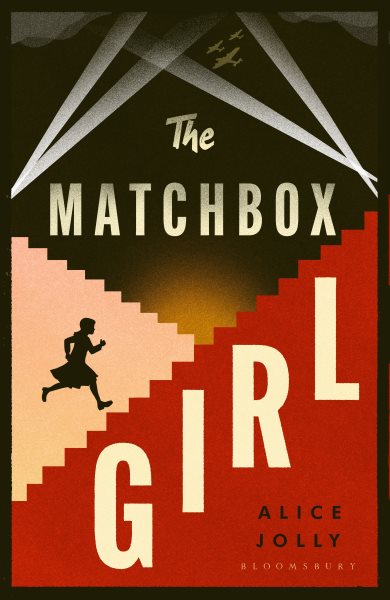
 My 20th and final book for the 20 Books of Summer challenge is the winner of this year’s Walter Scott Prize for Historical Fiction, Alice Jolly’s The Matchbox Girl. I wasn’t sure about reading this book as I’d heard that it was written in an unusual style, but as reading the Walter Scott Prize shortlists is a personal project of mine, I knew I’d have to at least give it a chance.
The matchbox girl of the title is Adelheid Brunner who is twelve years old when the novel opens in 1934. Accompanied by her pet rat Franz Joseph, Adelheid arrives at the Vienna Children’s Hospital where she will stay for a while to be assessed and observed by a team of doctors. It was her grandmother’s decision to send her there as she was struggling to cope with Adelheid’s unusual fixations, such as her obsession with collecting matchboxes which she is constantly counting, arranging and putting in order. One of the doctors at the hospital, referred to by Adelheid as Dr A, shows a particular interest in her behaviour because it aligns with his research into what he calls ‘autistic psychopathy’.
Dr A, as we’ll find out later, is Hans Asperger, the man whose name was given to Asperger’s Syndrome, although that term is no longer used for various reasons – partly because people are usually now diagnosed as being on the autism spectrum rather than with specific conditions, but also because of Hans Asperger’s ties with the Nazis. This Nazi connection becomes an important part of the novel as the years go by and the war gets under way. Adelheid is now working as an assistant in the Vienna Children’s Hospital, copying and typing records. She knows that some children are being transferred to another clinic, Am Spiegelgrund, where they’ll supposedly receive specialist treatment, but through her work with the hospital records, Adelheid discovers that these children are described as ‘useless eaters’ – in other words, not considered worthy of life or conforming to the Nazi ideal – and once they are sent there, they’re unlikely to return.
Dr Asperger’s role in all of this is quite ambiguous in the novel; we’re seeing things from Adelheid’s point of view and she doesn’t understand exactly what’s going on. How much knowledge did Asperger have of what was happening at Am Spiegelgrund and what was the extent of his involvement with the Nazis? In reality, it does seem that there’s still some debate around this and the level of his complicity. The other doctors and nurses are also people who really existed and Jolly incorporates some of their personal stories into the novel too, for example Anni Weiss and Georg Frankl, who also carried out research into autism at the hospital but were forced to flee Austria for America because they were Jewish, and Sister Viktorine and Dr Feldner, who both bravely try to defy the Nazi regime.
As well as collecting matchboxes, Adelheid loves writing in her notebooks, which she does compulsively. She never speaks – she’s not sure what she should and shouldn’t say, so it’s safer to not speak at all – but her voice still comes across strongly through her unusual way of writing. Unfortunately, I found this as irritating as I’d anticipated: random words have capital letters, there are no quotation marks around speech and Adelheid often repeats words three times (“For so long everything was the samesamesame. Until it was all changechangechange”). I do understand what Alice Jolly was trying to do here and I suppose it was quite effective, but I found it so distracting I couldn’t get invested in the story as much as I would have liked.
Still, the setting and subject were interesting enough to make this a worthwhile read for me. The insights into how children with autism were viewed and treated in the 1930s were fascinating and so was the portrayal of life in Nazi controlled Vienna. I can see why the Walter Scott Prize judges were impressed with this book, even if it wasn’t a complete success with me.

Book 20/20 of 20 Books of Summer


I’m glad you recognised the merit in the book even if you did find the writing style distracted from your enjoyment. I had similar feelings when I started the book but before long I found it helped me understand her way of seeing the world, a little chaotic and often overwhelming.
I’ve had the same challenge with some of the more ‘adventurous’ Walter Scott Prize winners, such as The Long Take and The Gallows Pole.
I’m not really a fan of unusual or experimental writing styles, but in this case I could at least understand why she chose to write like that and I found it less distracting as I got further into the book.
Sounds intriguingly different!! I’ll look out for it.
Yes, very different!
This one sounds really interesting overall, given its history. It sounds like a different focus point for this period of time novel wise and it sounds like I’d learn a lot from it. Its just a shame to hear how jarring the writing style is. Whether or not I enjoy it will ultimately come down to how I get along with that factor, I imagine, but I definitely want to at least give it a try sometime. Also congratulations on getting your 20 books of summer read 🥰
Yes, it’s fascinating. I’ve read a lot of other books set during WWII but never anything with this approach or perspective. The writing style is obviously intended to show how a person with autism might write, so it makes sense, but I found it a bit difficult to read. And thank you – I thought for a while I wasn’t going to be able to finish my 20 books of summer, but got caught up towards the end!
Doesn’t sound like one for me – I hate that kind of quirky writing. But the subject is interesting. Well done on completing your 20 Books with time to spare!
Yes, I think you would find the writing style annoying – it’s obviously supposed to reflect Adelheid’s autism, so it does make sense but I just found it irritating and distracting. And thank you – it’s not often I manage to complete 20 Books of Summer, but I’ve done it two years in a row now!
It sounds interesting, and I have added a link to your review onto my Walter Scott prize page. I need to doublecheck your page to make sure I haven’t missed any recent reviews, as I’m not always aware what’s on the list if I haven’t read it yet.
I don’t think I’ve read any other Walter Scott Prize books for a while, though I have some that I’m hoping to read soon. This one was fascinating in terms of the setting and topic even though I didn’t like the writing style.
That’s good, since I have to read it, too. I’ve been trying to keep up, but I still have most of the last two years to read, maybe three. I have read one for this year that I haven’t reviewed on my site yet.
This is a brave approach to a sensitive and – I suspect for some – painful subject. I can quite understand the quirks getting in the way of the storytelling but, knowing the variety of ways in which being on the spectrum can manifest, that might add to a sense of authenticity. Thanks for reviewing this, yet another title for me to get hold of and perhaps interest Emily in – as I may have mentioned, she has a PhD in psychology with an interest in how bullying affects those on the spectrum.
Yes, I’m sure the writing style is intended to convey the way Adelheid’s autism influences her use of language and how she sees the world. It’s very well done, but not particularly easy to read. I think you and Emily would both find this an interesting book.
Brava for completing your goal of 20 books!
Thank you!
Well done on completing your 20 Books of Summer and thanks for sharing your review with the Historical Fiction Reading Challenge!
Thank you! This is only the second time I’ve managed to complete it.