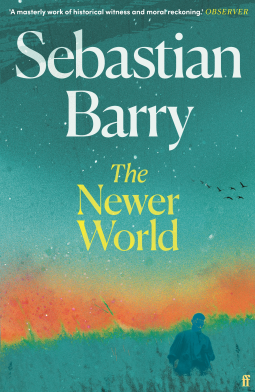
 Sebastian Barry’s latest novel, The Newer World, is loosely connected to two of his earlier books, Days Without End and A Thousand Moons. If you’ve read those books you’ll remember the characters of John Cole, Thomas McNulty and Winona and all three appear again in this book. However, it’s not necessary to have read them first as this book works as a standalone and focuses on Tennyson Bouguereau, who was a secondary character in A Thousand Moons.
Tennyson and his twin sister Rosalee are born into slavery in 1840s Tennessee and later freed – although as Tennyson observes, “freed is not the same as free” and a lot is left to be desired in terms of equality and opportunities for people who were formerly enslaved. After the Civil War, Tennyson and Rosalee find themselves living on Lige Magan’s farm, the same place Irish soldier Thomas McNulty, his partner John and their adopted Lakota daughter, Winona, have ended up. The farm won’t be a safe haven for long, though, and eventually Tennyson is forced to flee, leaving Rosalee and their friends behind. Assisted by a kind-hearted lawyer, Tennyson makes his way to Nashville, where he attends a college and finds that he has a talent for singing. Joining a touring choir, he unexpectedly has the chance to visit England and on his return finds that he’s faced with making a decision that could change his life forever.
The novel is narrated by Tennyson himself, a brave decision by Sebastian Barry. His publishers had apparently advised against it due to cultural appropriation concerns, which is obviously a controversial topic, but I thought Tennyson’s narrative voice felt authentic and the themes of racism, prejudice and slavery were handled sensitively and sympathetically. Through Tennyson’s eyes, we see how even after the abolition of slavery he still has to deal with restrictions on his everyday life, such as when he is threatened with a fine for simply ‘walking without purpose’.
During his time at college in Nashville, Tennyson reads the Odyssey and afterwards begins to draw parallels between his own life and the journey of Odysseus who, like himself, is far from home. But Tennyson, however, has lost so much and so many of the people he loved that he’s not sure where home really is anymore: “I knew as I made my way home that there was no home. All the old things, my days in the world, even the eyes I had seen them with, were gone forever.”
Sebastian Barry’s books are always beautifully written and this one is no exception, although I’ve found that in general I seem to prefer his books set in Ireland rather than this sequence set in America. I suspect he may be returning to this world for a fourth novel, though, as several characters have decided to head for Alaska to start a new life. There would also be the option of telling Rosalee’s story, left behind on the farm during Tennyson’s long absence. Whatever he chooses to write next, I’ll be looking out for it.
Thanks to Faber and Faber Ltd for providing a copy of this book for review via NetGalley.


I sometimes get put off Barry’s novels as I feel I need to have read several other of his books in order to get the benefit! This sounds really good though.
Yes, that can be off-putting! These three books do all work as standalones and just intersect now and then, but I would probably still recommend reading them in order if possible.
Enjoyed the review, although I’m not a super Barry fan. Isn’t it funny, how we click with some writers and, with others who are equally skillful, we just don’t? I have read one previous novel in this loose trilogy (Days Without End) and thought it very well done but — not for me! I think it struck me that the characters were a bit too “modern” in their thoughts & sensibilities to be living in that particular era. But that’s just me and others, more familiar with Barry’s work, thought otherwise! Despite my reservations, this latest sounds pretty good, particularly as I’m interested in all that post-Civil War history (there’s a type of U.S. blindness where many people think the struggle for freedom ended with the Civil War. On the contrary, it was just getting started. I’m from one of the former Confederate states and saw much of this struggle first hand). I think it would be interesting to see what an Irish writer makes of this.
Days Without End is actually my least favourite of all the Sebastian Barry books I’ve read. I also found the attitudes of the characters too modern for the period and I got so bored with the story I nearly gave up halfway through. I loved A Thousand Moons, though, and his earlier books set in Ireland.
I haven’t started with Barry yet although he’s been on my radar for years, this does sound appealing, very brave to take the voice of Tennyson and I’m interested in the Odyssey parallel.
I’ve enjoyed most of his books, but this was a particularly good one – I loved Tennyson’s narrative voice and the Odyssey themes. He always writes beautifully as well.
Excellent, I’m glad you enjoyed it. 😀 I like the front cover. 🙂
I love the colours on the cover.
Yes, they are beautiful. 🙂
He is such a wonderful writer. I’ve enjoyed those of his books that I’ve read and I have this one here too. Because his writing is so lovely but also very dense, it takes me a long time to get through his books.
Yes, his writing is beautiful and I know what you mean about it being dense – this is a short book but not as quick to read as I expected. I hope you enjoy it.
I wonder why he has shifted to settings in America for his last few books.
I prefer his Irish books, but I suppose the change of setting lets him explore different topics.
It’s been years since I read a Sebastian Barry book!
Thanks for sharing your review with the Historical Fiction Reading Challenge!
I love his books! He always writes beautifully.