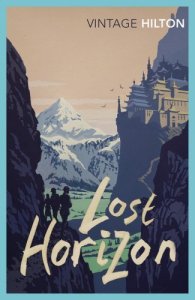
Lost Horizon by James Hilton

lost-horizon I’m very happy with the way my reading is going so far this year. I’ve read some great books already and this is another one. Published in 1933, Lost Horizon is the novel which introduced into popular culture the idea of Shangri-La as a sort of earthly paradise. It’s a fascinating story and very absorbing – I started it on a Saturday and was finished by Sunday; at just over 200 pages it’s a quick read but also the sort of book that leaves the reader with a lot to think about after the final page is turned.

We begin with a prologue in which the narrator is having dinner with a novelist friend, Rutherford. The two find themselves discussing a mutual acquaintance, Hugh Conway, who had disappeared under unusual circumstances only to be discovered by Rutherford several months later in a hospital in China. Conway has been suffering from amnesia but as his memories start to return, he tells Rutherford a long and remarkable story.

During a revolution in Baskul, Conway, who was the British consul at the time, was evacuated by plane along with three other people. The plane was supposedly heading for Peshawar, but it never arrived and its four passengers were believed to be dead. What Conway tells Rutherfurd, however, is that the plane was hijacked and flown in a different direction, stopping once to refuel and finally crashing to the ground in a mountain valley somewhere in Tibet. The pilot was killed but the passengers survived. Seeking shelter at the nearby lamasery (a monastery for lamas) known as Shangri-La, the group asked for help to continue their journey to Peshawar, but as the days and weeks went by and no help arrived, Conway began to wonder whether their presence at the lamasery was really an accident – and whether they would ever be able to leave.

Shangri-La is a mysterious place; beautiful, but slightly eerie too, I thought. How was such a beautiful building constructed in such a remote location? Who installed the modern western plumbing and who brought the grand piano, the harpsichord and the books for the library, considering that the only way to reach the lamasery (unless you happen to make a crash-landing there) is on foot through the dangerous mountain passes? What is the secret of the lamas, who look so much more youthful than they really are? And where is Shangri-La, exactly? All Conway can deduce is that they have flown “far beyond the western range of the Himalayas towards the less known heights of the Kuen-Lun” and into the shadow of the mountain Karakal, or ‘Blue Moon’.

I found it interesting that Conway’s three companions have such different reactions to their enforced imprisonment in Shangri-La. Mallinson, Conway’s young vice-consul, reacts with anger and frustration, and with every day that passes he becomes more and more desperate to escape; the American businessman, Barnard, is hiding secrets of his own and is content to enjoy the hospitality of the lamasery while looking for money-making opportunities in the valley; and Miss Brinklow, the British missionary, wonders if this is a challenge sent by God and if she has been brought here to carry out His work. The characters (apart from Conway) are thinly drawn, but they serve their purpose in the story – and it could be said that Shangri-La is actually the most important character in the novel anyway.

Conway himself is in no hurry to go anywhere; he is intrigued by the lifestyle of the lamas and the atmosphere of serenity and peace. With his curious, contemplative nature, the philosophy behind the lamasery appeals to him and he becomes captivated by this mystical place where time seems almost to stand still and the pressures of everyday life can be left behind. It is obvious from the framing story set up in the prologue that Conway does, for one reason or another, leave Shangri-La, but it is not at all clear how or why that will happen and this kept me in suspense and kept me turning the pages.

Lost Horizon was another read from my Classics Club list. I am coming to the end of my list now and will soon be putting another one together; I’ll have to think about including one or two more books by James Hilton – probably Random Harvest or Goodbye, Mr Chips. Has anyone read them?
The Red House Mystery by A.A. Milne

the-red-house-mysteryI don’t think I would have ever read The Red House Mystery if it hadn’t been for seeing other bloggers reading and reviewing it. I had always thought of A.A. Milne solely as the author of the Winnie the Pooh stories and it had never occurred to me to wonder what else he had written. It turns out that The Red House Mystery, originally published in 1922, was his first and only detective novel – which is a shame, because it’s excellent.
The novel opens on a beautiful summer’s day with Mark Ablett entertaining guests from London at his home, the Red House. Earlier that morning, Mark had announced to his friends that his brother, Robert, was on his way home from Australia, having been absent for fifteen years. The guests are surprised to hear this, as Mark had never mentioned a brother before, and unfortunately – or perhaps fortunately, given the descriptions of Robert’s character – they don’t get a chance to meet him, because almost as soon as Robert arrives at the Red House he is shot dead.

Antony Gillingham, a latecomer to the party at the Red House, is one of the first on the scene, along with Mr Cayley, the Abletts’ cousin. Seeing Robert’s dead body on the office floor and no sign of Mark, who appears to have run away, it seems quite obvious what has happened…but Antony is not so sure. Joining forces with his friend and fellow house guest, Bill Beverley, he begins to search for clues in an attempt to solve the mystery.

I loved this book; being such an early example of a detective novel, it contains many of the elements of a classic ‘locked room mystery’ which would still have felt fresh and new in the 1920s: a country house, secret passages, ghostly figures, midnight adventures, red herrings etc. I also think Milne is very fair to the reader, providing enough hints for us to at least guess at the solution, while not making it too easy to work out.

Antony and Bill make a great detecting team, falling perfectly into the roles of Sherlock Holmes and Dr Watson (they even refer to themselves as Holmes and Watson several times throughout the novel). They are both very likeable characters and I would have been happy to read a whole series of Gillingham/Beverley mysteries.

Most of all, though, I loved the writing style, which is light and lively, with plenty of humour and witty dialogue. Here, for example, is a conversation between two of the Red House servants:

“I was never the one to pretend to be what I wasn’t. If I’m fifty-five, I’m fifty-five – that’s what I say.”

“Fifty-eight, isn’t it, auntie?”

“I was just giving that as an example,” said Mrs. Stevens with great dignity.

And here we learn what Antony’s father thinks of his son:

Old Gillingham returned to his paper. Antony was a younger son, and, on the whole, not so interesting to his father as the cadets of certain other families; Champion Birket’s, for instance. But, then, Champion Birket was the best Hereford bull he had ever bred.

The Red House Mystery was great fun to read.  Having enjoyed it so much, I’m disappointed that there aren’t more mysteries to read by A.A. Milne, but if you think I might like any of his other books I would love to hear your recommendations.

The Red Sphinx by Alexandre Dumas

the-red-sphinx Well, it may be only January but I think I already know one book which will be appearing on my books of the year list this December! Having read and enjoyed all of Alexandre Dumas’ d’Artagnan novels over the last few years (beginning with a re-read of The Three Musketeers and ending with The Man in the Iron Mask), imagine my delight when I discovered that Dumas had written yet another Musketeers sequel – The Red Sphinx, which is being made available in a new English translation this month. Bearing in mind that this is a later Dumas novel, written towards the end of his career on the urging of his publishers, I was pleased to find, almost as soon as I started reading, that it was living up to my expectations!

I don’t think it’s at all necessary to have read The Three Musketeers first; The Red Sphinx is set in the same world – that is, in the 17th century at the court of Louis XIII of France – but it also stands alone and if you’re hoping to be reacquainted with d’Artagnan, Athos, Porthos and Aramis, you’ll be disappointed as the four friends don’t appear at all in this book. However, it does contain many of the same elements that made the original novel so much fun to read. There are dashing young heroes and beautiful heroines; duels, battles and sieges; spies and smugglers; secret messages, clever disguises, letters written in code – and political and romantic intrigue in abundance.

Beginning only a few weeks after the events of The Three Musketeers ended, the novel opens in Paris at the Inn of the Painted Beard where a hunchbacked marquis is trying to persuade swordsman Etienne Latil to assassinate a rival. When Latil hears that the man he is required to kill is the Comte de Moret, illegitimate son of the late King Henri IV, he refuses to accept the mission and a fight breaks out during which both Latil and the marquis are injured. As fate would have it, upstairs in the inn at that very moment are the Comte de Moret himself and one of the Queen’s ladies, who have met in disguise to arrange for Moret to attend a meeting with the Queen.

cardinal-richelieu

Cardinal Richelieu

At the meeting, Moret, who has only recently returned to France from Italy, delivers some letters to the Queen, Anne of Austria, the King’s mother Marie de’ Medici, and the King’s brother, Gaston d’Orleans, and learns that they are plotting the downfall of Cardinal Richelieu, the Red Sphinx of the title. Now, in The Three Musketeers, the Cardinal is portrayed as a villain; in The Red Sphinx, he is very much a hero. With an intelligence network stretching across half of Europe, he is shown to be a formidably clever man but also a loyal one who always acts with France’s best interests at heart – and although he’s accused of having too much influence over the king, it’s evident that he is trying to use his influence for the good of the country.

I can’t possibly describe the plot of this novel in any more detail; it’s so complex that I wouldn’t know where to start. I think it’s enough to say that most of it is devoted to the power struggle between Cardinal Richelieu and his allies on one side and the two queens and Gaston d’Orleans on the other, with the ineffectual young king caught in the middle. Dumas spends a lot of time introducing us to each character who plays a part in the story, even the minor ones, and although this makes the book longer than it probably needed to be, I didn’t mind because the amusing anecdotes he provides about them are so entertaining. He also includes whole chapters dedicated to explaining the political situation in France and across Europe or to describing the progress of key battles – and I’ll confess to not finding these very interesting. In general, though, I thought the balance was right and despite the length of the book it held my attention from beginning to end.

One important thing to know about The Red Sphinx is that it was never actually finished! In his introduction to the new edition, Lawrence Ellsworth (who is also responsible for the wonderful translation) suggests that maybe Dumas struggled to write an ending because he had already done this in an earlier work. This means that the novel comes to a rather abrupt end with several plot points left unresolved. Annoying – but not as annoying as it could have been, because Ellsworth comes to the rescue by pairing The Red Sphinx with another little-known Dumas work, The Dove. This is a short story (actually more of a novella) which continues the adventures of two of our main characters, the Comte de Moret and Isabelle de Lautrec, and brings at least some of the threads of the story to a satisfying conclusion.

The Dove was written earlier in Dumas’ career than The Red Sphinx and has a very different feel, being told in the form of letters carried by a dove. It’s an unashamedly sentimental story, but I loved it. I found it beautifully romantic and perfectly paced, with the suspense building and building from one letter to the next.

I will, of course, be reading more by Dumas – I have an upcoming re-read of one of my favourite books, The Count of Monte Cristo, planned – but I was also so impressed by Lawrence Ellsworth’s translation that I’ve had a look to see what else he has done. It seems that he has also edited The Big Book of Swashbuckling Adventure, which sounds very appealing. One to add to the wishlist, I think!

Thanks to Pegasus Books for providing a copy of this book for review via NetGalley.

Howards End by E.M. Forster

howards-endThis is only the second book I’ve read by E.M. Forster – the first one being A Room with a View. With plenty of his books left to choose from, I decided that the next one I read would be Howards End, which was recommended to me by almost everyone who commented on my review of A Room with a View back in 2013!
Howards End is the story of two sisters, Margaret and Helen Schlegel, and their relationship with the Wilcox family. At the beginning of the novel, Helen – the younger and more impulsive of the two – accepts an invitation to visit Howards End, the Wilcox country home, where she becomes romantically involved with the younger son, Paul Wilcox. Although their romance is quickly broken off, the two families stay in touch and the elder Schlegel sister, the more practical and sensible Margaret, becomes good friends with Paul’s mother, Ruth.

Ruth Wilcox longs to show Margaret Howards End, feeling that her new friend will appreciate the house more than her own children do. Margaret never gets a chance to visit while Mrs Wilcox is alive, but when she dies, early in the novel, she tries to bequeath Howards End to Margaret. However, the rest of the Wilcox family choose not to inform Margaret and burn the note which describes Ruth’s dying wish, leaving Margaret none the wiser. As time goes by, Margaret gets to know Ruth’s widowed husband, Henry, and a friendship forms which soon develops into something more. Could Margaret end up living at Howards End one day after all?

Meanwhile, Helen has also made a new friend: Leonard Bast, a young insurance clerk who is married to an older woman, Jacky. Acting on advice from Henry Wilcox, the Schlegels warn Leonard that the company he works for is in trouble and that he should look for another job. Leonard follows this advice, but when things go wrong and he ends up with nothing, Helen blames Henry for his misfortunes.  Will she ever be able to forgive him?

Published in 1910, Howards End explores the relationships between these three families, each occupying a different position in the British class system. The Wilcoxes are wealthy, materialistic capitalists who have made their money from the Imperial and West African Rubber Company. The Schlegels, who are half German, are cultured, intellectual and idealistic, and apparently based on the real-life Bloomsbury Group. Finally, the lower-middle class Leonard Bast has found himself impoverished and stuggling to get by, but is trying to improve his lot in life by exposing himself to music and literature.

Class is obviously an important theme in this novel, then, but there are others too, such as gender roles and feminism. With such a variety of characters, we get a variety of views ranging from Henry Wilcox saying that “the uneducated classes are so stupid”, Mrs Wilcox’s opinion that “it is wiser to leave action and discussion to men”, and Margaret thinking to herself, “Ladies sheltering behind men, men sheltering behind servants – the whole system’s wrong.” It’s interesting to think that within a few years of this book being published, the outbreak of war in Europe and also the progress of the women’s suffrage movement would bring social change to Britain and the world Forster is describing would no longer exist.

Howards End is a beautifully written novel and a fascinating and thought-provoking one. However, I don’t think I can say that I loved it, partly because I found so many of the characters difficult to like and care about.  Although Forster himself writes about each character with warmth and empathy, I didn’t feel that I was forming a very strong connection with any of them.  I preferred A Room with a View, but I’m probably in the minority with that as so many people have told me that this one is their favourite by Forster. I’m still looking forward to reading more of his novels, though, and I think A Passage to India will be next.

The Man in the Iron Mask by Alexandre Dumas

the-man-in-the-iron-mask I had considered starting 2017 by posting some reading plans and resolutions but, to be honest, after failing to keep most of last year’s, I don’t want to make any for this year. I do have one goal for 2017, though: I would like every book I read to be a potential book of the year. That’s unrealistic, I know, but it’s something to keep in mind when I’m choosing which books to read and when I’m deciding whether or not it’s worth continuing with a book I’m not enjoying. And I’m already off to a great start with my first January read – The Red Sphinx by Alexandre Dumas! I’m looking forward to telling you about that one after I’ve finished reading it, but in the meantime here are my thoughts on another Dumas novel I read just before Christmas.

The Man in the Iron Mask is the last book in the d’Artagnan series which began with The Three Musketeers and continued with Twenty Years After, The Vicomte de Bragelonne and Louise de la Vallière. The final three in the series were originally published as one novel, which must have been enormous; it’s easy to see why most publishers now split it into separate volumes! I think most people probably just go straight from The Three Musketeers to The Man in the Iron Mask – after all, they are the two best known and the most often filmed of the d’Artagnan stories – but I don’t regret having taken the time to read the ones in between. I did enjoy them all, particularly Twenty Years After, and it meant that I went into this, the final book, with the background knowledge I needed to be able to get straight into the story.

Unlike The Vicomte and Louise, which deal mainly with the political and romantic intrigues of various members of the 17th century French court, in The Man in the Iron Mask, the focus returns to d’Artagnan and his three friends, Athos, Porthos and Aramis. The first half of the novel revolves around Aramis and a plot involving a man imprisoned in the Bastille who bears a striking resemblance to the King of France. I won’t say too much about this as I wouldn’t want to spoil the story for future readers, but suffice it to say that things don’t go exactly as according to plan and both Aramis and Porthos (who, as usual, has become implicated in the schemes of others while blissfully unaware of what is really going on) find themselves in trouble.

We then catch up with Raoul, the young Vicomte de Bragelonne, who is trying to come to terms with the discovery that his beloved Louise de la Vallière is now the mistress of Louis XIV. Devastated by the loss of Louise, Raoul agrees to accompany the Duc de Beaufort on an expedition to Africa. How will his father, Athos, cope in his absence? D’Artagnan, meanwhile, has remained loyal to the king and for much of this novel he is caught up in the final power struggle between the two rival finance ministers, Fouquet and Colbert. When his duties bring him into conflict with Aramis and Porthos, however, d’Artagnan must find a way to serve his king without betraying his friends.

This is a much more exciting, action-packed book than the two preceding ones. The actual ‘man in the iron mask’ has a relatively small role to play but the plot has serious consequences which are explored throughout the remainder of the novel as we follow our old friends, the musketeers, to the end of their careers. I was pleased to see so much more of d’Artagnan and his friends than we did in the last two books, but I was disappointed by the lack of scenes with all four together (it was the relationship between the four of them, in my opinion, that made the first Musketeers novel such a joy to read) and that Athos’ storyline seemed to barely intersect with the others. Athos was my favourite character in the original Musketeers book and I really dislike the direction Dumas took him in throughout the later books in the series, particularly after Raoul became more prominent in the story. It’s funny that Aramis, my least favourite, ended up being the character I found the most interesting!

Towards the end, The Man in the Iron Mask also becomes a very sad book; after spending so much time with these characters – literally thousands of pages over the last few years – I didn’t want to have to say goodbye to any of them. Dumas ties things up very neatly in the final chapters…a bit too neatly for me; I would have preferred a happier ending with more left to the imagination! Still, I did enjoy this book and was delighted to discover that Dumas had written yet another, often forgotten, sequel to The Three Musketeers. It’s called The Red Sphinx and is being made available in a new English translation this month. I’m reading it now and am pleased to say that so far it’s definitely living up to my expectations!

Redgauntlet by Sir Walter Scott

redgauntlet Redgauntlet, one of Scott’s Waverley novels, is set in Scotland and the north of England in 1765, twenty years after the failed Jacobite Rising of 1745. Although the rising was unsuccessful and ended in disaster for Charles Edward Stuart and his supporters, there were still those who dreamed of restoring the exiled Stuarts to the throne. Redgauntlet centres around a fictional third Jacobite Rebellion and the lives of two innocent young men who accidentally become caught up in the plot.

The novel is made up of a mixture of letters, journal entries and first person narrative written from the perspectives of Darsie Latimer and his friend, Alan Fairford. Darsie, an orphan, has grown up in Scotland knowing very little about his family background, aware only that he has been forbidden to cross the border into England until he turns twenty-five, which is also when he will come into his inheritance. The reason for this unusual condition is unknown to Darsie but eventually becomes clear as the story unfolds and the truth about his past is revealed.

Kidnapped on a fishing expedition to the Solway Firth, Darsie discovers that he has fallen into the clutches of the mysterious Hugh Redgauntlet, a former Jacobite who seems to know more about Darsie than Darsie does himself. Help is on its way, however – when Alan Fairford, who is completing his legal studies in Edinburgh, receives a message from a beautiful young lady known only as Green Mantle, warning him that Darsie is in danger, he sets off at once in search of his friend.

Redgauntlet is the third Scott novel I’ve read (the others were Ivanhoe and The Heart of Midlothian) and my favourite so far. In fact, I was ready to name it one of my books of the year until the plot began to fizzle out towards the end, which meant it lost its place on my list. Up to that point, though, I was completely engrossed in the adventures of Darsie and Alan. No, it’s not a particularly easy book to read, and yes, there are some long, dry passages where Scott discusses the politics of the period or describes obscure points of Scottish law, but otherwise I loved it. I loved the setting, the characters, the air of mystery and foreboding, the exciting plot and the way the novel was structured to incorporate different forms of writing and different viewpoints. I particularly enjoyed reading the letters sent between Darsie and Alan in which the personality of each man – the practical, unimaginative Alan and the romantic, adventurous Darsie – come through strongly.

The problem I had with this novel was with the storyline surrounding the third Jacobite Rising. Knowing that it never happened historically took away some of the suspense and Scott didn’t manage to convince me that Redgauntlet’s schemes would ever come to anything. I enjoyed the build-up, but when the rebellion started to come to the forefront of the novel near the end of the book, this was when I lost interest. It all seemed such an anti-climax after sticking with the story through so many pages. Still, the good bits of Redgauntlet are very, very good – my favourite part was Wandering Willie’s Tale, a wonderful ghost story which appears in the middle of the book. It’s worth reading Redgauntlet for this story alone.

I’m looking forward to reading more of Scott’s novels. Having only read three so far, I certainly have plenty left to choose from. If you’ve read any of them, please let me know which you think I should read next. And I would love to hear other readers’ thoughts on Redgauntlet. Brilliant but flawed is my verdict!

The Woodlanders by Thomas Hardy

the-woodlanders I love Thomas Hardy but have been resisting the temptation to rush through his novels too quickly. I’m dreading there being none left for me to discover for the first time, so since reading Tess of the d’Urbervilles in 2010, I have been limiting myself to one or two a year. It’s been a while since my last Hardy, The Return of the Native, so a few weeks ago I decided it was time to read another one.

The Woodlanders, published in 1887, is set in the small woodland community of Little Hintock. For generations, the people of Little Hintock have made their living from the trees around them. The timber merchant George Melbury, however, is keen for his daughter, Grace, to experience life outside the woodlands and so he sends her away to be educated. The novel opens as she returns to the village after several years of absence and finds herself looking at her old home through new eyes.

Although Grace is promised to Giles Winterborne, a neighbouring woodsman, now that she has become used to a different way of life she can’t help noticing his lack of sophistication, causing her father to question whether the marriage he had planned for her is still appropriate. Grace’s return to Little Hintock coincides with the arrival of a newcomer – Edred Fitzpiers, a young doctor whom Melbury decides will make a much more suitable husband for his daughter than Giles. Despite his good intentions, however, Melbury’s meddling only succeeds in making everyone unhappy in typical Thomas Hardy fashion!

One thing I love about Hardy’s books is that although most of them are set in his fictional Wessex, each one covers a different aspect of Wessex life, from the rural farms of Far From the Madding Crowd and the country fairs and markets of The Mayor of Casterbridge to The Return of the Native’s wild and beautiful Egdon Heath. In The Woodlanders, we see how the lives of the characters have become defined by the woods which surround them, we see Giles Winterborne cutting down trees and pressing apples to make cider, and we see his neighbour, a young woman called Marty South, stripping bark from branches and shaping wood into spars to sell for thatching. It’s the two outsiders in the story – the newly arrived Dr Fitzpiers and the lady of the manor, Felice Charmond – who disrupt the harmony of life in Little Hintock, and Grace who is caught between the sophisticated, cultured world they represent and the simple traditions of her childhood home and friends.

Although this book isn’t as dramatic or tragic as some of Hardy’s others, there were still some scenes near the end that moved me to tears and others that had me holding my breath – and I found the final page beautifully sad and poignant. Not everyone gets the happy ending I would have liked, but that’s true to life, I suppose, and I don’t really expect happy endings from Hardy anyway.

The Woodlanders was apparently one of Hardy’s own favourites; he is quoted as having said, “On taking up The Woodlanders and reading it after many years, I like it as a story best of all”. Now that I’ve read more than half of his novels, I have to say that I think I agree with him. It’s not as powerful or as heartbreaking as Tess or Jude the Obscure, for example, but I really enjoyed it and would definitely include it in my top two or three Hardy novels read so far.