Cold Comfort Farm by Stella Gibbons

Cold Comfort Farm Cold Comfort Farm was the book the recent Classics Club Spin chose for me to read. I did actually manage to read it before the end of June, as the rules stated, despite the fact that I’m posting my review in July!

This is the story of Flora Poste, nineteen years old and recently orphaned, who decides to go and live with her relations. After writing to various family members and dismissing their offers as being unsuitable, something in the reply she receives from her cousin Judith Starkadder at Cold Comfort Farm in Sussex appeals to Flora and her mind is made up. Flora thinks she knows what to expect from life on a typical Sussex farm (it will be bleak, miserable and old-fashioned – and there’s sure to be a farmer called Amos and two young cousins called Seth and Reuben). As soon as she arrives she discovers that Cold Comfort Farm really is the typical farm she had imagined. Each of the farm’s inhabitants has their own set of problems that require Flora’s assistance, so armed with one of her favourite books, The Higher Common Sense by the Abbé Fausse-Maigre, she begins to ‘tidy up’ the lives of the Starkadders and help them adapt to modern life.

Not having read this book before or seen the adaptation, I didn’t know much about it before I started except that it was a parody of the British rural novel and supposed to be funny. Now, I’m going to be completely honest here and admit that I didn’t find it as funny as I’d expected. A sense of humour is such a personal, individual thing (and I do have one, honestly!) so who can say why a book works perfectly for one person and not so perfectly for another. I did think it was very clever, amusing and witty, but not hilarious. Anyway, it helped that I’ve read some of the types of books Gibbons is parodying (such as Thomas Hardy’s rural novels, for example) though it’s probably not essential to be familiar with these books.

What I enjoyed most about this book was meeting the collection of eccentric characters who live on the farm, from Amos Starkadder, Judith’s husband, who preaches at the Church of the Quivering Brethren to Aunt Ada Doom who “saw something nasty in the woodshed” when she was young and hasn’t left the farm since. Another of my favourites was Adam, the old farm hand who “cletters” the dishes with a twig (isn’t that a great word?) and refuses to use the little dishmop Flora buys him because it’s too pretty.

Something else I found interesting was the fact that this book is set in the future (at least, the future for when it was published in 1932) and there are a few references to video phones and other futuristic elements. I didn’t know about this before I started reading and saw the note at the beginning that told us “the action of the story takes place in the near future”. I’m not sure what the point of this was, though, as it didn’t seem to be necessary or to have any effect on the story.

I didn’t love Cold Comfort Farm the way most people seem to, which is a bit disappointing, and it’s probably not a book I’ll want to re-read, but I did still enjoy it and am grateful to the Classics Club Spin for picking it for me!

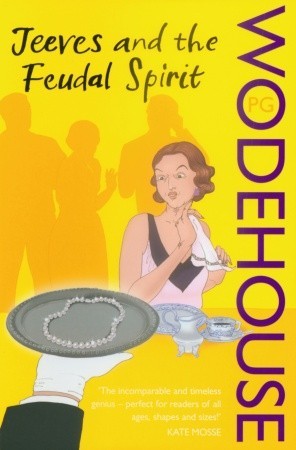
Jeeves and the Feudal Spirit by P.G. Wodehouse

Jeeves and the Feudal Spirit I’ve always loved going to the library and spending some time browsing the shelves, discovering books I’d never seen or heard of before and choosing which ones to take home with me. Browsing their ebook collection online isn’t quite the same, but I was pleased to discover recently that they had added a few P.G. Wodehouse books that I hadn’t read. Jeeves and the Feudal Spirit (also published as Bertie Wooster Sees it Through) was one of them.

At the beginning of the book, Bertie Wooster has grown a moustache while his valet, Jeeves, is away on a shrimping holiday. When Jeeves returns, it’s obvious that he disapproves – and so does everybody else, with the exception of Lady Florence Craye. After a series of misunderstandings, Florence’s suspicious fiancé, G. D’Arcy ‘Stilton’ Cheesewright becomes convinced that Bertie is trying to steal Florence from him. The jealous Cheesewright threatens to break Bertie’s spine in three places (soon increasing to four, then five) so that Bertie is forced to spend most of the novel devising ways to avoid him.

Meanwhile, Aunt Dahlia (Bertie’s “aged relative”) begs Bertie and Jeeves to help her conceal the fact that she has pawned her pearl necklace to fund the rights to a new serial novel for her magazine, Milady’s Boudoir. When her unsuspecting husband invites an expert to the house to have the pearls valued, Dahlia knows she’s in trouble, so she asks Bertie to pretend to ‘steal’ the necklace – which he does, with disastrous results! As usual, it’s up to Jeeves to get everyone out of the predicaments they’ve found themselves in.

I loved this book; it was so funny, though I would find it difficult to actually quote any examples as a lot of the humour results from the ridiculous, complicated situations Bertie gets himself into. The language is great too, of course. What ho! The only problem I had is that as I haven’t read all the previous Jeeves and Wooster books there were sometimes references to things that had obviously happened in earlier novels that I haven’t read yet. It wasn’t too big a disadvantage, though, and I could still follow the story without having all of the relevant background knowledge.

Jeeves and the Feudal Spirit may not be a hugely important, must-read novel that will change your life, but it’s perfect for brightening up a boring Sunday afternoon or relaxing after a long day at work – and sometimes that’s all I really want from a book.

Far from the Madding Crowd by Thomas Hardy

Far from the Madding Crowd Far from the Madding Crowd is set in Thomas Hardy’s fictional Wessex and tells the story of Bathsheba Everdene and her relationships with three very different men. Near the beginning of the book, Bathsheba inherits her uncle’s farm and, being confident in her ability to make a success of the business, decides to run it herself. This is not a conventional thing for a woman to do in Victorian England and it’s not suprising that Bathsheba attracts a lot of attention.

Soon she has two men in love with her: the first is the shepherd, Gabriel Oak, who had already proposed to Bathsheba before she inherited the farm and had been turned down. Despite being rejected, Gabriel remains quietly devoted to Bathsheba and as time goes by she comes to rely on him more than she realises. Her second suitor, Mr Boldwood, is a well-respected neighbouring farmer. When Bathsheba sends him a valentine saying “Marry me”, Farmer Boldwood becomes determined to make her his wife, unaware that the valentine was intended as a joke. But neither Gabriel nor Boldwood can hope to compete with the handsome but untrustworthy Sergeant Troy who seems set to succeed where they have both failed.

I loved Far from the Madding Crowd. Thomas Hardy is one of my favourite Victorian authors and having read five of his books now, none of them have disappointed me. I read the beautiful Penguin English Library edition of this book which I won in a giveaway from Heavenali last year, and I would like to say how much I appreciated the fact that the ‘introduction’ is at the back of the book instead of the front! I wish all publishers would do that, as it would reduce the risk of an unsuspecting reader having the story spoiled for them (I have never understood why it’s apparently considered acceptable to give away the entire plot of a novel in the introduction or on the back cover just because the book is a classic).

Hardy is often criticised for being too depressing, but this one isn’t really a tragic, heartbreaking book like Tess of the d’Urbervilles or Jude the Obscure – although it does still have its moments of sadness. Things do go wrong, bad things happen and not every character gets a happy ending. However, it also has some humour, which is maybe not something usually associated with Hardy. Most of this is provided by the wonderful collection of secondary characters – the eccentric villagers and rustic farm workers who gather at the Buck’s Head Inn in the evenings to discuss the day’s news. Their conversations are so funny and give some relief from the darker parts of the central storyline.

I found Bathsheba very frustrating, although it’s her flaws – her vanity and her impulsive nature – that make her such a fascinating character. There’s a lot to admire about her, such as her desire to run the farm and be successful at it, despite farm management still being very much a man’s world, but after seeming to be such a strong, independent person at the start of the book, she begins to make one mistake after another. Gabriel Oak, though, I loved. I loved him for his patience and devotion, for the way he coped with rejection, and the fact that he didn’t judge too harshly. Like the oak tree his name suggests, he is a constant, reassuring presence throughout the story and certainly my favourite character in any of the Hardy novels I’ve read so far.

Of all the Hardy novels that I’ve read, with the possible exception of Under the Greenwood Tree, this is the most pastoral, with lots of beautiful descriptions of the countryside and lots of information on farming and agriculture. I should now be able to shear sheep, hive bees, forecast the weather by watching the movements of slugs and toads, and deal with a fire in a hayrick! (Well, maybe not.)

I need to choose my next Thomas Hardy book now so any recommendations are welcome. I’ve already read Tess of the d’Urbervilles, Jude the Obscure, Under the Greenwood Tree and A Pair of Blue Eyes.

The Ladies’ Paradise by Émile Zola

The Ladies' Paradise The Ladies’ Paradise is only the second book I’ve read by Zola; my first was Thérèse Raquin and the two are very, very different. Au Bonheur des Dames, to give it its French title, was published in 1883 and is the story of a Paris department store, based on the real-life Le Bon Marché.

At the beginning of the novel, Denise Baudu arrives in Paris with her two younger brothers, hoping to find work in her uncle’s draper’s shop. She is disappointed to discover that he is unable to offer her a job because his shop, along with the other small shops in the street, is losing business to a new department store, the Ladies’ Paradise. The new store is able to offer a larger selection of products at cheaper prices all under one roof, and none of the smaller traders can hope to compete. Still, Denise desperately needs to earn money to support her brothers so although she understands how her uncle feels, she is pleased when she is offered a job at the Paradise.

Denise quickly finds that life as a salesgirl at the Paradise is not easy but she’s determined to succeed and overcome whatever obstacles are put in her way. And when she catches the eye of the owner of the Paradise, Octave Mouret, he soon discovers that she is a woman with morals and principles; it’s obvious that she is not going to give him any encouragement – but this only makes him want her more.

I was hoping to love this book as much as Thérèse Raquin but that didn’t happen. The Ladies’ Paradise is a book that I enjoyed, but not one that I loved. It offers some fascinating insights into both Parisian life and the rise of the department store in the late 19th century – and of course, the idea of a larger, cheaper store putting all the small, independent shops out of business is still very relevant today – but I disliked most of the characters and while the long descriptions of the silks, satins and other fabrics sold at the Paradise were beautifully detailed I did get a bit bored after a while. Maybe I just don’t like shopping enough!

However, I did find it fascinating to read about the way the Paradise was run and what it was like to work there. In some ways working at the Paradise was a very different experience from working in retail today, one of the biggest differences being that the salesgirls employed by the Paradise lived and ate on the premises and were treated almost like servants. But from a selling and marketing perspective, I was surprised to learn how modern and sophisticated Mouret’s methods were; a lot of the ideas he had for running the store, advertising its products and attracting customers are still used today (though I didn’t really like the implication that women are so easy to trick and tempt into parting with their money).

The only character I really liked was Denise. I had sympathy with all the ordeals she faced after starting her new job: having trouble fitting in with the other women, feeling that her clothes and hair weren’t right, being bullied by other employees, and worrying about making enough money to take care of her two younger brothers. I found it harder to like or care about any of the other characters (Denise’s brother, Jean, particularly annoyed me – surely he was old enough to take more responsibility for himself and his actions), though I did admire what Mouret had achieved in making the Paradise such a success.

I don’t want to sound too negative about this book because I still found a lot of things to enjoy about it, but I’m hoping the next Zola novel I read will be more to my taste than this one. Any suggestions are welcome!

Doctor Zhivago by Boris Pasternak

Doctor Zhivago Do you ever find that after finishing a book you’re still not sure what you thought of it and couldn’t even say whether you had actually enjoyed it or not? That’s the way I felt about Doctor Zhivago. I’m glad I’ve finally read it as it’s a book I’ve been curious about for a long time, but while I didn’t dislike it I didn’t love it either. Thankfully I don’t even attempt to rate books on my blog but I do on Goodreads and wavered between three and four stars for a long time before settling on three. Doctor Zhivago is a long book and definitely not a light, easy read, so I was disappointed that I couldn’t rate it more highly after investing so much time and effort in it.

Doctor Zhivago was published in 1957 and Pasternak was awarded the Nobel Prize for Literature a year later. The novel is set in Russia and follows the life of Yuri Zhivago, a doctor and poet. Yuri’s mother dies when he is still a young child and he is raised by his Uncle Kolya. After studying medicine at university, he marries his childhood friend, Tonya, and they have a son together but Yuri and Tonya are separated when Yuri joins the army as a doctor. Recovering in a field hospital after being wounded, he is drawn to another woman, Lara, who is working there as a nurse and over the years that follow he is torn between his loyalty to Tonya and his love for Lara. But this is more than just Yuri’s story…it’s also the story of Russia itself and the events that shaped the country throughout the first half of the twentieth century.

I have to admit that before I started reading this book I had absolutely no idea what it was about, though I think I must have had the impression it was a romantic historical epic set against a backdrop of beautiful snowy landscapes. Although I’ve never actually watched any of the film or television adaptations of this book it seems that they have chosen to focus more on the love story aspect, which is probably why I had this misconception of what the book would be like. This particular edition of the book does nothing to dispel that idea, with the claim on the cover that this is “one of the greatest love stories ever told”. It isn’t. Not in my opinion, anyway. After reaching the end of the book it seemed to me that the romance had only formed a minor part of the story, taking second place to the Russian history and politics, though whether this is a good thing or a bad thing depends on your personal preference, of course!

Doctor Zhivago was originally written in Russian and the translators of this edition are Max Hayward and Manya Harari. I hadn’t looked into which other translations are available – I just picked the book up on a whim when I noticed it on the library shelf because I’ve been interested in reading it for a while. Maybe there are other translations that are better, but I didn’t have any problems with this one; I thought the writing flowed well and was easy enough to read (although the story itself is disjointed, almost episodic). There are some beautiful, moving passages, and yes, some wonderful descriptions of snowy Russian landscapes too. But what did make this book very challenging for me was my complete lack of knowledge of most of the history involved: the February and October Revolutions, for example, and the Civil War between the Reds and the Whites. If you’re planning to read Doctor Zhivago and know nothing about the historical context I would strongly recommend doing some background reading first – I wish I had as I’m sure it would have made the story a lot easier to understand and follow!

The parts of the book that I did enjoy were excellent – I particularly loved the penultimate chapter, Again Varykino, and its atmospheric descriptions of a deserted town surrounded by howling wolves – but I was disappointed that I never managed to form any kind of emotional connection with any of the characters. Although Yuri, Lara and Tonya found themselves in situations that I could sympathise with, I thought their characters felt underdeveloped. They never felt like real people to me, so their stories didn’t affect me as much as they should have done.

I wish I had been able to write a more intelligent, articulate review but I think I’ll have to leave that to other people as I’m aware that a lot of the political and philosophical aspects of the story just went over my head. To fully appreciate this book I would have to read it again and I don’t think that’s something I’ll ever want to do! I do usually like Russian literature in general – I loved Mikhail Bulgakov’s The Master and Margarita, I enjoyed Anna Karenina and am currently taking part in a group read of War and Peace – so I have to conclude that Pasternak and Doctor Zhivago are just not for me.

The Last Chronicle of Barset by Anthony Trollope

The Last Chronicle of Barset In April 2010 I read my first Anthony Trollope novel, The Warden, and now here I am, three years and six books later, at the end of the Chronicles of Barsetshire at last!

Being the final book in this series, characters from all five previous novels are brought together in this one, so if you have yet to start reading the Chronicles I would strongly recommend leaving this one until last. If you approach this book having already read the first five, you will be as excited as I was to discover how many old friends reappear in The Last Chronicle…Archdeacon Grantly, Mr Harding (probably my favourite Trollope character) and his daughter Eleanor, Mark Robarts, Bishop and Mrs Proudie, Dr Thorne and too many others to list here!

The main storyline follows the Reverend Josiah Crawley, a poor clergyman who has been accused of stealing a cheque for twenty pounds from Lord Lufton to pay his debts to the butcher. Crawley is unable to explain how it came into his possession but he insists that he didn’t steal it. As news of the scandal begins to spread through Barsetshire, some people believe that Crawley is guilty while others are convinced that he is innocent.

Most of Trollope’s characters are fully developed, three-dimensional people with believable motivations and emotions, but I thought Mr Crawley was particularly complex and fascinating. He did appear earlier in the series, in Framley Parsonage, but we get to know him much better here, with all his conflicting flaws and virtues. He has a lot of admirable qualities but at the same time he is very frustrating; he’s too proud to accept help from anyone, he insists on walking all the way from Hogglestock to Barchester rather than letting a friend drive him (even though it nearly kills him), and stubbornly refuses to have a lawyer defend him. This is what Trollope has to say about him:

“I think that at this time nobody saw clearly the working of his mind,—not even his wife, who studied it very closely, who gave him credit for all his high qualities, and who had gradually learned to acknowledge to herself that she must distrust his judgment in many things. She knew that he was good and yet weak, that he was afflicted by false pride and supported by true pride, that his intellect was still very bright, yet so dismally obscured on many sides as almost to justify people in saying that he was mad. She knew that he was almost a saint, and yet almost a castaway through vanity and hatred of those above him. But she did not know that he knew all this of himself also. She did not comprehend that he should be hourly telling himself that people were calling him mad and were so calling him with truth. It did not occur to her that he could see her insight into him.”

I won’t tell you whether or not Crawley really was guilty of stealing the money, but as the story progresses it starts to look less and less likely that the truth will ever be discovered. To make things worse, his daughter Grace is romantically involved with Major Henry Grantly, the son of Archdeacon Grantly. While Crawley is suspected of theft, the Archdeacon is opposed to the idea of his son marrying Grace – and although Grace is sure her father is innocent, she doesn’t want to damage Henry’s reputation through association with her family. Two other people with an interest in Mr Crawley’s fate are the long-suffering Bishop Proudie and his formidable wife. Mrs Proudie is a real masterpiece of characterisation and their conversations continue to be hilarious.

“Under these circumstances,” continued the bishop, “looking to the welfare of your parish, to the welfare of the diocese, and allow me to say, Mr. Crawley, to the welfare of yourself also—”

“And especially to the souls of the people,” said Mrs. Proudie.

The bishop shook his head. It is hard to be impressively eloquent when one is interrupted at every best turned period, even by a supporting voice.

Lily Dale and Johnny Eames, who we first met in The Small House at Allington, also return in this book. Their storyline was left unresolved at the end of The Small House and is picked up again here several years later. Will Lily agree to marry Johnny at last or will she stick to her decision to remain single forever? And although Johnny does still seem to love Lily, he also becomes involved with another woman in London, Madalina Demolines, while his friend, the painter Conway Dalrymple, begins an affair with the married Mrs Dobbs Broughton. My only criticism of this book is that I felt some of these subplots were unnecessary. I didn’t have much interest in the new characters such as Miss Demolines or Mrs Dobbs Broughton and their storylines were a distraction from the much more absorbing storylines involving the Crawleys, Grantlys and Proudies.

Looking back at the series, my favourites are still Barchester Towers and Doctor Thorne, but I can honestly say I’ve enjoyed all of them. I’m looking forward to starting the Palliser novels next, but I’m sure I’ll be returning to Barsetshire again in the future!

Classics Club May Meme

classicsclubI haven’t participated in the last few monthly memes from the Classics Club but I thought I would join in this month as it’s a nice, easy question to answer.

Tell us about the classic book(s) you’re reading this month. You can post about what you’re looking forward to reading in May, or post thoughts-in-progress on your current read(s).

Before I start to discuss this month’s books, I should probably mention the three books from my Classics Club list that I read in March and April and still haven’t found time to write about yet! They are:

Doctor Zhivago by Boris Pasternak
The Last Chronicle of Barset by Anthony Trollope
The Ladies’ Paradise by Emile Zola

I’ve been behind with my reviews all year, but I hope to post my thoughts on these three in the next couple of weeks.

This month I’m planning to read these:

Far from the Madding Crowd

Far from the Madding Crowd by Thomas Hardy

I received a beautiful Penguin English Library edition of this book in a giveaway from Heavenali last year and feel bad that I haven’t had a chance to read it yet. This will definitely be the next classic I read and I’ll probably start it this weekend. I’ve only read a few of Thomas Hardy’s books but I loved them and am really looking forward to reading more of his work.

Twenty Years After

Twenty Years After by Alexandre Dumas

I re-read The Three Musketeers recently and mentioned that I want to continue with the other books in the Musketeers series. Twenty Years After is the second one and I can’t wait to read it as I’ve loved everything else I’ve read by Dumas. This is a very long book, though, so I might not finish it before the end of the month.

And those are my plans for May! I also need to read this month’s section of War and Peace (Book 2, Parts 3 and 4) for the readalong I’m taking part in.

Are there any classics you’re looking forward to reading this month?