Classics Challenge June Prompt: A tour of Elizabeth Gaskell’s Monkshaven

This year I am taking part in a Classics Challenge hosted by Katherine of November’s Autumn. The goal is to read at least seven classics in 2012 and every month Katherine is posting a prompt to help us discuss the books we are reading. Our task for June is to create a Visual Tour of a scene or description from the book.

The novel I’m currently reading for the challenge is Sylvia’s Lovers by Elizabeth Gaskell. The story is set in the 1790s in the fictional town of Monkshaven which Gaskell based on Whitby in North Yorkshire. Whitby was also the setting for Bram Stoker’s Dracula and is a beautiful coastal town with a busy harbour and a ruined abbey on the cliff. I would highly recommend a visit if you have the opportunity!

In Chapter 2 of the novel Sylvia and her friend Molly are walking into Monkshaven so that Sylvia can buy a new cloak. While they are there, a whaling ship returns from a voyage to the Greenland Sea. I have chosen some images that I think help to visualise Gaskell’s descriptions in this chapter.

..but as they were drawing near Monkshaven they stopped, and turned aside along a foot-path that led from the main-road down to the banks of the Dee. There were great stones in the river about here, round which the waters gathered and eddied and formed deep pools.
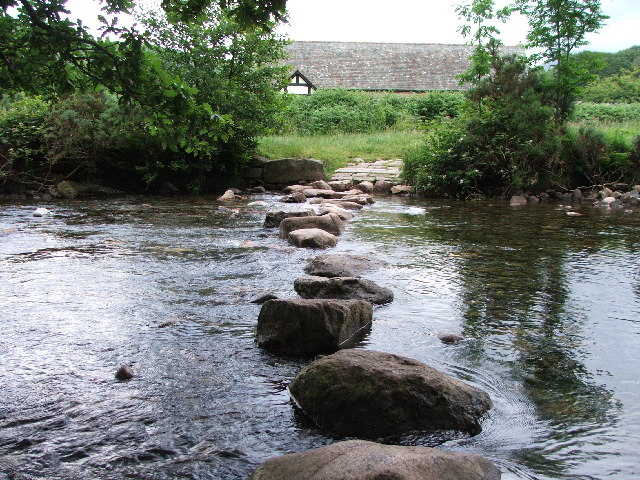
Image from Wikipedia

The next turn of the road showed them the red peaked roofs of the closely packed houses lying almost directly below the hill on which they were. The full autumn sun brought out the ruddy colour of the tiled gables, and deepened the shadows in the narrow streets.

Image from Wikipedia

The narrow harbour at the mouth of the river was crowded with small vessels of all descriptions, making an intricate forest of masts.
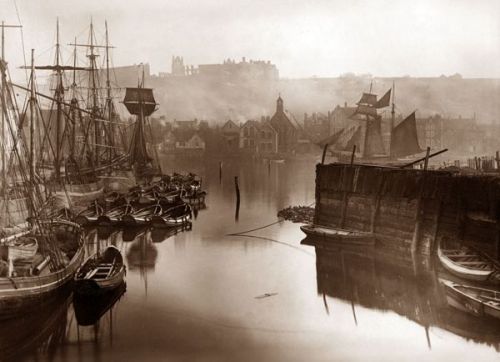
Image from Wikipedia – sepia photograph by Frank Sutcliffe, dated around 1890

There the old stone cross was raised by the monks long ago; now worn and mutilated, no one esteemed it as a holy symbol…

Image © bythestars – Caedmon’s Cross at St Mary’s Churchyard, Whitby

The red and fluted tiles of the gabled houses rose in crowded irregularity on one side of the river…

Image from Wikipedia

The fresh salt breeze was bringing up the lashing, leaping tide from the blue sea beyond the bar. Behind the returning girls there rocked the white-sailed ship, as if she were all alive with eagerness for her anchors to be heaved.
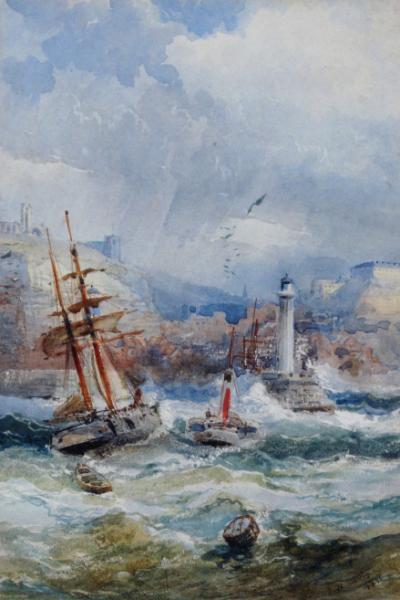
Image from Wikipedia – Whitby 1886, a watercolour on paper by Frederick William Booty

I hope these pictures have helped bring Gaskell’s writing to life for you! I’ll be posting my thoughts on Sylvia’s Lovers after I’ve finished reading the book.
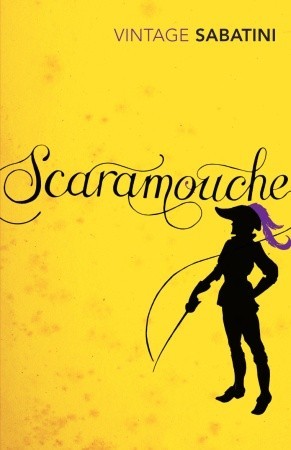
Scaramouche by Rafael Sabatini

Scaramouche is set at the beginning of the French Revolution and tells the story of Andre-Louis Moreau, a young lawyer from Britanny who has been brought up by his godfather, a man who many people believe is really his father. Andre-Louis has little interest in politics until his friend Philippe, who is passionate about the revolutionary cause, is provoked into fighting a duel with the Marquis de La Tour d’Azyr. It’s a duel Philippe has no chance of winning and when he is killed by the Marquis, Andre-Louis considers it to be murder.

Deciding that his friend’s voice must not be silenced, Andre-Louis speaks out against the privileged classes but when his speeches turn out to be much more successful than he expected, he finds himself in trouble with the law and is forced to run for his life. Joining a group of travelling actors, he takes the role of Scaramouche and discovers he has a natural talent for both acting and writing plays. First as Scaramouche, then as a fencing master and a politician, Andre-Louis sets in motion a plan for taking revenge on the man who killed Philippe.

From the wonderful opening line of this 1921 novel by Rafael Sabatini (“He was born with a gift of laughter and a sense that the world was mad”) I could tell I was going to love Scaramouche! And I did – it’s one of the best books I’ve read so far this year. The story involves a bit of everything: action, romance, history, political intrigue, humour and adventure.

Some readers might find Andre-Louis too unbelievable as a character, in the way he seems to succeed at almost everything he does, whether it’s acting, writing, orating or fencing, as well as being clever, courageous, quick-witted and charismatic. I can definitely understand this point of view, but it wasn’t really a problem for me. I thought he was a great character and I was able to suspend disbelief enough to just accept that he was good at everything! And he’s not perfect; he can be difficult to like at times and is often described by other characters as heartless (though we, as the reader, know that sometimes he’s putting on an act and not showing his true feelings). He does have flaws, he makes mistakes and his motives are not always easy to understand. His enemy, the Marquis, is another interesting character with more depth than he appears to have at first and some good qualities as well as bad ones – he’s more than just a stereotypical villain.

My favourite part of the book was the section in the middle where Andre-Louis joins the troupe of Commedia dell’Arte actors. Before I read this book I admit that I would have been unable to explain exactly what Commedia dell’Arte involved; now I know that it’s a form of improvisational theatre where the actors perform ‘scenarios’ or sketches, with each member of the group taking on one specific role. The best known of the stock characters found in Commedia dell’Arte, all of which have their own costumes and characteristics, include Harlequin, Pierrot, Pantaloon, Columbine and Scaramouche, who Wikipedia describes as a ‘roguish clown character’. Andre-Louis seems to identify with the character so much that even when he’s not acting he still sometimes thinks of himself as ‘Scaramouche’.

The events leading up to the French Revolution are central to the plot but this aspect of the book never became too overwhelming so if you don’t have much knowledge of the historical background it shouldn’t be a problem. There’s a good balance of historical detail and swashbuckling action, and there’s always something happening: a swordfight, a last-minute escape or a dramatic revelation. The fencing and duelling scenes are well written though I wished I understood all the terminology so I could fully appreciate Andre-Louis’ skill!

I’m not sure why it never occurred to me before to read Sabatini, considering he’s often compared to Alexandre Dumas, who I love. Having now read this book, I can understand the comparisons. Scaramouche has a lot in common with The Count of Monte Cristo, one of my favourite novels of all time (they are both historical adventure novels with a French setting, both have vengeance and justice as major themes and the character of Andre-Louis reminded me in some ways of Edmond Dantes). If you like Dumas or other books of this type, then I would highly recommend giving Scaramouche a try. I’ll definitely be reading more of Sabatini’s books – Captain Blood next, I think.

Ivanhoe by Sir Walter Scott

Sir Walter Scott is one of those authors who I’ve always felt intimidated by, for some reason assuming I would find him difficult to read. And yet, I had a feeling I would probably enjoy his books if I could just get around to actually reading them. I had no idea which book would be the best to start with, but as Ivanhoe is probably his best known novel I decided to try that one first.

Ivanhoe is set in England towards the end of the 12th century, during the reign of Richard the Lionheart, who has been away fighting in the crusades, leaving behind his brother Prince John plotting and scheming in his absence. The title character, Wilfred of Ivanhoe, banished and disinherited by his father, has just returned to England and on his return he becomes swept up in a series of adventures involving feuding Saxon and Norman noblemen, a beautiful Jewish girl, Robin Hood and a mysterious Black Knight.

Anyone with an interest in the medieval period and tales of chivalry will find that Ivanhoe has everything you would expect to see in this type of novel: jousting, sword-fighting, archery, tournaments, castles under siege, damsels in distress, bands of outlaws in the woods, and knights in shining armour. I loved it! I discovered that although Walter Scott’s writing is very descriptive and long-winded (lots of detailed descriptions of clothing and weapons etc) I didn’t have any problems understanding what was happening. The dialogue is written in an archaic style but it’s still readable and it all adds to the medieval atmosphere of the story.

I have no idea how much of the historical background is accurate but what does come across strongly is the resentment between the Saxons and the conquering Normans, as well as the tensions between Christians and Jews. Scott introduces us to characters from all four of these groups, which sets the scene for most of the conflict in the novel (the Saxons, for example, are represented by characters such as Cedric, Ivanhoe’s father, who still views the Normans as invaders more than a century after the Battle of Hastings and the Norman conquest). The attitudes of many of the characters towards the Jews are very negative, but I got the impression that this didn’t reflect Walter Scott’s own opinions. I thought he portrayed the Jewish characters themselves in quite a sympathetic way, which was good to see considering the time period in which this book was written. Rebecca, the daughter of Isaac the Jewish moneylender, was one of the strongest characters in the novel and much more interesting than the other heroine, Rowena.

I thought Ivanhoe himself was a bit of a disappointment. When he made his first appearance as the Disinherited Knight I thought he was going to be a great character, but he quickly seemed to fade into the background and was overshadowed by some of the other, more memorable characters – including the Black Knight, Wamba the Jester, Gurth the Swineherd, and the three villainous Norman knights, Front-de-Boeuf, de Bracy and Brian de Bois-Guilbert. I had never realised there was any connection between Robin Hood and Ivanhoe, but he appears in the novel under the name Locksley, and we also meet a friar living in a hermitage in the forest (Friar Tuck). Apparently Ivanhoe inspired the image of Robin Hood we have today and brought into popular use a lot of the elements of the Robin Hood legend.

So, now that I’ve read Ivanhoe and enjoyed it, which Sir Walter Scott book should I try next? Any recommendations are welcome!

Classics Challenge – April: Book Covers

This year I am taking part in a Classics Challenge hosted by Katherine of November’s Autumn. The goal is to read at least seven classics in 2012 and every month Katherine will be posting a prompt to help us discuss the book we are reading. I missed answering last month’s question, on the subject of settings, but might go back and answer that one at a later date. This month the focus is on book covers.

The classic novel I’m currently reading is Ivanhoe by Sir Walter Scott, which I’m really enjoying and finding easier to read than I had expected. Now that I’m no longer intimidated by him I’m sure I’ll be reading more of his work in the future. I’ll be posting my thoughts on Ivanhoe after I’ve finished the book.

I’m reading this novel as a free ebook and it doesn’t actually have a cover image, so instead I’m going to look at the covers of a few different editions of Ivanhoe.

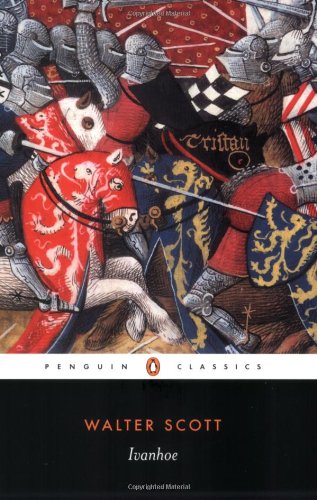
This is the cover of the Penguin Classics edition. The cover image shows ‘detail from a 15th century French illuminated manuscript showing a tournament‘.

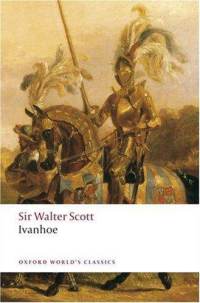
And here is the cover of the Oxford World’s Classics edition. The cover illustration is ‘Knight Enters the Lists at the Eglinton Tournament, of Archibald William Montgomery (13th Earl of Eglinton) by Edward Henry Corbauld (1815-1905)‘.

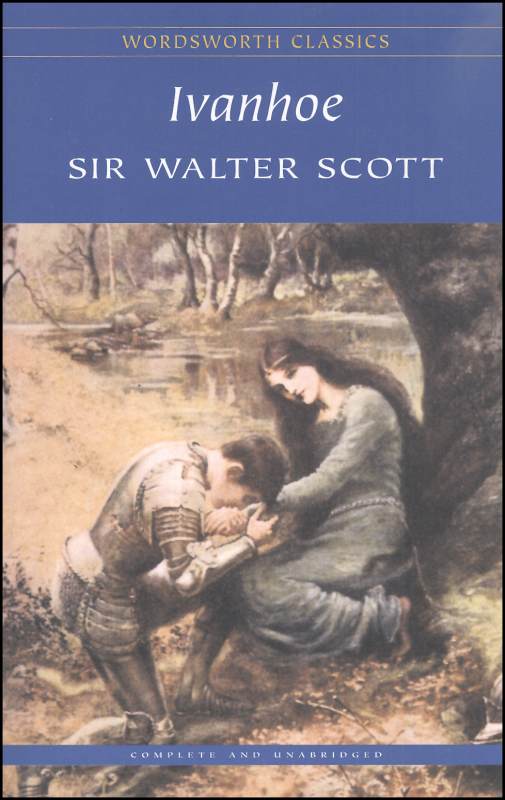
The third image I want to include here is the cover of the Wordsworth Classics edition. As you can see, this one is very different to the other two and shows ‘A medieval knight with his young lover (1898) by P. Clarke‘.

It’s interesting that only one of these three publishers has chosen to focus on the romantic aspect of the novel – if you picked up one of the other two without knowing anything about the story you would never guess there was any romance involved.

What do you think? Which of these covers would make you more likely to read the book?

Clarissa Group Read: March update

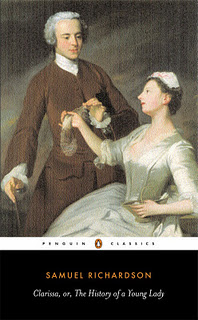
I’m taking part in a year-long group read of Clarissa by Samuel Richardson hosted by JoAnn and Terri. The story is told in the form of 537 letters, the first being dated 10th January and the last 18th December. The idea of reading Clarissa over an entire year is so that the letters can be read on or close to the dates mentioned in the book.

This is my first post on Clarissa since I started reading the book in January – I didn’t post an update in February as I wasn’t very far into the book at that point and felt I didn’t really have much to say about it. Following the group read schedule of reading the letters on or around the correct dates, January and February were lighter months in terms of the number of letters we needed to read (11 in total for those two months); March was much more intense (61 letters) and it didn’t surprise me at all that I soon found myself falling behind. This time last week I was starting to despair of ever making any progress with this book and was wondering whether I really wanted to continue with it – however, I decided to make a big effort to get caught up and I managed to finish the March letters this morning.

Like the January and February letters most of this month’s letters have been between our title character, Clarissa Harlowe, and her friend Anna Howe. Despite the fact that I’m now 3 months and 72 letters into the novel very little has actually happened in terms of plot advancement. Clarissa’s family are determined to keep her away from Lovelace and to force her to marry Mr Solmes, but Clarissa is equally determined not to marry him. It’s all getting very repetitive, with various members of the family pleading with her, commanding her or trying to bully her into doing as they request, and Clarissa refusing to give in to their demands. I was beginning to get impatient, wondering when Lovelace would eventually appear – and we finally heard from him in Letter 31.

Although Lovelace hasn’t yet done anything too bad (other than bribing one of the Harlowe’s servants to spy for him) it’s obvious that he really is going to be the villain Clarissa’s family and friends have suggested he is. He claims to love Clarissa, but it seems that he’s more interested in getting revenge on her family. I was interested to read Samuel Richardson’s footnote where he felt the need to explain some of Lovelace’s motives, as he was apparently disappointed that so many of his readers liked Lovelace and had been misinterpreting his letters. Personally I don’t there’s a single character in this novel that I actually like – though I do have sympathy with the position Clarissa is in and am very glad I’m not living in the eighteenth century!

After Lovelace’s appearance I thought the plot might start to move forward at last, but after Letter 72 things are still the same. The repetitiveness is very effective in showing how Clarissa is running out of options and how hopeless her situation is, but at the moment I feel as if the story is just going round in circles. I’m now ready to start reading the April letters and although I’m feeling much more positive about the book than I was a couple of weeks ago, I hope something is going to happen soon!

Three Men on the Bummel by Jerome K. Jerome

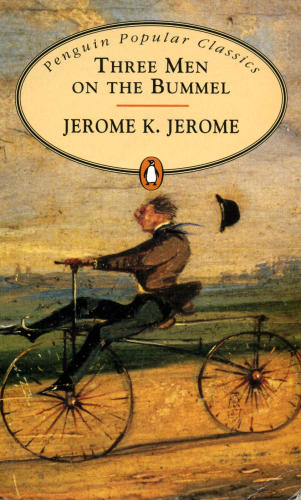
Last year I read Jerome K. Jerome’s Three Men in a Boat (To Say Nothing of the Dog) which was one of my favourite books of 2011 and one of the funniest books I’ve ever read. Three Men on the Bummel is the sequel, less well known but still worth reading. It’s set a few years after Three Men in a Boat but it’s not really necessary to read them in the correct order. In this book we join our old friends J, Harris and George again (this time without Montmorency the dog) on a bicycle tour across Germany’s Black Forest. There’s not much of a plot – like the first book, the whole story really just consists of a series of mishaps and disasters, funny anecdotes told by the three friends, descriptions of the places they visit, and some philosophical musings and observations from our narrator, J.

The humour in this book is very much the same as in the first and some of the stories are very similar too (if you remember reading about Uncle Podger in Three Men in a Boat, for example, there are more Uncle Podger stories here). But I did start to lose interest a little bit towards the end of the book and I couldn’t help feeling that maybe Jerome had used up most of his better ideas in the previous book. There’s nothing here that has stuck in my mind the way the pineapple incident or the Hampton Court maze did, to give just two examples. But there are still some moments that stand out: George being accused of embarking on a life of crime after getting on a train with the wrong ticket, the three of them being lost on a hillside arguing over which way was north, Harris and his encounter with a man watering the road, George’s experiment with a phrase book, and a few others. My favourite was the trick J and Harris play on George, leading him to believe a statue is following him around the town, appearing in four different places at once.

“Why, that thing,” said George; “look at it! There is the same
horse with half a tail, standing on its hind legs; the same man
without his hat; the same–”

Harris said: “You are talking now about the statue we saw in the
Ringplatz.”

“No, I’m not,” replied George; “I’m talking about the statue over
there.”

“What statue?” said Harris.

George looked at Harris; but Harris is a man who might, with care,
have been a fair amateur actor. His face merely expressed friendly
sorrow, mingled with alarm. Next, George turned his gaze on me. I
endeavoured, so far as lay with me, to copy Harris’s expression,
adding to it on my own account a touch of reproof.

“Will you have a cab?” I said as kindly as I could to George.
“I’ll run and get one.”

The German setting in my opinion didn’t work as well as a backdrop for the novel as the River Thames did in Three Men in a Boat but it does give Jerome an opportunity to have fun with British and German stereotypes (though in a gentle way, I thought) and the misunderstandings that could arise from differences in language and culture. He spends a lot of time discussing different attitudes to law and order for example:

Nowhere, and under no circumstances, may you at any time in Germany walk on the grass…The very dogs respect German grass; no German dog would dream of putting a paw on it. If you see a dog scampering across the grass in Germany, you may know for certain that it is the dog of some unholy foreigner. In England, when we want to keep dogs out of places, we put up wire netting, six feet high, supported by buttresses, and defended on the top by spikes. In Germany, they put a notice-board in the middle of the place, “Hunden verboten,” and a dog that has German blood in its veins looks at that notice-board and walks away.

Overall this wasn’t quite as funny as Three Men in a Boat and I can see why it’s not as popular, but I still enjoyed reading it. Both books were written in the late Victorian period (this one was published in 1900) but I would recommend them even to people who don’t usually like Victorian fiction as they do have quite a modern feel and a lot of the humour is still relevant today.

Oh, and if you’re wondering what the word ‘bummel’ means, it is explained but you’ll have to wait until the end of the book to find out!

Great Expectations by Charles Dickens

Despite my love of Victorian literature, Charles Dickens has never appealed to me as much as other 19th century writers and until recently the only Dickens novel I had actually read was A Christmas Carol. A couple of years ago I decided to give him another chance and although I still don’t think Dickens will ever be one of my favourite Victorians, I’m pleased to say that my opinion of his work is rapidly improving with every book of his I read!

Great Expectations is narrated by Pip, a young orphan who is brought up by his sister and her husband, Joe Gargery, a blacksmith. Near the beginning of the book two important incidents occur: first Pip meets an escaped convict in the graveyard near his home, and then soon after this he is invited to visit the eccentric Miss Havisham who lives at Satis House. When Pip unexpectedly receives a large sum of money he moves to London to become a gentleman and leaves his old friends behind. But who is the mysterious benefactor and will Pip’s ‘great expectations’ really change his life for the better?

I won’t go into the plot in any more detail for two reasons: firstly, because I suspect many of you will already be familiar with the story even if you haven’t read the book, and also because I wouldn’t want to spoil any of the surprises and plot twists the novel contains. But as well as the wonderful plot, Great Expectations is also full of strong and memorable characters. Miss Havisham, hidden away in her ruined mansion wearing her wedding dress, is probably the one most people will think of when they think of this book, but from the convict Abel Magwitch and Pip’s best friend Herbert Pocket to the lawyer Mr Jaggers and Miss Havisham’s adopted daughter Estella, the book is full of unforgettable characters. I posted a few weeks ago about one of my favourites, Joe Gargery, and how sad it is to see the way Pip’s relationship with Joe changes after he is given his great expectations.

If you’ve never read any Dickens before, I think this might be a good place to start. I’ve read four of his other novels (A Christmas Carol, Bleak House, Our Mutual Friend and The Mystery of Edwin Drood) and in comparison to some of those, I thought this one was much easier to read and understand. And I loved all the observations on life and human nature that Dickens scatters throughout his writing, like this:

“That was a memorable day to me, for it made great changes in me. But, it is the same with any life. Imagine one selected day struck out of it, and think how different its course would have been. Pause you who read this, and think for a moment of the long chain of iron or gold, of thorns or flowers, that would never have bound you, but for the formation of the first link on one memorable day.”

Or this:

“So, throughout life, our worst weaknesses and meannesses are usually committed for the sake of the people whom we most despise.”

Now I just need to decide which of Dickens’ books I should try next. I have three of his novels on my list for the Classics Club: David Copperfield, A Tale of Two Cities and Oliver Twist. Have you read any of those or is there another one you would recommend?