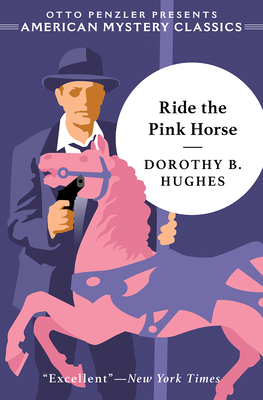
Ride the Pink Horse by Dorothy B Hughes

Ride the Pink Horse was the book chosen for me in the last Classics Club Spin and I have finished it just in time to write about it by the Spin deadline, which is this weekend. There were two reasons why I added this book to my Classics Club list in the first place. One was that I loved Dorothy B Hughes’ The Expendable Man and wanted to read more of her work; the other, I have to admit, was that I liked the title. Otherwise, I would probably never have picked this book up based on the description alone as it didn’t really sound like my usual sort of read. And that would have been a shame, as I thoroughly enjoyed it!

Ride the Pink Horse was published in 1946 and is set in Santa Fe during Fiesta, a festival commemorating the reconquest of New Mexico by the Spanish. The central character, known only as Sailor, was once ‘confidential secretary’ to Senator Willis Douglass (in reality, his job involved carrying out the corrupt senator’s dirty work for him) until the day the senator’s wife was murdered during what appeared to be an attempted robbery. Only Sailor and the Sen, as he calls him, know what really happened that day and Sailor is determined that if the Sen wants him to keep quiet then he will have to pay him for his silence. Sailor has followed the Sen to the Fiesta, planning to get as much money out of him as possible and then cross the border into Mexico to start a new life – but he hasn’t bargained for the appearance of McIntyre, a Chicago detective who is also on the senator’s trail in search of answers.

The first thing I should tell you about Ride the Pink Horse is that it’s not really a mystery, even though it’s currently being published as part of the Otto Penzler American Mystery Classics series. There’s a detective, but we don’t actually watch him doing any detecting because we see everything solely from Sailor’s perspective and Sailor already knows how the Sen’s wife was murdered. However, there’s still plenty of suspense as we are kept wondering whether Sailor will get what he wants from the Sen or whether he will drop his attempt at blackmail and tell McIntyre what he knows instead. The way in which the novel is written meant I honestly had no idea what would happen and which choices Sailor would make, so I found the ending both surprising and realistic.

The next thing I want to mention is the setting, which is wonderfully atmospheric. Santa Fe is not actually mentioned by name – Sailor, who is from Chicago, just refers to it as a ‘hick town’ – but it can be identified by the descriptions of the Fiesta and the festival traditions such as the burning of Zozobra, the wooden effigy of ‘Old Man Gloom’. Hughes creates an amazing sense of place and a feeling that, for Sailor, Fiesta is not a fun or exciting experience but a stifling, claustrophobic one – a trap from which there is no escape:

The whole town was a trap. He’d been trapped from the moment he stepped off the bus at the dirty station. Trapped by the unknown, by a foreign town and foreign tongues and the ways of alien men. Trapped by the evil these people had burned and the ash had entered into their flesh.

Sailor himself is not a very appealing or pleasant character, but as we learn more about his past – and his unhappy childhood, growing up in poverty with an alcoholic father – it becomes easier to have sympathy for him. One of his least attractive traits is his racism, so be warned that he uses offensive language to describe the Mexican and Native American people he meets during Fiesta. However, as he gradually befriends Pancho, a good-natured merry-go-round owner, and Pila, the young girl who rides the ‘pink horse’ of the title, there are signs that his attitude is beginning to change, as seen here in this conversation with McIntyre:

“…they don’t shove you around. They give you a smile. Even if you don’t talk their language they don’t shove you around. The way we shove them around when they come up to our town.”

“I know,” Mac said. “I’ve thought sort of along that line myself. We’re the strangers and they don’t treat us as strangers. They’re tolerant. Only they’re more than tolerant. Like you say, they’re friendly. They give you a smile not scorn.”

I loved this book and am so pleased it came up for me in the Classics Club Spin! I think The Expendable Man is still my favourite of the two, but I’m looking forward to reading more by Dorothy B Hughes; In a Lonely Place will probably be next.

This is book 25/50 read from my second Classics Club list
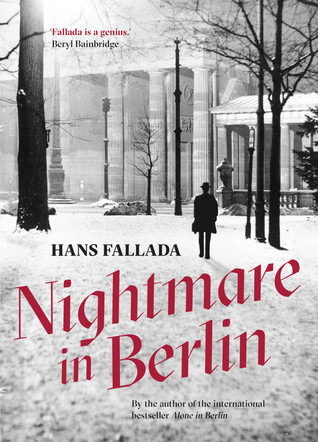
Nightmare in Berlin by Hans Fallada

The war had destroyed everything, and all that was left to him were the ruins and the ugly, incinerated detritus of former memories.

For this year’s German Literature Month, hosted by Lizzy and Caroline, I decided to read a book by one of my favourite German authors, Hans Fallada. Nightmare in Berlin was one of his final novels, written just before his death in 1947, and although I don’t think it’s as good as some of his others – particularly Alone in Berlin and Little Man, What Now? – I did find it an interesting and powerful read. This 2016 translation by Allan Blunden is the first time the book has been made available in English.

Nightmare in Berlin begins in the spring of 1945, just as the war ends and the Red Army march into Berlin. Dr Doll, who had been a successful author before the war, and his much younger wife Alma, live in a small rural town and, unlike most of their neighbours, choose to welcome the Soviet troops into their home. Doll is rewarded by being appointed mayor of the town, but soon finds that he is being viewed with suspicion and resentment by his fellow Germans. Eventually, they decide that it’s time to move back to Berlin, having fled from the city to the countryside during the war. When they arrive in Berlin, however, they discover that someone else has moved into their apartment and that it’s going to be much harder than they’d expected to pick up the threads of their old life.

As Doll sets out to look for help in finding somewhere to live and in getting medical treatment for his wife’s injured leg, he is struck by the greed and selfishness of many of the people he encounters, who think nothing of cheating other Germans to get what they want. Disillusioned and depressed, Doll is overcome with shame and apathy, beginning to despair for Germany’s future.

In this time of the country’s collapse and defeat, no feelings last for long; the hatred passed away, leaving only emptiness, deadness, and indifference behind, and people seemed remote, out of reach.

Although this is obviously quite a bleak novel, it does have its more uplifting moments: there are times when Doll is shown some kindness and compassion, restoring his faith in human nature at least temporarily. The relationship between Doll and Alma is portrayed as a warm and loving one, so that no matter what is going on around them, they know they can always rely on each other. However, the Dolls are also both reliant on drugs, taking morphine and sleeping pills to escape from reality and get through the day, and the middle section of the novel follows their experiences in the hospitals and sanatoriums where they are being treated for their addictions. This part of the book was of much less interest to me (I wanted to see more of post-war Berlin, rather than the inside of a hospital) and I felt that it seemed to come out of nowhere – drugs were never mentioned until the Dolls left their rural town to return to Berlin and yet they had apparently both been addicts for a long time.

Nightmare in Berlin seems to be a very autobiographical novel. Hans Fallada (born Rudolf Wilhelm Friedrich Ditzen) struggled with morphine addiction himself, as did his younger second wife, Ursula Losch. Like Dr Doll, he was appointed mayor of a small country town shortly after the Soviet invasion and then spent the remainder of his life going in and out of hospital. I think the book might have worked better as non-fiction rather than a novel, but maybe Fallada found it easier to write about his own experiences by disguising them as fiction. Still, this is a fascinating novel and worth reading for the insights it offers into the mood of the German people in the aftermath of the war.

This is book 24/50 from my second Classics Club list.

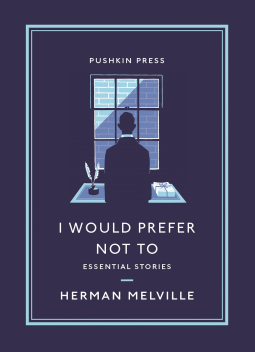
I Would Prefer Not To by Herman Melville

I’ve never read anything by Herman Melville – I know I should have read Moby Dick by now, but it has never sounded appealing to me – so when I spotted this new collection of Melville short stories from Pushkin Press it seemed a good opportunity to experience some of his work without having to commit to a 600+ page novel.

I Would Prefer Not To contains four stories, although the final one takes up more than half the book and is probably better described as a novella. My favourite was the first story, Bartleby the Scrivener, which was first published in Putnam’s Magazine in 1853. The narrator is an elderly Wall Street lawyer who employs two clerks, or ‘scriveners’ – Turkey and Nippers – whose job is to make copies of legal documents, and one office boy, Ginger Nut. An increase in work leads the lawyer to look for a third scrivener and, as he has been having difficulties with the temperamental natures of the other two, he decides to hire Bartleby, a quiet man whom he hopes will be a good influence on the others.

At first Bartleby works hard at his copying, but when the lawyer asks him to proofread a copied document, he replies with, “I would prefer not to”. Over the following days, he refuses to do more and more of the tasks that are requested of him – never giving an angry or rude response; always just those same five words: “I would prefer not to”. As the lawyer decides how to deal with this unexpected problem, the reader wonders what is wrong with Bartleby and what has caused his unusual behaviour. I enjoyed the story, but it left me very confused and I didn’t really understand what Melville was trying to say. However, after turning to Google for help, it seems that the meaning of the story was deliberately ambiguous and it can be interpreted in many ways, which made me feel a lot better about not understanding it!

Next is The Lightning-Rod Man, a short and intriguing tale of a salesman who arrives at the narrator’s house in Albania during a thunderstorm and tries to sell him a lightning-rod. The narrator is sceptical and says he will trust God to keep him safe, but the salesman won’t take no for an answer. Again, the meaning is not immediately obvious, but it’s an entertaining story and reminded me of Edgar Allan Poe. The third story, John Marr, is the weakest in the book, in my opinion. The title character is a retired sailor trying to adjust to a life on land, in a remote community on the American prairies. Feeling isolated and out of place, he remembers his seafaring days through songs and poems. The piece included in this collection is taken from John Marr and Other Sailors, a volume of poetry published in 1888, so maybe it would have worked better if read in the context of the original book.

Finally, we have the novella Benito Cereno, in which an American sea captain sailing off the coast of Chile encounters a Spanish slave ship in distress. Boarding the ship to see if he can help, he meets the Spanish captain, Benito Cereno, who tells him how the ship came to be in trouble. As he observes the behaviour of Benito Cereno and his slaves, he begins to wonder whether there is more to this than meets the eye. This was another interesting story, but I felt that it was much too long and too easy to guess the twist; we see things only through the eyes of the narrator, who is frustratingly oblivious to what is really happening on the Spanish ship. It was also another difficult one to interpret: was it a racist, pro-slavery story or an anti-racist, anti-slavery story? It could be either and it can’t be assumed that the views of the narrator reflect the views of the author.

So, now that I’ve had my introduction to Herman Melville, will I be reading Moby Dick? At the moment I think I would prefer not to, but maybe I’ll be ready to tackle it one day in the future!

Thanks to Pushkin Press for providing a copy of this book for review via NetGalley.

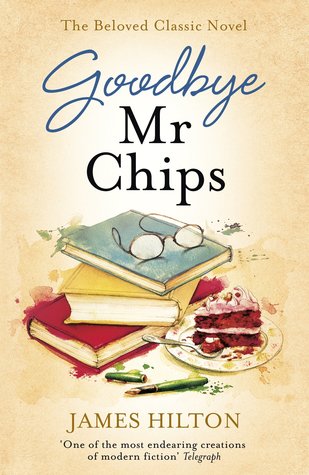
Goodbye, Mr Chips by James Hilton

Since reading James Hilton’s Lost Horizon, which I loved, I have wanted to try more of his work – and although it’s taken me a few years, I’ve finally read another of his books! If I’d known how short Goodbye, Mr Chips was I would have tried to read it before now; there are only about 120 pages in my edition, so it’s a very quick read.

Before starting the book, I thought I already knew the story because I’ve seen two of the adaptations – the 1939 one and the 1969 musical version (both of which I enjoyed). The earlier film is much more faithful to the book, but neither follow the original story exactly and there are incidents in both that don’t appear in Hilton’s text. The novella tells the story of Mr Chipping, a quiet, unassuming teacher, and follows his career at the fictional Brookfield School over a period of many decades. Chipping – or Mr Chips as the boys call him – teaches Greek and Latin and, as the years go by and the world begins to change around him, he gains a reputation for being old-fashioned and traditional, reluctant to embrace new teaching methods and belonging to an earlier time. We first meet him as an old man – the sort of old man people struggle to imagine ever being young:

…white-haired and only a little bald, still fairly active for his years, drinking tea, receiving callers, busying himself with corrections for the next edition of the Brookfeldian Directory, writing his occasional letters in thin, spidery, but very legible script. He had new masters to tea, as well as new boys. There were two of them that autumn term, and as they were leaving after their visit one of them commented: “Quite a character, the old boy, isn’t he? All that fuss about mixing the tea — a typical bachelor, if ever there was one.”

Of course, Mr Chips was young once and the boys would have been surprised to learn that he wasn’t always a bachelor. Back in 1896, at the age of forty-eight he had married Katherine Bridges – and although their time together was tragically short, Katherine’s kind heart and sense of humour had a profound effect on Chips, leaving him a better person and changing his outlook on life.

The story is told in a series of flashbacks, with the elderly Mr Chips looking back on his life and career, remembering not only the happy days of his marriage to Katherine, but also the more difficult times he has lived through, such as the First World War. It’s a nostalgic and sentimental book, but quite a sad and poignant one too. I found it too short to be completely satisfying and I think this is one of the few occasions where I would say I preferred the film – either of them – to the book, but I did still enjoy it and am looking forward to reading Random Harvest, the other James Hilton novel I have on my TBR.

This is book 23/50 read from my second Classics Club list.

Carmilla by Sheridan Le Fanu

My first book for this year’s RIP challenge is Irish author Joseph Sheridan Le Fanu’s classic vampire novella, Carmilla. First published in 1872, it is thought to have influenced Bram Stoker’s Dracula, which came more than twenty years later, and is one of the earliest examples of vampire fiction (although John Polidori’s The Vampyre and Byron’s Fragment of a Novel were written earlier still).

My previous experience with Le Fanu has been limited to his Victorian Gothic novel, Uncle Silas, and one of his short stories, Laura Silver Bell, both of which I read ten years ago. I’ve always intended to read more of his work, so when I saw Carmilla available through NetGalley (a new Deluxe Edition is being published by Pushkin Press this week) it seemed the perfect opportunity.

The story is narrated by nineteen-year-old Laura, who lives in a lonely castle in Styria, Austria, with only her father and governesses for company. Laura longs for a friend her own age and it seems she may get her wish when a young woman is injured in a carriage accident near the castle. Her name is Carmilla and her mother, who is desperate to continue on her journey, asks Laura’s father to take care of her daughter until she returns. Laura is delighted to have Carmilla staying with them, but also feels uneasy, because she has seen Carmilla before – in a dream that has haunted her since her childhood.

As this is a very short book, if I say much more I will be giving away the entire plot – and anyway, as I’ve already said that this is a vampire novel, you can probably guess what Carmilla really is and how the rest of the story will unfold. For the modern day reader there are no big surprises here, although I’m sure that at the time when it was published, as one of the first of its kind, it would have felt much more original and shocking. However, there are still plenty of things that make this book an entertaining and worthwhile read.

First of all, it’s interesting to read Carmilla while keeping in mind its place in history and its influence on later vampire fiction – there are some very obvious similarities with Dracula and Anne Rice has cited it as an inspiration for her Vampire Chronicles. It can also be read as an early example of a lesbian romance; although the constraints of 19th century fiction prevent Le Fanu from being too explicit, the relationship between Laura and Carmilla is clearly based upon physical attraction and we learn that Carmilla always chooses young women as her prey. Finally, with its sinister atmosphere, remote castle setting and other elements of classic Gothic literature, it’s the perfect choice if you’re taking part in the RIP event or just looking for something dark and spooky to read as we head towards Halloween!

Thanks to Pushkin Press for providing a copy of this book for review via NetGalley.

Book 1 read for R.I.P XVI

St Martin’s Summer by Rafael Sabatini

St Martin’s Summer is a term used to describe a period of unusually warm weather taking place in early November – but the title of this Rafael Sabatini novel from 1909 has a double meaning, as the name of our hero is also Martin: Martin Marie Rigobert de Garnache. When a young heiress, Valerie de la Vauvraye, writes to the Queen of France requesting urgent help, Garnache is the man the Queen sends to her assistance. Valerie is betrothed to Florimond de Condillac, but Florimond has been away fighting in Italy for the last three years and in his absence his stepmother, the Marquise de Condillac, has been trying to marry the girl to her own son, Marius, instead. Can Garnache rescue Valerie from the Marquise’s clutches and reunite her with Florimond?

Having read Rafael Sabatini’s most famous novels, Scaramouche, Captain Blood and The Sea-Hawk, I have moved on to his lesser known titles and have had mixed success with the ones I’ve chosen so far; some I have enjoyed, while others have been disappointing. I had high hopes for St Martin’s Summer, which seemed to be a popular one and came highly recommended by a blog reader (thank you, Cheryl T) – and I’m pleased to say that it definitely lived up to my expectations.

First of all, it’s a lot of fun to read. Set in early 17th century France, the story itself is quite simple and straightforward, revolving entirely around Garnache’s attempts to free Valerie from her imprisonment in the Chateau de Condillac and the Marquise’s attempts to thwart him. What makes the book so entertaining, though, are the lengths both sides go to in their efforts to get one step ahead: there are duels, disguises, impersonations and all sorts of other tricks and deceptions, some of which are obvious to the reader, but not to the characters, who repeatedly fall into each other’s traps!

Garnache is a wonderful character. Like many of Sabatini’s heroes, he has great courage, a quick brain and an array of other skills and talents, but also one or two serious flaws – in this case an inability to keep his temper under control:

The greatest stumbling-block in Garnache’s career had been that he could never learn to brook opposition from any man. That characteristic, evinced early in life, had all but been the ruin of him. He was a man of high intellectual gifts, of military skill and great resource; out of consideration for which had he been chosen by Marie de Medicis to come upon this errand. But he marred it all by a temper so ungovernable that in Paris there was current a byword, ‘Explosive as Garnache.’

Garnache’s temper gets him into trouble and ruins his plans again and again, which is frustrating to watch but makes him a more believable and sympathetic character than he would otherwise have been. At the beginning of the book he also has a low opinion of women – he has remained single to the age of forty – but as he spends more time in the company of Valerie, as well as being forced to pit his wits against such a formidable female opponent as the Marquise de Condillac, he begins to change his views! The Marquise is obviously a great villain, but I also liked Garnache’s quick-thinking servant Rabecque, who is sometimes more perceptive than his master, and Monsieur de Tressan, the Seneschal of Dauphiny, a cowardly man who tries to ‘run with the hare and hunt with the hounds’.

I really enjoyed this book – it was so much better than my last Sabatini, The Minion, and I hope my next choice will be another good one!

~

Book 22/50 from my second Classics Club list

Book 35/50 read for the 2021 Historical Fiction Reading Challenge.

Book 8/20 of my 20 Books of Summer 2021

I Will Repay by Baroness Emmuska Orczy

I haven’t been very successful recently at finishing the books chosen for me by the Classics Club Spins, so I decided to make an early start on my current Spin book, I Will Repay by Baroness Orczy – and have finished it three weeks before the 22nd August deadline! It helped that it was a relatively short book, as well as a light and entertaining one that I found easy to read.

First published in 1906, this was the first sequel to The Scarlet Pimpernel to be published, but if you’re reading the series in chronological order, as I am, it’s the fourth. I have previously read Sir Percy Leads the Band and The League of the Scarlet Pimpernel and found them both disappointing in comparison to the original book, but I’m pleased to say that this one was more enjoyable. Not everyone will agree, as we do see very little of the Scarlet Pimpernel and nothing at all of his wife Marguerite, but I thought it was quite an exciting and gripping story in its own right.

The novel opens in 1783 with Paul Déroulède and the young Vicomte de Marny fighting a duel in a Paris tavern. When the Vicomte is accidentally killed, his father, devastated at losing his son and heir, forces his other child, fourteen-year-old Juliette, to swear an oath promising to avenge her brother’s death: “May my brother’s soul remain in torment until the final Judgment Day if I should break my oath, but may it rest in eternal peace the day on which his death is fitly avenged.”

Ten years later, the Revolution is underway and Paris has become a dangerous place for a young noblewoman like Juliette:

And the afternoons were very lively. There was always plenty to see: first and foremost, the long procession of tumbrils, winding its way from the prisons to the Place de la Révolution. The forty-four thousand sections of the Committee of Public Safety sent their quota, each in their turn, to the guillotine. At one time these tumbrils contained royal ladies and gentlemen, ci-devant dukes and princesses, aristocrats from every county in France, but now this stock was becoming exhausted…

Walking through the streets one day, Juliette’s expensive lace-trimmed clothes draw the attention of a mob and she escapes from them by hammering on the door of the nearest house, which happens to be the home of Paul Déroulède. Paul, who has made himself popular with the citizens of Paris despite his own royalist sympathies, protects her from the mob and takes her into his household. As Juliette gets to know her brother’s enemy, she finds herself falling in love – so when a chance comes to send Paul Déroulède to the guillotine, she faces a very difficult decision.

You’re probably wondering where the Scarlet Pimpernel himself comes into the story; as I’ve said, we don’t see very much of him, but he does have an important role to play towards the end. However, the absence of the Pimpernel for most of the novel probably explains why this book was not more popular on its publication as people who were expecting a Scarlet Pimpernel book would have been disappointed. Personally, this didn’t really bother me as I was so caught up in the story of Juliette and Déroulède, and all the detail of this period of the French Revolution. The novel is set shortly after the assassination of Jean-Paul Marat, during the ‘Reign of Terror’, and Orczy does a wonderful job of recreating the atmosphere on the streets of Paris where anyone with a drop of noble blood risks being denounced and sent to their death. Orczy makes no secret of the fact that she is clearly on the side of the aristocrats, while the ordinary citizens of Paris are portrayed as brutal and bloodthirsty, but I suppose you would expect bias from someone who was a baroness!

Having enjoyed this one, I’m planning to continue with the next book in the series, The Elusive Pimpernel, which I’ve been told is one of the best.

This is book 21/50 from my second Classics Club list.

Book 33/50 read for the 2021 Historical Fiction Reading Challenge.