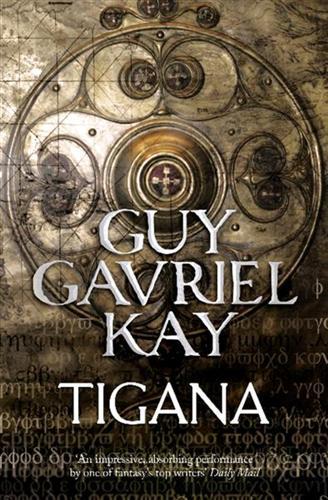
 Tigana is a fantasy novel set in the Peninsular of the Palm, a world loosely based on Renaissance Italy. Divided into nine rival provinces, the Palm is an easy target for two invading tyrants, one from the east and one from the west. Four of the Palm’s nine provinces have fallen to Alberico of Barbadior and four to Brandin of Ygrath, both powerful sorcerers, with only one province still to be conquered.
During the battle for one of these provinces, Prince Valentin of Tigana killed Brandin’s son, Stevan, which brought down Brandin’s wrath upon the entire province and its people. Brandin destroyed Tigana’s cities, its culture and its identity, then to complete his revenge he wiped all memory of Tigana and even its name from the minds of everyone in the peninsular, with the exception of those who were born in the province before the invasion. Eighteen years later, at the time when our story is set, a group of Tiganese exiles (including Prince Valentin’s only surviving son) set out to free the Palm of the two tyrants and restore Tigana’s name to the world.
This is the first book by Guy Gavriel Kay I’ve read, although I’ve been aware of his books for years and am now annoyed with myself for waiting so long to actually read one! I loved Tigana – not unreservedly, but enough to make it one of my books of the year so far.
I’ll admit to being very confused at first, as Kay doesn’t make things easy for the reader and throws us straight into a strange, unfamiliar world. Making a few notes of names and places helped, but really all that was needed was some patience. By the time I was halfway through the book, a world with one blue moon and one white, where people worship a Triad of Gods called Eanna, Adaon and Morian, and where wizards can be recognised by their two missing fingers, seemed almost as real as our own! I very rarely read fantasy anymore (not for any particular reason; I did used to enjoy it and am not sure why or when I stopped) but I actually thought that the overall feel of the book and the effort needed to understand the history, folklore and politics of the Palm were not a lot different from reading historical fiction. I could soon see the parallels with Renaissance Italy and the way its feuding city states left it vulnerable to threats from outside.
One of the things I liked about this book is that, with the possible exception of Alberico, none of the characters are portrayed as entirely good or entirely bad. The best example of this is probably Brandin of Ygrath, who at first appears to be one of the villains of the book because of what he has done to Tigana. It’s only later in the novel that we start to get closer to Brandin and see him from the point of view of the woman who loves him. This is Dianora, who is herself from Tigana and has spent several years in Brandin’s saishan (harem) on the island of Chiara, intending to kill him and lift his curse from Tigana. However, when she finds herself falling in love with him, she begins to wonder whether she’ll be able to carry her plan through to its end. I didn’t particularly like Dianora or agree with all of her choices, but I thought the scenes describing her internal conflict were very well written.
I don’t think the problem I had with Dianora was necessarily with the character herself, by the way, but more with the fact that her introduction into the novel came at a point where I had just begun to really understand the plot and to get to know Devin, Alessan, Catriana and the other characters; at that stage I didn’t want to be taken away from them and have to spend two chapters meeting a new character with a long backstory. I did become more interested in Dianora later in the book, but her sections were never my favourites and I was always glad to get back to the other characters’ storylines.
Another example of the boundaries between right and wrong becoming blurred involves the binding of a wizard. I don’t want to go into too many details as part of the fun of reading this book, being someone who doesn’t read much fantasy, was in learning about the various types of magic used in the Palm. However, the wizard binding episode raised some interesting questions. Can it ever be right to enslave a man against his will? Is the freedom of one person as important as the freedom of an entire nation?
As for the ending of the book, I both liked it and disliked it. I couldn’t quite believe in one of the romantic pairings at the end, as there had been so little hint of it throughout the book. There were other things that were left unresolved (or rather, they weren’t resolved in the way I wanted them to be) but I could accept that not everybody could have a happy ending. The revelation about one of the characters (again, I don’t want to say too much here and spoil the story for future readers) was heartbreaking! And the very last line of the epilogue is one of those final sentences that leaves you with something to continuing thinking about and trying to interpret even after you close the book and put it back on the shelf. I’ve got The Lions of Al-Rassan to read next and am excited to think that I might potentially have a new name to add to my list of favourite authors!


