The Feast by Margaret Kennedy

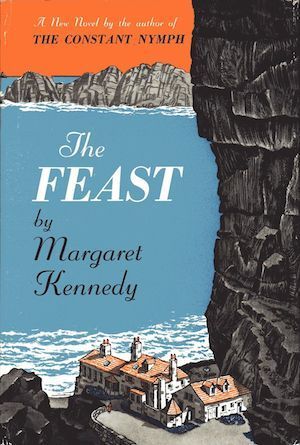
It would have been Margaret Kennedy’s birthday today and she is the next author to be featured in Jane’s Birthday Book of Underappreciated Lady Authors. Having only read three Margaret Kennedy novels – The Constant Nymph, Lucy Carmichael and Troy Chimneys – I still have a lot of her books to choose from, but I decided on The Feast for this year’s Margaret Kennedy Day as I’ve seen several people name it as a favourite. Now that I’ve read it myself I can understand why!

The Feast was published in 1950 and is set three years earlier, in the summer of 1947. The novel follows a week in the lives of a group of guests who are staying at Pendizack Hotel on the coast of Cornwall. The week will end in tragedy when part of the cliff collapses on the hotel, killing everyone inside. This is not a spoiler because the book opens with a prologue in which we see the Reverend Bott attempting to write a sermon in memory of the dead. We also know that there will be some survivors – but the identities of those who will live and those who will die won’t be revealed until the end of the book.

The hotel is owned by the Siddals, although it’s Mrs Siddal who does all the work while her lazy husband does nothing at all and their three sons, now adults, make their own plans for the future. The housekeeper, Mrs Ellis, is a bitter, resentful woman who spends most of her time gossiping about other people, so the Siddals are relying more and more on the maid, Nancibel, a friendly, kind-hearted local girl.

The guests are a varied and not particularly pleasant group of people. They include Sir Henry Gifford, his selfish wife and their four children (three of whom are adopted); Mrs Cove, a cold and heartless woman who has very little affection for her three neglected daughters; the Paleys, a couple whose marriage has been strained since the loss of their child several years earlier; bad-tempered, overbearing Canon Wraxton and his long-suffering daughter Evangeline; Anna Lechene, an unscrupulous, irresponsible writer who is working on a new book about the Brontës, and her chauffeur, a handsome young man called Bruce who tells lies to make himself sound more interesting.

I was aware before I started the book that Margaret Kennedy had based the personalities of some of her characters on the Seven Deadly Sins and this added an extra layer of interest as I matched up different characters with different sins as I read. There are some obvious villains in the novel – Mrs Cove, Lady Gifford and Canon Wraxton are particularly nasty – but others have a mixture of good and bad qualities. I knew which characters I wanted to survive and which I didn’t, but life is not always fair and people don’t always get what they deserve, so there was still an element of suspense as the story moved towards its tragic conclusion.

I loved following the lives of the Siddals, their guests and their servants. Bearing in mind that the whole story takes place over the course of just seven days, there’s an impressive amount of character development with people making life-changing decisions, searching for happiness and taking control of their own futures. With over twenty characters all playing important roles in the novel, some authors would have struggled to make each man, woman and child different and memorable, but Margaret Kennedy succeeds and the result is a really enjoyable and absorbing read. It’s probably my favourite of her books so far – although I did love Troy Chimneys as well!

Quartet in Autumn by Barbara Pym #1977Club

This is my second choice for this week’s 1977 Club (hosted by Simon and Karen) and the third book I’ve read by Barbara Pym. Having so far read only Excellent Women and Less Than Angels, I was surprised by how different Quartet in Autumn is. It’s a much darker, sadder, more poignant novel and, although I did like it, I found it a little bit depressing.

The ‘quartet’ are two women and two men – Letty, Marcia, Edwin and Norman – who work together in the same office in 1970s London. They are four very different people with different personalities, but they have two things in common: they are all in their sixties and they all live alone. Although Pym never specifies exactly what their jobs involve, it is implied that the four of them have been sharing an office for several years and have an understanding of each other’s personal circumstances and living arrangements. Despite this, and despite their loneliness, they never do anything together outside of working hours – they eat lunch separately and then go their separate ways again at the end of the day.

We learn very little about Norman, except that people consider him an ‘odd little man’ and that his social life consists solely of dentist appointments and occasional visits to see his brother-in-law, whom he dislikes. Edwin, a widower, is sometimes invited to stay with his married daughter and grandchildren, but otherwise tries to keep himself busy by taking part in as many church activities as possible. The two men seem to play slightly smaller roles in the novel, at least until halfway through when the women retire (not to be replaced) and the quartet is reduced to a duo.

Letty has always planned to move to the countryside with her friend Marjorie after her retirement, but when the unthinkable happens and Marjorie gets engaged, she is left facing a future in an old people’s home instead. But it’s Marcia who is the most tragic character – Marcia who has had surgery for breast cancer and looks forward to her trips to the hospital as ‘holiday treats’, who has developed an obsession with hoarding empty milk bottles in the garden and who attracts the unwelcome attention of a concerned social worker.

A book about four lonely people doing meaningless, unappreciated jobs and looking for ways to fill boring, empty lives does not make the most uplifting of reads, but Pym still manages to sprinkle some humour into the story and to leave us with the sense that there is some hope for our characters after all. Letty, at least, seems to want things to change and to be willing to take the first steps towards bringing about those changes.

Despite the sad, melancholic feel of the book, I think it is my favourite so far by Barbara Pym. Her observations are both witty and sensitive and I found myself really caring about Letty, Norman, Marcia and Edwin. Another good choice for 1977 Club and now I’m looking forward to reading Jane and Prudence, the other Pym novel I have on my shelf.

Early Warning by Jane Smiley

This is the second in Jane Smiley’s Last Hundred Years trilogy which follows the lives of one American family across a period of a century. The first book, Some Luck, took us from 1920 to the end of 1952, and this one, Early Warning, covers 1953 to 1986.

It had been almost two years since I read Some Luck, so I was worried that I would struggle to remember who the characters were and how they were related to each other. On beginning Early Warning, then, I was relieved to see that Jane Smiley addresses this problem by beginning the novel with a family gathering – the funeral of Walter Langdon, the man who, with his wife Rosanna, had been at the heart of the previous novel. The funeral is attended by all of his adult children – Frank, Joe, Lillian, Henry and Claire – some of whom are now married and have children of their own. As the family sit around a table reminiscing about the past, this gives the reader a chance to get reacquainted with the characters.

So far so good, but once the different branches of the family depart and go back to their own homes, things quickly become much more confusing! In the previous book, the action revolved around the Langdon farm in Iowa, but now that the children have grown up, some of them have moved away and there are now Langdons scattered all over America, in different towns and different states. As the years and decades go by, moving from the 1950s to the 60s, 70s and finally the 80s, the grandchildren grow up too and build lives of their own, bringing even more characters into the story. I was constantly referring to the family tree at the beginning of the book and can’t imagine how I would have coped if I’d been reading it as an ebook!

The novel follows the same structure as the first one, with one chapter devoted to each year. As I mentioned in my Some Luck review, this means that, although it keeps the story moving forward, we are also left with some big gaps. When we leave the characters behind at the end of one chapter, we leap straight into the middle of the following year with the next chapter and haven’t ‘seen’ everything that happened in the meantime. It’s an unusual way to structure a novel and while it’s successful in the sense that it makes the trilogy feel different and memorable, it’s too restrictive and I’m glad not all books are written like this!

There is really very little more that I can say about Early Warning. There are some dramas, of course – births, deaths, marriages, divorces, affairs, house moves and changes of career – but there is no real plot, any more than anybody’s life ‘has a plot’. With so many characters, I couldn’t keep track of everything that was happening, but some of the things that stood out for me in this book were the exploration of Frank’s wife Andy’s mental state and the therapy she undergoes, the rivalry between their twin sons, Michael and Richie, and the pressure Lillian’s husband Arthur find himself under as a result of his job with the CIA. I was also particularly intrigued by the introduction of a new character, Charlie, whom we first meet as a small child and who appears to be unconnected to anyone else in the book. Smiley writes very convincingly from a child’s perspective and I really enjoyed reading these sections and guessing how Charlie would eventually fit into the story.

Some of the major events of the period are featured too, including the Vietnam War and the Cold War, and whereas in Some Luck the family on their Iowa farm were largely sheltered from the outside world, this time, because the geographical scale of the story has broadened, there are family members affected in some way by almost all of the world events touched on in the novel.

I have now started the third book, Golden Age, but with yet another generation of characters to get to know, I’m anticipating an even more confusing read than this one!

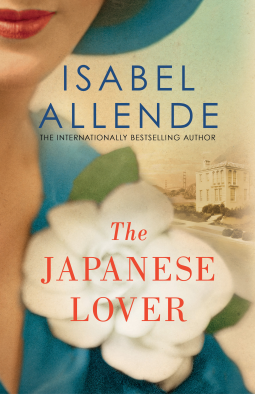
The Japanese Lover by Isabel Allende

The Chilean author Isabel Allende is probably best known for her first novel The House of the Spirits, but since its publication in 1982 she has written over twenty other books, most recently last year’s In the Midst of Winter. The Japanese Lover (2015) is the first one I’ve read; I was drawn to it by its wartime setting and by the fact that, unlike some of her other books, it didn’t seem to include any magical realism, of which I’m not really a fan.

The novel opens in the present day with Irina Bazili, a young woman from Moldova, starting a new job at Lark House, a home for the elderly in San Francisco. Irina soon settles in, getting to know the old people in the home and forming a special bond with one of them, a woman called Alma Belasco who is able to live independently on the ground floor of the building but knows the day could soon come when she no longer can. When Irina is introduced to Seth, Alma’s grandson, the two are united in their concern for Alma and their curiosity over her occasional disappearances from Lark House. Eventually they piece together the story of Alma’s life, but this only happens gradually over the course of the entire novel.

When I first read the synopsis for this book I assumed it was a dual timeline novel with two alternating stories – Irina’s in the present day and Alma’s in the past. Well, it is, but not in the same way as dual timeline novels written by authors like Lucinda Riley, Kate Morton or Susanna Kearsley, for example. In other words, it doesn’t feel like a book with two distinct storylines, but more like a book set in the present with some chapters describing events from Alma’s past.

And Alma is a character with a very interesting past. At the beginning of the Second World War, she is sent away from her native Poland to stay with rich relatives in San Francisco and here she meets Ichimei Fukuda, the son of the family’s Japanese gardener. As time goes by, Alma and Ichimei begin to fall in love, but when war finds its way to America and the Japanese become ‘the enemy’, the Fukudas are sent to an internment camp. The two young lovers are later reunited, only to be separated again, a pattern which will repeat itself several times over the decades and their relationship will endure despite Alma’s marriage to another man. It is this relationship which Irina and Seth find so intriguing and which they hope to learn more about.

Although I struggled to believe in the love Alma and Ichimei felt for each other (I couldn’t sense much passion between them and, for me, it just wasn’t the heartbreaking romance I thought it should have been, given the setting and subject), I did find it interesting to read about the injustices suffered by the Fukuda family, their time in the internment camp, and the racial, cultural and class barriers that stood in the way of Ichimei and Alma’s happiness. However, Allende does not just focus on this storyline; she also delves into Irina’s background and those of some of the other characters, touching on a huge number of issues such as child abuse, homosexuality, pornography, drug use and abortion. All things which are relevant to modern life, but the book was not really long enough to explore them in much depth.

I found plenty of things to like about this book, but there were times when I felt that I was reading a long string of facts and information rather than an engaging story – too much ‘telling instead of showing’ – and there’s also not much dialogue, which could explain why I found it difficult to connect with Alma and Ichimei. I was slightly disappointed, but it’s possible that I just chose the wrong Isabel Allende book to begin with. I know she has a lot of fans who love her writing, so I’m hoping that if I try another of her books I’ll understand why.

This book counts towards this year’s What’s in a Name? Challenge: A title containing a nationality.

Someone at a Distance by Dorothy Whipple

Today would have been Dorothy Whipple’s birthday – and she is the next author in Jane’s Birthday Book of Underappreciated Lady Authors. I have never read any of her books but have been curious about them for a while and I thought a good place to start might be Someone at a Distance, her 1953 novel which seems to be her most popular and which has been published both as a standard dove-grey Persephone and as a Persephone Classic.

On the surface, Someone at a Distance is the simple story of the breakdown of a marriage. At the beginning of the novel, publisher Avery North and his wife, Ellen, seem to be the perfect couple. Having been married for twenty years, they are no longer passionately in love but still have an affectionate relationship and appear to be quite content with their comfortable, middle-class lives. They are devoted to their two children – eighteen-year-old Hugh, who is away on National Service, and fifteen-year-old schoolgirl Anne – and have a lovely house in the countryside with a large paddock for Anne’s beloved pony, Roma. If only Avery’s mother, the elderly Mrs North, hadn’t begun to feel lonely living alone in her big house nearby, and if only she hadn’t decided to look for a companion for the summer…

Old Mrs North responds to an advertisement in The TimesYoung Frenchwoman desires to spend July, August in English home. French conversation. Light domestic duties – and soon Louise Lanier comes to stay. Louise is the daughter of a bookseller in a provincial town in France and sees coming to England as a way of escaping from the humiliation of being rejected by her lover who has recently married another woman. Bored and miserable, Louise sets her sights on Avery North and won’t be satisfied until she has caused as much trouble as possible.

As I’ve said, the plot is a simple one, but Whipple’s writing and the way in which she tells the story give it the additional layers that make it such a compelling read. You can see what is going to happen almost from the start, but you don’t know exactly when or how it will happen – and when the inevitable moment comes, you feel as shocked and upset as the characters themselves. My sympathies were with Ellen; she came across as such a genuinely nice person, who really didn’t deserve the treatment she receives from Avery and Louise. I was impressed by how well she coped with the huge changes in her life…at least until an incident near the end of the book, which disappointed me slightly as I discovered that Ellen didn’t feel quite the way I would have liked her to have felt (sorry for being vague, but I’m trying to avoid too many spoilers).

The reactions of the other characters – the North children, the servants, friends and neighbours, and Louise’s family in France – are also explored. In some ways their thoughts and emotions are timeless, but in others this does feel like a book of its time, for example when Anne is too ashamed to tell her teachers and friends at school about her parents’ separation because she thinks they will view her differently. As for Louise, she is a wonderful character. It would have been easy for Whipple to write her as a one-dimensional villain, who does what she does purely out of spite and nastiness, but instead she takes the time to show us Louise’s life in France and to try to explain what made her such a bitter person. There were times when I could almost, but not quite, feel sorry for Louise – although in the end it was her parents I pitied, as they were forced to come to terms with the sort of woman their daughter was.

Someone at a Distance is a great book, with much more emotional depth and complexity than I expected when I first started to read. Now that I’ve been introduced to Dorothy Whipple, I’m sure I’ll be reading more of her work.

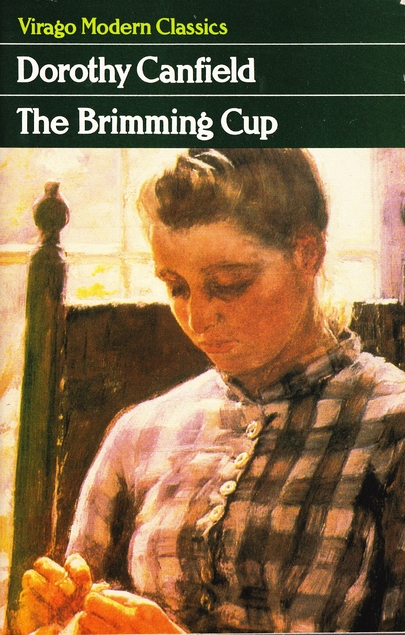
The Brimming Cup by Dorothy Canfield Fisher

I had never read anything by Dorothy Canfield Fisher, so when I saw that she was the next author in Jane’s Birthday Book of Underappreciated Lady Authors, I thought this would be the perfect opportunity. Ideally I would have started with her most popular book, The Home-Maker, but as I didn’t have a copy of that one, it made sense to read the one I did have instead.

The Brimming Cup opens with a prologue set in Italy in 1909 in which we briefly meet Neale and Marise, a young couple who are very much in love and making plans for the future. Marise has a very clear idea of what she wants and expects from their relationship:

“But what would poison us to death…what I’m afraid of, between two people who try to be what we want to be to each other…how can I say it?” She looked at him in an anguish of endeavor, “…not to be true to what is deepest and most living in us…that would be the betrayal I’m afraid of. That’s what I mean. No matter what it costs us personally, or what it brings, we must be true to that. We must!”

Eleven years later, Marise and Neale are married and living in Vermont. It’s 1920 and Marise has just sent their youngest child, Mark, off to school for the first time. Where once she had three children at home all day, now she has none and, with Neale so busy running the family business, Marise’s role as wife and mother is no longer the same as it used to be.

When Mr Welles, a retired office worker, moves in next door accompanied by his younger friend, Vincent Marsh, Marise begins to feel even more unsettled. Vincent makes her think differently about her life and about her relationships with her husband and children. Do the children appreciate everything she has done for them? Do they even truly love her or would they feel the same about any adult who raised them? Is her life being wasted in this quiet little town in Vermont? Forced to question all the things in which she has ever believed, Marise remembers the vow she made in Rome – that she and Neale should each be true to themselves no matter what.

I found it interesting to see how this novel, published in 1919, explores some of the attitudes, views and theories of the time surrounding issues such as childcare, parenthood, identity and marriage. As newcomers to the town, Mr Welles and Vincent Marsh introduce Marise to different ideas and opinions. Vincent’s suggestions that Marise should be making more of her talent as a pianist and break away from the role she has fallen into in the home seem very tempting – especially as she is starting to wonder whether Neale is really the man she thought he was – while Mr Welles’ interest in helping his cousin in Georgia to fight prejudice against black people also gives her something to think about.

I found a lot to appreciate and enjoy in this novel, but I can’t say that I loved the book as a whole and I’m not sure yet whether Dorothy Canfield Fisher is really an author for me. There were times when some of the writing felt a bit too sentimental for my taste and there were some plot developments towards the end, involving another family, the Powers, which felt unnecessarily melodramatic and out of balance with the rest of the story. I will probably try at least one more of her books, though, because it could just be that this one wasn’t the best of introductions for me. I’m tempted by Rough-Hewn, which was published after The Brimming Cup and seems to be a prequel, but maybe I should read The Home-Maker instead to see why so many people love it so much.

Britannia Mews by Margery Sharp

I discovered Margery Sharp through Jane of Beyond Eden Rock who, for the last few years, has been hosting an annual Margery Sharp Day on the author’s birthday. This year, Jane is doing something slightly different: she has put together a Birthday Book of Underappreciated Lady Authors to celebrate the work of some of her favourite writers throughout the year. Margery Sharp is first on the list and as I’ve enjoyed her books in the past, I wanted to join in.

Britannia Mews (1946) is my fourth Margery Sharp novel and probably my favourite so far. Beginning in the 1870s and taking us through to the 1940s, it follows the story of Adelaide Culver from childhood to old age. We first meet Adelaide as a curious ten-year-old exploring Britannia Mews, a London street inhabited by servants and coachmen – a street which is considered less than respectable and off limits to middle-class children like Adelaide. Returning to the Culver’s comfortable townhouse in nearby Albion Place, Adelaide has no idea that in just a few years’ time Britannia Mews will be her home.

It’s all cousin Alice’s fault; if she hadn’t been suffering from a cold and missed their drawing lesson, Adelaide would never have been left alone with their drawing master, Henry Lambert, and then he might never have told her that he loved her. But Alice does have a cold and Mr Lambert does declare his love for Adelaide – and Adelaide, despite knowing that her parents will disapprove, does agree to marry him.

Their marriage takes place on the day the rest of the Culver family move away to a lovely new house in the countryside. Adelaide, meanwhile, is moving into Mr Lambert’s rooms above a coach house in Britannia Mews. Estranged from her family, living in what is rapidly becoming a slum and finding that her new husband is not quite the person she thought he was, married life proves to be very challenging for Adelaide. When she finally has the opportunity to escape from Britannia Mews, however, she must decide whether she really wants to leave the street that has become her home.

Britannia Mews is very different from the other books I’ve read by Margery Sharp – The Nutmeg Tree, The Flowering Thorn and Cluny Brown. All three of those are lovely novels but they are much lighter in tone and, although Britannia Mews is not entirely without its moments of wit and humour, in general this is a darker and more serious story. I don’t want to give the impression that it’s a depressing one, though, because it isn’t. Yes, Adelaide’s life is difficult, at least at first, but it’s her own life – she has made her own choices and had to live with them, made her own mistakes and had to find her own solutions. Unlike her cousin Alice, who represents the ideal of what a Victorian woman should be, Adelaide is unconventional, independent and, by the time the twentieth century arrives, an inspiration to the younger generation.

One woman in particular who belongs to the younger generation is Dorothy – Dodo – Baker, daughter of Adelaide’s cousin Alice. Like Adelaide before her, Dodo feels stifled by the middle-class circles in which her parents move and she knows she wants something different out of life. Britannia Mews, which by the 1920s has become a lively and fashionable address, is, for Dodo as well as for Adelaide, a symbol of freedom and the opportunity to be who you want to be. The second half of the novel is very much Dodo’s story rather than Adelaide’s; it took me a while to adjust to the change of heroine but once I did I found Dodo just as interesting to read about. I enjoyed watching her get to know the Lamberts and waiting to see whether she would uncover the secret they had kept hidden for so many years.

Of course, the most important character of all is Britannia Mews itself, a street which seems to cast a spell over those who live there, pulling them back every time they might think about leaving. I loved reading about the changing nature of the street over the years and the people who inhabited it at various times in its history. I was also fascinated by the descriptions of the Puppet Theatre which Adelaide opens in one of the old coach-houses and the magnificent hand-made puppets created by Henry Lambert.

This was a wonderful choice of book to celebrate Margery Sharp’s birthday this year and I’m hoping to join in with some of Jane’s other Birthday Book authors in the months to come.