A Word Child by Iris Murdoch

Iris Murdoch is not a writer I’m very familiar with. A few years ago I read her Booker prize-winning novel, The Sea, The Sea, but have never investigated her other books. And so I’d like to thank Open Road Media for making A Word Child available through Netgalley and re-introducing me to Murdoch’s work.

The ‘word child’ of the title is Hilary Burde, our narrator.  Following an unhappy childhood Hilary’s future prospects looked bleak, until he discovered a passion for words and languages and embarked on a promising academic career at Oxford. However, when we first meet Hilary at the beginning of the novel, he is working as a low grade civil servant in London. We don’t know at first why he left Oxford, but we are given hints that he had been involved in some kind of scandal there – and when Gunnar Jopling, a figure from his past, comes to work in Hilary’s office building, everything starts to become clear.

The book has an interesting structure, with each chapter headed by a day of the week. Hilary has tried to establish order and routine in his life by having certain things that he always does on certain days of the week (dinner with friends on Thursday, visiting his sister on Saturdays, for example) and the novel follows him as this monotonous cycle of events is gradually thrown into disarray. Murdoch’s writing never becomes over descriptive or flowery, yet she manages to convey vivid images of the stations on the London Underground, the yellow fog that hangs over the Thames, the Peter Pan statue in Kensington Gardens. She also gives an amusingly accurate portrayal of daily office life, where Hilary is relentlessly teased by two of his colleagues, and there are other moments of humour involving Hilary’s lodger, Christopher.

Hilary himself is not an easy character to like. He controls every aspect of his sister Crystal’s life and the way he behaves towards his poor girlfriend, Thomasina, is even worse. And yet I could still empathise with him at times because his dysfunctional relationships and desperate attempts to stay in control are signs of the unhappiness and inner turmoil from which he’s suffering. I really wanted Hilary and the other main characters to have a happy ending and although I’m obviously not going to tell you whether they did or not, I did think the ending was stunning: dramatic, surprising and very satisfying.

I enjoyed this book very much and loved Murdoch’s insights into topics such as redemption, forgiveness and moving on after a tragedy. It was such a surprise because I wasn’t expecting something so accessible and readable. I’d recommend A Word Child to anyone who may be wondering where to begin with Iris Murdoch.

Room by Emma Donoghue

It’s been more than a month since I read this book but it has taken me until now to find the inspiration to post about it. That’s not to say that I didn’t enjoy the book, but as I’ve said before I find it difficult to write about a book that has attracted so much attention and already been raved about by such a lot of people.

I’m sure most of you will already have seen so many reviews of Room that you won’t need a synopsis, but for those of you who do, the plot can be summarised very quickly. The story is narrated by Jack, a five-year-old boy who has spent his whole life living with his mother in a converted shed measuring eleven foot square. His mother had been kidnapped seven years ago and Jack was born in captivity. He has no idea that a world exists outside Room and apart from Ma and Old Nick, the man who is keeping them captive, he has never seen another human being.

The story could have been very harrowing, but I was surprised to find it was less upsetting than I thought. There are a lot of aspects of the plot that are very disturbing and uncomfortable to read about but there are also some positive things that come out of the story: the strong mother/son bond, for example, and the way Jack’s mother uses her imagination to keep him busy and entertained. Being told from a five-year-old’s point of view, there’s nothing very graphic but there are always dark undercurrents beneath the surface. The trauma of Ma’s kidnapping and the abuse she suffered at the hands of Old Nick are only lightly touched on; we know they happened but aren’t given many details because those are things Jack is too young to really understand.

When I first started reading I found Jack’s narration very irritating and I had an awful feeling I was going to have to abandon the book after a few pages. Luckily though, it seemed that I just needed to get used to it. Once I got further into the story I didn’t have a problem with Jack’s voice and even stopped noticing his unusual language after a while. I can see why Donoghue chose to use a child narrator to show the situation through the innocent eyes of a child born into such an unnatural environment. Jack doesn’t know that a different way of life is possible so is quite content with how things are and when Ma finally decides to ‘unlie’ and tell him about Outside, he finds it almost impossible to believe that such a place really exists. His mother was of course fully aware of what had happened and it would have been interesting to have read the same story from her perspective as well, but of course it would then have been a completely different and probably much more traumatic book.

I’m not sure this is a book I would want to read again, but it did keep me completely gripped and I’m glad I’ve finally read it, as it hadn’t really appealed to me when everyone seemed to be reading it last year.

Have you read Room? Do you think I would like any of Emma Donoghue’s other books?

The Tiger’s Wife by Téa Obreht

As you may know, the winner of the 2011 Orange Prize for Fiction will be announced on 8th June. I’ve read three of the six books from this year’s shortlist but I’ve been so far behind with my reviews this year that I haven’t yet posted on any of them – even though it’s now been a while since I finished reading them. I’m beginning to catch up now so hopefully I’ll be posting my thoughts on all three books this week. As for the other three shortlisted books, I would still like to read them eventually.

The Tiger’s Wife, Téa Obreht’s first novel, was one of the Orange titles I was most looking forward to reading and although I did enjoy it, I felt that it didn’t quite fulfil its promise. There were parts of the book that I loved, but I thought the story was made up of too many separate elements that in my opinion never really came together as a whole.

Set in an unnamed Balkan nation, The Tiger’s Wife is an unusual mixture of myth, magic and reality. The main thread of the story follows Natalia, a doctor who is on a goodwill mission to inoculate the children at an orphanage in the fictional town of Brejevina. When Natalia discovers that her beloved grandfather has died, not at home with her grandmother as might be expected, but in a village not far from the orphanage where she is headed, she decides to investigate and find out what he was doing there.

Interspersed with Natalia’s story are accounts of important events in her grandfather’s life and some of the Balkan folk-tales she remembers him telling her. One of these is the story of an escaped tiger living near a remote village in the mountains and a young deaf-mute woman said to be the tiger’s wife; another involves Darisa the bear hunter. I particularly enjoyed reading about the grandfather’s encounters with the ‘deathless man’, a mysterious individual who can predict the deaths of other people without ever dying himself. However, some of these tales were so long and involved that by the time we returned to the present day storyline I found it difficult to pick up where we had left off. And to be honest, I found Natalia’s grandfather and his magical stories a lot more interesting than the character of Natalia herself.

Although the country in which the book is set is never named and any towns and villages that are mentioned are fictional, it’s not difficult to tell that we’re reading about the former Yugoslavia. The city in which Natalia lives is referred to only as ‘The City’ but is probably Belgrade. But despite the anonymity of the setting, Obreht still conveys a great sense of place through her wonderfully descriptive writing.

I can see why this book has been getting so many accolades, but for me, I think it may have been a little bit too ambitious and the disjointed structure of the book stopped me from loving it as much as I had hoped to. The ending of the book left me feeling confused and with the impression that all the separate threads of the story hadn’t been adequately pulled together. If only the author could have found a way to weave the various parts of the novel into a more coherent story The Tiger’s Wife had the potential to be an excellent book, and I’m looking forward to seeing what Téa Obreht does next.

Touch by Alexi Zentner

In Touch, the debut novel by Alexi Zentner, we follow the story of three generations of one family who live and work in Sawgamet, a small Canadian mining and logging town. Our narrator, Stephen, has just returned to Sawgamet after a long absence because his mother is dying. Back in his childhood home Stephen becomes lost in memories – and shares some of those memories with the reader. Foremost in Stephen’s thoughts is the day his grandfather, Jeannot, came back to the town after disappearing for many years and announced that he had come to “raise the dead”.

With tales of sea witches and creatures that live in the forest, dogs that sing and golden caribou, the line between fantasy and reality often becomes blurred. I’m not always a fan of magical realism but it is done perfectly here, and so is the non-linear narrative which moves seamlessly between past and present.

Sawgamet is one of the most vivid settings I’ve encountered in a book for a long time. I could picture Jeannot’s cabin and mill, the miners panning for gold in the river, the suffocating blankets of snow that buried the landscape during the long cold winters. Enchanting and magical one minute, dark and threatening the next, the atmosphere Zentner created was wonderful. His writing is beautiful and elegant and there are some haunting images that have stayed in my mind even after finishing the book.

As a debut novel I thought Touch was hugely impressive and I’ll certainly be looking out for more work by this author in the future.

Swamplandia! by Karen Russell

Swamplandia! is an alligator-themed amusement park in the Everglades run by Chief Bigtree, his wife, Hilola, and their three children. For years tourists have been flocking to the park to see the star attraction: Hilola Bigtree and her alligator-wrestling act. The fortunes of the Bigtree family start to change, however, when Hilola dies of cancer – and then a rival theme park called World of Darkness opens on the mainland nearby and the downfall of Swamplandia! is complete.

Swamplandia! first came to my attention when it appeared on the Orange Prize longlist. Not having read anything by Karen Russell before I didn’t know what to expect from this book but was intrigued by the unusual setting and subject. And at first I loved the originality and quirkiness of the story. I loved reading about the Swamplandia! theme park (complete with Swamp Café and Bigtree Family Museum), the alligator-wrestling and the other details of the Bigtree family’s life on the island. After a while the novelty started to wear off, but luckily the characters were strong enough to keep me interested.

The three Bigtree children all have an innocence that makes them likeable and endearing characters. It’s understandable in a way, as they haven’t had the most conventional of childhoods. They’ve been homeschooled on the island and the only other children they’ve really come into contact with have been tourists visiting the park. After their mother’s death, each of the three tries in their own way to cope with what has happened, unable to rely on their father who is reluctant to accept that his beloved park is in trouble and who fails to be there for his family when they need his support.

Osceola, the elder sister, announces that she’s in love with a dead man – and begins ‘dating’ him via séances and possessions. Ossie’s ghostly romance seemed ridiculous at first, but was actually quite a poignant and moving story. Her brother, seventeen-year-old Kiwi, runs away from Swamplandia! quite early in the story and goes to work on the mainland in an attempt to earn money to solve his family’s financial problems. But it’s Ava, as the youngest girl, who is particularly vulnerable. It’s Ava’s narration (including some disturbing scenes involving a ‘journey to the underworld’ with a stranger who calls himself the Bird Man) that gives the book an underlying darkness, with some moments of real sadness and heartbreak.

I loved the chapters narrated by Ava and I was also interested in Ossie’s storyline, but whenever the action switched to Kiwi’s adventures on the mainland, I quickly got bored. I can see why the Kiwi sections were included, as a way of lightening the mood of the book and to show how his childhood growing up in the swamps left him completely unequipped for life on the mainland, but to me they just didn’t fit with the rest of the book and I would rather have stayed with Ava’s narration. This was potentially a great book but the uneven plot let it down.

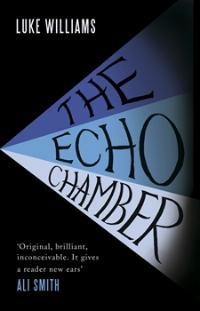
The Echo Chamber by Luke Williams

The Echo Chamber is narrated by Evie Steppman who was born in Lagos in 1946. Evie has always considered herself to have a remarkable sense of hearing – she even remembers listening to her father telling her stories while she was still in the womb – but now that she’s getting older she can’t hear as well as she used to. Sitting in her attic in Scotland surrounded by diaries, maps, postcards and other items from her past, Evie decides that it’s time to write the story of her life.

This is an interesting and unusual book which encourages the reader to think about sound in a new way. It made me really appreciate the everyday sounds that we take for granted.

At first I found it difficult to form an emotional connection with Evie as a person. There were other characters that I found more interesting – I was particularly fascinated by the character of Evie’s grandfather, Mr Rafferty, a watchmaker who tried to create a clockwork replica of his late wife. And so I appreciated the inclusion of two chapters in which we get the chance to read Evie’s lover’s diary; seeing her through someone else’s eyes gave an extra dimension to her character. I also enjoyed the chapters which dealt with Evie’s childhood in Nigeria during the final years of British rule.

The Echo Chamber is written in a number of different formats – diary entries, question and answer sessions, stories-within-stories – and although I’m not sure this really worked for me it did add to the originality of the book. I didn’t find it an easy read, but as a debut novel I think Luke Williams can be proud to have come up with something so different and imaginative.

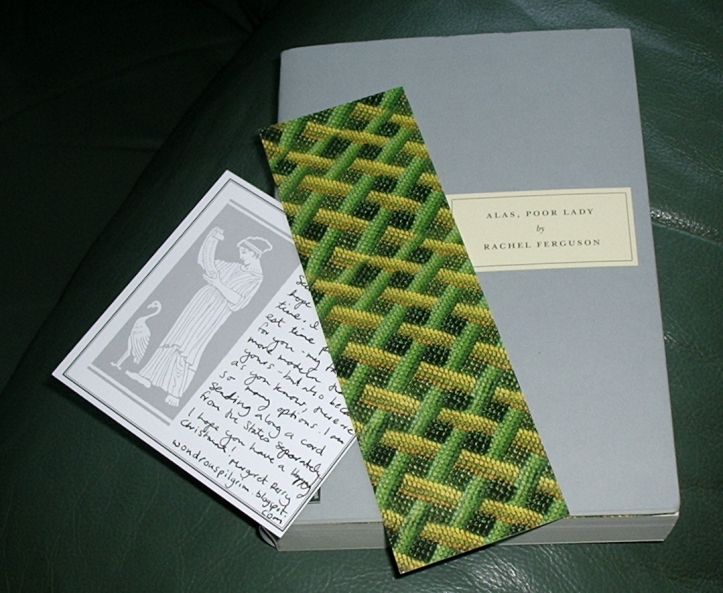
Alas, Poor Lady by Rachel Ferguson

This is the book that I received for Christmas from my Persephone Secret Santa, Margaret of Ten Thousand Places. Choosing a book for another person is never easy, but of all the titles published by Persephone Margaret managed to select one that was perfect for me. Thank you, Margaret!

Alas, Poor Lady tells the story of one London family, the Scrimgeours, over a period of more than sixty years, from the Victorian era through to the 1930s. Captain and Mrs Scrimgeour have eight children – seven are girls and only one, the youngest, is a boy – and we get to know all of them, some better than others. We watch as they grow up and try to find their place in society – a society designed to cater only for men and, to a lesser extent, for married women. For a woman who stayed single (whether by choice or not) her options in life were very limited.

Three of the Scrimgeour girls marry and leave home early in the story, though they do reappear from time to time. Of the other four, Mary is the eldest sister still living at home and is portrayed as the stereotypical ‘spinster’, a quiet, sensible woman who can usually be found reading a book and who has never really been expected to get married. Agatha decides to follow a different route after it starts to look likely that she, like Mary, is also going to remain single – but will this really lead to happiness? What Queenie really wants is to get a job, but after considering several possible career paths is forced to come to a disappointing conclusion. And finally there’s Grace, the youngest sister, who through no fault of her own finds herself facing poverty and in the uncomfortable position of becoming a burden to her family.

Although the focus of the book is on the seven girls, it’s interesting to see how their brother, Charlie, is also under pressure to conform to society’s expectations of how a boy should behave. In some ways, he doesn’t really have any more freedom to be himself than his sisters do. His father is furious with him when he discovers him playing with Grace’s doll, for example, instead of his own toy soldiers.

Another thing I liked was the amount of information we are given on everyday life in the 19th and early 20th centuries. Although the Captain keeps insisting he’s ‘not a rich man’ and worrying about money, the Scrimgeours are evidently a very wealthy family with a large house and servants. It was interesting to see how their way of life changed over the years as a result of poor financial decisions and changing economics.

I loved this book but I know it won’t appeal to everyone. It’s slow and detailed, doesn’t have a lot of plot, and it did seem to take me a long time to read it. And yet without anything really ‘happening’ there’s still so much going on in this book that this post could easily have been twice as long as it is.

So, for anyone with an interest in feminism and the differing roles of men and women in society, I can’t recommend Alas, Poor Lady highly enough. Although my favourite Persephone so far is still Little Boy Lost (largely due to the emotional impact it had on me) this one is now a close second.