The Island of Sea Women by Lisa See

One of the things I love about reading is that it gives me the opportunity to learn about places and cultures I would otherwise be likely to go through life knowing little or nothing about. Before reading Lisa See’s latest novel, The Island of Sea Women, I had never heard of the haenyeo communities of Jeju in South Korea, but now I have been enlightened!

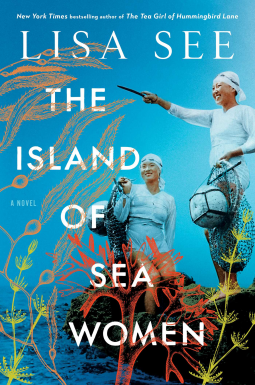
The haenyeo, for anyone else who doesn’t know, are female divers who gather seafood such as abalone, octopus and conch from the waters surrounding the island of Jeju. The Island of Sea Women is narrated by Young-sook, a haenyeo whom we follow over a period of many years, from the 1930s to 2008. It’s a story of friendship and betrayal, war and suffering, and the importance of forgiveness – but most of all, it’s a fascinating study of a society of ‘sea women’ and how their way of life changes as the decades go by.

At the beginning of the novel, we see Young-sook joining her village’s diving collective, of which her mother is the leader, and starting to learn the skills she will need in her career as a haenyeo. Although she is excited about taking her first dives with the other women, she is also nervous about the many dangers lurking in the depths of the sea. Fortunately for Young-sook, she has a friend the same age – a girl called Mi-ja – with whom to share her experiences.

Mi-ja is the daughter of a ‘Japanese-collaborator’, at a time when Japanese colonists are disliked and resented across Jeju, but Young-sook loves and trusts her and is closer to her than to her own brothers and sisters. The friendship between Mi-ja and Young-sook endures through loss and tragedy and political turmoil, through marriage and motherhood, through times of peace and times of war, until the day comes when one of the women is faced with a difficult choice – and the decision she makes that day means that nothing will be the same again.

I enjoyed The Island of Sea Women, but it wasn’t always an easy or pleasant book to read – Young-sook and her family live through a very eventful and turbulent period of Korea’s history, including Japanese colonialism, World War II and the Korean War, and Jeju’s strategic location means it is often at the heart of the action. The most memorable part of the book for me was the section covering the ‘4.3 Incident’, the horrific massacre of protesters by police and government forces that took place in April 1948. Although I’d felt that for the first half of the book, the balance between fact and fiction wasn’t quite right and that we were being given a lot of information and detail at the expense of characterisation and plot, from the 4.3 Incident onwards, the story became much more compelling and the characters began to feel very real to me.

Lisa See writes so well about female friendships. Like Pearl and May in Shanghai Girls, Lily and Snow Flower in Snow Flower and the Secret Fan, and the three girls in China Dolls, Young-sook and Mi-ja have a special, unbreakable bond, yet they also go through some very dark and difficult times that stretch their bond to its limits. As I read, I kept thinking about how important perspective is; we only see things from Young-sook’s point of view in this novel, but had we been given Mi-ja’s side of the story it would have become a different book entirely.

The haenyeo culture is fascinating to read about and See weaves several of their myths, legends and proverbs into the story, showing us the importance haenyeo place on praying to the goddess of the wind and attending religious rituals led by their female shaman. It is in many ways a matriarchal society where the women are the ones who go out to work and provide for their household, while the men stay at home to look after the children. In the haenyeo community, the birth of a girl is welcomed as much as a boy because she will eventually be able to earn money and feed the family, yet it is only men who can perform the ritual of ‘ancestor-worship’ and who are allowed to inherit property.

I thought it was interesting that Young-sook’s husband is insistent that their daughters should be sent to school and given the same opportunities as their sons, while Young-sook, illiterate herself, can’t see the need for female education because it won’t be necessary for a life spent diving into the sea. There is logic behind her viewpoint, because when the story comes up to date in the 21st century, we see that with improvements in education, many of the island’s young women are leaving Jeju for less dangerous jobs on the mainland. Most of the remaining haenyeo are aged over fifty-five – and some are in their seventies and eighties, still spending hours each day submerged in cold water, holding their breath for more than two minutes at a time.

If you would like to find out more about these amazing women and their work, Lisa See has a collection of photographs and videos of the haenyeo on her website.

Thanks to Simon & Schuster for providing a copy of this book for review via NetGalley.

This is book 1/20 of my 20 Books of Summer
The Adventurers by Jane Aiken Hodge

I’m enjoying working my way through Jane Aiken Hodge’s novels but, as I suppose is the case with many authors’ work, I’m finding that the quality varies a lot. The Adventurers (first published in 1965) is certainly much better than the last one I read, First Night, but not as enjoyable as Marry in Haste, Watch the Wall, My Darling or Strangers in Company.

The novel is set towards the end of the Napoleonic Wars when, following the Battle of Leipzig in 1813, the defeated French army begin their retreat through Germany. The von Hugel castle lies in their path and seventeen-year-old Sonia von Hugel hides in the hayloft as her family and servants are massacred around her. When the violence is over, Sonia escapes from the castle disguised as a boy, intending to make her way to her aunt’s home across the mountains. Stopping at an inn along the way, she has an encounter with the mysterious Charles Vincent, who makes her an offer which causes her to change her plans and agree to accompany him to France instead.

In England, meanwhile, we meet Lord Denbigh and his nephew Philip Haverton, who are preparing to travel to France on diplomatic business. What will happen when their paths cross with Charles and Sonia’s? What is their connection with Sonia’s friend, Elizabeth Barrymore? And, most importantly, where does Charles keep disappearing to without explanation?

As this novel, like many of Aiken Hodge’s, is set in the Regency period, it’s difficult not to make comparisons with Georgette Heyer. The opening sequence, with the heroine dressing as a boy and meeting the hero at an inn – and the misunderstandings that follow – is exactly the sort of storyline that will be familiar to Heyer readers. After this promising beginning, though, the story becomes much less Heyer-like, with very little humour and lightness and a more serious, sombre feel. The politics of the period also form quite an important part of the novel, with Napoleon facing defeat and a plot to restore the Bourbon monarchy gathering pace.

I have described Charles and Sonia as the hero and heroine – and it did seem that way at first – but I quickly began to lose interest in them, especially as Charles was absent for such long sections of the novel (for reasons I found too easy to predict). It was disappointing that their plan to travel across Europe as ‘adventurers’, making their living from winning money at cards, didn’t really come to much and there was far less adventure in the book than I had hoped for. One character who did interest me was Elizabeth Barrymore; I felt that it was her story rather than Sonia’s that the author really wanted to tell. She is given a romantic interest of her own and although I found the way it develops predictable as well, I thought it was more engaging and more moving than Sonia’s – a story of mistakes, regrets and second chances, a bit like Anne Elliot’s in Jane Austen’s Persuasion. Aiken Hodge wrote biographies of both Austen and Heyer, so it’s not surprising that their influence can be seen in her work.

The Adventurers is not a favourite by this author, then, but I did enjoy getting to know Elizabeth and learning a little bit about the political situation in Europe in the aftermath of the Battle of Liepzig.

Thanks to Agora Books for providing a copy of this book for review via NetGalley.

After the Party by Cressida Connolly

When I saw the list of titles shortlisted for this year’s Walter Scott Prize for Historical Fiction, After the Party was not one that particularly appealed to me but I have set myself a challenge of reading all of the shortlisted books since the prize began in 2010, so as my library conveniently had a copy available I brought it home and gave it a try.

The story is divided between two time periods. In 1938 we meet Phyllis Forrester, who has just returned to England with her husband and children after a long absence abroad. The narrative takes us through the events of that year and the wartime years which follow. There are also some sections set in 1979 with Phyllis looking back on that earlier time and on the choices and mistakes which led to her imprisonment. Yes, we know from the beginning that she has been to prison – but we don’t know exactly how or why that happened because the reasons are deliberately kept quite vague throughout most of the novel.

The 1930s storyline follows Phyllis as, back in England for the first time in three years, she occupies herself by helping her sister, Nina, to run a summer camp for young people. The camp is part of a new political movement which Nina and her husband are very enthusiastic about and they are hoping that the charismatic man they call ‘The Leader’ will visit at some point that summer. Unless I wasn’t paying attention, the name of this political group and its leader are rarely, if ever, mentioned in the book – certainly not until near the end, anyway – but with a little bit of knowledge of the period it’s easy enough to guess who they are.

If you believe that Phyllis is being honest with the reader, it seems that she has little idea of the true nature of the group or the values it represents. There’s a sense that her involvement has happened mainly because she has been at a loose end and looking for something useful to do to fill her days, and because she likes the idea of ‘belonging’ somewhere. For a while it all seems quite innocent; the main aims of the organisation appear to be to promote peace and avoid another war and it’s quite understandable that many people at the time would have supported those aims, with the horrors of the recent Great War fresh in their minds. Gradually, though, we start to see some uglier ideas being expressed and we can only assume that Phyllis must be aware of these views and agrees with them or at least can see nothing wrong with them. I thought it was quite an effective way of showing how people can become slowly indoctrinated into dangerous ways of thinking, something which is still as relevant today as it was in 1938.

I’m not sure how much sympathy we were intended to have for Phyllis but, although the circumstances of her arrest and the descriptions of her time imprisoned in Holloway are certainly horrible, I struggled to warm to her at any point, and I didn’t like any of the other people in her family and social circle either. They were the sort of people that, if I knew them in real life, I wouldn’t really want anything to do with; people who move in a world of snobbery and gossip, thinking they are better than everyone else. That was maybe the point – that the superiority and sense of status that these characters feel is partly why they are so open to the views of The Leader – but I didn’t particularly enjoy reading about them and their lives. I also felt that the incident at the party which is made to sound so dramatic in the novel’s blurb – the incident where Phyllis ‘lets down her guard for a single moment, with devastating consequences’ – was not as significant as it sounded and after reading so many pages waiting for that moment to come, it was an anti-climax when it did.

For the reasons above, this is not my favourite of the books I’ve read so far from this year’s Walter Scott Prize shortlist but I can see why it has been nominated as it’s a much more interesting and layered novel than I had initially thought it would be and one that left me with a lot to think about after reaching the end.

The Scottish Chiefs by Jane Porter

When the book chosen for me in the recent Classics Club Spin was The Scottish Chiefs by Jane Porter, I was quite happy with that result. It was a book I’d wanted to read for a while, it had been recommended to me by more than one person and I thought I might find it more enjoyable than my last Spin book, Dombey and Son by Charles Dickens, which I still haven’t managed to finish.

Jane Porter (1776-1850) was born in England but grew up in Edinburgh, where Sir Walter Scott was apparently a regular visitor to the family. The Scottish Chiefs reminded me very much of Scott’s work, although it was published several years before Scott’s first novel, Waverley. I don’t know whether Scott read and was influenced by Porter’s novel or not, but it’s hard to believe that he wouldn’t have done.

The Scottish Chiefs was published in 1809 and tells the story of Scottish hero William Wallace, a story many people are familiar with through Braveheart. Like Braveheart, this is a highly romanticised account of Wallace’s life and can’t be assumed to be entirely accurate; however, there is a limit to what historians know about Wallace anyway and for centuries one of our major sources has been Blind Harry’s narrative poem from the 1400s, The Actes and Deidis of the Illustre and Vallyeant Campioun Schir William Wallace.

The novel opens in the summer of 1296. Having recently acted as arbitrator in a dispute over the succession to the Scottish throne – resulting in John Balliol becoming king rather than his rival Robert Bruce of Annandale – Edward I of England has entered Scotland with his army and gained victory at the Battle of Dunbar. Balliol abdicates and is sent to the Tower of London, while the majority of Scotland’s other noblemen agree to acknowledge Edward as their overlord. William Wallace, who is ‘too noble to bend his spirit to the usurper, too honest to affect submission’, is one of the few who refuse to accept this and at the beginning of the novel we see him visiting a fellow rebel, Sir John Monteith of Douglas Castle. Monteith presents him with a small, heavy iron box, which he had been given by Lord Douglas with the following message:

“…commit the box in strict charge to the worthiest Scot you know; and tell him that it will be at the peril of his soul, who dares to open it, till Scotland be again free! When that hour comes, then let the man by whose valour God restores her rights, receive the box as his own; for by him only it is to be opened.”

As Wallace rides away, the iron box is seen by English soldiers who assume that it contains treasure and soon the English Governor of Lanark, Heselrigge, arrives at Wallace’s home hoping to gain possession of it. In the violence that follows, Wallace’s beloved wife Marion is murdered by Heselrigge and when Wallace takes revenge by killing the Governor, he swears that he won’t rest until he has freed Scotland from Edward’s control and the day comes when the mysterious box can finally be opened.

I enjoyed The Scottish Chiefs, although I did find it a bit uneven. There are some gripping set pieces – such as the storming of Dumbarton Castle and Wallace’s infiltration of Edward’s court disguised as a minstrel – but there are other parts that were much less interesting and where I struggled not to lose concentration. It has to be remembered, though, that the book was published in the early nineteenth century and written in the wordy style that you would expect from literature of that period. It’s also a very long book – I read an ebook version and hadn’t appreciated just how long it was until I started reading!

Not many of the characters have the depth and complexity I prefer; most of the women, such as Marion and Helen Mar, are portrayed as paragons of virtue, while Wallace himself is too perfect and heroic to be true. The more villainous characters were the most interesting, particularly Helen’s stepmother, Joanna, Countess of Mar (in her notes at the end of the book, Porter says that Joanna was a real historical figure, daughter of the Earl of Strathearn and a princess of Orkney, but I haven’t been able to find any information about her anywhere). Porter doesn’t use any Scots dialect so her Scottish characters sound the same as the English ones, but some authors can write very convincingly in dialect and others can’t, so I think it’s best not to use it at all than to use it badly!

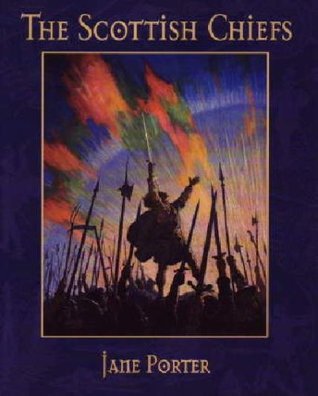
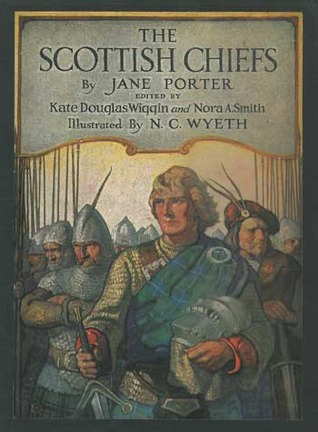
I ended up reading the free Project Gutenberg version of the book, mainly because there doesn’t seem to be a decent edition in print. The book covers in this post are for illustration purposes only. I hope someone like Penguin Classics or Oxford World’s Classics will decide to publish an edition at some point – with notes giving us more idea of which parts of the story are based on fact and which are purely fictional – as that might encourage more people to read this book; at the moment The Scottish Chiefs seems to be a bit of a forgotten classic, which is a shame as despite the flaws I think it’s definitely worth reading if you’re interested in Scottish history or in early examples of historical fiction.

This is book 13/50 read from my Classics Club list.

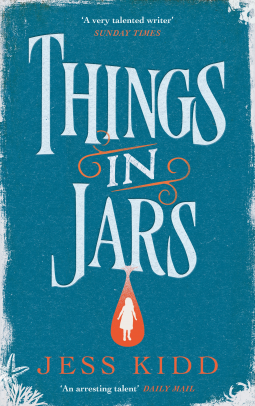
Things in Jars by Jess Kidd

What an unusual book! Not having read anything by Jess Kidd before, I didn’t know what to expect from this new Victorian mystery, but I immediately fell in love with the playful writing and imaginative plot. I knew as soon as the ghost of a tattooed boxer arose from a tomb in Highgate Cemetery that this was going to be no ordinary detective novel.

The story takes place in 1863 and our heroine is Bridie Devine, a former surgeon’s apprentice from Dublin who, since arriving in London, has built a new career for herself as a private investigator. At the beginning of the novel, Bridie – ‘A small, round upright woman of around thirty, wearing a shade of deep purple that clashes (wonderfully and dreadfully) with the vivid red hair tucked (for the most part) inside her white widow’s cap’ – is asked to look into the disappearance of Christabel Berwick, a little girl whose strange physical characteristics make her a valuable prize for those who collect curiosities and oddities. With the ghost of boxer Ruby Doyle by her side, Bridie must try to find Christabel before she becomes a ‘thing in a jar’.

Things in Jars is one of the most enjoyable books I’ve read so far this year. It reminded me, in different ways and at different times, of The Mermaid and Mrs Hancock, The Essex Serpent and Once Upon a River, but written in a style that makes it all Jess Kidd’s own. Bridie is a wonderful character; I admired her for her independence and intelligence but had a lot of sympathy for her as well, as the story of her troubled childhood unfolds in parallel with the 1860s one. Her romance with Ruby (as far as you can have a romance with a man who isn’t alive) is both moving and mystifying. Ruby claims to have known her for years, but Bridie can’t remember him. Who is he – and why has he come into her life again?

The secondary characters are excellent too, all described with Dickensian detail, from Bridie’s seven foot tall housemaid Cora Butter with the ‘unnerving glare’ to her landlord, the elderly bell maker Mr Wilks, who has the look of ‘something that has been carefully varnished and then put away for a long time’. The descriptions of London – sometimes written from the perspective of a raven flying over the rooftops – wouldn’t be out of place in a Dickens novel either:

The raven levels off into a glide, flight feathers fanned. Slick on the rolling level of rising currents and down-draughts, she turns her head, this way and that. To her black eyes, as blacked as pooled tar, London is laid out – there is no veil of fog or mist or smoke-haze her gaze cannot pierce!

Below her, streets and lanes, factories and workhouses, parks and prisons, grand houses and tenements, roofs, chimneys and tree tops. And the winding, sometimes shining, Thames – the sky’s own dirty mirror.

As for the mystery of Christabel’s disappearance, it really takes second place to the setting and the characters and the humour, but it was interesting enough to keep me gripped until the end, wondering what the little girl’s fate would be. I also enjoyed the way legends of the mythical Irish being known as the merrow were worked into the plot.

I would love Jess Kidd to write another book about Bridie Devine but, failing that, I will have to look for her previous novels, Himself and The Hoarder. Although they sound very different from this one, I am looking forward to reading more of her work!

Thanks to Canongate Books for providing a copy of this book for review via NetGalley.

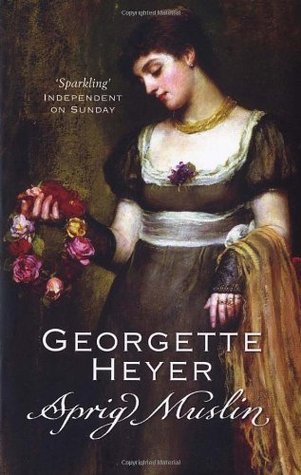
Sprig Muslin by Georgette Heyer

Georgette Heyer is almost always a delight to read and I found this 1956 novel, Sprig Muslin, particularly enjoyable and entertaining. Set in the Regency period she recreated so convincingly, it has all the humour, adventure and romance I expect from her work and although the plot is similar in many ways to the later Charity Girl, the two books are different enough that there’s no risk of confusing them with each other.

It’s been seven years since Sir Gareth Ludlow lost his beloved fiancée in a tragic carriage accident but he is still sure that he will never feel for another woman what he once felt for Clarissa. At the age of thirty-five, he knows he can’t put off marrying any longer so, having given up hope of falling in love again, he makes the decision to propose to his old friend, Lady Hester Theale. Things don’t go quite according to plan, however…

Stopping at an inn on the way to Hester’s estate, Sir Gareth encounters Amanda, who is ‘very nearly seventeen’ and is running away from home as part of a plot to force her grandfather into allowing her to marry the young army officer she loves. Aware of all the dangers that could befall a young lady travelling alone, Sir Gareth insists on taking Amanda with him to Brancaster Park where Hester can take care of her until he is able to discover her full name and return her safely to her family. Furious at what she calls her ‘abduction’ and determined to continue with her plans, Amanda soon escapes from Sir Gareth’s clutches and our hero sets off in pursuit. The rest of the novel follows their escapades as Amanda does her best to stay one step ahead of Gareth, often with hilarious results!

I think the Heyer novels that take place on the road, like this one and The Corinthian, are particularly fun to read. There’s never a dull moment during Amanda and Gareth’s journey and they meet a selection of colourful characters along the way, including Hester’s lecherous uncle, Fabian Theale, the aspiring poet Hildebrande Ross and farmer’s boy Joe Ninfield. As for the main characters, I really liked Sir Gareth who, although he’s not one of my personal favourites, is everything you could want in a Heyer hero, and I also loved the contrast between the book’s two heroines. Amanda is a bit silly, admittedly, but she kept me amused with her imaginative stories and inventions and the way she stumbles from one scrape to another, while I warmed to Hester more and more as the novel progressed and an inner strength was revealed beneath her quiet, gentle exterior.

Now I’m looking forward to my next Heyer; I just need to decide which it will be!

The Alchemist of Lost Souls by Mary Lawrence

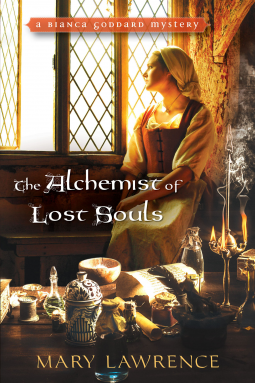
The Alchemist of Lost Souls is the fourth book in a series of historical mysteries set in Tudor England and featuring the character of Bianca Goddard, an alchemist’s daughter. Not having read any of the previous novels, I wondered whether I would be at a disadvantage in starting with this one, but that wasn’t really a problem. Although it would have been nice to have been more familiar with the backgrounds of the characters and to have followed them from the beginning, this novel works as a standalone mystery and it was easy enough to understand what was happening without any prior knowledge.

The story takes place in London in the spring of 1544 and opens with Bianca’s father, the alchemist Albern Goddard, discovering a new element – a stone which gives off a brilliant light and which has properties that are both powerful and dangerous. Before he has time to explore the potential of this new substance, it is stolen from him and the suspected thief is found dead in a street near the Dim Dragon Inn with a glowing green vapour rising from her mouth. Albern asks for his daughter’s help and soon Bianca is investigating both the theft and the murder, as well as looking for any trace that may remain of her father’s precious element.

This is an entertaining mystery and a more complex one than it appeared to be at first, with a range of suspects including alchemists, apothecaries, chandlers – and even Bianca’s mother, Malva Goddard. I didn’t manage to guess the solution correctly, but I was happy just to watch Bianca try to unravel it all. Bianca is a very likeable character; she is intelligent and independent, but her behaviour is usually believable enough in the context of being a sixteenth century woman. Like her father, she is interested in science, but her gender means she cannot be an alchemist so instead she works as a herbalist, making remedies for common ailments in her ‘room of Medicinals and Physickes’.

Bianca’s relationship with her husband, John, is one area where I felt I may have missed out by not reading the previous books in the series. In this book he, like the other men from Southwark, has been called up to fight in Henry VIII’s army (as a pikeman after failing to impress with his archery skills) and faces being sent away from home to deal with the threats from Scotland and France. With Bianca pregnant with their first child, a separation at this time is obviously going to be particularly difficult for them both, but I think I would have found their storyline more emotional if I had known both characters better and had seen how their relationship developed.

Apart from Henry VIII’s military endeavours, which are kept mainly in the background of the novel, the story concentrates very much on fictional characters and fictional events, but I could see that Mary Lawrence was making an effort to capture the atmosphere of Tudor England and the details of how people may have lived and worked at that time. The focus is on ordinary, working class Londoners rather than the royalty and nobility, which gives the story a gritty feel and a sense of reality, despite the more fantastical elements of the plot (not just the alchemy but also the mysterious character of the Rat Man, whose role I’m not sure I fully understood). I also appreciated the author’s attempts to use vocabulary appropriate to the period and although some of the slang didn’t feel quite right to me, it did add colour to the writing and there is a glossary at the back of the book if you need to look up any unfamiliar words.

It was nice to meet Bianca Goddard and now I’m wondering if there will be more books in the series.

Thanks to Mary Lawrence and Kensington Books for providing a copy of this book for review via NetGalley.