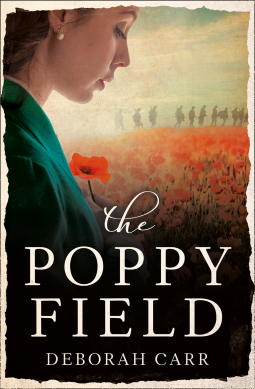
The Poppy Field by Deborah Carr

2018 has been an eventful year in many ways and in November we marked the one hundredth anniversary of the end of the First World War. I picked up Deborah Carr’s new novel, The Poppy Field, to read over the centenary weekend, but I’ve since fallen behind with my reviews, which is why I’m only posting about it now.

The Poppy Field has two narratives, one set in 2018 and the other in 1916-18. First, in the present day, we meet Gemma, a British trauma nurse who has taken some time away from her stressful job to work on the renovation of a farmhouse in Doullens, in Northern France. Her father has recently inherited it and wants to get it into a good enough condition to be able to sell. With the help of Tom, a man she meets in Doullens who offers to assist with the building work, Gemma begins the long and difficult task of restoring the house to its former beauty. During the refurbishment, they discover a bundle of old letters dating back to World War I, written by an Alice Le Breton, and as soon as Gemma settles down to start reading them, she becomes obsessed with finding out how Alice’s story will end.

The other thread of the novel follows Alice, a young woman from Jersey in the Channel Islands, who volunteers as a VAD nurse at a casualty clearing station near Doullens during the war. Working conditions at the station are challenging and often horrifying, as wounded soldiers are brought in from the front line and the doctors and nurses do their best to save lives with the limited medication and equipment available to them. In the midst of so much pain and suffering, Alice is still able to find some happiness when she falls in love with one of her patients – but in times of war life is uncertain and Alice knows that her dreams could be shattered in an instant.

Although Alice and Gemma are very different people, there are many parallels between their stories – they are both nurses, they have both reached important turning points in their lives, and they have both found themselves in the same part of France. They also each become involved in a romance, but while I found Alice’s very moving (as wartime romances usually are), I thought Gemma’s was less convincing and very predictable. She meets the man who will become her love interest almost as soon as she arrives in France and there’s no real suspense involved in wondering whether they will end up together or not. Gemma’s whole storyline felt like little more than a frame for Alice’s, but I find that’s often the case with dual-time period novels and I almost always prefer one narrative over the other.

Although I’d hoped for more from this book, I did still enjoy it, particularly the historical sections and the details of Alice’s nursing work. The two separate threads of the story tie together nicely towards the end and the novel as a whole is an interesting and poignant read.

Thanks to HarperImpulse for providing a copy of this book for review via NetGalley.
House of Glass by Susan Fletcher

I loved Susan Fletcher’s Corrag, a novel about the Glencoe Massacre of 1692, but for some reason have never read any of her other books until now. That has clearly been a mistake because House of Glass is another impressive novel. Although it is a very different type of story from Corrag, there are still some similarities, such as the beautiful writing and the interesting, unusual protagonist.

The novel is set in 1914, just before the outbreak of the First World War. Our narrator is Clara Waterfield, a young woman who suffers from osteogenesis imperfecta, better known as brittle bone disease. Because of her condition, Clara has led a very sheltered life, kept indoors where she is less likely to fall and injure herself. She has made the best of her situation, using books to educate herself on the people and places she is never likely to see, but still she longs to go out into the world and have the experiences that other people take for granted. When she is twenty years old, Clara loses her mother to cancer and, left alone in their London home with her well-meaning but over-protective stepfather, she takes her first tentative steps towards taking control of her own life.

Venturing as far as Kew Gardens, Clara discovers a love of plants and returns day after day to learn everything the head gardener can teach her about botany. Her new skills lead to her being summoned to Shadowbrook, a large estate in Gloucestershire, where the owner, Mr Fox, is looking for an expert to help fill his new glasshouse with plants from Kew. Almost as soon as Clara arrives at Shadowbrook, however, she becomes aware that something is wrong. Why do the housekeeper and the maids seem so afraid? Could the house really be haunted by the ghost of a former occupant, Veronique Pettigrew? And is the mysterious Mr Fox ever going to make an appearance?

House of Glass seems at first to be a typical Gothic ghost story. It certainly has all the elements of one: a neglected mansion with secrets hidden behind closed doors; unexplained noises in the night; servants who hint at trouble in the house’s past; and various other eerie occurrences which may or may not have a rational explanation. There are definite shades of classic novels such as Jane Eyre and Rebecca or, to give a more recent comparison, The Little Stranger by Sarah Waters. Throughout the first half of the book the sense of mystery builds as we try to work out what is really happening at Shadowbrook and Clara is as much in the dark as we are. Because of the way her life has been until now, her contact with other people has been very limited which means, as well as trying to solve the mysteries of Shadowbrook, she also has a lot to learn about social relationships and human nature. As she moves around the house and its grounds, asking questions and making observations, she not only makes some discoveries about Mr Fox and the Pettigrews, but she grows in confidence as a person too. I didn’t always like Clara quite as much as I felt I should have done, but I admired her for her strength and resilience.

In the second half of the book, everything changes; some revelations are made which send the story in a different and slightly unexpected direction and although some of my questions – and Clara’s – were answered, I wasn’t entirely convinced by these new plot developments. I wasn’t disappointed, exactly, but I did feel that I was reading a different type of story than it had seemed to be at first.

Now I need to go back and read some of the other Susan Fletcher books I seem to have missed out on over the last few years. Apart from this one and Corrag, have you read any you can recommend?

Thanks to Virago for providing a copy of this book for review via NetGalley.
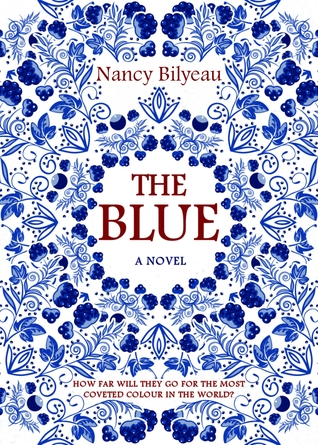
The Blue by Nancy Bilyeau

Since reading the Joanna Stafford trilogy (The Crown, The Chalice and The Tapestry) a few years ago, I’ve been waiting and hoping for a new book from Nancy Bilyeau and here it is at last: The Blue. Bilyeau wrote so convincingly about Tudor England in the Joanna Stafford books that I was surprised to find she was switching to an entirely different period for this latest novel – the Seven Years War of 1756 to 1763, a war which involved most of Europe, with Britain and France on opposite sides. Set against this backdrop, The Blue is an exciting, thrilling tale of espionage, art, religious persecution – and the race to create a new and beautiful shade of blue.

Our heroine, Genevieve Planché, is a young Huguenot woman whose family fled France when it became impossible for them to openly practise their religion. Despite her French ancestry, Genevieve has grown up in London among the silk weavers of Spitalfields and considers herself to be English, viewing the French king as someone to be feared. As a talented artist, she longs to have the chance to study painting and develop her skills, but as a woman she discovers that most of the opportunities open to men are closed to her. Her grandfather has made plans for her to go to a porcelain manufactory in Derby where she can paint pretty designs on plates and vases, but that’s not what Genevieve wants out of life. Then, just as she’s losing hope, she meets Sir Gabriel Courtenay at a party and receives a very tempting offer…

Sir Gabriel urges her to take up the position she has been offered at the Derby Porcelain Works and track down their chemist who is working on the development of a new colour blue. If Genevieve can steal the formula for blue and pass it to Sir Gabriel, he will help her travel to Venice where, he tells her, she will be taken seriously as a female artist. Genevieve is quick to agree, but once she is in Derby and the true scale of her mission becomes apparent, she begins to have doubts. Why is Sir Gabriel so desperate for the blue? What is the colour’s significance? And what will happen if she is caught?

The Blue is a fascinating novel – I learned so much about the production and decoration of porcelain, the meanings of different colours, and the ways in which art and science can combine to create things of beauty – but it is also a gripping and suspenseful historical thriller. One of the things I enjoyed most about the story was that it was so difficult to decide who could and could not be trusted. From the young woman Genevieve shares a room with at the Porcelain Works to Sir Gabriel himself, she has no idea who is on her side and who is likely to betray her. Although she sometimes makes silly mistakes, that is to be expected when she is faced with trying to navigate her way through so many dangerous situations!

This is the first book I have read via The Pigeonhole, a website/app which makes books available in daily instalments (referred to as ‘staves’). Each stave ended on a cliffhanger which left me desperate to get back to the story the following morning and reading it over a period of ten days was a wonderful experience. The book is written in present tense, something I usually find off-putting, but it seemed to work much better in the serialised format because it helped me to feel closer to Genevieve, almost as if I was sharing in her adventures as they happened.

I would love to read a sequel to The Blue, but if that doesn’t happen then I will look forward to whatever Nancy Bilyeau chooses to write about next.

Thanks to The Pigeonhole and Endeavour Quill for the opportunity to read this novel.

The Witches of St Petersburg by Imogen Edwards-Jones

I love reading about Russia, so the title of this novel alone was enough to attract my attention. When I discovered that it was set in the final years of the Romanov dynasty I was even more interested in reading it – it’s such an eventful period of history, yet most of my Russian reading has been set either earlier than that or later.

The novel opens in 1889 with the arrival in St Petersburg of two Montenegrin princesses. Militza and her younger sister Stana (Anastasia) are the daughters of the King of Montenegro and are being married off to members of Russia’s Imperial Court. Despite the high positions they now hold as a result of their marriages, the sisters are not fully accepted by the Russian courtiers who look down on them because of the smallness and perceived insignificance of their home country. They do make some friends, however, including the Tsarina Alexandra who, having given birth to four daughters, is now desperate to provide the Tsar with a son and heir.

Militza and Stana believe they may be able to help. With their knowledge of magic, their ability with spells and charms, and their skill at channelling spirits, they are what many people would call witches, but despite all of their efforts they are still unable to produce a son for the Tsarina and turn at last to a monk from Siberia by the name of Rasputin. Rasputin proves to be a sensation and the princesses are proud to have been responsible for his introduction to court – but when his influence with the Tsar and Tsarina begins to surpass their own, they start to wonder what they have done.

There were things that I liked about The Witches of St Petersburg and things that I didn’t like. I loved the setting as I’d hoped I would, and as I had never read about Militza and Stana before, I enjoyed getting to know them. Stana’s role in the novel is mainly confined to her marital problems – her husband Prince George Maximilianovich spends most of his time in Biarritz with his mistress and Stana longs for a divorce – but Militza is an interesting character and the one who drives the story forward, working to raise the sisters’ profile at court and to get close to the Tsarina. As a ‘witch’, she is also the more powerful of the two, conducting séances and speaking to the dead. The magical aspects of the book confused me, though; I wasn’t sure whether we were supposed to believe that Militza really did have magical powers and really was a witch or whether it was all just a pretence.

The first half of the novel felt too long and repetitive – there were only so many times I wanted to read about the sisters being snubbed at parties and taunted for their provincial background and ‘smelling of goat’ – and I wondered when Rasputin was going to arrive on the scene and liven things up. His first appearance doesn’t come until halfway through the book and the story does become more compelling after that, as Militza and Stana begin to regret their role in bringing him to St Petersburg and wonder how they can get rid of him. However, this is a particularly repulsive portrayal of Rasputin! Some of it may be realistic, but I wished there wasn’t so much graphic detail on how dirty and revolting he was. This is not really a book for the squeamish.

I had a mixture of feelings about The Witches of St Petersburg, then, but overall my interest in the Russian history and in two women I had previously known nothing about was enough to make me keep reading.

Thanks to Head of Zeus for providing a copy of this book for review via NetGalley.

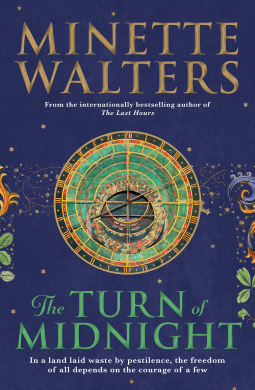
The Turn of Midnight by Minette Walters

This is the sequel to The Last Hours, which followed the fortunes of a group of people during the Black Death which reached England in 1348. When I finished the first novel last year, I wasn’t sure whether I had liked it enough to want to read any more, but in the end I couldn’t resist finding out how the story would conclude.

The Turn of Midnight picks up where The Last Hours left off, with the people of Develish in Dorsetshire living in quarantine while the plague rages across the land. The reason their community has survived largely intact while others around them have been wiped out is because of the precautions taken by Lady Anne, who gathered her people within the moat that surrounds her manor house and burned the bridges, cutting them off from contact with the outside world. Now that winter has come and food supplies are running low, Lady Anne’s loyal serf Thaddeus Thurkell, accompanied by several other young men from Develish, has crossed the moat and ventured into the countryside to see what he can find.

Despite the strong leadership skills of Lady Anne and the intelligence and courage of Thaddeus, Develish has no lord, Lady Anne’s husband Sir Richard having succumbed to the plague early in the previous novel. This has left the demesne in a vulnerable position, so together Thaddeus and Lady Anne come up with a plan to protect the people of Develish…but if they fail Thaddeus could find himself in serious danger.

I’m glad I decided to read this book because I enjoyed it quite a bit more than The Last Hours. It feels faster paced, with more going on, and of course, being the second of a pair of two novels, it has a much more satisfying ending. Where the previous novel was set mainly in and around the manor of Develish, this one has a wider scope, concentrating less on Lady Anne and her family and more on Thaddeus. Towards the end of The Last Hours I felt that Thaddeus and his companions were wandering aimlessly in the countryside without much happening, but this time they have adventure after adventure as they explore desolate towns and villages, make new friends and new enemies, and carry out charades and deceptions.

My main criticism of this book is that I still couldn’t really believe in either Thaddeus or Lady Anne as realistic 14th century characters. As I mentioned in my review of The Last Hours, I found their attitudes and thought processes far too modern and wasn’t at all convinced that they, unlike the rest of the population, could have had such an accurate understanding of how the Black Death was spread and how to protect themselves from it. I was also disappointed that Lady Anne’s stepdaughter, Lady Eleanor, is reduced to such a minor role in this book. Eleanor was very much the villain of the previous novel, but near the end some reasons were given for her terrible behaviour and there were hints that she might have been about to turn a corner. She is certainly much more likeable in this second book, but sadly the transformation of her character is not explored in any depth which I thought was a wasted opportunity.

This is such an interesting period of history to read about, though, and I did find the portrayal of a country devastated by plague vivid and convincing, even if the characters were not. Minette Walters is much better known as a crime author and has moved into new territory with these two novels; I’ll be curious to see whether she writes any more historical fiction in the future.

Thanks to Allen & Unwin for providing a copy of this book for review via NetGalley.
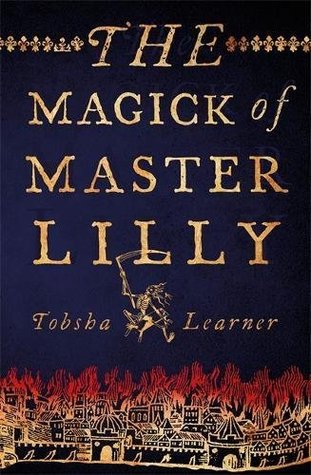
The Magick of Master Lilly by Tobsha Learner

Although I have read a lot of books set in 17th century England, I can’t remember ever reading anything about the astrologer William Lilly so I was immediately intrigued by the title and premise of Tobsha Learner’s new novel which promised to bring Lilly’s story to life.

We first meet Master Lilly in 1641, living quietly in the Surrey countryside after finding himself out of favour with Parliament. Even in exile, though, he is still famous for his knowledge of the occult and his skill at reading fortunes, and it’s not long before he is summoned back to London to draw up an horary (a form of horoscope) for Charles I. As Master Lilly looks to the future to discover what fate has in store for his King and his country, he sees only war, fire and plague on the horizon. He and his fellow ‘Cunning Folk’ will need to use all the magical powers they possess if they are to avert disaster – but is it really possible to change what is written in the stars? Master Lilly thinks it is:

We are all born with our Fates written like maps across the cosmos, but our faith and humanity give us choice. This is what I, William Lilly, believe: the Stars incline, they do not compel, and it is up to us mortals to know when to play our hand and when to fold.

The Magick of Master Lilly had the potential to be a good book, and in some ways it was. As I’ve said, I knew nothing about William Lilly before I started reading, so it was nice to be introduced to him and to learn about his life and work (the author includes some notes at the end to give some indication of what is based on fact and what isn’t). Whether you believe that some people can really see into the future or not, it seems that Lilly, among his other achievements, quite accurately predicted the Great Fire of London. He is also a healer and herbalist, and a writer of astrological texts and almanacs, although his day to day work, as he explains in the first chapter of the novel, consists mainly of “horaries, Natal figures, seduction of reluctant lovers, the finding of lost things, and the location of errant husbands”.

Lilly is not always the most likeable of characters, particularly where his relationship with his wife, Jane, is concerned, but despite this his narration is warm and lively, pulling us into his story. The tone of the novel reminded me of Rose Tremain’s Restoration and Anna-Marie Crowhurst’s The Illumination of Ursula Flight. I could have done without the long, in-depth descriptions of every horoscope Lilly casts, though! I found myself skimming through those sections as I was much more interested in Lilly himself – his interactions with people at court; his meetings with other magicians; his romance with the (fictional) Magdalene de Morisset – than in the intricate details of his work.

My biggest problem with this book was the language. I’m usually the first to complain when the language used in historical fiction is too modern, but sometimes when the author attempts to write in a style appropriate to the period it can be just as distracting and I felt that was the case here. The word ‘hath’, for example, was used in place of ‘have’, but not consistently and not always when it made grammatical sense within the sentence. Modern words and phrases are used alongside the archaic ones, which just felt wrong to me. Also, Lilly often talks about his wife being a Quaker, a term which wasn’t used until the end of the English Civil War.

Just little things, but there were a lot of them, and they meant that I didn’t enjoy this book as much as I’d hoped to. Still, I was pleased to make Master Lilly’s acquaintance. I do love reading about this period of history and with appearances from characters such as the Witchfinder General Matthew Hopkins and the female painter Artemisia Gentileschi, this was still an interesting read at times.

Thanks to Little, Brown Book Group for providing a copy of this book for review via NetGalley.
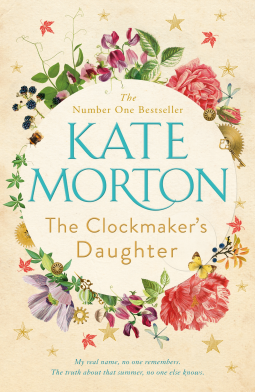
The Clockmaker’s Daughter by Kate Morton

A 19th century artist and his beautiful model; a young girl raised in India and sent to an English boarding school; a writer who takes her children to the countryside during World War II; and a 1920s biographer researching his latest work. These are just some of the characters whose stories are told in The Clockmaker’s Daughter and tied together by a present day archivist, Elodie Winslow, who is trying to make sense of it all.

At the beginning of the novel, in 2017, Elodie comes across two intriguing items in the archives of a man called James Stratton. One is an old photograph showing a woman dressed in Victorian clothing; the other is a sketchbook with a drawing of a house near the bend of a river. Elodie feels that the house looks familiar somehow…but where could she have seen it before? And who is the woman in the photograph?

To find the answers to these questions, we have to go back to the summer of 1862 when a group of young artists known as ‘the Magenta Brotherhood’ are gathering at Birchwood Manor, the home of the talented painter Edward Radcliffe. By the end of their stay, a woman has been killed, another has vanished without trace and a valuable jewel has disappeared. We know that these incidents must be linked in some way to the photograph and sketch that Elodie has found, but before we can fully understand their significance we must follow the stories of all the characters I mentioned above – and several more.

The Clockmaker’s Daughter is a complex novel and, I have to admit, I would have preferred it to have been a bit less complex! There were far too many different strands to the story and I struggled to keep track of what was happening and how the various characters were related to each other. New characters, often seemingly unconnected to any of the others, were still being introduced well into the second half of the book and it wasn’t always very clear how they were going to fit into the sequence of events. It all makes sense in the end, but I’m not sure it was really necessary for things to be so confusing.

Although I would have preferred a more straightforward, linear structure, I still found a lot to like about this book: there’s a supernatural element which I thought was used very effectively; I loved Birdie Bell, the eponymous clockmaker’s daughter; and I really enjoyed the last few chapters, in which we finally discover what really happened that summer in 1862. To compare it with the other two Kate Morton novels I’ve read, I thought this one was better than The Distant Hours but not as good as The Forgotten Garden. I’m not sure whether I will be reading any more of her books, although I could probably be tempted.

Thanks to Pan Macmillan for providing a copy of this book for review via NetGalley.