Blood Upon the Snow by Hilda Lawrence

Having read Death of a Doll last year, my first novel by American crime writer Hilda Lawrence, I have been looking forward to more of her books being reissued so I would have the opportunity to read another one. Death of a Doll was the third of only three novels Lawrence wrote featuring the detective Mark East, so I was delighted to find that the first in the series, Blood Upon the Snow – originally published in 1944 – has now been made available again too.

The novel opens with Mark East’s arrival in the small town of Crestwood on a dark, snowy evening, having been hired by the elderly historian Joseph Stoneman who is staying with friends, the Moreys, in a remote country house in the mountains. After making his way up to the house to meet his new employer, Mark is surprised to find that Stoneman believes he is a private secretary, not a private detective. However, the old man’s shaking hands and uneasy manner tell Mark that Stoneman knows exactly who he is and what he does. Intrigued, Mark agrees to stay on in the role of secretary for a while, hoping that eventually Stoneman will tell him what is going on and why he has secretly summoned a detective.

As Mark gets to know the other people living and working in the house, he becomes even more convinced that something is not right. What – or who – are the servants so afraid of? What is wrong with the pale and nervous Laura Morey? And was Stoneman’s fall on the cellar stairs a few days before Mark’s arrival really an accident? Then a woman dies under suspicious circumstances and suddenly Mark’s skills as a detective are required after all.

I found this book quite different from Death of a Doll, but equally enjoyable. While Death of a Doll is set almost entirely within the walls of Hope House, a women’s refuge in New York, Blood Upon the Snow has a very different setting – one that I loved from the opening descriptions of a remote ‘one-lane town’, ‘lying at the foot of Big Bear Mountain and surrounded by a dark forest’.

The cold, snowy winter weather provides atmosphere and the portrayal of a small community where everyone knows everyone else’s business increases the sense of suspense and danger as the people of Crestwood become aware that the killer must be someone they all know. I didn’t guess the solution and, to be honest, I wasn’t completely convinced by it; it certainly wasn’t something the reader could be expected to work out from the clues we are given. Mark East tends to keep his thoughts to himself too and doesn’t give us a lot of hints as to how he is progressing with solving the mystery – although now and then he does confide in Beulah Pond and Bessy Petty, two spinsters he meets in the town shortly after his arrival in Crestwood.

I remembered Beulah and Bessy appearing halfway through Death of a Doll and being a bit confused as to who they were and how they knew Mark, so it was good to see the beginnings of that relationship and to have my questions answered! The two women are fans of crime fiction and Beulah in particular likes to do some amateur detective work, which adds a bit of light-heartedness to the story even if it doesn’t do much to move the actual plot forward.

Now that I’ve read the first book in this series and the last, I will be looking out for the middle one, A Time To Die. What a shame Hilda Lawrence only wrote three of them.

Thanks to Agora Books for providing a copy of this book for review via NetGalley.
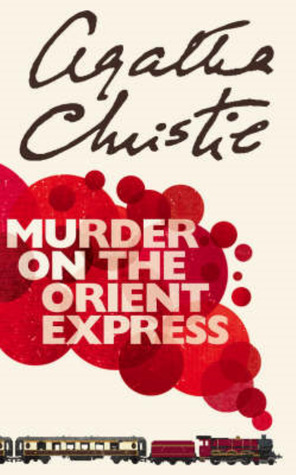
Murder on the Orient Express by Agatha Christie

The January theme for the Read Christie 2020 challenge is ‘a book that changed Christie’s life’. The challenge is hosted by agathachristie.com and their selection for this month was Christie’s first novel, The Mysterious Affair at Styles, but that would be a re-read for me so I chose a different title from their list of alternative suggestions: Murder on the Orient Express!

Murder on the Orient Express is one of Christie’s best known books and has been adapted several times for television, film and stage, but this is precisely why I’ve been putting off reading it for so long – I already knew the solution to the mystery and thought that might affect my enjoyment of the book. Of course, no adaptation is going to be exactly the same as the written version, and once I started reading I could see that some parts of the story were familiar but not all of it.

At the beginning of the novel, Hercule Poirot is in Turkey when he receives a telegram requesting him to return to London. He attempts to book a first-class berth on the Orient Express which is leaving Istanbul that night, but is told that the train is unusually full. It is only with the assistance of Monsieur Bouc, the director of the railway company, who happens to be an old friend of Poirot’s, that he manages to obtain a space in a second-class compartment. Once on board the train, Poirot observes that his fellow passengers are a very diverse group of people of different nationalities, backgrounds and classes. Among them are an American businessman and his secretary, a Russian princess and her German maid, a British Colonel, a Hungarian Count and Countess and several others.

It is the American businessman, Mr Ratchett, who is found stabbed to death in his compartment just after the train comes to a stop in heavy snow near Vinkovci (in what was then part of Yugoslavia). It seems clear that the murderer must be one of the other passengers on the train, but which one? As Poirot begins to investigate, he uncovers clues that, rather than revealing the truth, seem to complicate things further – and the statements he takes from the passengers appear to contradict each other, making the situation even more confusing. Armed with only his ‘little grey cells’, can Poirot solve the mystery?

Yes, of course he can…and for once, so could I, thanks to already knowing the basic outline of the story before I began. It would certainly have been a better – or at least a different – experience to have read the book with no idea of who was responsible for the murder, but as that wasn’t possible, I still enjoyed watching Poirot sort through the evidence and put the pieces of the puzzle together. I think Christie does give us all the information we need, but it’s difficult to say whether I would have been able to guess the solution anyway. Probably not, as I usually don’t.

As well as the mystery, I loved the atmosphere of the book and the claustrophobic feel Christie creates with the simple idea of a train stuck in snow and a murderer onboard. The characterisation is interesting too, although some of the assumptions made about the actions and behaviour of the various suspects based on their nationality feel very dated – for example, M. Bouc’s theory that the murderer must be Italian because the knife is an Italian weapon and Poirot’s reply that he disagrees because the careful, long-term planning requires an ‘Anglo-Saxon brain’. It seems that every passenger on the train has formed a stereotypical view of each of the others and this gives us some insights into attitudes of the time (the book was published in 1934).

Going back to the theme of this month’s Read Christie 2020, I wondered how this book in particular was one that had ‘changed Christie’s life’. Well, it seems that the Orient Express itself did, as she travelled on the train in 1928 to attend an archaeological dig in Syria and it was during this trip that she met the man who would become her second husband. That can certainly be considered a life-changing experience! Anyway, I really enjoyed this book and am looking forward to February’s selection.

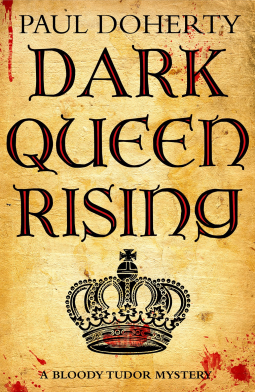
Dark Queen Rising by Paul Doherty

Paul Doherty is a very prolific author of historical mysteries; he has been writing since the 1980s and has written many series under several pseudonyms, set in a variety of periods including medieval England, Ancient Greece and Ancient Egypt. So far, my only experience of his work has been his standalone novel, Roseblood, which I really enjoyed, so when I came across Dark Queen Rising, the first in a new series set during my favourite period – the Wars of the Roses – I immediately wanted to read it.

The novel opens in 1471, just after the Battle of Tewkesbury, a battle which has ended in victory for the House of York and defeat for their rivals, the House of Lancaster. With the deposed Lancastrian king, Henry VI, held prisoner in the Tower of London, the victorious Yorkist army sets about destroying the other prominent noblemen who fought for Lancaster, including Henry’s heir, the young Prince of Wales. The Yorkist king, Edward IV, now sits securely on the throne of England – or does he? Margaret Beaufort, mother of one of the few remaining Lancastrian claimants, Henry Tudor, is making plans on behalf of her son, while Edward IV’s own brother – George, Duke of Clarence – is also gathering information that could bring about the king’s downfall.

Dark Queen Rising is described as the first in a series of ‘Margaret Beaufort mysteries’, which I think is slightly misleading – and looking at other reviews, it does seem that a lot of readers were expecting a different sort of book. There is a mystery, which develops when four men in the service of the Duke of Clarence are found dead in a tavern, but this doesn’t happen until the middle of the book and is never really the main focus of the novel. It’s more of a thriller, delving into the politics of the time and exploring some of the intrigue, plotting and controversy that makes this such a fascinating period of history.

Bearing in mind that Margaret Beaufort is one of the main characters in this book, I was surprised when, early in the novel, I saw a reference to her husband, ‘Sir Humphrey Stafford’. Margaret’s husband, of course, was Henry Stafford. Henry did have a brother called Humphrey who, coincidentally, was also married to another Margaret Beaufort, so I can see where the confusion has come from, but there’s really no excuse for not knowing which Margaret your novel is about. I was even more disappointed when, later in the book, references were made to Margaret’s future husband, William Stanley. This should have been Thomas Stanley, William’s brother. As the names of not just one but two of Margaret’s husbands were wrong, this made me question the accuracy of everything else in the novel, which is a shame as I do love this period and really wanted to enjoy this book.

George, Duke of Clarence has clearly been cast as the villain in this series, which is fair enough as history certainly tells us that he wasn’t the most honourable or trustworthy of people, but the way he is depicted in this book made him feel more like a caricature than a real person. When I think of the much more nuanced portrayals in books like Sharon Penman’s The Sunne in Splendour and Patrick Carleton’s Under the Hog, it’s disappointing. The character who did intrigue me in this book was Christopher Urswicke, who appears to be in Margaret’s employ but whose motives and true loyalties are not always very clear. I found the parts of the story written from Urswicke’s perspective much more interesting.

The second book in the series – Dark Queen Waiting – is out now, but because of the inaccuracies in this one, I’m not planning to read it, although I could possibly still be tempted by a sequel to Roseblood if one is ever written. Meanwhile, I’m now reading Thomas Penn’s new non-fiction book on the Wars of the Roses, The Brothers York, so I should be posting my thoughts on that one soon.

Thanks to Black Thorn for providing a copy of this book for review via NetGalley.
The Long Farewell by Michael Innes

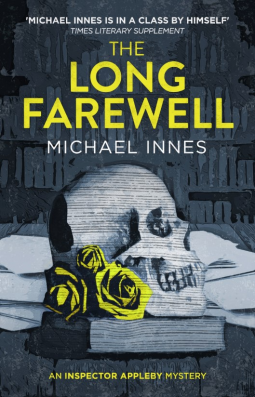
“Farewell, a long farewell!” This line from Shakespeare’s Henry VIII is written on a piece of paper found next to the body of Lewis Packford, shot dead in his own library. The words are in Packford’s handwriting, but is this really suicide or is it a cleverly disguised murder? There’s certainly no shortage of suspects; the dead man had been hosting a house party and his home, a small country estate called Urchins, was full of guests at the time of the shooting. Sir John Appleby of Scotland Yard is sent to investigate, but Sir John also has a personal involvement in the case – he had visited Packford earlier in the year at his Italian villa and got the impression even then that something wasn’t quite right…

I have read several of Michael Innes’ Inspector Appleby novels over the last few years and I’ve found them to be of very mixed quality. I’ve loved a few of them, but some have had such bizarre plots I haven’t enjoyed them much at all. I’m pleased to say that I think The Long Farewell is one of the better ones. In comparison to some of the others, it’s quite a conventional murder mystery with plenty of suspects, clues and red herrings. It’s also the type of mystery I prefer, concerned mainly with the motives of the characters and the relationships between them, rather than getting too caught up with alibis, times on clocks and layouts of rooms.

After a brief opening section in which Appleby visits Packford in Italy and they have a discussion about fraud, forgery and Shakespeare, we get straight to the murder and the investigation, so there’s no long build-up. It’s a short book, but I thought it was just the right length for the story that is being told. Although Packford’s home in England, the strangely named Urchins, is full of his fellow eccentric academics who have stayed on after his death to assist with the inquiries, with the exception of the opening chapter I’ve just mentioned there are very few of the scholarly, erudite conversations you often find in novels by Innes. No knowledge of Shakespeare is needed to be able to understand and enjoy the mystery either!

The Long Farewell was originally published in 1958 and I found the portrayal of the female characters in the book particularly interesting. There are two women amongst the guests at Urchins – Ruth and Alice – who come from very different walks of life and who both had different reasons for wanting to marry Lewis Packford. Without going into too much detail here and spoiling things, it occurred to me that had the book been written in the modern day, this part of the plot wouldn’t have worked at all.

Overall, this is an entertaining Appleby mystery (I loved the farcical scene which unfolds in the library late at night) and although it falls somewhere in the middle of the series I think it could be a good one to start with if you’re new to Michael Innes.

Thanks to Agora Books for providing a copy of this book for review via NetGalley.
The Pale Horse by Agatha Christie

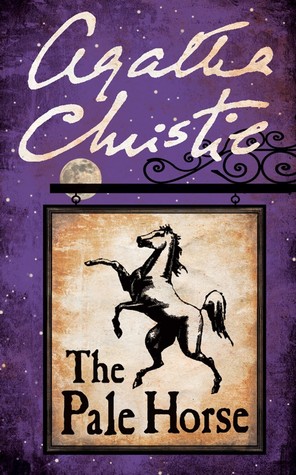
Last year I took part in the Read Christie 2019 challenge hosted by the Agatha Christie website. The idea was to read twelve Christie books – one per month – corresponding to twelve different categories. I didn’t manage to join in with all twelve, but I read eight of them and enjoyed them all, particularly The ABC Murders, Dumb Witness, and the book for December, The Pale Horse. There’s a new BBC adaptation of The Pale Horse coming soon (not sure of the exact dates, but sometime in 2020) so I’m pleased to have had a chance to read it first.

The Pale Horse is one of Christie’s standalones and doesn’t feature either of her famous detectives, Miss Marple or Hercule Poirot, although there are a few appearances from another recurring character, Ariadne Oliver. The story is narrated by Mark Easterbrook, not a detective but a writer and historian who is researching a book on Mughal architecture. At the beginning of the novel, Mark witnesses two young women fighting in a London coffee shop. A few days later, he is surprised to hear that one of the girls, Tommy Tuckerton, has died of what appear to be natural causes, unconnected with the fight. Presumably this is just a coincidence, but soon afterwards Mark learns of a list of names found in the shoe of a murdered priest – and one of those names is Tuckerton. When Mark recognises another of the names, that of his godmother Lady Hesketh-Dubois, who has also recently died, he becomes convinced that something sinister is happening.

With the help of his crime writer friend Ariadne Oliver and a young woman called Ginger Corrigan, Mark begins to investigate and finds a series of clues leading him to a former inn, The Pale Horse, which is now home to three witches. Not real witches, of course…or are they? Mark isn’t sure what to think, but it certainly seems that The Pale Horse is well known within the community as the place to go if you want to put a curse on somebody.

Christie’s novels are always entertaining, but this is one I particularly enjoyed. The plot intrigued me from the beginning; it seemed such an unusual set of circumstances and while I didn’t really believe that the three women of The Pale Horse were able to kill people through supernatural means, I couldn’t work out how else the murders were being committed. It was all quite unsettling, with a real sense that something evil was taking place. I had to avoid reading this book late at night!

It was good to see Ariadne Oliver again, who plays a small but important part in the solution of the mystery and in her role of crime novelist gives Christie an opportunity to put a little bit of herself into the story. There are plenty of other memorable characters too, though, from the three witches to Ginger Corrigan to Mr Osborne, a pharmacist who witnesses one of the murders and insists that he knows who the culprit is, despite all evidence to the contrary!

The Read Christie Challenge is happening again in 2020, with a new set of monthly categories. January’s theme is ‘a book that changed Christie’s life’ and we have been given a few suggestions to choose from. I have opted for Murder on the Orient Express!

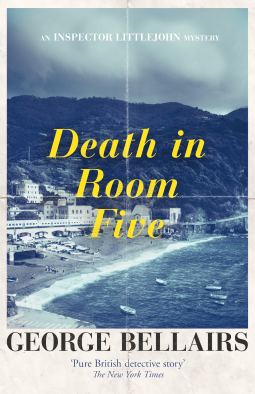
Death in Room Five by George Bellairs

George Bellairs, author of over fifty crime novels, many of them featuring the character of Inspector Littlejohn, seems to be enjoying a resurgence in popularity recently due to various publishers bringing a selection of his titles back into print. This one, Death in Room Five, is the second I’ve read and like my first, A Knife for Harry Dodd, it has been reissued by Agora Books.

In Death in Room Five, first published in 1955, Inspector Littlejohn is looking forward to taking a break from detective work and enjoying the sun, sea and sand of the French Riviera. His holiday has hardly begun, however, when a party of British tourists arrive, one of them is stabbed to death in the street, and Littlejohn finds himself drawn into a murder investigation. The dead man – the Alderman Dawson, from the fictional English town of Bolchester – appears at first to have been a respectable, honourable pillar of the community, but Littlejohn soon discovers that there is no shortage of people who had reasons to dislike Dawson or to benefit from his death.

This is an interesting and well-constructed murder mystery with plenty of suspects all with a possible motive for wanting Dawson dead. In order to understand the background of each suspect’s relationship with the Alderman, Littlejohn has to make a brief journey back to England to interview the residents of Bolchester (leaving the long-suffering Mrs Littlejohn to continue their holiday alone) but most of the action takes place in the south of France. I loved the beautiful descriptions of the Riviera, and the French setting also allows Bellairs to explore an intriguing motive for the murder – Dawson’s involvement with the French Resistance during the war.

It’s quite a complex mystery and although I didn’t find the solution particularly convincing, I appreciated the way Bellairs misleads us with red herrings and keeps us guessing to the end. However, I didn’t enjoy this book quite as much as A Knife for Harry Dodd because I thought the characters in that one were more interesting to read about. Apart from the formidable Mrs Beaumont, I found the characters in this book less memorable and so the novel as a whole was not as entertaining. I did love the setting, though, and was pleased to discover that there are several other Littlejohn mysteries set in France, as well as on the Isle of Man, which is where Bellairs lived after his retirement. I’m looking forward to trying some of them.

Thanks to Agora Books for providing a copy of this book for review via NetGalley.
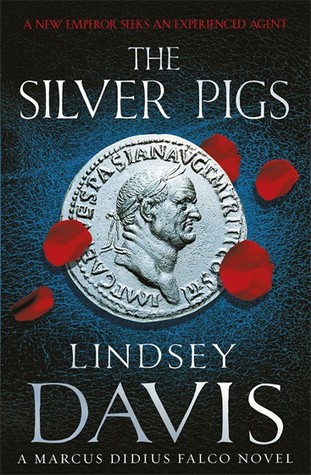
The Silver Pigs by Lindsey Davis

I love historical mysteries but have never felt drawn to Lindsey Davis’ Falco series as the setting – Ancient Rome – is not one of my favourites. Recently, though, I have discovered a few books set in Rome that I’ve enjoyed and have been open to reading more, so I thought I would give the first book, The Silver Pigs, a try. When I noticed that my library had the first four in the series available to download as audiobooks, I decided that as I was stepping slightly out of my comfort zone anyway with the Roman setting, I may as well step out of it completely with a format I usually avoid.

Audiobooks tend not to work for me because I find that my attention wanders more easily when I’m listening to a book than it does when I’m reading it on paper, but I did my best to concentrate on this one and was mostly successful. It is read by the British actor Christian Rodska and although I wasn’t sure about his voice at first (he sounded too old for the thirty-year-old Falco) I changed my mind after a while and decided that his voice was well suited to the down to earth, humorous style of the writing.

The novel opens in the year 70 AD with an encounter between our narrator, ‘private informer’ Marcus Didius Falco, and a young woman who is being chased through the Forum. After helping her to escape from her pursuers, Falco learns that the girl’s name is Sosia Camillina and that she is the niece of a powerful senator. It seems that Sosia has become embroiled in a conspiracy involving a secret stockpile of silver ingots (known as ‘silver pigs’) – a conspiracy which could pose a threat to the rule of the Emperor Vespasian.

To find out who is behind the plot, Falco is sent to the silver mines of Britannia, something he is less than thrilled about because Britannia is a cold, miserable place in winter. During his time there he meets the senator’s daughter Helena Justina, Sosia’s cousin, an intelligent, opinionated young woman to whom Falco takes an instant dislike – and the feeling is mutual. Given the job of escorting her back to Rome, Falco is unsure which task will give him more trouble: solving the mystery of the silver pigs or dealing with Helena!

As I’ve said, Ancient Rome is not one of my usual subjects when it comes to reading historical fiction, so this was an educational read for me as well as an entertaining one. Knowing that Lindsey Davis seems to be highly regarded for her research and accuracy, I could trust that what I was learning was correct (apparently since the book was first published in 1989 new evidence emerged showing that the description she gives of the process used in the formation of silver pigs may not be accurate, but that’s just proof of how our knowledge of history is still changing and evolving).

I wasn’t sure what to think of Falco as a character; I found him a bit off-putting in the opening chapters where his first thought on seeing sixteen-year-old Sosia Camillina is that she’s ‘wearing far too many clothes’ and then, when she tells him she’s not married, he thinks ‘she looked like a person who soon should be’. As I read on, though, I found that he is maybe not quite the sophisticated womaniser he wants us to think he is, but a young man who is trying to get out from under the thumb of his domineering mother and the shadow of his late brother, the military hero Didius Festus, and who is a beloved uncle to his little niece Marcia.

The mystery itself didn’t really interest me, to the point where I started to lose track of what was happening towards the end, although that could have been partly because, as I’ve mentioned, I find it harder to concentrate on the spoken word than the written word. This is the first book in the series, though, so it’s possible that some of the later ones have stronger plots. I will try the second one, but probably in traditional book format rather than audiobook.

Since I finished The Silver Pigs, it has been announced that there are plans for a new adaptation of the Falco novels by ITV and Mammoth Screen, so it seems I have chosen a good time to start reading them!