The Sentence is Death by Anthony Horowitz

I loved The Word is Murder, Anthony Horowitz’s first book to feature the detective Daniel Hawthorne, so when I heard that there was going to be a second book I couldn’t wait to read it. I didn’t have to wait too long, as this one has been published only a year after the first, and I’m pleased to report that I enjoyed it just as much, if not more.

When high profile divorce lawyer Richard Pryce is found bludgeoned to death with an expensive bottle of wine, the culprit seems quite obvious. Just days earlier, Pryce had been threatened by a client’s ex-wife who poured a glass of wine over his head in a restaurant. Surely that can’t be a coincidence? But Pryce has plenty of other enemies, whose identities come to light as investigations continue. Could one of them have wanted him dead? And what is the significance of the numbers painted on the wall near Pryce’s body? As this is clearly a more complex case than it seemed at first, ex-police detective Hawthorne is asked to assist with solving the crime.

Having worked with Hawthorne on his previous mystery in The Word is Murder, author Anthony Horowitz reluctantly agrees to team up with him again and document the progress of the investigations in a second book, The Sentence is Death. Hawthorne is supposed to be the hero of the book, but this time Anthony decides to do some detecting of his own in the hope of reaching the solution first. Can he solve the mystery before Hawthorne does?

If this sounds confusing, I should explain that, as in the previous novel, Horowitz is a character in his own book. The Anthony in the story is clearly based on the author himself – he frequently discusses his career as a novelist and screenwriter and refers to his wife and his publisher by name – yet he interacts with fictional characters, takes part in fictional storylines and struggles to solve the mystery the real Horowitz has created. I think it’s a clever concept and great fun, though not everyone will agree – it’s probably something you’ll either love or you won’t.

It’s not really necessary to have read the first book before starting this one as the mysteries are entirely separate. Like the first, this is a strong, well-constructed mystery with plenty of clues but plenty of red herrings as well. I didn’t manage to solve it (I confess that I allowed myself to be distracted and misled by every one of those red herrings) but I was happy to be kept in suspense and wait for Hawthorne – or Anthony, of course, if he got there first – to explain it all for me.

However, I would still recommend reading both books in order if you can, so that you can watch the progression of Anthony’s relationship with Hawthorne. Hawthorne is no more pleasant or likeable now than he was when we first met him in The Word is Murder, and he is still every bit as much of an enigma, but we do pick up a few new bits of information about him here, with some glimpses of his home and his life away from his detection work. I think he’s a great character, for all of his flaws, and I love his partnership with the fictional Anthony.

When I read the first novel I found the details of Anthony’s publishing and television career a slight distraction from the main plot, but in this book they seemed to form a more intrinsic part of the story and I liked that aspect much more. Horowitz seems to be having fun at the expense of his fictional self, as Anthony stumbles from one disaster to another; I particularly enjoyed the opening scenes on the set of Foyle’s War and a later scene involving the theft of a book – and I’m curious to know whether the literary fiction author Akira Anno was based on a real person (although if she was, I doubt her true identity will ever be revealed).

I loved this book – and the good news for Horowitz and Hawthorne fans is that there’s going to be a third.

Thanks to Century for providing a copy of this book for review via NetGalley.
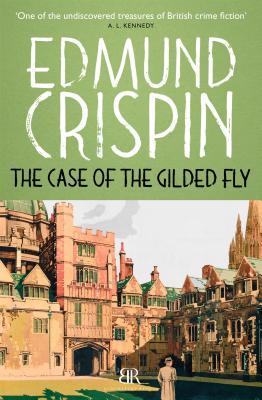
The Case of the Gilded Fly by Edmund Crispin

Like many people, I first encountered Edmund Crispin’s Oxford don detective Gervase Fen in The Moving Toyshop, the third in the series and the one which is usually said to be his best. I loved it and wanted to read more, so going back to the beginning of the series and reading The Case of the Gilded Fly seemed a good idea. As it was published in 1944 I had hoped to read it for last month’s 1944 Club but didn’t have time and ended up reading it after the event was over.

The novel opens with an introduction to each of the main characters as they travel to Oxford on the train. Among them are Gervase Fen, Professor of English Language and Literature at Oxford University, and his old friend the Chief Constable, Sir Richard Freeman. Ironically, Fen’s passion is for detection, while Sir Richard’s is for literature, which leads to some interesting conversations between the two of them. Although this is the first book in the series, it is implied that Fen already has some experience of solving mysteries. He certainly has no difficulty in solving the ‘Case of the Gilded Fly’, even though everyone else finds it baffling.

Also arriving on the same train as Fen and Sir Richard are Robert Warner, a playwright who has chosen an Oxford theatre for the premiere of his new play, and several members of the cast. One of these is the aspiring young actress Yseut Haskell, a spiteful, self-obsessed person who seems to cause trouble everywhere she goes. As we get to know the characters better during their first night in Oxford, we discover that almost everyone has a reason to dislike her, so when Yseut is found dead in a room in the college the next day, there’s no shortage of people with motives. The problem is, none of them seemed to have had an opportunity to enter the room unobserved and carry out the murder. How did the killer manage it? And what is the significance of the Egyptian-style gilded ring found on Yseut’s finger?

This is a complex locked-room-style mystery with a lot of discussion of alibis, floor plans and the timings of events. I didn’t come close to solving it, although Fen works it out very early on but has no proof and keeps us waiting until the end to find out who did it and how it was done. He also faces a moral dilemma: as Yseut was such an unpleasant person and nobody is particularly sorry to see her dead, does he really want the killer to be punished – especially as the police have already decided it was suicide? In my opinion Yseut had done nothing to deserve being murdered, but I suppose this provides a reason why Fen doesn’t immediately tell the police what he knows and bring the novel to an end before it even begins!

I enjoyed this book, but I found it slightly disappointing in comparison to The Moving Toyshop. As a more conventional sort of mystery, it doesn’t have quite the same feeling of originality and novelty, and although there are still plenty of witty comments and literary allusions flying back and forth between Fen and his friends, they are not as much fun as the limericks and ‘Detestable Characters in Fiction’ game in The Moving Toyshop. It’s possible that I would have liked The Case of the Gilded Fly more if I’d read it first and had nothing to compare it with.

Have you read any of the Gervase Fen mysteries? Which ones are your favourites?

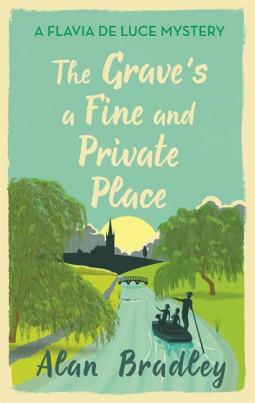
The Grave’s a Fine and Private Place by Alan Bradley

After reading Alan Bradley’s Thrice the Brinded Cat Hath Mew’d last month, I decided to move quickly on to the next in the Flavia de Luce mystery series, The Grave’s a Fine and Private Place. This is the ninth Flavia novel and brings me completely up to date with the series (for now; another book is due early next year).

In this book, our twelve-year-old detective is coming to terms with the terrible news she received at the end of the previous novel. Along with her two elder sisters, Feely and Daffy (Ophelia and Daphne), and her father’s old friend and servant, Dogger, Flavia is taking a boating trip to try to relax and recover from the shock. Trailing her hands in the water as they sail down the river, Flavia suddenly feels her fingers get caught between teeth – it seems that she has discovered yet another dead body. Being Flavia, she is more excited than repulsed, and when the corpse of a young man is pulled to the shore she can’t wait to find out how and why he died.

The dead man is Orlando Whitbread, an aspiring actor with a local theatre company. As Flavia delves more deeply into Orlando’s background, she discovers links with a murder that took place several years earlier. In her usual way, she sets about searching for clues and speaking to suspects – but this time she has some help. It seems that Dogger has been carrying out some investigations of his own and is proving to be Flavia’s equal as a detective, while Daffy, who is never to be found without her nose in a book, offers her assistance in solving some literary clues. This is something new for Flavia, for whom crime-solving has always been a very solitary activity.

We see more of Dogger in this book than ever before and he and Flavia are working together almost as equals, but I was particularly happy with the improvement in her relationship with Daffy. She is getting on better with her other sister too, and for the first time seems to be appreciating that there’s more to Feely than meets the eye. Maybe it has taken some family tragedies to make them overcome their differences – or maybe they are all just growing up. There have certainly been some changes in Flavia and she has come a long way from the tantrum-throwing eleven-year-old she was at the beginning of the series. On the other hand, I think she’s less fun as a character and maybe that’s why I can’t help feeling that the last few books in the series have lacked the charm of the earlier ones. That charm was important because it was what kept me reading and loving the Flavia books, even when the mysteries weren’t particularly strong.

The mystery in this one is slightly more complex than some of the others and I enjoyed meeting the characters who are drawn into it, such as Hob Nightingale, the undertaker’s son, and Mrs Palmer, a published poet who befriends Daffy. I found the final solution a bit unconvincing, however – the reasons for both the original murder and Orlando’s death seemed quite weak. Back to Flavia’s personal story, though, and this book has a much happier ending than the previous one! There were hints that the series might be about to go in an intriguing new direction, but I will have to wait for book 10, The Golden Tresses of the Dead, to find out.

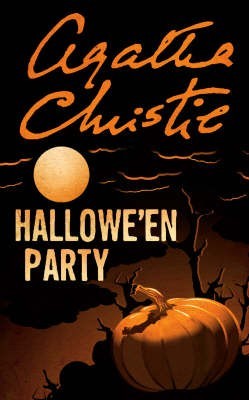
Hallowe’en Party by Agatha Christie

With this year’s R.I.P. Challenge rapidly coming to a close, I decided to squeeze an Agatha Christie novel in before the end of the month. Hallowe’en Party was one I hadn’t read before so I thought it would be a good choice for a late October read. As one of the final Poirot novels, published in 1969 towards the end of Christie’s career, I wasn’t expecting it to be one of her better books – and I don’t think it was – but I did still enjoy reading it.

At the beginning of the book, Mrs Drake is hosting a Halloween party for a group of teenagers. One of them, thirteen-year-old Joyce, who likes to be the centre of attention, tries to impress the others by insisting that she had once been a witness to a murder. Knowing Joyce’s reputation for telling lies, nobody believes her…but at the end of the party, she is found dead, drowned in the bucket of water which had been used for the traditional Halloween game of bobbing for apples. It seemed that somebody may have believed Joyce after all and has murdered her before she can say any more.

Among the adults helping out at the party is the crime novelist, Ariadne Oliver, who summons her old friend, Hercule Poirot, to the village, sure that he will be able to identify Joyce’s killer. But when Poirot arrives he quickly discovers that before he can begin to solve the mystery of Joyce’s death, there’s another murder to investigate first: the one which Joyce claimed to have witnessed and which someone was so desperate to cover up that they were prepared to kill again.

As I said, I found this an enjoyable Poirot novel but not a great one. The solution to the mystery didn’t seem as complex or original as some of the others and I found some of the characters hard to distinguish from each other. Having said that, I did guess who had committed the murders before the truth was revealed – although I have to confess my guess was just based on gut instinct and not because I’m a better detective than Poirot. There are some other surprises towards the end as well, although one particular revelation felt too far-fetched – it seemed to come out of nowhere with no real reason for it.

I enjoyed reading about the preparations for the party and the games that were played at it, but I was slightly disappointed that the Halloween theme didn’t continue after the first few chapters. The rest of the book could have been set at any time of the year, really. It’s still quite an atmospheric book, though; I particularly loved the descriptions of the ‘sunk garden’ in the quarry where some of the later scenes take place.

There’s not much more I can say about this book. It’s a good entry in the series, although not my favourite, and if you’re already a Poirot fan I’m sure you’ll find a lot to like – especially if you’ve read some of the earlier books featuring Ariadne Oliver. If you’re new to Poirot, I would probably recommend choosing a different one to start with.

I’m counting this book towards the R.I.P. XIII challenge (category: mystery).

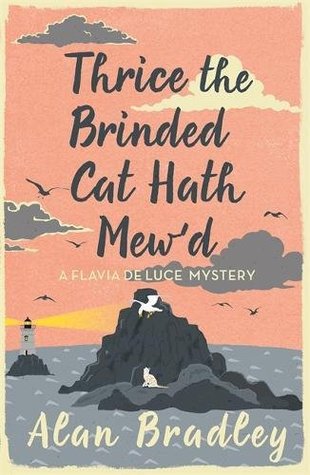
Thrice the Brinded Cat Hath Mew’d by Alan Bradley

In this, the eighth book in the Flavia de Luce mystery series, Flavia is back in England following her adventures at Miss Bodycote’s Female Academy in Canada, which are described in the previous novel As Chimney Sweepers Come to Dust. If you haven’t yet met Flavia I would recommend starting at the beginning with The Sweetness at the Bottom of the Pie; it’s not essential, as this one does stand alone as a murder mystery, but I think you’ll get more out of it if you already know Flavia and understand her family background.

At the beginning of Thrice the Brinded Cat Hath Mew’d (Alan Bradley’s books always have great titles), twelve-year-old Flavia returns to Buckshaw, the de Luce ancestral home, hoping for a warm welcome. Instead, the household feels strangely subdued and quiet. The reason for this becomes clear when Flavia learns that her father is seriously ill in hospital. Desperate to go and see him immediately, she is disappointed to be told that Father needs to rest and her visit will have to wait until the next day. The thought of staying in the house with her two unpleasant sisters Feely and Daffy and her annoying little cousin Undine is unbearable, so Flavia hops on to Gladys, her trusty bicycle, and goes out for a ride.

Calling at the home of her friend, the vicar’s wife, Flavia agrees to take a message to Roger Sambridge, an elderly woodcarver. Finding Roger’s door unlocked, she enters the house – only to discover the body of the woodcarver hanging upside down behind the bedroom door. Apart from a cat, there’s no sign that anyone else has been inside the room. It seems that Flavia has stumbled upon another mystery to solve…

This book is definitely an improvement on the previous one; I hadn’t really liked Flavia being taken out of her usual environment, so I was pleased to have her back at Buckshaw, riding Gladys and conducting experiments in her beloved chemistry laboratory. I was disappointed, though, that we didn’t see her interacting more with the other members of the de Luce household. Before she left for school in Canada at the end of the sixth book, there seemed to be hints that her relationships with Feely and Daffy (Ophelia and Daphne, in case you’re wondering) could be about to turn a corner, but in this book they barely speak to each other. I was also surprised that the Nide, the secret society which played a part in the plots of the last two novels, was only referred to once or twice – not that I’m complaining as I wasn’t very keen on that particular plot development anyway.

Although Flavia has only aged by a year or two since the beginning of the series, she does feel more mature now and is more daring in the methods of investigation she chooses to use. However, she is still only twelve and I found it unconvincing that she would really have been able to do some of the things she does in the novel (such as posing as a biographer in a meeting with a publisher). On the other hand, Flavia has always been unusual for her age, which is part of the charm of these books. I did enjoy watching her solve the crime and although I guessed one or two of the twists, I didn’t guess everything.

This is, I think, the second Flavia novel to be set at Christmas, but unlike the other one (I Am Half-Sick of Shadows), it doesn’t have a very festive atmosphere – which is understandable, with Father so ill in hospital. The last page of the book wasn’t really what I was expecting and I am now looking forward to reading the next one, The Grave’s a Fine and Private Place, to see what Alan Bradley has in store next for Flavia and her family.

I am counting this book towards the R.I.P. XIII challenge (category: mystery)

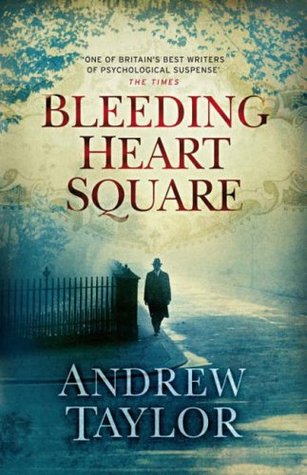
Bleeding Heart Square by Andrew Taylor

Andrew Taylor is one of my favourite authors of historical mysteries and after reading his latest one, The Fire Court, earlier this year, I remembered that I still had Bleeding Heart Square to read.

The novel opens in London in 1934 with Lydia Langstone, stepdaughter of the wealthy Lord Cassington, walking out on her violent and brutal husband. Armed with her copy of Virginia Woolf’s A Room of One’s Own, Lydia heads straight for Bleeding Heart Square, home to her father, Captain Ingleby-Lewis. The Captain isn’t entirely respectable and neither is the address, but Lydia doesn’t care – she just needs somewhere to stay until she can build a new, independent life for herself.

Another new resident of Bleeding Heart Square is Rory Wentwood, a young man who has recently returned from India to find that his girlfriend, Fenella, is no longer interested in marrying him. Rory still cares about Fenella, though, and when he hears about the disappearance of her aunt, Philippa Penhow, several years earlier, he decides to uncover the truth. The house at Bleeding Heart Square had belonged to Miss Penhow until she signed it over to the current owner, Joseph Serridge, before supposedly going to live in America. Rory has his doubts and has taken a room in the house so that he can investigate further.

When a number of foul-smelling parcels addressed to Mr Serridge begin to arrive at Bleeding Heart Square, the residents are both disgusted and intrigued. The packages contain rotten hearts neatly wrapped in brown paper and are obviously intended as a message to Mr Serridge – but who is sending them and why? What really happened to Philippa Penhow? And why is a policeman watching the house? Lydia teams up with Rory to try to find the answers, while doing her best to avoid her abusive husband.

Bleeding Heart Square is a mystery novel, but it is also a fascinating portrayal of life in 1930s London, with a particular focus on the rise of the fascism movement in Britain. One of the most memorable scenes in the book involves a meeting of the British Union of Fascists which descends into chaos when a few brave voices dare to question the party’s policies and are forcibly removed by Oswald Mosley’s black-shirted supporters. I found this aspect of the book interesting because of course with World War II on the horizon, fascism would soon become forever associated with Hitler and Mussolini and not something decent people would want to be part of – but here we see respectable people taking Mosley’s views seriously and considering giving him their support. It’s frightening to think of how different things could have been, and also still frighteningly relevant today.

Despite the 1930s setting, however, I thought the plot and the characters seemed much more suited to the Victorian period – there was a definite Dickens influence and in fact Bleeding Heart Yard appears in Little Dorrit. If you removed the fascism storyline, the rest of the novel could easily have been set in the 19th century; I was taken by surprise every time somebody got into a car as I felt it should have been a horse and carriage!

I liked both Lydia and Rory and found their personal stories so interesting that the central mystery felt almost secondary – although I was intrigued from the start by the brief diary entries and the comments by an unknown narrator that open every chapter. What will we learn from the diary and who is the narrator talking to? The ending of the book, in which the truth is revealed, was unexpected, but maybe there were clues from the beginning if I had been paying more attention!

Bleeding Heart Square isn’t my favourite of Andrew Taylor’s books – that would be The American Boy – but I did enjoy it and now that I’ve read all of his historical mysteries I’m wondering which of his other books I might like. Any recommendations are welcome!

This book counts towards the R.I.P. XIII challenge (category: mystery).
I am also counting it towards the What’s In a Name? challenge – a book with a shape in the title.

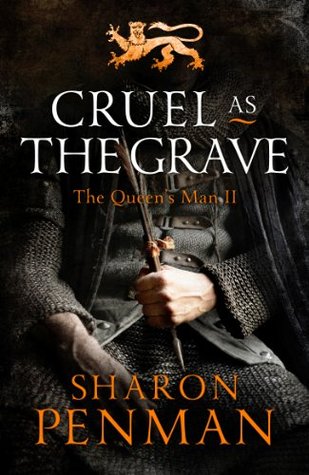
Cruel as the Grave by Sharon Penman

This is the second book in Sharon Penman’s Justin de Quincy mystery series set in medieval England. I liked but didn’t love the first one, The Queen’s Man, which is why it has taken me a while to get round to continuing, but I’m pleased to report that I found Cruel as the Grave a stronger and more enjoyable book. You could start with this one if you wanted to – there are some recurring characters but it works perfectly well as a standalone mystery.

In this book, set in 1193, Justin de Quincy, illegitimate son of the Bishop of Chester, is investigating the murder of Melangell, a young Welsh girl found dead in a London churchyard. The main suspects are the two sons of a wealthy merchant – the handsome, favoured eldest son, Geoffrey Aston, and his bitter, envious, younger brother Daniel. The Aston family are expecting Justin to clear the boys’ names, but as he delves deeper into the circumstances surrounding Melangell’s death, he is not sure he will be able to do that. The more he learns about the girl, a poor pedlar’s daughter, the more he begins to feel an affinity with her and he becomes determined to bring her killer to justice no matter what.

Meanwhile, two other brothers are also causing problems for Justin. The King of England, Richard I – the Lionheart – has been captured by the Duke of Austria and handed over as a prisoner to the Holy Roman Emperor. His mother, Eleanor of Aquitaine, is looking for a way to free him from captivity. In Richard’s absence, his younger brother John is plotting to take the crown for himself and has seized control of Windsor Castle. As Justin has assisted Eleanor in the past, she turns to him again for help.

Justin’s two missions are quite separate – one having implications for the whole country and the other much more intimate, affecting only a small number of people – but there are some parallels, such as the relationship between Geoffrey and Daniel resembling the one between Richard and John. The two storylines alternate throughout the book, but plenty of time is devoted to each one and I found them both interesting. As a murder mystery it is more tightly plotted than the first book in the series and although the culprit turned out to be the person I had suspected almost from the beginning, I still enjoyed watching the truth unfold.

Penman is better known for her long, sweeping historical novels such as Here Be Dragons and The Sunne in Splendour. Her mystery novels are much shorter, quicker reads but they still immerse the reader in the medieval period, giving us enough information to set the story in its historical context without going into a huge amount of detail. Justin himself, although perfectly likeable, continues to be slightly bland and forgettable, but the characters around him are strong and vibrant; his relationship with the queen’s lady, Claudine, is particularly intriguing and develops further in this book. I also loved Penman’s portrayal of the future King John – charismatic, complex and unpredictable:

Unlike Durand, John was not hostile. He seemed curious, almost friendly, as if welcoming a distraction midst the monotony of the siege. The Prince of Darkness. Justin wondered suddenly if John knew about Claudine’s private jest. He suspected that John would have been flattered, not offended. He must not let down his guard with this man. John could as easily doom him with a smile as with a curse.

I’ll think about reading the other two books in the series next time I’m in the mood for a medieval murder mystery, but first I really need to read The Reckoning, the final book in her Welsh Princes Trilogy, which I’ve had on my shelf since finishing the previous one, Falls the Shadow!

I am counting this book towards the R.I.P XIII Challenge (category: mystery).