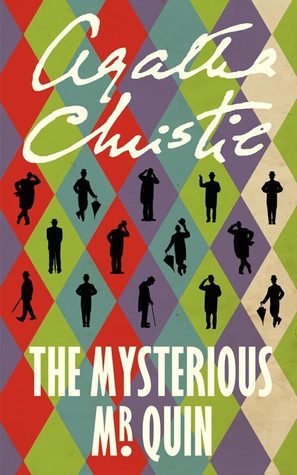
The Mysterious Mr Quin by Agatha Christie

Have you met Mr Satterthwaite and his mysterious friend, Mr Harley Quin? I hadn’t, until I saw that the book selected for Read Christie 2019 this month was The Mysterious Mr Quin, a collection of short stories published in 1930 and featuring a very unusual sort of detective. In fact, he is not really a detective at all, but more of a catalyst who “has a power – an almost uncanny power – of showing you what you have seen with your own eyes, of making clear to you what you have heard with your own ears…”

There are twelve stories in the collection, all of which originally appeared separately in various magazines throughout the 1920s. They all stand alone as individual mysteries but reading them in the order they appear in the book is very effective as each one seems to build on the one before – and the twelfth story, Harlequin’s Lane, should definitely be read last.

The first story, The Coming of Mr Quin, sets the tone for the rest of the book. It begins with Mr Satterthwaite, an elderly English gentleman, attending a New Year’s Eve party at a country house when conversation turns to the suicide of Derek Capel, the former owner of the house. The suicide took place several years earlier, but is still unexplained. In the middle of this discussion, there is a knock at the door and Mr Satterthwaite’s friend Harley Quin appears, asking for shelter while his broken-down car is repaired. Mr Quin joins in the conversation and, by prompting Satterthwaite to ask relevant questions and to think carefully about the sequence of events, the truth behind Mr Capel’s death suddenly becomes obvious – and has important implications for some of the guests at the party that night.

Most of the other stories, with one or two exceptions, follow a similar format: Mr Satterthwaite is at a house party, an opera, on holiday, or attending some other sort of social gathering with his upper-class friends, when he becomes aware that one or more of his companions is hiding a secret – a criminal past, a thwarted love affair or an involvement in a murder. Mr Quin then makes a sudden appearance (sometimes in person and sometimes by leaving a message or cryptic clue) and steers Mr Satterthwaite in the right direction, enabling him to solve the mystery. Some of these mysteries have been unsolved for many years and Mr Quin claims that he is acting as an ‘advocate for the dead’, getting justice for long-ago victims of crimes, while also helping Mr Satterthwaite to influence people’s lives in the present.

Although Mr Satterthwaite is a rich man, with a comfortable, privileged lifestyle, I found him quite a sad and lonely character. He has never married and despite his busy social life his friendships seem to be mainly on a superficial level. He describes himself as a ‘looker-on at life’, someone who observes other people’s dramas without being involved in any himself. If it wasn’t for the fact that other characters in the book see and interact with Mr Quin, I could have believed that Mr Satterthwaite had invented him as an imaginary friend. There is certainly something surreal and otherworldly about Mr Quin, with his unexpected arrivals and departures, and the way his appearances are usually accompanied by a strange trick of the light – he is seen silhouetted against the setting sun, standing in front of a stained glass window, or illuminated by the sun shining through the trees.

This is the only collection of Mr Quin stories, although I think he and Mr Satterthwaite do make one or two appearances in other books or stories. I found this book quite different from anything else I’ve read by Christie and I’m loving the way taking part in this challenge is encouraging me to pick up titles I might otherwise have ignored in favour of the more popular Poirots and Marples.

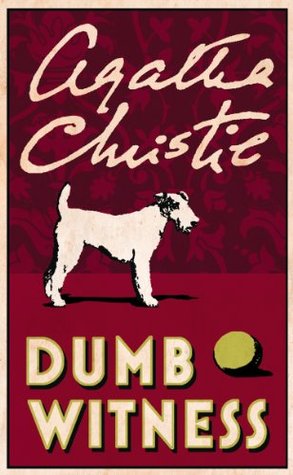
Dumb Witness by Agatha Christie

Dumb Witness (also published in the US as Poirot Loses a Client) was May’s selection for the Agatha Christie Reading Challenge I’ve been taking part in this year. I missed last month’s because the chosen book – The Murder of Roger Ackroyd – was one I’d read before and wasn’t ready to read again – but this one was new to me and sounded very appealing.

Published in 1937, Dumb Witness is one of several Christie novels which feature her famous detective Hercule Poirot and are narrated by his friend Captain Hastings. The novel opens with the family of old Emily Arundell gathering to celebrate the Easter weekend at her home, Littlegreen House, in the fictional village of Market Basing. Emily’s dog, Bob, is excited because there are more people to play his favourite game with him – bouncing his ball from the top of the stairs to the bottom. When Emily gets up during the night and falls down the stairs, however, it’s poor Bob who gets the blame. He must have left his ball there and his mistress didn’t see it in the dark; what other explanation could there be? And yet…

Surely — surely, she must be mistaken…One often had queer fancies after an event had happened. She tried — earnestly she tried — to recall the slippery roundness of Bob’s ball under her foot…
But she could recall nothing of the kind.
Instead —

Convinced that her fall was not an accident and not Bob’s fault, Emily writes to Hercule Poirot and hints that she would like him to investigate the ‘incident of the dog’s ball’, but by the time he receives the letter it’s too late. Emily Arundell is dead, presumably of natural causes. Studying the letter she sent him, Poirot is sure that it wasn’t a natural death at all so, with Hastings by his side, he sets off for Littlegreen House to prove that Miss Arundell has been murdered.

There is certainly no shortage of suspects. Her nieces and nephew and their partners are all in need of money for various reasons and could all have had an opportunity to carry out the murder, while the person who does actually benefit financially from her death – her companion, Miss Lawson – also has to be considered. Then there are the other servants at Littlegreen House, as well as two spiritualist women who claim to have seen a halo of light around Emily Arundell’s head. With her usual skill, Christie directs our suspicions first at one character, then at another, and although I kept thinking I had identified the culprit, I didn’t manage to guess the correct solution until just before it was revealed. However, I did still pick up on one or two important clues before Poirot did, so I don’t need to feel too ashamed!

I really enjoyed this particular Poirot novel; I usually do tend to enjoy the ones narrated by Hastings and I wish there had been a few more of them. The real star of this book, though, has to be Bob the dog! Although he is presumably the ‘dumb witness’ of the title, Christie gives him a personality of his own – and even some dialogue, of a sort. It’s little touches like this that made this book so entertaining. Now I’m wondering what the June choice for the challenge will be.

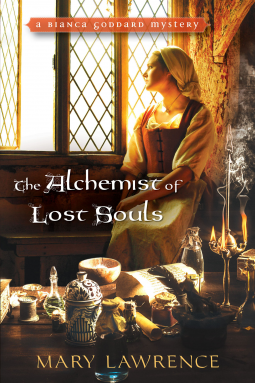
The Alchemist of Lost Souls by Mary Lawrence

The Alchemist of Lost Souls is the fourth book in a series of historical mysteries set in Tudor England and featuring the character of Bianca Goddard, an alchemist’s daughter. Not having read any of the previous novels, I wondered whether I would be at a disadvantage in starting with this one, but that wasn’t really a problem. Although it would have been nice to have been more familiar with the backgrounds of the characters and to have followed them from the beginning, this novel works as a standalone mystery and it was easy enough to understand what was happening without any prior knowledge.

The story takes place in London in the spring of 1544 and opens with Bianca’s father, the alchemist Albern Goddard, discovering a new element – a stone which gives off a brilliant light and which has properties that are both powerful and dangerous. Before he has time to explore the potential of this new substance, it is stolen from him and the suspected thief is found dead in a street near the Dim Dragon Inn with a glowing green vapour rising from her mouth. Albern asks for his daughter’s help and soon Bianca is investigating both the theft and the murder, as well as looking for any trace that may remain of her father’s precious element.

This is an entertaining mystery and a more complex one than it appeared to be at first, with a range of suspects including alchemists, apothecaries, chandlers – and even Bianca’s mother, Malva Goddard. I didn’t manage to guess the solution correctly, but I was happy just to watch Bianca try to unravel it all. Bianca is a very likeable character; she is intelligent and independent, but her behaviour is usually believable enough in the context of being a sixteenth century woman. Like her father, she is interested in science, but her gender means she cannot be an alchemist so instead she works as a herbalist, making remedies for common ailments in her ‘room of Medicinals and Physickes’.

Bianca’s relationship with her husband, John, is one area where I felt I may have missed out by not reading the previous books in the series. In this book he, like the other men from Southwark, has been called up to fight in Henry VIII’s army (as a pikeman after failing to impress with his archery skills) and faces being sent away from home to deal with the threats from Scotland and France. With Bianca pregnant with their first child, a separation at this time is obviously going to be particularly difficult for them both, but I think I would have found their storyline more emotional if I had known both characters better and had seen how their relationship developed.

Apart from Henry VIII’s military endeavours, which are kept mainly in the background of the novel, the story concentrates very much on fictional characters and fictional events, but I could see that Mary Lawrence was making an effort to capture the atmosphere of Tudor England and the details of how people may have lived and worked at that time. The focus is on ordinary, working class Londoners rather than the royalty and nobility, which gives the story a gritty feel and a sense of reality, despite the more fantastical elements of the plot (not just the alchemy but also the mysterious character of the Rat Man, whose role I’m not sure I fully understood). I also appreciated the author’s attempts to use vocabulary appropriate to the period and although some of the slang didn’t feel quite right to me, it did add colour to the writing and there is a glossary at the back of the book if you need to look up any unfamiliar words.

It was nice to meet Bianca Goddard and now I’m wondering if there will be more books in the series.

Thanks to Mary Lawrence and Kensington Books for providing a copy of this book for review via NetGalley.

The Western Wind by Samantha Harvey

When The Western Wind was longlisted for the Walter Scott Prize for Historical Fiction in March, I decided to read my copy of the book before the shortlist was announced so that I could see whether I agreed with its inclusion or omission. Now that I’ve read it, although I can’t really say that I particularly enjoyed it, I wasn’t surprised to see this morning that it has been shortlisted as I found it a complex, multi-layered novel with an unusual structure and some interesting ideas to explore. The sort of book judges usually like, I think!

The Western Wind is, on the surface, a murder mystery set in a small English village in 1491. Oakham in Somerset is an isolated place, cut off from the rest of the world by a river without a bridge. The wealthy Thomas Newman, who understands the importance of trade, has plans to rebuild the bridge, but before work can begin he disappears, presumed to have been swept away by the river and drowned. But was it an accident or was it murder? Lord Townshend, who has been losing some of his lands to Newman, would seem to have the most obvious motive, but he is not the only suspect…

Under pressure from his dean to discover what really happened, village priest John Reve listens to the confessions of his parishioners and is surprised by how many of them are willing to confess to having some involvement in Newman’s death. It is up to Reve to use his judgement and his knowledge of his friends and neighbours to decide who is telling the truth. The story, however, is told in reverse, beginning on day four and then moving back in time to a point just before Newman’s disappearance – and by the time we reach the end of the novel, it has become clear that Reve himself knows much more than he seemed to at first.

Despite the mystery at the heart of this novel, I didn’t feel that it was the main focus of the book. The fate of Tom Newman acts as a starting point from which we – through the eyes of John Reve – explore the daily lives of the people of Oakham, their personalities and relationships, the way their community is structured, and the superstitions and traditions that rule their lives. Social and economic change is another theme; even Newman’s name is symbolic, as he is a relevant newcomer to the village, bringing with him new ideas and new ways of looking at the world.

Although we are told that the book is set in February 1491 (at the beginning of Lent) I would otherwise have found it hard to say exactly when the story is taking place. There are very few references to anything happening in the wider world that give us any clues to the precise time period, but maybe that is the point – news from outside would be slow to reach the isolated, insular Oakham after all. I’m not sure how much importance the author places on historical accuracy in any case; she has acknowledged that the confession box which plays such a big part in the story wouldn’t have arrived in English churches until the following century, but she decided to keep John Reve’s box in her novel anyway. I have to admit, I’ve never given any thought to when confession boxes first came into use – but I am fairly sure that fifteenth century men didn’t wear trousers with waistbands as Herry Carter does in the opening chapter of the book. This is the sort of thing that will either bother you or it won’t, I suppose.

I did like Samantha Harvey’s writing but, as well as the points I’ve made above, there was something about the story that left me feeling slightly dissatisfied. I think part of that was due to the fact that, with the exception of John Reve as our narrator, I struggled to connect with any of the characters. This was probably because the way the novel is structured makes it difficult to tell whether we can trust or rely on anything they say or do, especially as we only witness their words and actions from Reve’s perspective. I’m sure that if I’d taken the time to go back and read the whole book again from the beginning, it would have been a very different experience the second time. I didn’t enjoy the book enough to want to do that, but I think it would have helped me to fully understand and appreciate it.

Thanks to Jonathan Cape for providing a copy of this book for review via NetGalley.

The Mirror Crack’d from Side to Side by Agatha Christie

This month’s book for the Agatha Christie Reading Challenge is one of her later Miss Marple mysteries, The Mirror Crack’d From Side to Side, published in 1962. I tend to prefer the Poirots to the Marples, so I was curious to see what I would think of this one.

The novel opens with the elderly Jane Marple recovering from a recent illness and deciding to take a walk around ‘the Development’, a new housing estate near her home in St Mary Mead. She falls and is helped to her feet by Heather Badcock, one of the new residents, who rushes out of her house to assist. Later, Mrs Badcock is poisoned during a party at nearby Gossington Hall hosted by its new owner, the famous American actress Marina Gregg. It seems unlikely, however, that Mrs Badcock had been the intended victim…it was only through an unfortunate set of circumstances that she came to drink the poison instead of Marina.

Detective-Inspector Dermot Craddock begins to investigate, interviewing all those who were present at Gossington Hall at the time of Heather Badcock’s death and delving into Marina Gregg’s past, uncovering stories of adopted children, jealous rivals and a series of failed marriages. Miss Marple, however, is conducting some very different investigations of her own, based around what she knows of human nature. She is sure that the key to the mystery lies in discovering what caused the strange expression on Marina Gregg’s face just before Mrs Badcock dropped dead – an expression which other guests at the party described as reminding them of Tennyson’s poem The Lady of Shalott (“Out flew the web and floated wide – The mirror crack’d from side to side; ‘The curse is come upon me,’ cried The Lady of Shalott).

This hasn’t become a favourite Christie novel and I didn’t find it quite as clever as some of her others, but I did still enjoy reading it. It seems that she got the idea for the plot from the tragic true story of a real American actress, although I won’t tell you her name because if you look it up it will completely spoil the surprises contained in the solution to the mystery. I correctly guessed who the murderer was very early in the story, but I had no idea what the motive could have been and had to wait for Miss Marple to explain it all for me at the end of the book!

As well as being a murder mystery, this book is also an interesting study of some of the social changes taking place in 1960s Britain with a lot of time devoted to describing the houses on the ‘Development’ and the type of people who live there – with Miss Marple coming to the conclusion that, whatever the time and place, people are still people with the same hopes and ambitions, fears and uncertainties. It is through observations like this that she is able to move towards solving the mystery, drawing parallels between the suspects and other people she has known in the past. Miss Marple is also having personal problems of her own in this book, with her companion/housekeeper Mrs Knight, who treats her like a child and is generally overbearing and domineering. It’s clear that, however much Miss Marple’s age might be catching up with her physically, there is nothing wrong with her mind and she resents Mrs Knight’s condescending attitude. Again, I don’t want to spoil things, but there is a happy ending to this part of the story too!

I can’t say that I loved this one, but I am looking forward to working through the rest of the Marple novels that I haven’t read yet.

Death of a Doll by Hilda Lawrence

Hilda Lawrence was an American crime author best known for her series of novels featuring the private investigator Mark East, published during the 1940s. This one from 1947, Death of a Doll, is the third in the series and has been reissued this month by Agora Books. Lawrence is one of several ‘forgotten’ or lesser known crime writers to be brought back into print by various publishers recently; sometimes it’s easy to see why an author’s books have been allowed to fade into obscurity, but I was very pleasantly surprised by this one and am hoping the rest of the Mark East series will be made available again too.

The story is set in and around Hope House, a home for young women in New York City run by Monica Brady and her assistant Angelina Small. The home provides seventy girls with a safe refuge where, for a small fee, they can have a bed, hot water, two meals a day and the opportunity to make new friends. At the beginning of the novel we meet Ruth Miller, a woman in her twenties who works in Blackmans department store and who is excitedly telling her regular customer, Roberta Sutton, that she has been offered a place at Hope House. We don’t know why Ruth has found herself with nowhere else to go and nobody to turn to, but she gives the reader a hint that there has been some sort of trouble in her past. Later that day, we see her arriving at her new home, suitcase in hand, full of optimism for the future.

Two days later, Ruth is dead, having fallen from a window on the seventh floor of Hope House during a party at which all of the girls were dressed in rag doll costumes. Suicide is assumed, but Roberta is not convinced. Why would Ruth have killed herself just as her life was beginning to improve? What the reader knows, but the characters don’t – although some of them suspect – is that during those few days at Hope House, Ruth came face to face with someone from the past…but who was it and how could this have led to her death?

Roberta calls in her private investigator friend, Mark East, who arrives in New York accompanied by two more amateur detectives, the elderly spinsters Miss Beulah and Miss Bessy. It’s going to be difficult to know where to start – there’s so little known about Ruth and her background, and the fact that all of the girls were dressed in identical doll costumes on the night of her death doesn’t help – but surely between the three of them they can solve the mystery?

I really enjoyed this book. Although the story is slow to unfold – a lot of time is spent on exploring the relationships between the various girls and employees at Hope House – I still found it difficult to put down. I didn’t guess the culprit correctly, but felt as though I probably should have done! I did suspect almost all of the ‘dolls’ at one point or another, constantly changing my mind as more information was revealed. The setting is wonderful too; I could vividly picture the interior of Hope House, with Kitty answering the phones on the switchboard, Jewel operating the elevator, and Miss Brady and Miss Small seeing that everything ran smoothly, while making ambitious plans for the future.

My only problem with the book was that I felt there were too many characters and that we saw things from too many different viewpoints. I’m not sure whether we really needed three detectives either. I think Beulah and Bessy were probably included to lighten the mood and provide some comedy, but they didn’t add much to the story in my opinion and I would have preferred to have spent more time following Mark’s investigations instead. Otherwise, this was a great first introduction to Hilda Lawrence’s work and an unusual combination of the cosy and the dark and suspenseful.

I received a copy of this book for review via NetGalley.

Who Killed Dick Whittington? by E and MA Radford

Dean Street Press have recently brought an intriguing selection of Golden Age crime novels back into print, including several by husband and wife writing team E and MA (Edwin and Mona Augusta) Radford. This book – and the other two Radford titles which have just been reissued, Murder Jigsaw and Murder Isn’t Cricket – all feature Harry Manson, a detective and forensic scientist who works at Scotland Yard’s Crime Research Laboratory.

Who Killed Dick Whittington?, published in 1947, has a theatrical setting and takes place during the Christmas season. The Henri de Benyat theatre company are performing Dick Whittington at the Pavilion in Burlington-on-Sea and, in the tradition of all good British pantomimes, the hero is played by a woman. Her name is Norma de Grey and to say she is not popular with the rest of the cast would be an understatement. When she is killed with a lethal dose of prussic acid one night while on stage in the role of Dick, suspicion falls on the actor playing her Cat – but when the Cat is also found poisoned, it seems that someone else must have been responsible.

Doctor Manson is called in to investigate, but as well as the Dick Whittington poisonings he is also busy with another case, this one involving a series of suspicious fires which have possibly been caused deliberately as part of an insurance fraud. At first the two cases seem entirely separate, but eventually links begin to emerge between the two. Manson uses a range of scientific methods to carry out his investigations and I thought this aspect of the book was fascinating. As it was written in the 1940s, there were obviously fewer, less sophisticated techniques available to Manson than there would be to modern day scientists, but I was still impressed by how much he was able to discover by, for example, weighing the ash found at the fire scenes or analysing the hairs inside the Cat costume.

I also found the details of theatrical life interesting. Apparently Mona Radford had been an actress herself and this does come through in the novel, which shows a deep understanding of everything involved in rehearsing and staging a pantomime, including the things that go on behind the scenes! When a book is written by a pair or team of writers, I am always curious to know how they broke down the writing duties amongst themselves. Well, according to the introduction to this new edition:

The plot was usually developed by Mona and added to by Edwin during the writing. According to Edwin, the formula was: “She kills them off, and I find out how she done it.”

Another thing I liked about this book was the way the authors make it clear that they have tried to give the reader all the clues needed to be able to identify the culprit. There are several ‘Interludes’ at certain points in the novel which are addressed directly to the reader, asking us to put together what we have learned so far and solve various aspects of the mystery. I obviously wouldn’t make a good detective as I still wasn’t able to work any of it out despite the hints, but I was happy to wait until Doctor Manson revealed the truth at the end of the book.

I thought this was a very entertaining mystery by two authors I had never come across before. I’m interested in reading more books by E and MA Radford now.

Thanks to Dean Street Press for providing a copy of this book for review.