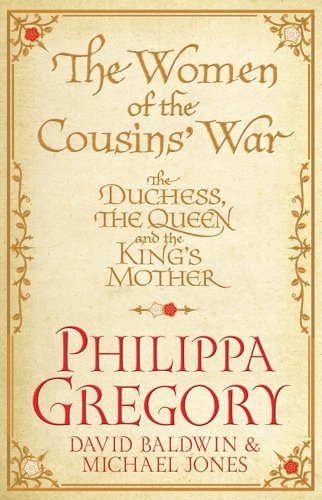
The Women of the Cousins’ War by Philippa Gregory, David Baldwin and Michael Jones

The Women of the Cousins’ War: The Duchess, the Queen and the King’s Mother is a non-fiction companion book to Philippa Gregory’s Cousins’ War series of historical fiction novels. The series tells the story of the Wars of the Roses from the viewpoints of some of the women who were involved, including Jacquetta of Luxembourg, her daughter Elizabeth Woodville, who was married to Edward IV, and Margaret Beaufort, the mother of Henry VII. Their stories were told in The Lady of the Rivers, The White Queen and The Red Queen respectively. The Women of the Cousins’ War features an essay on all three of these women, each written by a different historian, and in addition to the essays we are given some family trees, maps, list of battles, illustrations and colour photographs.

The book begins with a long introduction written by Philippa Gregory, which I actually found as interesting to read as the rest of the book! The introduction discusses the possible reasons why women in history have often been ignored and overlooked, and why it’s important to study the roles they played. Gregory also looks at the differences between writing history and writing historical fiction, and as a lover of historical fiction myself I find it fascinating to read about an author’s reasons for writing it.

The introduction is followed by Gregory’s essay on the life of Jacquetta of Luxembourg. Unfortunately very little is known about Jacquetta, there are no existing biographies and apparently there are only a few occasions where she actually appears in historical records, so Gregory didn’t have a lot of information to give us. For most of the essay she can only guess at what Jacquetta may or may not have done and how she probably reacted to the historical events going on around her. However, this was the essay I enjoyed the most and it was as easy to read as Gregory’s fiction. It sounds as if Jacquetta had a fascinating life and it’s a shame that so few historians have taken the time to study her.

The second essay is written by the historian David Baldwin and looks at Elizabeth Woodville. I did find Baldwin’s writing style slightly dry, but Elizabeth Woodville is a historical figure who interests me, so I still enjoyed reading the essay. The book’s final section is written by Michael Jones and examines the life of Margaret Beaufort. Again, there’s not a huge amount known about Margaret, but I thought Jones did a good job of working with what little information is available. He also spends some time discussing Margaret’s family history to help us understand the background she came from and to build up a more complete picture of the sort of person she was.

This book could be read either as a stand-alone non-fiction/reference book or as an accompaniment to Philippa Gregory’s three Cousins’ War novels. I’m not sure how satisfying it would be for a serious historian or history student though, as there are no footnotes or endnotes and only some brief lists of sources. I should point out that I have never studied the Wars of the Roses in any depth (most of what I know about the period comes from the small number of historical fiction novels I’ve read set during that time) and for the general reader like myself I would say that the book is very accessible and easy to follow. It filled some of the gaps in my knowledge and I thought it was worth reading, particularly for the wonderful introduction!

I received a copy of this book for review from Simon & Schuster

Winter King: The Dawn of Tudor England by Thomas Penn

Winter King: The Dawn of Tudor England is a biography of Henry VII, England’s first Tudor king – a king of whom Francis Bacon said, “he were a dark prince, and infinitely suspicious, and his times full of secret conspiracies and troubles”.

I previously knew very little about Henry VII and was drawn to this book in the hope that it would be a good introduction to the subject. The book opens with a prologue which details the years of unrest and uncertainty that accompanied the Wars of the Roses and explains how Henry VII came to the throne in 1485. Penn then takes us through all the important moments of Henry’s life and reign, including the marriage of his eldest son Arthur to Catherine of Aragon and Arthur’s subsequent death which led to Henry’s second son (the future Henry VIII) becoming his heir.

Henry VII himself is portrayed as a complex and secretive person, clever and shrewd, manipulative and controlling (especially where money and power are concerned). Something that is emphasised throughout the book is that Henry knew his claim to the throne had not been a strong one and that he went to great lengths to convince his subjects to accept him as a legitimate king of England and to prove to them that the rival houses of York and Lancaster had been reconciled under the Tudor name. Despite his efforts, though, he found himself the constant target of plots and conspiracies. The book goes into a lot of detail in recounting some of these planned rebellions and the reasons why they failed.

As someone who doesn’t read a lot of historical non-fiction and who is not an expert on the Tudors, I still had no problems understanding any part of this book. Although it does require some concentration, I found it a very interesting and absorbing read from beginning to end. For those of you who do already have a good knowledge of Henry’s reign, there might not be anything new here but I’m sure you’ll still find plenty to enjoy. Penn’s descriptions of royal weddings, funerals, court pageants etc are particularly well-written and vivid.

The book is very thorough and detailed, with all sources and references provided in the notes. It’s not what you could describe as a quick and easy read, but it’s still very enjoyable and I would highly recommend it to anyone who is interested in learning about the reign of Henry VII and the early life of his son, Henry VIII. Thomas Penn appears to have stayed objective and resisted the temptation to let his own opinions and theories get in the way of the facts, giving us a balanced and unbiased view of a fascinating period of history. I hope he goes on to write more books as he’s definitely a name to look out for.

I have to admit, before I started reading this book I already had a very negative impression of Henry VII due to the way he is portrayed in novels such as The Sunne in Splendour by Sharon Kay Penman and The Daughter of Time by Josephine Tey. Winter King hasn’t done much to change my opinion of him, but I’m pleased that at least I’ve now had the chance to fill in some of the gaps in my knowledge.

Samuel Pepys: The Unequalled Self by Claire Tomalin

As you may have noticed, I don’t often read non-fiction (a big clue can be found in my blog name) but this is something I’d like to change. I have heard a lot of praise for Claire Tomalin’s biographies, so I had high hopes for this one.

Samuel Pepys: The Unequalled Self is a long and comprehensive biography of an important historical figure, most famous for the diaries he kept during the 17th century. I haven’t actually read the diaries of Samuel Pepys yet but would certainly like to read them at some point in the future. I wasn’t sure whether not having read the diaries would cause problems with my understanding of the biography, but luckily it didn’t seem to matter – in fact, it might actually be best to read the biography first as it helps to put the diaries in context.

The first few chapters deal with Pepys’ childhood and early life (pre-diary) and understandably we don’t have a lot of information regarding this period of his life – we can only speculate about what Pepys may or may not have done. I found these chapters quite boring in comparison to the rest of the book, although I did enjoy learning about a typical day in a 17th century school – and I was fascinated by the description of the operation Pepys had to remove a stone from his bladder. I’ve always had an interest in the history of medicine and it never ceases to amaze me how anybody ever survived at all!

Tomalin explains that what makes Pepys’ diary so interesting and noteworthy is that he records a mixture of both public events and personal experiences. Pepys lived through a fascinating and eventful period of English history and his famous diary covers such events as the Restoration of Charles II, the plague of 1665 and the Great Fire of London in 1666. I was slightly disappointed that more attention wasn’t given to the plague as it’s a topic I find fascinating to read about (I hope that doesn’t sound too morbid!) but as Tomalin explains it was something that didn’t affect Pepys personally and so he doesn’t spend a lot of time talking about it.

The most interesting parts of the book for me were the descriptions of daily life. While I confess to struggling to get through some of the chapters about Pepys’ political and business activities, I found the more personal sections completely gripping. I thought Tomalin stayed very objective throughout the biography, drawing attention to both the good and the bad aspects of Pepys’ character (and to be honest, he didn’t seem to be the most pleasant of people). But I can tell that even though Tomalin doesn’t shy away from discussing his negative points, she has a lot of enthusiasm and liking for her subject. She also fleshes out the characters of other important people in Pepys’ life including his wife Elizabeth, with whom he had a very complex and volatile relationship. He could be very cruel to her and both physically and verbally abusive, but they did appear to have some genuine affection for each other and Tomalin describes some of the happy times they had together as well as the bad.

For someone like myself who doesn’t often read this type of literary biography, this was quite a challenging book but worth the effort. If I had tried to read this book straight through from beginning to end I probably wouldn’t have managed to finish it, but reading it over the course of a month, a few chapters at a time between reading my usual fiction books, worked perfectly for me.

Have you read any of Claire Tomalin’s biographies? Which ones would you recommend?

The Suspicions of Mr. Whicher by Kate Summerscale

One night in June 1860 a little boy called Saville Kent was murdered at his home in the village of Road, Wiltshire. As it seemed certain that nobody had entered the house from outside, suspicion fell on the Kent family and their servants. When the local police proved to be incompetent, the Home Secretary requested that Scotland Yard send Detective Inspector Jonathan Whicher to assist them with the investigation. In The Suspicions of Mr. Whicher, Kate Summerscale tells the full story of the case and how it affected Whicher’s career.

This is a non-fiction book based on a true story. Considering the book combines two of my favourite things in literature – mysteries and the Victorians – you won’t be suprised to hear that I thought it was completely fascinating! And although I regretted not reading it sooner (it was first published in 2008), my timing actually couldn’t have been better. Just after finishing the book I discovered that it had been adapted for television, so the story was still fresh in my mind when I sat down to watch it on ITV1 last night (Monday 25th April). I enjoyed the TV adaptation but I’m glad I managed to read the book first.

I appreciated the fact that Summerscale was careful not to give away the solution to the mystery too early in the book, which meant the reader had a chance to study the clues and try to solve the mystery along with Whicher. It was interesting too to see how the vocabulary used in detective work has developed over the years, such as the origins of the word ‘clue’.

Summerscale also explains how during the 19th century people began to place a greater importance on the privacy and security of their homes than they had in the past. Thus a case like the Road Hill one was even more shocking in that it had taken place behind locked doors. The sanctity of the home had been violated and it seemed that the murderer was almost certainly one of the household. This must have made people all over the country afraid that the same thing could happen in their own family home. And with the multitude of new national and local newspapers that had appeared in recent years, detailed reports of this and other horrific crimes could be brought to an even wider audience. This, of course, allowed the public to become ‘armchair detectives’ and come up with their own theories as to what really happened.

The murder at Road Hill House captured the imagination of the British public and inspired a number of fictional detective stories such as The Moonstone by Wilkie Collins, which I read a few years ago. The character of Sergeant Cuff in The Moonstone is thought to be based on Whicher and I can also now see how Collins incorporated some other elements of the Road Hill investigation into his story – the importance which is placed on checking the family’s laundry, for example. I really need to re-read The Moonstone soon because I’m sure that knowing some of the background behind it will help me to get more out of it!

Have you read The Suspicions of Mr Whicher? Are there any other true crime stories that you’ve enjoyed reading?

Spilling the Beans on the Cat’s Pyjamas by Judy Parkinson

My sister gave me this pretty little book for Christmas, which was great because it’s not the type of book I would usually think about buying for myself. The title might leave you wondering exactly what this book is about, but the subtitle helps to explain: Popular Expressions – What They Mean and Where We Got Them.

The book looks at some of the well-known phrases and proverbs which appear in the English language and explains what they mean and how they originated. Do you know what ‘to shoot the moon’ means, for example, or why we give someone ‘the third degree’. Why do we ‘steal someone else’s thunder’ and why do we ‘go to the Land of Nod’ when we fall asleep?

The phrases appear in alphabetical order. I was a bit disappointed by some of the entries which are little more than a straight definition of the phrase or proverb, but the majority were interesting and I learned a lot of fascinating little facts. Some of them such as ‘ballpark figure’ and ‘take a rain check’ have American origins. Others stem from Ancient Greece or Rome. There are others that come from the Bible, some that are derived from Aesop’s fables and some that were made famous by Shakespeare. A few of the phrases have no definite origins and in these cases the author tells us that the definitions she’s providing are merely speculation.

I particularly liked the explanation for the phrase ‘to blow hot and cold’.

The expression has its origins in the Aesop’s fable that describes the experience of a traveller who accepted the hospitality of a satyr (one of the gods of the forest, a creature who is part goat and part man). The chilly traveller blew on his cold fingers to warm them – and then blew on his hot broth to cool it. The indignant satyr ejected him because he blew hot and cold with the same breath.

This is not really a book you would read from cover to cover in one sitting; it’s perfect for dipping in and out, reading a few entries at a time. It’s strangely addictive though as the entries are temptingly short (usually no more than two or three paragraphs). I’d recommend it to anyone with a love for the English language. It’s a perfect book to buy as a gift too, as it even has a special page at the front where you can write your ‘to’ and ‘from’!

The Dressmaker of Khair Khana by Gayle Tzemach Lemmon

When journalist Gayle Lemmon was looking for a subject that hadn’t already been given a lot of news coverage, she became intrigued by the topic of female entrepreneurs working in war zones. Travelling to post-Taliban Afghanistan, Lemmon intended to report on women who were running their own businesses. Unfortunately finding female business owners at first proved more difficult than she had expected, but eventually she heard about Kamila Sidiqi. In The Dressmaker of Khair Khana, subtitled Five Sisters, One Remarkable Family, and the Woman Who Risked Everything to Keep Them Safe, Lemmon tells Sidiqi’s amazing story.

After receiving her teacher training certificate from college in 1996, Kamila Sidiqi was looking forward to going to university and becoming a teacher like her elder sisters, when the Taliban took control of Kabul and everything changed almost overnight. Suddenly women found their freedom stripped away from them. Required to wear the chadri (full-length burqa) and unable to go outdoors without being accompanied by a male relative, the options available for a woman to earn her living became very limited.

Trying to find a way of making money that would still comply with the Taliban’s rules, Kamila decided to set herself up as a seamstress, making clothes in her own living room and selling them to local tailor’s shops. As the weeks and months went by, Kamila’s dressmaking business grew in size and reputation until eventually she and her sisters and several of their neighbours were working round the clock to meet their orders. Kamila also came up with the idea of starting a school to teach other girls from the neighbourhood the basics of dressmaking, enabling them to support themselves and their families.

Throughout the book you can never forget the danger Kamila was in and the risks she was taking. For example, there’s a frightening moment where she and two female friends are caught taking a bus to Pakistan without their mahram (male companion). Kamila’s courage and quick-thinking really shines through in situations like this.

Lemmon has a nice clear writing style, and the book is as easy to read as fiction. As well as being a fascinating story, I also found The Dressmaker of Khair Khana completely inspiring. Kamila and her sisters refused to be defeated, searched for solutions to every problem and managed to prosper despite the oppressive conditions they were forced to live under.

Recommended.

The Dressmaker of Khair Khana will be published by HarperCollins in March 2011. I received a review copy as an ebook from NetGalley.

Review: Persepolis by Marjane Satrapi

This is the first graphic novel I’ve read. There, I’ve admitted it. I can’t explain why it has taken me so long to read one. It’s not that I think they’re childish or ‘not real literature’ or anything like that; it had just never occurred to me to read them and until I started blogging I didn’t even realise how popular they were. When I did decide I’d like to try one I thought a graphic memoir might be the best to start with and as I’d seen Persepolis reviewed on so many blogs it seemed a good choice. And it was, because I loved it.

This edition is actually two books in one: The Story of a Childhood and The Story of a Return. They can be bought separately but you really need to read the first book before the second.

These two books are the memoirs of Marjane Satrapi. In The Story of a Childhood she tells us what it’s like to be a child growing up in Iran during the 1970s and 80s. Due to the Islamic Revolution and the Iran-Iraq War, Iran becomes an oppressive and often dangerous place to live, particularly as Marjane develops into a rebellious teenager. Her concerned parents eventually decide that the safest option is to send their daughter away to start a new life in Europe.

Before beginning this book, I didn’t know very much at all about Iranian history and politics. I found that seeing things through a child’s eyes was fascinating and informative. Marji is an intelligent, imaginative girl and like all children she’s always curious and full of questions, so for someone who knows very little about Iran, this book offers an opportunity to learn along with Marji.

In the second volume, Marji is living in Austria, struggling to adapt to life in a country with an entirely different culture. This second book is more about the personal problems she faces with relationships, drugs and money and although I had a lot of sympathy for the situation she was in, I didn’t enjoy reading this book as much as the first one. I did find it more interesting towards the end when she finally returns to Iran several years later and finds she has as much trouble fitting back into her old life as she’d had fitting into life in Austria.

Although this was definitely a new experience for me, I was quickly able to forget that I was reading a ‘graphic novel’ and become absorbed in Marjane Satrapi’s story. The simple, stark black and white drawings were perfect and made it easy to understand what was happening. Rather than just illustrating the text, the pictures played an equally important part in telling the story.

I enjoyed this book much more than I expected to. It was a powerful and moving story, with some moments of humour too. So, if you are also new to graphic novels and unsure where to start, I have no hesitation in recommending this one to you!