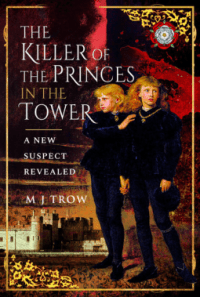
The Killer of the Princes in the Tower by MJ Trow

The fate of the Princes in the Tower – Edward V and his younger brother Richard, Duke of York – remains one of the greatest unsolved mysteries of all time. Reportedly last seen in the grounds of the Tower of London in the summer of 1483, the disappearance of the two boys has divided historians ever since. Their uncle, Richard III, is the man most often accused of being responsible for their deaths, while the names of Henry VII and Henry Stafford, Duke of Buckingham have also been suggested as possible culprits. In all three cases there is a logical political motive: to remove rival claimants to the throne. But what if the murder (assuming that it was actually murder) was not politically motivated at all? What if the princes were killed for an entirely different reason, by someone completely unexpected?

MJ Trow’s new book, The Killer of the Princes in the Tower, is subtitled A New Suspect Revealed, and I have to admit, when I first started reading, I was very sceptical about this. The Wars of the Roses and Richard III’s reign in particular is a period of history I’m very interested in and I’ve read a lot of books over the years, both fiction and non-fiction, that deal with the subject of the Princes in the Tower. Could Trow really come up with a ‘new suspect’? Well, yes he does – or at least, one that I can’t remember being suggested in any of the other books I’ve read.

If you have any prior knowledge of the period and the controversy surrounding the princes, it will probably be helpful, but if not Trow does provide plenty of background information, describing the whole sequence of events following the death of the boys’ father, Edward IV, and explaining how Richard III came to take the throne before the young Edward V could be crowned. He spends some time discussing the idea that the princes could have been secretly released from the Tower and not murdered at all – a theory some people believe is supported by the appearance a few years later of a ‘pretender’, Perkin Warbeck, claiming to be the younger of the princes, Richard of York – but (sensibly, in my opinion), he doesn’t consider this as a serious possibility. He then looks at all of the potential suspects one by one, presenting the evidence for each one being the murderer and then dismissing it, until only one name is left…

Trow approaches the mystery like a modern day police investigation, believing that no stone should be left unturned and looking for motive, means and opportunity. Beginning with the three most obvious suspects, he moves on to consider their supporters, servants and family members; even Richard III’s wife, Anne Neville, and the princes’ own mother, Elizabeth Woodville, are discussed – because, as Trow says, they would certainly have been interviewed by the police if the boys had disappeared today. He also examines the reliability of the various sources and what we can learn from them.

The revelation of the new suspect did take me by surprise because it’s not someone who would ever have occurred to me. It’s true that this person certainly had the means and the opportunity, but I wasn’t at all convinced about the motive, even though Trow devotes a whole chapter to drawing comparisons with other people throughout history who have killed for similar reasons. Although what Trow suggests is not impossible, I don’t think it’s very likely either and as far as I’m concerned the mystery remains unsolved! Still, it’s good to read a theory that is neither pro-Ricardian nor anti-Ricardian and that looks at the whole subject from a very different angle. I found this book almost as gripping as fiction, so despite not agreeing with the conclusion I still really enjoyed reading it.

Thanks to Pen & Sword for providing a copy of this book for review via NetGalley.

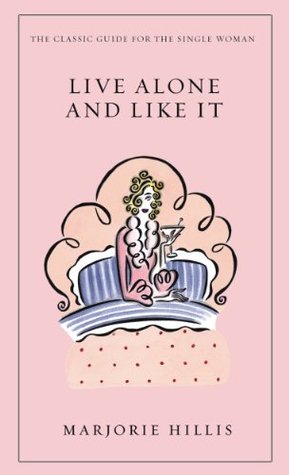
Live Alone and Like It by Marjorie Hillis – #1936Club

This week Karen and Simon are hosting another of their clubs where we all read and write about books published in the same year – and I think this particular year, 1936, is one of the best so far. I’ve already read a lot of great 1936 books and there are many more that I considered reading for the club.

Live Alone and Like It by Vogue editor Marjorie Hillis, is a self-help book for single women who, either intentionally or unintentionally, find themselves living alone. I’m not someone who normally reads self-help books, but I thought it might be fun to read one published in 1936 and, as I do live alone, to see if Hillis has any good advice for me!

As nice, perhaps, as any other way of living, and infinitely nicer than living with too many people (often meaning two or more others) or with the wrong single individual. You can live alone gaily, graciously, ostentatiously, dully, stolidly. Or you can just exist in sullen loneliness, feeling sorry for yourself and arousing no feeling whatever in anybody else.

As you can probably tell from the quote above, Hillis has very little patience with women who indulge in self-pity and sit around complaining about their living arrangements. Her view is that single women can easily become a burden to other people and should avoid doing so at all costs: ‘Remember that nothing is so damaging to self-esteem as waiting for a telephone or door-bell that doesn’t ring.’ Instead, in her brisk, no-nonsense style she urges us to take control of our own lives and raise our self-esteem by giving ourselves little treats, cooking nice meals, wearing new clothes, and not telling ourselves that it ‘doesn’t matter because nobody sees you’.

There are some amusing question and answer sections, with questions like ‘How late is it proper for a woman living alone to entertain a man friend, and how can she get him to go at the correct time?’ and each chapter ends with a selection of case studies, showing how some women have perfectly mastered the art of successfully living alone while others unfortunately haven’t. She devotes a whole chapter to the pleasures of sleeping in a single bed, pointing out that ‘most people have more fun in bed than anywhere else, and we are not being vulgar’ and another takes us step-by-step through the correct preparation, cooking and serving of meals for one person:

Very well, then, have your orange juice and black coffee and toast…Our plea is merely for plenty of orange juice, coffee and toast; really good orange juice, coffee and toast; and orange juice, coffee and toast attractively served.

There’s no doubt that Hillis’ target audience were women of a certain class; she seems to take it for granted that you will probably have a maid – and if you don’t, you’re very unfortunate as you’ll have to do everything yourself – and she provides lots of tips on hosting the perfect cocktail party or bridge night. There’s also an assumption that you will be living in a large city like New York with plenty of clubs, theatres and exhibitions to go to; women who live alone in a small town or in the countryside aren’t given as much attention, except in a few of the case studies. However, a lot of her advice is still relevant today and to everyone, such as how to meet people and make new friends. I will leave you with a quote that I think applies to all of us live-aloners, whatever our personal circumstances:

Living alone, you can – within your own walls – do as you like. The trick is to arrange your life so that you really do like it.

The Haunting of Alma Fielding by Kate Summerscale

I’ve had mixed experiences with Kate Summerscale’s books so far: I loved The Suspicions of Mr Whicher, liked The Wicked Boy and gave up on Mrs Robinson’s Disgrace after a few chapters. I didn’t know what to expect from The Haunting of Alma Fielding, then, but I hoped it would be another good one!

Like Summerscale’s others, this is a non-fiction book based on a true story, in this case the story of an ordinary thirty-four-year-old woman, Alma Fielding, who becomes the centre of paranormal activity in her London home. The book follows Nandor Fodor of the International Institute for Psychical Research as he investigates Alma’s claims, desperately hoping that this time – after being disappointed by a long line of frauds – he has finally come across a genuine haunting.

At first, having witnessed for himself the smashed glasses, spinning teacups, moving furniture and broken eggs, Fodor is convinced that a poltergeist is at work in the Fielding household. The more he learns about Alma’s abilities, which include producing live animals out of thin air and transporting herself from one area of London to another, the more intrigued he becomes…until, eventually, he begins to have doubts. Is this a real paranormal phenomenon he is investigating or is Alma haunted by something very different?

I found some parts of this book fascinating. Although I was sure Alma must have been involved in some sort of elaborate hoax and that there must have been logical explanations for the things she claimed were happening to her, I didn’t know exactly what she was doing or how she was doing it. I was amazed to see the lengths Alma went to in her efforts to prove that her psychic abilities were real and the lengths Fodor and the other ghost hunters went to in their efforts to verify them. Some of the methods they used to investigate Alma’s claims were quite harmless, such as conducting word association tests, but others were intrusive and cruel, and although I didn’t like Alma it made me uncomfortable to read about the way she was treated – particularly as Fodor believed that her powers were the products of various traumas she had suffered earlier in life.

At times, Summerscale widens the scope of the book to put Alma’s story into historical context, to discuss the influence of novels and films of that period, and to look at some of the other things going on in society at that time. The ‘haunting’ and the investigation took place in 1938, when the world was on the brink of war and Summerscale suggests that people were turning to spiritualism as a distraction:

The ghosts of Britain, meanwhile, were livelier than ever. Almost a thousand people had written to the Pictorial to describe their encounters with wraiths and revenants, while other papers reported on a spirit vandalising a house in Stornoway in the Outer Hebrides, and on a white-draped figure seen gliding through the Hawker aircraft factory in Kingston upon Thames. The nation’s phantoms were distractions from anxiety, expressions of anxiety, symptoms of a nervous age.

However, although I found plenty of things to interest me in this book, I did have some problems with it. I felt that it became very repetitive, with endless descriptions of Alma’s various manifestations and detailed accounts of the researchers’ experiments. I thought Summerscale also devoted too much time to anecdotes about other alleged psychics and spiritualists, which didn’t really have much to do with Alma. It seemed that Alma’s story on its own wasn’t really enough to fill a whole book, so a lot of padding was needed.

I didn’t like this book as much as Mr Whicher or The Wicked Boy, but Kate Summerscale does pick intriguing topics and I’ll look forward to seeing what she writes about next.

The Fall of the House of Byron by Emily Brand

The poet Lord Byron was famously described by Lady Caroline Lamb as ‘mad, bad and dangerous to know’. This recent biography by Emily Brand shows that he is not the only member of his family to whom this description could apply! Subtitled Scandal and Seduction in Georgian England, the book takes the Byron ancestral home, Newstead Abbey in Nottinghamshire, as its starting point and shows how this once grand house falls into ruin over the years, mirroring the downfall of the Byron family.

George Gordon Byron, 6th Baron Byron, the Romantic poet, is obviously the best known Byron; a lot has already been written about his life and work, so he is not really the focus of this book. He does appear from time to time, but the majority of the book is devoted to the stories of his parents and grandparents, great-aunts, great-uncles and their children. As was common in that era, the same names tended to be passed down from father to son and mother to daughter, so there are lots of Johns, Williams and Georges, Isabellas, Elizabeths and Sophias. The family tree at the beginning of the book is useful, but it’s still easy to get confused! However, some of the family members are given more attention than others and these include:

* William Byron, 5th Baron Byron – Known as ‘the Wicked Lord’, William Byron is rumoured to have tried to abduct an actress at the same time as negotiating his marriage to an heiress. He is also tried for murder after killing a friend in a duel. In later life (after his son elopes with his own cousin), William finds himself in financial difficulties, selling off parts of the family estates and unable to keep Newstead Abbey in good repair.

* Vice Admiral John Byron – Nicknamed ‘Foul-Weather Jack’, John Byron is a Royal Navy officer and explorer. The book describes his adventures at sea, including a shipwreck off the coast of Chile, his role in claiming the Falkland Islands for Britain, and the battles he fought in during the American Revolution. Towards the end of a career which had once seemed so impressive, John returns home under the shadow of failure and suffering from ill health.

* Isabella Howard, Countess of Carlisle – William and John’s sister marries the Earl of Carlisle and lives with him at his estate of Castle Howard in Yorkshire until she is widowed in 1758. Her second marriage, to a much younger man, makes her the subject of gossip, and after separating from him several years later, she travels Europe in the company of a German soldier, writing poetry, throwing parties and falling into debt.

* Captain John Byron – Later known as ‘Mad Jack Byron’, he is Foul-Weather Jack’s son and George Gordon’s father. In 1785, he marries a Scottish heiress, Catherine Gordon, for her money and proceeds to waste her fortune on ‘gambling, pretty women, thoughtless spending on clothes, alcohol and horses’.

Although all of these people were individually fascinating to read about (I was most interested in Isabella, an independent and unconventional woman who is often unfairly judged by the standards of the time), I found the structure of the book quite disjointed and difficult to follow at times. In the first half of the book, each of the main characters has a chapter devoted mainly to them, but by the second half their stories overlap so much that I was struggling to keep them all straight in my mind. Having said that, I’m not sure how else the book could have been structured as the actions of one family member obviously have an impact on the lives of all of the others and it would have probably been impossible to continue writing about each of them separately.

As well as exploring the downfall of the Byron family, the book also offers lots of interesting insights into Georgian life; I particularly enjoyed the descriptions of the fashionable society of Bath and the friendship between Sophia Byron (Mad Jack’s mother) and the authors Fanny Burney and Hester Thrale. Emily Brand has obviously carried out a huge amount of research for this book; I can’t comment on the accuracy as I’ve never read any other non-fiction about the Byrons, but she does quote from a large number of primary sources and everything is clearly referenced at the end of the book. Although at times I found it all slightly overwhelming and felt that I was being given so much information I couldn’t digest it all properly, I still very much enjoyed reading this book and getting to know the members of this scandalous family!

The Light Ages by Seb Falk

The Dark Ages is a term still used – although maybe not as often as it used to be – for the period between the fall of the Roman Empire and the Renaissance, bringing to mind images of people living in an intellectual darkness, a time when little scientific progress and cultural advancement took place. In The Light Ages, historian Seb Falk dispels this idea by showing how this period was actually a time of discovery, invention and learning, and that the word medieval ‘rather than a synonym for backwardness should stand for a rounded university education, for careful and critical reading of all kinds of texts, for openness to ideas from all over the world, for a healthy respect for the mysterious and unknown.’

Instead of concentrating on the work of famous historical figures, Falk has chosen to focus on a man whose name is probably unfamiliar to most of us: Brother John of Westwyk, a monk who lived in the late fourteenth century. Although there’s a lot we still don’t know about John, Falk takes us through the known facts and uses his general knowledge of the period to flesh things out, describing what John’s life may have been like at St Albans Abbey where he was ordained and outlining the type of education he would have received at Oxford University. Later, John continued his mathematical and astronomical studies at Tynemouth Priory and then went on crusade with Henry le Despenser in 1383 before returning to London where he produced his biggest scientific accomplishment:

He had made an equatorium – an equation-solver, a computer – and he was calibrating it to give the precise positions of the planets.

I won’t pretend that I understood the descriptions of John Westwyk’s famous Equatorie of the Planetis (once believed to have been the work of the poet Geoffrey Chaucer) – like a lot of the information in this book, it went completely over my head. However, before we get to the discussion of the Equatorie, Falk explores several of the other scientific, mathematical and astronomical advancements and discoveries that made such an invention possible. The topics covered include the Babylonian base-60 system of numbering, the development of early clocks, mapping and the magnetic compass, and the functions of the device known as the astrolabe. Some of it is fascinating (did you know how to count to 9,999 on your fingers?), but there are also a lot of geometric diagrams, equations and calculations that will probably be of much more interest to people with a background in physics and mathematics than to the general reader.

A line runs from the Middle Ages to modern science. It is not an unbroken line, of course, and certainly not straight. But if you struggled with any of the trigonometry in earlier chapters, you will admit that medieval people – who carried out such painstaking calculations without the help of any electronics – were not stupid.

Although the book often became too technical for me, I did enjoy all the insights we are given into medieval life. I loved the image of John trying to work on his astronomical tables in his room in St Albans while pigs roam the streets outside:

According to local tradition, pigs too small to sell were donated to the hospital. As they trotted through the streets, Londoners fed them up from runts to valuable livestock, in small but frequent gestures of civic charity. The hospital marked its porcine property with bells to prevent their confiscation and deter theft. For John Westwyk, though, the grunting and clanging from the street cannot have aided his attempts to comprehend Ptolemaic planetary theory.

The Light Ages has clearly been thoroughly researched, drawing on medieval documents and texts ranging from Pierre le Pèlerin’s Letter on the Magnet to Bernard of Gordon’s Lily of Medicine and making occasional diversions to other parts of the world to discuss the impact of the Crusades or to highlight the work of the Persian polymath, Tusi, to give a few examples. For readers who want to explore further, there’s a large selection of primary and secondary sources provided at the end of the book. This wasn’t the ideal book for me as I would have preferred something slightly less academic, but for the right reader I’m sure it would be a wonderful read!

Thanks to Penguin Press UK – Allen Lane for providing a copy of this book for review via NetGalley.

The Lifted Veil and Silly Novels by Lady Novelists by George Eliot – #NovNov

The second book I’ve read for this month’s Novellas in November is one of the Penguin Little Black Classics series. It contains a novella by one of my favourite Victorian authors, George Eliot – The Lifted Veil – as well as an essay, Silly Novels by Lady Novelists, also written by Eliot.

The Lifted Veil was written very early in Eliot’s career and published in 1859, the same year as her first novel Adam Bede. It’s a controversial story which seems to get very mixed reviews and now that I’ve read it, although I found it quite enjoyable, I can understand why. It’s not her usual sort of book at all; I’ve seen it described as science fiction, Gothic fiction and horror, none of which are genres you would normally associate with Eliot!

Our narrator, Latimer, is a young man who suffers from an illness which seems to leave him with an unusual and unwelcome gift – the ability to see into the future and into the minds of other people. It begins with a vision of Prague, a city he has never visited or seen in a picture, and it is so incredibly detailed – ‘right down to a patch of rainbow light on the pavement, transmitted through a coloured lamp in the shape of a star’ – that Latimer is both excited and alarmed. Other episodes of clairvoyance follow, including dreamlike sightings of a tall, blond-haired young woman dressed in green. This turns out to be Bertha, his brother Alfred’s fiancée…but Latimer has seen a future version of himself married to Bertha. Will this come true – and if so, will the marriage be as unhappy as the vision seems to suggest?

I can’t say much more about the plot without spoiling the story, but I found The Lifted Veil an interesting and intriguing read. For such a short piece of writing, it contains many different topics and themes: the contemporary scientific ideas of Eliot’s time, ranging from mesmerism and phrenology to blood transfusions; fate and whether it can be changed; the possibility of life after death; and the question of what we can see when the ‘veil is lifted’. I should warn you that there is a scene involving a dead body – as I said, this is not a typical Eliot book – although it’s quite tame if you’ve read a lot of Edgar Allan Poe, as I have!

The novella takes up just over half of this 110 page book. The essay from 1856 that follows, Silly Novels by Lady Novelists, is unrelated and seems to be a bit of a random choice to fill the remaining pages in the book. Still, I thought it was fascinating to read Eliot’s thoughts on her fellow female authors. In case you can’t tell from the title, Eliot has a very low opinion of books she describes as ‘the frothy, the prosy, the pious or the pedantic’, and an even lower opinion of the women who write them:

It is clear that they write in elegant boudoirs, with violet-coloured ink and a ruby pen; that they must be entirely indifferent to publishers’ accounts, and inexperienced in every form of poverty except poverty of brains. It is true that we are constantly struck with the want of verisimilitude in their representations of the high society in which they seem to live; but then they betray no closer acquaintance with any other form of life. If their peers and peeresses are improbable, their literary men, tradespeople, and cottagers are impossible; and their intellect seems to have the peculiar impartiality of reproducing both what they have seen and heard, and what they have not seen and heard, with equal unfaithfulness.

Although I did feel a bit sorry for the lady novelists mentioned in the essay, including the authors of Laura Gay, The Old Grey Church and Rank and Beauty (three of the novels which come in for particular criticism from Eliot), I can also see why Eliot would have felt frustrated by female writers who were perpetuating stereotypes of Victorian fiction such as the perfect, virtuous heroine, and making it difficult for more literary authors like herself to be taken seriously. Of course, her male pseudonym would help to distance her work from the type of novels she despised and I’m sure Eliot would be pleased to know that her own novels have stood the test of time while the ‘silly novels’ and their authors have largely been forgotten.

So, two very different short reads in one book! Have you read either of them? I would love to hear what you thought.

The Brothers York: An English Tragedy by Thomas Penn

I don’t often get excited about non-fiction books, but having enjoyed Thomas Penn’s Winter King – a biography of Henry VII – a few years ago, I was really looking forward to reading this new one, particularly as it covers one of my favourite periods of English history: the Wars of the Roses. I’ve read about this period many times now, but it sounded as though this book had something different to offer, promising to focus on Edward IV, Richard III and George, Duke of Clarence – three of the sons of Richard, Duke of York and Cecily Neville.

The Wars of the Roses were a series of battles for control of the throne of England fought between two rival branches of the House of Plantagenet: the House of York and the House of Lancaster. The background to the conflict is quite complex, but Thomas Penn devotes the early chapters of the book to explaining how it came about and the efforts of first the Duke of York and then his eldest son, Edward – assisted by his cousin, the Earl of Warwick – to take the throne from the Lancastrian king, Henry VI. Penn then takes us through the whole of Edward’s reign until his death in 1483 when his youngest brother, Richard, claims the throne under controversial circumstances. A relatively short account of Richard’s reign follows, before the book comes to an end with Richard’s defeat at the Battle of Bosworth and the rise of a new dynasty: the Tudors.

The Brothers York is as well written and thoroughly researched as I would expect from a Thomas Penn book, yet I had mixed feelings about it. On the one hand, it provides an excellent overview of a complicated, fascinating period of history written in a very readable and accessible style; on the other hand, if you’re already familiar with the period, as I am, there’s nothing new here that hasn’t been covered before in other books. I found The Hollow Crown by Dan Jones, for example, just as engaging and informative – and a more manageable length! I should mention that The Brothers York is a very long book that took me most of January to read; if you’re planning to read it, bear in mind that it’s going to be quite a commitment.

The majority of the book deals with Edward IV, which is understandable as his reign spanned more than twenty years (apart from a few months in 1470-71 when the crown was briefly reclaimed by Lancaster). I thought Penn’s portrayal of Edward seemed quite fair and unbiased, showing his transformation over the years from the brave, handsome, charismatic young man who succeeded so brilliantly on the battlefield to an increasingly overweight and unhealthy king, interested mainly in comfort and pleasure, accused of showing favouritism towards his wife’s Woodville relatives, something which caused resentment amongst his own loyal friends and supporters.

The portrayal of Richard, whose short and troubled reign is covered in the final section of the book, is less well balanced. It’s certainly not as negative as some I’ve read, but I definitely felt that Penn was selective about which sources he used and which aspects of Richard’s life he chose to focus on in order to show him in a bad light. That’s not really surprising though, as his sympathies are clearly with Henry Tudor, the subject of his previous book. What did surprise me was that the mystery of the Princes in the Tower is hardly mentioned at all. It’s implied that Richard was responsible, but it’s all passed over very quickly and none of the other theories for the princes’ disappearances are explored, which I thought was unusual (not that I particularly wanted to read about all of that again, but if this was the first time you’d read about it you wouldn’t realise it was actually one of history’s biggest unsolved mysteries).

As for the third York brother, George, Duke of Clarence, although he never becomes king himself he spends most of his adult life alternating between supporting Edward and conspiring against him, and in conflict with Richard over the inheritance of the Neville lands (George was married to Isabel Neville and Richard to her sister, Anne). The book is subtitled An English Tragedy and I think it’s obvious that the tragedy we are being shown here, as far as the House of York is concerned, is that the division within the family and the inability of the brothers to stay united and work together is what led to their downfall.

While the focus of the book is obviously on the situation in England, events taking place elsewhere in Europe are also discussed, including the succession to the Duchy of Burgundy and diplomatic relations between France and England. It’s all very interesting and all adds up to give a full and detailed portrait of the period. What I really wanted from a book with the title The Brothers York, though, was more analysis of the relationships between the three brothers and more insight into their characters, and there was just not enough of that for me. I think I learned almost as much about the Earl of Warwick as I did about Edward, George and Richard.

Overall, this is a very good book but I suppose I was slightly disappointed because I was hoping for something a little bit different and not just a straightforward retelling of the Wars of the Roses. For newcomers to the period, though, I’m sure you will find a wealth of information here and I would have no hesitation in recommending this book as a suitable place to start.

Thanks to Penguin Books for providing a copy of this book for review via NetGalley.