The Idle Thoughts of an Idle Fellow by Jerome K. Jerome

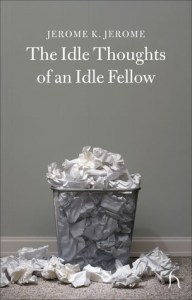
The Idle Thoughts of an Idle Fellow It is impossible to enjoy idling thoroughly unless one has plenty of work to do. There is no fun in doing nothing when you have nothing to do. Wasting time is merely an occupation then, and a most exhausting one. Idleness, like kisses, to be sweet must be stolen.

Jerome K. Jerome’s Three Men in a Boat is one of the funniest books I’ve ever read. I still pick it up from my shelf at times to re-read certain passages when I want to cheer myself up. The sequel, Three Men on the Bummel, wasn’t quite as funny but I did enjoy reading that book too and was looking forward to trying this one, The Idle Thoughts of an Idle Fellow (published in 1886, a few years before Three Men in a Boat).

Unlike the other two books I’ve read by Jerome, this is not a novel but a collection of short essays covering topics as diverse as Cats and Dogs, Eating and Drinking, Being in Love and Being Shy. The tone of his writing varies from essay to essay – sometimes he is melancholy and poignant, sometimes satirical and hilarious (I should warn you that if you read any of Jerome’s books in public, you won’t be able to stop yourself from smiling and should be prepared for people asking you what’s so funny).

A few examples:

On the vanity of cats…

I do like cats. They are so unconsciously amusing. There is such a comic dignity about them, such a “How dare you!” “Go away, don’t touch me” sort of air. Now, there is nothing haughty about a dog. They are “Hail, fellow, well met” with every Tom, Dick, or Harry that they come across. When I meet a dog of my acquaintance I slap his head, call him opprobrious epithets, and roll him over on his back; and there he lies, gaping at me, and doesn’t mind it a bit. Fancy carrying on like that with a cat! Why, she would never speak to you again as long as you lived.

On babies…

There are various methods by which you may achieve ignominy and shame. By murdering a large and respected family in cold blood and afterward depositing their bodies in the water companies’ reservoir, you will gain much unpopularity in the neighbourhood of your crime, and even robbing a church will get you cordially disliked, especially by the vicar. But if you desire to drain to the dregs the fullest cup of scorn and hatred that a fellow human creature can pour out for you, let a young mother hear you call dear baby “it.”

On buying an umbrella…

I bought one and found that he was quite correct. It did open and shut itself. I had no control over it whatever. When it began to rain, which it did that season every alternate five minutes, I used to try and get the machine to open, but it would not budge; and then I used to stand and struggle with the wretched thing, and shake it, and swear at it, while the rain poured down in torrents. Then the moment the rain ceased the absurd thing would go up suddenly with a jerk and would not come down again; and I had to walk about under a bright blue sky, with an umbrella over my head, wishing that it would come on to rain again, so that it might not seem that I was insane.

I did enjoy this book, but I didn’t like it as much as the two Three Men…novels. I found it very uneven – there are some great lines and anecdotes, but it’s also quite boring in places, especially when he becomes very sentimental. It’s worth reading (and the lack of a plot makes it a perfect book to dip in and out of when you have a few spare minutes) but I wouldn’t describe it as an essential, must-read classic. On the other hand, this is what Jerome himself says about the book in his Preface:

What readers ask nowadays in a book is that it should improve, instruct, and elevate. This book wouldn’t elevate a cow. I cannot conscientiously recommend it for any useful purposes whatever. All I can suggest is that when you get tired of reading “the best hundred books,” you may take this up for half an hour. It will be a change.

It was certainly a change!

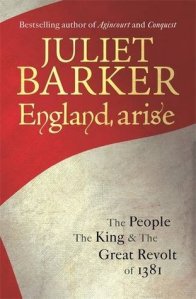
England, Arise by Juliet Barker

England Arise After reading Dan Jones’ The Hollow Crown recently, I moved straight on to another non-fiction book on English history while I was still in the right mood! But while The Hollow Crown looked at the Wars of the Roses, a period I’m starting to become very familiar with, this book deals with an entirely different subject and one that I previously knew very little about: the Peasants’ Revolt of 1381.

The first thing I discovered on beginning Juliet Barker’s England, Arise was that even the little I thought I did know about the revolt was incorrect. To call it the ‘Peasants’ Revolt’ is inaccurate because the people involved actually came from a range of different backgrounds and included craftsmen, artisans and apprentices as well as agricultural workers. Peasants’ Revolt was a label used by 19th century historians; Barker replaces it in this book with other terms such as ‘Great Revolt’, which is a more accurate description. I also hadn’t realised that there was not just one single revolt, but a whole series of uprisings, riots and rebellions taking place across large areas of the country.

In the first few chapters of the book, Barker puts things into context for us and explains some of the possible causes and motives for the revolt. First, she provides some political background by discussing the final years of the reign of Edward III and the challenges faced by his successor, his grandson Richard II, who came to the throne at the age of ten. The ongoing war with France meant that money was urgently needed and the solution was to tax the English people…three times, in quick succession. There was widespread discontent and resentment over the collection of the taxes and this is what sparked the rebellion. Of course, it wasn’t quite as simple as that – in some cases the anger was directed at the church or at corrupt officials, and this is also discussed in the book.

Next, we are given some information on living conditions in England at that time: the feudal system and why it was starting to break down, the effects of the plague on the population, the differences and similarities between rural and urban societies, and the types of employment people could expect to find. The author also tries to dispel some popular perceptions of medieval life, suggesting that literacy levels were higher than we tend to think and that travel from one place to another was much more common. People were becoming increasingly literate and well informed but still had little say in how the country was run. All of these things may have contributed to the circumstances that led to the revolt.

I loved reading about the lifestyles of medieval people, but the part of the book dealing with the revolt itself was actually of less interest to me. I found it too detailed for the general reader, describing countless incidents that occurred in each county and giving names of dozens of individuals who rebelled and who they were rebelling against. I didn’t feel that I really needed all of this information and it quickly started to become repetitive. The book does seem to be very sympathetic towards the rebels. At first I thought this was fair but as I read one account after another of their burning and looting, stealing from churches and plundering palaces, beheading the Archbishop and Chancellor, storming prisons, destroying legal documents and murdering Flemish immigrants, I wasn’t so sure!

The only individual name I had ever heard of in connection with the revolt (or the only one whose name has stuck in my mind, at least) was Wat Tyler, but it seems that Wat Tyler played a much smaller part in the revolt than I had imagined. He and two other names commonly associated with the period – Jack Straw and John Balle – are each given their own appendix at the end of the book, but there were many, many other participants in the revolt whose roles are also discussed throughout the text. The reaction of Richard II and the way he tried to respond to the rebels is examined too, and the final chapters of the book look at the aftermath and consequences of the revolt.

England, Arise was a fascinating read and I do recommend it but, as I didn’t find the actual revolt as interesting to read about as I’d hoped, I think a more general social history of the 14th century would probably have been a better choice for me. I would still like to read Juliet Barker’s biography of the Brontës, though – it’s only the length that has been putting me off that one!

I received a copy of this book for review via NetGalley.

The Hollow Crown by Dan Jones

The Hollow Crown A rare non-fiction review here today! Having loved Dan Jones’ book on the Plantagenets, I was curious to see how he would approach the Wars of the Roses, which is one of my favourite periods of English history. I was looking forward to another well written, thoroughly researched book that would make a complex subject accessible and easy to understand – and that’s what I got, although there were one or two problems which prevented me from enjoying this book as much as the previous one.

The Hollow Crown: The Wars of the Roses and the Rise of the Tudors begins with the marriage of Henry V and Catherine of Valois, laying the foundation for the years of conflict that would follow. Best known for his victory over the French at Agincourt, Henry V was considered one of England’s great medieval kings, but when he died in 1422 of a sudden illness with his only heir still a baby, the scene was set for decades of uncertainty and instability. As Henry’s son, Henry VI, grew into an adult it became obvious that he was unfit to rule. Suffering from an unspecified mental illness, he was a weak and ineffectual king, and this paved the way for rival claimants to the throne – Richard of York and his son, the future Edward IV.

From the 1450s to the 1480s a series of battles were fought between the two rival branches of the royal house – York and Lancaster. This book takes us through the entire period in chronological order, detailing each battle and its outcome and examining the reigns of Henry VI, Edward IV, Richard III and finally Henry VII, who defeated Richard at the Battle of Bosworth and founded a new royal dynasty – the Tudors. Naturally a lot of the focus is on the male figures of the period – the kings and dukes and earls – but Jones shows understanding and sympathy for some of the women too: Margaret Beaufort who gave birth to Henry Tudor at the age of thirteen and according to Jones may have been left physically and mentally traumatised by the experience, and Henry VI’s wife, Margaret of Anjou, who found herself with the responsibility of trying to maintain some sort of control of the kingdom during her husband’s long spells of illness.

This is a shorter book than The Plantagenets (and focuses more intensely on a shorter period of history) and, like the previous volume, it’s very readable and even quite gripping in places. There was one area, though, where I felt that this book was not as good as the first one. In The Plantagenets I felt that Jones had given a fair and balanced account of the historical people and events concerned but The Hollow Crown feels very biased towards the Lancastrian/Tudor point of view. The bias is most noticeable, maybe not surprisingly, in the sections dealing with Richard III where Jones makes it clear where he stands on the questions of what happened to the Princes in the Tower and how Henry VI met his death. Now, I know Richard is a controversial figure and it would be difficult for any historian not to have an opinion of him one way or the other, but it would have been nice if some alternative theories could have been explored here as well instead of just being dismissed in one or two sentences!

I did enjoy The Hollow Crown, though. Dan Jones’ writing style is lively and entertaining, which means his books are good choices for someone like myself who prefers fiction to non-fiction. I feel that I’m starting to have quite a good knowledge of the Wars of the Roses now but there was still some information here that was new to me (particularly near the end of the book, where he looks at the fate of the de la Poles, the final Yorkist claimants). This book could also be a good place to start if you know nothing about the Wars of the Roses – it’s a very complex and confusing period but Jones does a good job of making it as easy to understand as possible…I hope you’ll find it as fascinating as I do!

I received a copy of The Hollow Crown for review via NetGalley.

The Infernal World of Branwell Brontë by Daphne du Maurier

The Infernal World of Branwell Bronte I’ve been interested in reading this book since I read Daphne by Justine Picardie in 2011. In Daphne, among other storylines, the fictional du Maurier is researching a biography of Branwell Brontë, hoping to find evidence of his talent and the possibility that he may have contributed to his sisters’ famous novels. This book, The Infernal World of Branwell Brontë, published in 1960, is the result of that research.

Even without reading Justine Picardie’s novel, I would have known du Maurier was a fan of the Brontës as their influence is obvious in some of Daphne’s own novels, particularly Rebecca and Jamaica Inn. I can understand why she may have been fascinated by Branwell, whom she probably saw as a tragic and misunderstood figure. His story is certainly quite a sad one, though a lot of his problems were self-inflicted. As the only boy in a family of girls his father had high hopes for him (to the Victorians it was probably unthinkable that a brother would be outshone by three of his sisters, but with the Brontës that was exactly what happened) and du Maurier suggests that this put him under a lot of pressure to succeed.

As a child, Branwell, like Charlotte, Emily and Anne, was bright and imaginative. He and Charlotte worked together on a set of stories set in the imaginary world of Angria, while Anne and Emily created the fictional land of Gondal. His future seemed full of promise, but as he grew older everything he did seemed to end unhappily. Unlike his sisters he was not sent to school (possibly because his father thought he was too sensitive) and plans for him to study painting at the Royal Academy never came to anything. He tried repeatedly to have some of his poems accepted by Blackwood’s Magazine and was ignored every time; du Maurier tells us that he even wrote to William Wordsworth but didn’t receive a reply. After being dismissed from his job as a clerk at the railway station and then his next job as a tutor (where he possibly had an affair with his employer’s wife), he descended into alcohol and opium addictions and died in 1848 aged thirty-one.

This doesn’t feel like a particularly academic biography and I’m sure there will be more up to date information about Branwell that has come to light since 1960, so I can’t really comment on its accuracy. Du Maurier was a novelist first and foremost and I get the impression her main concern was to capture the essence of Branwell’s character and explore the reasons why he failed where his sisters succeeded and why all his hopes and dreams came to nothing. She also spends a lot of time discussing and analysing Branwell’s work. I was surprised that so many examples of his writing have survived – a lot of his poems are included in this book and some of his prose and letters.

Du Maurier clearly has a lot of sympathy for Branwell, which is not surprising as she has obviously set out to try to restore his reputation and help him gain the recognition he never had during his lifetime. I always think it helps when you can tell that a biographer is genuinely interested in the person he or she is writing about! However, even with du Maurier’s enthusiasm for her subject she never tries to claim that Branwell’s writing was something it wasn’t and she comes to the conclusion that although he did have some talent, his poems were nothing special. His biggest contribution to the literary world may have been the influence he had on the writing of his three sisters.

Daphne du Maurier is one of my favourite authors, but this is the first of her non-fiction books I have read. Since I also love all three Brontë sisters (Wuthering Heights and Jane Eyre are two of my favourite Victorian novels with The Tenant of Wildfell Hall not far behind) this seemed a good choice to begin with. I did find it interesting and the style of the writing is not too different from du Maurier’s novels. I’m not sure how much appeal it would have to people who don’t share my interest in both du Maurier and the Brontës, but for those of you who do want to know more about Branwell and the other Brontës, I definitely think it’s worth reading. I would also highly recommend Jude Morgan’s novel The Taste of Sorrow – it’s a fictional account of the Brontë family (including Branwell and the two older sisters who died as children) but it sticks very closely to the known facts.

The Renaissance: The Best One-Hour History by Robert Freeman

The Renaissance I spotted this book on Netgalley towards the end of last year and as I’ve been trying to read more historical non-fiction recently, I requested it immediately. It has taken until now for me to get round to reading it, which I feel guilty about as it really did only take an hour to read from beginning to end!

This book is part of a series of One Hour History books each dealing with a different historical period or theme. Other titles include The Protestant Reformation, The French Revolution and The Vietnam War, with more to come soon. This particular volume covers the period of history we know as the Renaissance.

Freeman begins by explaining how factors such as the decline of the feudal system following the Black Death, the fall of Constantinople which led to Greek scholars returning to other parts of Europe, and the decline in the influence of the Catholic Church marked the transition from the ‘Dark Ages’ into the Renaissance. Next he looks at Renaissance art (paintings, sculptures and examples of architecture) and developments in other areas including religion, printing, exploration and medicine. Finally, there’s a timeline showing the dates of significant events.

The author suggests googling the names of the paintings and sculptures discussed in the book so that you can look at them as you read. Most of these works of art were already familiar to me (Freeman chooses to focus on famous pieces such as Leonardo da Vinci’s Mona Lisa and The Last Supper, Botticelli’s The Birth of Venus and Michelangelo’s Sistine Chapel ceiling, which is understandable, as this book is only intended to give a concise overview) and may be familiar to you too, but I would still recommend searching for the images to look at while you read what Freeman has to say about perspective, light and shadow and other techniques.

This very short book is obviously not intended for people who already have an in-depth understanding of the Renaissance (and it would probably not be very satisfying for those readers) but for anyone with little or no knowledge this is an ideal introduction. After reading it you may decide that you now know as much as you want to know about the Renaissance, but it could also be used as a good starting point for a deeper study of the period – although it’s disappointing that there is no list of suggestions for further reading.

This was not what I would describe as a particularly fun or entertaining book to read – with so much history to get through in so few pages there’s no time for anything but the basic facts – but it was an interesting and educational way to spend an hour of my time.

Review copy received via Netgalley.

The Secret Life of Wilkie Collins by William M. Clarke

The Secret Life of Wilkie Collins After reading The Frozen Deep recently, my interest in Wilkie Collins was reawakened and I decided it was time to read the biography I bought when I was in the middle of my Collins obsession a few years ago. There were not many to choose from at that time and this one sounded like the best available. I ordered a copy, but by the time it arrived I had moved on to other authors and didn’t feel like reading it anymore. Since then, one or two other biographies have been published which sound more appealing than this one, but it made sense to read the one I already own rather than buying a new one.

The Secret Life of Wilkie Collins was first published in 1988, although the edition I have was revised in 1996. The author, William M. Clarke, is married to Wilkie Collins’ great-granddaughter, Faith Elizabeth Dawson, and maybe because of this connection, the focus of the book is on Wilkie’s private life and relationships with his family and friends rather than on his work. Clarke does attempt to show us the circumstances surrounding the writing of most of Collins’ books, plays and stories and what may have inspired them, but he doesn’t often go into any detailed analysis of these.

After a brief introduction, the book follows Wilkie’s life in chronological order, beginning with his birth in January 1824. Wilkie was the eldest son of the Royal Academy landscape painter William Collins and his wife, Harriet Geddes, who was also from a family of artists. The first few chapters describe Wilkie’s early childhood, some of which was spent in France and Italy and the rest in London. I found this the least interesting section of the book, but it does show us some of the influences Wilkie was exposed to from an early age which would have had an impact on his future career (an appreciation of Italian art, for example, and familiarity with all the writers, poets and authors who were part of his father’s social circle including William Wordsworth, Samuel Taylor Coleridge and John Constable). I also enjoyed reading about Wilkie’s school days and how one of the older boys bullied Wilkie into telling stories late at night!

Clarke then takes us through Collins’ adult life, including his friendship with Charles Dickens, his battle with rheumatic gout (an illness he suffered from for many years), his six-month reading tour of America, and his addiction to laudanum and his unsuccessful attempts to withdraw from it. I’ve mentioned that Clarke doesn’t spend much time discussing Wilkie’s writing, but I did find it interesting to read his thoughts on the effects of laudanum and how in the later stages of his career it may have affected Wilkie’s ability to write descriptions of visual landscapes and construct the intricate plots he was famous for.

There are also some accounts of Collins’ travels with Dickens and I enjoyed reading about these, especially their walking tour of the Lake District (which reminds me that I still haven’t read The Lazy Tour of Two Idle Apprentices). It seemed Dickens disapproved of his daughter, Kate, marrying Wilkie’s younger brother, Charles Collins, and this put a strain on their friendship in later years.

But it’s Wilkie’s romantic relationships that are given the most attention, which is understandable as this book is supposed to be about his ‘secret life’. Wilkie never married but was in long-term relationships with two different women, Caroline Graves and Martha Rudd. He lived openly with Caroline and Harriet, her daughter from a previous marriage, while having three children with Martha, whose household he established at a separate address. Each woman was aware of the other and their children even visited each other. I’m sure neither woman could have been very happy with the position they were in but it seems they were both prepared to accept it as this arrangement continued for more than twenty years! Caroline did leave him briefly to marry another man (Wilkie actually attended the wedding) but returned several years later. Collins does seem to have genuinely cared about both of his families but this sort of behaviour must have been scandalous by Victorian standards (and not very admirable by modern standards either) and led to his sister-in-law, Kate, describing him as “as bad as he could be, yet the gentlest and most kind-hearted of men”.

Wilkie’s life was fascinating to read about, but I can’t really say that I enjoyed this book as I found Clarke’s writing style quite dry and boring. This is a book I’ve been dipping into over the last few weeks and reading a few pages at a time rather than ever feeling a compulsion to sit down and read it from cover to cover. It has clearly been thoroughly researched with lots of quotes from Collins himself and from people close to him (references are provided), and there’s plenty of supplementary material – notes, photographs, family trees, bibliography and several appendices, including an analysis of Wilkie’s bank accounts (Clarke’s unique position as the husband of one of Wilkie’s descendants meant he could access this information) but I think I would have been more interested in a book with more balance between Collins’ private life and his writing.

I’m going to finish this post with a question: do you like reading biographies of your favourite authors or do you think knowing too much about an author’s personal life can affect your enjoyment of their work?

The Plantagenets by Dan Jones

The Plantagenets As someone who has always read mainly fiction, I have been making an effort to read more non-fiction. The type of non-fiction books I find myself drawn to tend to be books about history or biographies of historical figures; I’ve read a few of these recently and The Plantagenets by Dan Jones is one of the best I’ve read. It’s a very long book at almost 700 pages but as the book covers two centuries of history that’s not surprising!

The book begins in the year 1120 with the wreck of the White Ship in which King Henry I lost his only son and heir. This led to the period of English history known as The Anarchy, a civil war with the country divided between supporters of Henry’s daughter, Matilda, and of his nephew, Stephen. It was the son of Matilda and her husband, Geoffrey of Anjou, the future Henry II, who was England’s first Plantagenet king. Dan Jones tells the story of not only Henry II’s reign, but the reigns of all the Plantagenets who followed, up to and including Richard II who was deposed in 1399. Of course there were several more Plantagenet kings after Richard II, but Jones does explain why he chose to end the book at this point.

I love reading about the Plantagenets and find them far more interesting than the Tudors. However, I have to admit that most of my knowledge of them comes from reading historical fiction and while I certainly think it’s possible to learn through fiction, it was good to have the opportunity to read a factual account of the period. Actually, I found this book almost as entertaining and compelling as a novel anyway; Dan Jones does a great job of making the historical figures he’s writing about come to life and conveying the drama of some of the most important events of their reigns. Instead of just telling us that Henry I’s son died in a shipwreck, for example, he describes the sails of the ship billowing in the wind, the shouts of the crew and the freezing water pouring into the ship. This makes the book very readable, though despite it not being too academic it still feels thoroughly researched and I never had any reason to doubt the accuracy.

Before beginning this book, there were some Plantagenet kings whose lives I was more familiar with than others. I found that I already had quite a good knowledge of Henry II and his relationships with his wife, Eleanor of Aquitaine, his sons and daughters, the knight William Marshal and the Archbishop of Canterbury, Thomas Becket. And I knew the basic facts about Richard I (the Lionheart) and his crusades, and about his brother, King John. The story of the final king featured in the book, Richard II, was also familiar to me, but I had less knowledge of the others in between – Henry III and the three Edwards (I, II and III). I enjoyed learning about Simon de Montfort’s rebellion during the reign of Henry III, the 1326 invasion of England by Queen Isabella and Roger Mortimer, and the possible fate of Edward II, all subjects I had previously known very little about.

The Plantagenets would be a great choice for any history lover looking for an accessible introduction to a fascinating time period. I’m hoping for a second volume covering the 15th century and the Wars of the Roses.

I received a copy of this book from Netgalley for review.