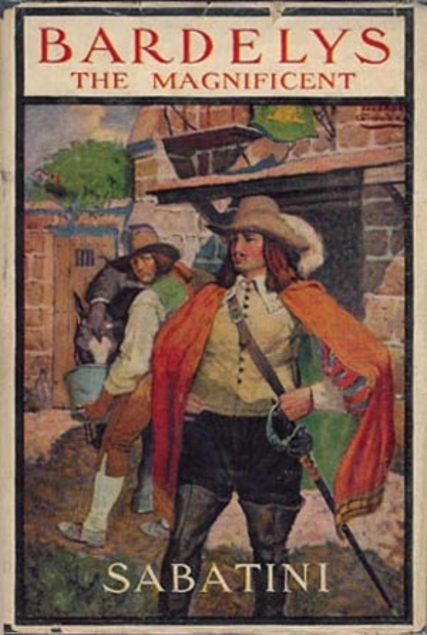
Bardelys the Magnificent by Rafael Sabatini

I love Rafael Sabatini’s books. His classic tale of the French Revolution, Scaramouche, and his two famous pirate novels, Captain Blood and The Sea-Hawk, have been some of my favourite reads of the last few years, while Bellarion was a great book too. I’m now beginning to explore his more obscure books and chose this one, Bardelys the Magnificent, more or less at random when I was putting my Classics Club list together. I hoped it would be a good choice – and it was!

The story is set in 17th century France, during the reign of Louis XIII, and is narrated by the wealthy Marquis de Bardelys, a ‘libertine, a gambler, a rake, a spendthrift’ and a favourite of the King. As the novel opens, Bardelys is hosting a party in Paris at which his rival, the Comte de Chatellerault, makes an unwelcome appearance. It is well known that Chatellerault has recently tried and failed to win the hand in marriage of the beautiful Roxalanne de Lavedan and as Bardelys and his friends tease the Comte about his failure, the discussion becomes more heated. Before the night is over, Bardelys finds himself wagering his entire fortune that he can succeed where Chatellerault could not – and he sets off the next day for Languedoc, the home of Roxalanne.

Of course, things don’t go according to plan and following a series of misunderstandings, Bardelys arrives at the Lavedan estate under a mistaken identity. When he meets Roxalanne and discovers that he is genuinely falling in love with her, he knows that he should tell her the truth about who he really is, but as time goes by it becomes harder and harder to do this. To complicate things further, Bardelys learns that the man whose identity he has stolen is a wanted traitor. Our hero’s life quickly becomes such a confusing mess that it’s difficult to see how anything can ever be resolved! Will he lose his fortune, his life, or the love of Roxalanne – or will he somehow manage to keep all three?

Bardelys the Magnificent is one of Sabatini’s earliest novels, published in 1906, and although I did find it weaker than the others I’ve mentioned above, it’s another entertaining adventure with all the drama, romance, political intrigue and sword fights that you would expect. As a character, I found Marcel de Bardelys less memorable than other Sabatini protagonists such as Andre-Louis Moreau, Peter Blood and Oliver Tressilian, but he is still interesting and engaging. I referred to him as a hero above, but he is not particularly heroic at all – he is selfish and irresponsible, he makes one mistake after another, and his original reason for wanting to marry Roxalanne is hardly very admirable. Despite all of this, I still had some sympathy for him and wanted him to succeed – and, thankfully, he does also develop as a character as the novel progresses. While concealing his true identity, he finds out what people really think of him and sees himself as he appears to others.

Although I wouldn’t recommend Bardelys as the best place to start with Sabatini, if you’re already a fan I’m sure you’ll enjoy this early example of his work as much as I did. I’m looking forward to exploring more of his lesser-known novels and hope my next choice will be another good one.

This is book 11/50 from my Classics Club list.

When Women Ruled the World by Kara Cooney

Despite my love of history I know very little about Ancient Egypt, so when I was given the opportunity via National Geographic and TLC Book Tours to read When Women Ruled the World, I was immediately interested. Written by Kara Cooney, professor of Egyptology at UCLA, the book explores the lives of six female rulers – Merneith, Neferusobek, Hatshepsut, Nefertiti, Tawosret and Cleopatra – asking how each was able to come to power, what challenges they faced during their reign and what the modern world can learn from studying them.

Apart from Cleopatra, I had never read about any of the other five rulers before, so I was looking forward to adding to my knowledge, but I don’t feel that I’ve learned as much about these six women as I would have expected to from this book. I can appreciate that the author was doing her best to work with the limited amount of factual information we have available to us, but there’s still a lot of speculation, interpretation and uncertainty. The book has clearly been thoroughly researched and there are detailed notes at the back, as well as an impressive list of resources and further reading; I just don’t feel that I’ve come away from the book with any real idea of what these female pharaohs may have been like as people, what their style of ruling was like or what their main accomplishments were.

To be fair, the author does point out that one of the reasons why we know so little about these women’s achievements is because the male pharaohs who followed tried to remove all traces of their predecessor from the historical records. Thutmose III, who ruled after his aunt Hatshepsut, “smashed her statues to bits, chiseled away the reliefs of the Punt expedition, and reassigned kingly images to her husband or father.”

This is a book with a very strong feminist message, which is fascinating when related directly to the Egyptians, for example when Cooney discusses how Nefertiti may have had to assume a male name and identity in order to rule, or how Hatshepsut had herself depicted wearing masculine clothes and with the appearance of a man. However, the author spends too much time drawing parallels with modern politics, discussing the stereotypes directed at female leaders and the language used to describe women like Hillary Clinton, Margaret Thatcher or Angela Merkel. It seems that the purpose of the book is to show that women have qualities which make them better equipped to rule the world than men and that the stories of the six female pharaohs of Egypt are being used to illustrate that point, rather than because they are interesting historical figures in their own right whose stories deserve to be remembered.

On a more positive note, I thought this book was written at the right level to make it accessible to the general reader. It wasn’t necessary to have any prior knowledge of Ancient Egypt and I found it easy enough to follow and to understand. There’s a map at the beginning and a useful chronology showing each ruler’s place in history, as well as an interesting selection of photographs and illustrations. Although this book wasn’t quite what I’d expected, I’m pleased to have at least been made aware of women like Merneith, Neferusobek and Tawosret, whose names weren’t even familiar to me before. I would like to read more about them one day.

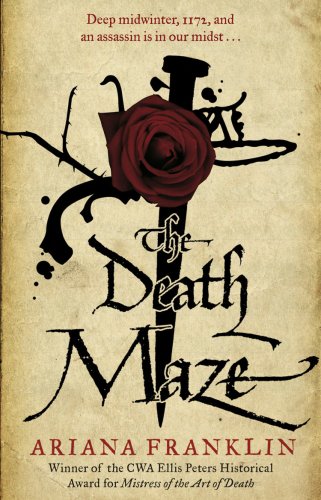
The Death Maze by Ariana Franklin

This is the second novel in Ariana Franklin’s Adelia Aguilar mystery series, set in the 12th century. My feelings about the first book – Mistress of the Art of Death – were quite mixed (I liked the medieval setting but found the dialogue and the main character too modern), but I wanted to try at least one more in the series and came across this one in the library a few weeks ago.

If you’re new to these books, I don’t think it’s necessary to have read the previous one before reading this one. The Death Maze, which has also been published under the title The Serpent’s Tale, begins with the poisoning of Rosamund Clifford, Henry II’s mistress. Henry’s estranged queen, Eleanor of Aquitaine, is immediately suspected, being the person with the most obvious motive for wanting The Fair Rosamund dead. If this is true, the repercussions could be huge and could lead the country into civil war. The king needs someone to investigate on his behalf – and so he summons Adelia Aguilar, his ‘mistress of the art of death’.

Adelia, before coming to England, had studied medicine at the famous medical school in Salerno which accepted female students as well as men. Since solving her first case for Henry II (a series of child murders which formed the basis of the previous novel), she has been living a quiet life in the countryside with her baby daughter, Allie, and it is with some reluctance that she agrees to undertake this new task. The king cannot be refused, of course, so Adelia soon finds herself setting off for Rosamund’s castle, escorted by Rowley Picot, her former lover, now the Bishop of St Albans. During their investigations, they are taken captive by Eleanor and her supporters, but when snow begins to fall the whole party become trapped for the winter at the nunnery in Godstow, where the mystery deepens as more murders take place.

In some ways, I enjoyed this book more than the first one. I thought the mystery was more complex – and certainly not as dark and disturbing as the previous one. I didn’t guess who the murderer was, although I had my suspicions, but I think we were given enough clues to work it out with no unfair surprises or information being withheld.

This is a period of history I always find interesting to read about and I felt that the portrayals of real historical figures in this book, such as Henry II and Eleanor of Aquitaine, were very different from the way they have been depicted in other novels I’ve read. Eleanor is certainly not the sympathetic, admirable character she is in Elizabeth Chadwick’s The Summer Queen trilogy, for example – she comes across as quite selfish and petulant. Most of the other characters, though, are fictional – as is most of the plot, including many of the details of Rosamund Clifford’s story. I did like the descriptions of the maze of hedges surrounding Rosamund’s tower; the scene where Adelia and her friends try to find their way through it reminded me of the famous Hampton Court Maze episode in Three Men in a Boat.

‘I’m sorry, I’m sorry,’ Adelia shouted. She faced Rowley. ‘Don’t you see, if a maze is continuous, if there aren’t any breaks, and if all the hedges are connected to each other and you follow one of them and stick rigidly to it wherever it goes, you’ll traverse it eventually, you must, it’s inevitable, only…’ Her voice diminished in misery, ‘I chose the left-hand hedge. It was the wrong one.’

As for Adelia herself, I can’t make up my mind about her. I do like her as a character because she has all the qualities I admire in a heroine – intelligence, courage and independence, as well as a passion for her career which made her turn down the chance of marriage to Rowley as she knew that would bring her medical work to an end. However, she is the sort of heroine I would expect to find in a much more modern setting; her behaviour and attitudes make her very unconvincing as a medieval woman. I could say the same about the language Ariana Franklin uses, which I think also often feels far too modern for the time period. I suppose whether or not you will enjoy these books depends on how important those things are to you, but I always struggle to overlook them.

I’m not sure if I will read any more of the Adelia Aguilar books, but I might try one of Ariana Franklin’s earlier novels published under her real name, Diana Norman.

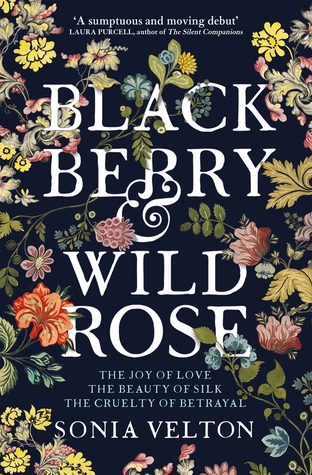
Blackberry and Wild Rose by Sonia Velton

It’s 1768 and Sara Kemp has just arrived in Spitalfields, the London parish which has become home to a thriving community of Huguenot silk weavers. Sara is full of hope and optimism, ready to start a new life, but before she’s had time to get her bearings she finds herself the victim of a cruel trick which leaves her with no choice other than to live and work in a notorious brothel.

In a much more respectable house nearby lives the master weaver Elias Thorel and his wife Esther. Their marriage is not a loving or happy one, but Esther has been trying to take an interest in her husband’s work and has discovered an aptitude for designing floral patterns. There’s nothing she wants more than to see one of her own designs woven in silk, but Elias is scornful and refuses to acknowledge her talent. Still determined to turn her dreams into reality, Esther approaches the journeyman weaver who has been using the loom in the Thorels’ attic to weave his master piece.

Two women leading very different lives – but their paths cross when Esther is distributing Bibles in the poorer areas of Spitalfields and sees Sara being abused by her madam outside the brothel. Soon Sara is working as a lady’s maid in Esther’s household, but how will she repay Esther for her act of kindness?

I was drawn to Blackberry and Wild Rose by the beautiful cover – and the mention of an 18th century setting and the comparisons to Jessie Burton and Tracy Chevalier made me want to read it even more. Of course, none of those things guaranteed that I would like the book, but I’m pleased to say that I did!

First of all, there are the fascinating details of weaving, of using looms, designing patterns, and everything else involved in creating beautiful figured silk. At the beginning of the novel, Esther knows very little of any of this – she only knows that she wants to see her designs brought to life – but she learns a lot from the weaver she befriends, and her enthusiasm (and, I think, the author’s) comes through very strongly:

By the time the candle had burned down to a waxy stump, the thinnest sliver of iridescent silk clung to the heddles. ‘I can’t believe it,’ I breathed. I was finally looking at the very beginning of a silk made to a pattern I had designed. My own creation. ‘How long will it take to finish it?’

I could feel Esther’s excitement and pride as her silk took shape, as well as her disappointment and anger at her husband’s lack of support. Through the stories of Esther’s weaver friend Bisby Lambert and some of the other Spitalfields weavers, we also learn about some of the issues and challenges the industry faced and how the workers had to fight for their rights against unscrupulous masters and the threat of cheap imports from abroad.

An even more engaging aspect of the book is the relationship between the two main characters, Esther and Sara, whose narratives alternate throughout the novel. At first, Esther feels sorry for Sara, as she would for any woman driven to prostitution, and she wants to do what she can to help. Once Sara is there, in the Thorel household, however, their relationship is an uneasy one and Esther begins to wonder whether she has done the right thing in bringing Sara into her home:

She was like a cat sidling in uninvited and looking about. You don’t want to turn it out straight away so you offer it a scrap of food. The next thing you know it’s curled up on your favourite chair, watching you with unblinking elliptic eyes.

As for Sara, she quickly becomes aware that Esther’s life is not as perfect as it seems and that she is hiding some secrets of her own. While a friendship does form between the two women, they are not entirely comfortable around each other and neither is quite sure whether the other can be trusted, which makes for a tense and exciting story! The plot kept me gripped throughout the book and although I thought I could predict how it would end, I was wrong and the ending was actually much more realistic than I’d expected. This is an impressive debut novel and I hope to read more from Sonia Velton in the future.

Thanks to Quercus for providing a copy of this book for review via NetGalley.

I am counting this book towards the What’s in a Name? challenge (a book with a fruit or vegetable in the title).

Campion at Christmas by Margery Allingham

I love Margery Allingham so I was pleased to have the opportunity to read this new collection of four short stories, all with a festive theme. The title is slightly misleading as only three of the four stories feature Albert Campion, but they are all quite enjoyable in their different ways. They are also very short, so perfect for readers with busy Christmas schedules who just want something quick to read!

The first story, On Christmas Day in the Morning, was my favourite and involves Campion investigating the death of a postman hit by a car on Christmas morning. The culprits have been identified, but the evidence provided by local residents is confusing and Campion must decide whether the suspects and the victim really could have been in the right location at the right time for the accident to have taken place. It’s not much of a mystery, but I found it a sad and poignant story which reminded me of how lonely some people feel at Christmas.

Next we have Happy Christmas, probably the weakest story in the book, in which a young couple with a passion for the 19th century decide that they would like to have a traditional Victorian Christmas. Campion doesn’t appear at all in this story and I’m not sure that it really belonged in this collection. I’m not entirely sure what the point of it was, although I do love the idea of a Victorian Christmas.

The Case of the Man with the Sack is a more conventional detective story. Albert Campion is celebrating Christmas with friends at their country house when a theft takes place – and the main suspect is Santa Claus. This is a slightly longer story than the others, so there’s more time to develop the plot. Of course, it can’t compare with a full-length Campion mystery, but it was interesting enough to hold my attention until the end.

Finally, there’s Word In Season, a lovely but unusual tale about Campion and his dog, Poins. Did you know that, according to myth, animals are given the power of speech in the final hour of Christmas Eve? I didn’t, but that’s what this final story is about.

These four Christmas stories were obviously ideal for the time of year and I did find them entertaining, but I thought they were too short to be completely satisfying. I’m looking forward to reading some more of Allingham’s longer novels soon.

Thanks to Agora Books for providing a copy of this book for review via NetGalley.

Zennor in Darkness by Helen Dunmore

One of the reading challenges I have been participating in during 2018 is the What’s in a Name? challenge which involves reading books with certain words in the title. Having reached November with only four of the six required books completed, it was looking unlikely that I would be able to finish the challenge, but I’m pleased to say that I have managed to squeeze the final two books into my December reading – starting with this one, Zennor in Darkness (a book with a title that begins with Z).

Published in 1993, Zennor in Darkness was Helen Dunmore’s first novel. I had high hopes for it, as I’ve enjoyed some of her others, particularly Exposure and Birdcage Walk. Unfortunately, although there were things that I liked about this one, I was slightly disappointed with it, even more so because most people who have read it seem to have loved it and I’m sorry that I couldn’t love it too.

The novel is set in 1917 in Zennor, a village on the coast of Cornwall where the author DH Lawrence lives for a while during the First World War. Hoping to find some peace and quiet away from the controversy caused by the recent publication of his novel, The Rainbow, Lawrence and his wife Frieda have decided to rent a cottage in Zennor where they can wait for the war to end and for a time when he may be able to resume his writing career. But even as Lawrence gets to know the local farming families and discovers the charms of rural life, he finds himself the centre of controversy yet again – this time because of Frieda, who happens to be German. The villagers view Frieda with suspicion, disapproving of her red stockings and her German songs, and convinced that she and Lawrence are sending signals to the U-boats lurking off the Cornish coast:

‘All the same though, there are things not right up there. They say they’ve put different coloured curtains up. In the same window.’
‘Why, whatever would they want to do that for?’
‘In the window looking over the sea.’
‘You mean -‘

One person who doesn’t care about the gossip and who is happy to befriend the Lawrences anyway is Clare Coyne, a young woman who lives with her widowed father. Clare is a talented artist and is helping to illustrate a new book her father is writing on botany; she is also in love with her cousin, John William Treveal, who is home on leave from the trenches before starting his training as an officer. The rest of the family are unaware of Clare’s feelings for John William, so she keeps her fears and worries for him to herself, hoping that as he has survived this long, he will continue to survive and will come back to her when the war is over.

The novel is partly about Clare’s relationship with DH Lawrence and partly about her love for John William, but I felt that the two elements of the story didn’t work together very well and could have formed the basis of two separate books. I found the central love story by far the most engaging and interesting aspect of the novel, while the inclusion of Lawrence added very little for me. I couldn’t help making comparisons with Mr Mac and Me by Esther Freud, a very similar story about the architect Charles Rennie Mackintosh, where I thought the blending of real historical characters and fictional ones was more successful.

I did love the portrayal of life in a small village during the war, touching on topics such as shell shock, desertion and the effects of war not only on those who are fighting in it but on the loved ones they leave behind. The writing is certainly beautiful – both poetic and insightful, with some lovely descriptions – but books written in third person present tense are often a problem for me and that was the case here as I found it distracting and emotionally distancing. I think the writing style is what prevented me from enjoying this book as much as I’d hoped to. Not a favourite by Helen Dunmore, then, but I will continue to read her books and will hope for better luck next time.

~

I would like to take this opportunity to wish you all a Merry Christmas! I’ll be back soon with my books of the year, my December Commonplace Book and maybe another review or two before New Year.

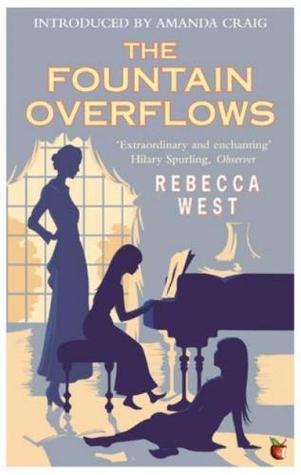
The Fountain Overflows by Rebecca West

Rebecca West is the final author to be celebrated in Jane at Beyond Eden Rock’s Birthday Book of Underappreciated Lady Authors this year. Having previously only read The Return of the Soldier by Rebecca West, I decided to read The Fountain Overflows next as it is one of the books on my Classics Club list. This is the first in a trilogy (the other two – This Real Night and the unfinished Cousin Rosamund – were published posthumously), and although it is a work of fiction, it does apparently draw on the author’s own childhood experiences.

The Fountain Overflows is set in the early 20th century and tells the story of the Aubrey family through the eyes of Rose, one of the children. As the novel opens, the family are preparing for a move from Scotland to London, having only recently returned to Britain from South Africa. The children have become used to changing address on a regular basis due to the fact that their father, a newspaper editor, seems unable to stay in one position for very long. He is irresponsible, unreliable and has a habit of gambling his money away on the stock exchange, but his wife and children love him anyway and hope that this time he can make a success of the job he has been offered and that they will be able to stay in their new home for longer than usual.

The Aubreys are a creative, cultured and highly gifted family – Rose and her twin sister, Mary, are talented pianists; their little brother Richard Quin, as he grows older, discovers an aptitude for the flute; and Cordelia, the eldest, plays the violin. Their mother, Clare Aubrey, had been a concert pianist herself, and it falls to her to see that each of her children receives the correct guidance and tuition to make the most of their abilities. This proves particularly challenging where her eldest daughter is concerned, as thanks to a well-meaning but interfering teacher, Cordelia is led to believe she is much more talented than she really is. I found the Cordelia storyline very moving – it’s obvious from the beginning what is going to happen but it takes a long time to play out and I dreaded the moment when she would inevitably discover the truth.

Although this is a story driven by characters, relationships and family bonds, there is also some drama. There is an episode where Rose and her mother visit the home of Rose’s Aunt Constance and cousin Rosamund, only to find the house apparently haunted by poltergeists. Later in the book, the mother of a friend from school is accused of murder and the Aubreys are drawn into that too. But these incidents, each of which could have formed the entire plot of a different sort of novel, are relatively minor aspects of The Fountain Overflows and no more or less important than many of the other things that happen in Rose’s life.

I loved Rose’s narrative voice; not all authors can write convincingly from the perspective of a child, but Rebecca West certainly does. She really captures the way children think and feel, the things that matter to them and the way they look at the world. But the most engaging character, for me, was Rose’s mother. I admired her for her strength in trying to keep her family and marriage together, seeing that the rent is paid on time, helping others despite her own financial hardship, and providing a stable, loving home for her children when their father couldn’t or wouldn’t.

With such strong, believable characters and such lovely writing, this was a wonderful read. I was sorry to have to leave the family behind at the end, but I’m looking forward to meeting them again in This Real Night.

This is book 10/50 from my second Classics Club list.