Rediscovering Elric of Melniboné

This is a tale of tragedy, this tale of Melniboné, the Dragon Isle. This is a tale of monstrous emotions and high ambitions. This is a tale of sorceries and treacheries and worthy ideals, of agonies and fearful pleasures, of bitter love and sweet hatred. This is the tale of Elric of Melniboné. Much of it Elric himself was to remember only in his nightmares.
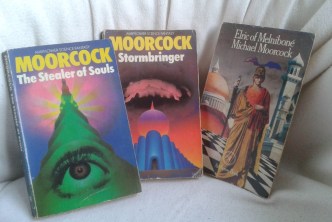
Elric I have my father to thank for introducing me, as a teenager, to Elric of Melniboné. I would almost certainly never have thought about reading these books otherwise and probably wouldn’t have even heard of them, as I’ve never had a lot of interest in reading fantasy, especially of the ‘swords and sorcery’ type. Michael Moorcock’s Elric books (and to a lesser extent, his Corum series) are among the small number of fantasy novels I’ve actually read and enjoyed. I hadn’t thought about them for years but when I was tidying my shelves one day a couple of weeks ago I came across my old copies (or rather, my dad’s old copies, some of which I’ve pictured above) and decided it might be fun to re-read them.

I only meant to re-read the first one but couldn’t resist reading most of the series again. This is not such an impressive feat as it sounds – there are six core books in the series, if you don’t count the sequels published later, and most of them are less than 200 pages long. Because they are so short (and some of them are collections of short stories rather than full-length novels) the pace is quick – there’s always something happening and the plot moves forward with every page. There seems to be some debate over the correct reading order for the series but as a general guide, Elric of Melniboné should be read first, followed by The Sailor on the Seas of Fate, The Weird of the White Wolf, The Sleeping Sorceress, The Bane of the Black Sword and finally, Stormbringer. Some of the individual stories in these books are also collected together in different orders in other volumes such as The Stealer of Souls.

The series follows the story of Elric of Melniboné, the four hundred and twenty-eighth Emperor to sit upon the Ruby Throne. Melniboné, or the Dragon Isle, is an island nation of sorcerers who once ruled the world but have seen their power gradually diminished as their human neighbours from the Young Kingdoms grow stronger and the gods of Law and Chaos battle for supremacy over the world. Some of the Melniboneans, including Elric’s ambitious cousin Yrykoon, believe Elric is not strong enough to rule as Emperor and to restore Melniboné to its former glory – because Elric is an albino, born with a deficiency of the blood which forces him to rely on magic potions to maintain his strength and prevent him from becoming weak and lethargic. When Yrykoon attempts to kill him and take both the throne and Elric’s lover, Cymoril, for himself, Elric enters into a bargain with Arioch, the Lord of Chaos. Arioch will come to his assistance whenever possible, but in return Elric will be bound to the enchanted black sword, Stormbringer, which steals the souls of its victims and often seems to have a mind of its own.
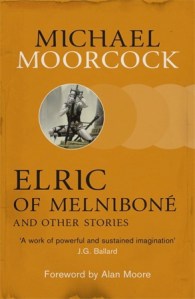
Elric of Melnibone and Other Stories Although Elric is the character around whom the whole series revolves, his actions are not always very heroic and in fact, he is much more of an anti-hero than a hero. He is not evil, but not ‘good’ either and it is often unclear whether he is fighting on the side of Chaos or of Law. I think the reason I found Elric so appealing when I was younger was because, not having read a lot of adult fiction at that time, I’d rarely encountered a fictional character with so much darkness and complexity and who didn’t always do what the reader wanted or expected him to do. From what I’ve read, Moorcock was trying to create an antithesis to other more traditional fantasy heroes such as Conan the Barbarian and so, rather than succeeding through physical power, Elric is brooding and melancholy, relying on sorcery rather than strength. Other characters come and go throughout the series – enemies such as Jagreen Lern, the Theocrat of Pan Tang, and the sorcerer, Theleb K’aarna, and friends including Rackhir the Red Archer, Dyvim Slorm, the Dragon Master, and my favourite, Moonglum of Elwher.

I’ll admit that you probably couldn’t describe these books as great literature, but they are not badly written and are very entertaining – and for such short books, the level of world building is very impressive. Moorcock’s style is not overly descriptive, but he manages to paint vivid images in only a few words: gold-plated battle-barges negotiating the rocks and grottos of the Melnibonean sea-maze; the underwater kingdom of Straasha and his water elementals; the dragons slumbering in their caves below the Dreaming City of Imrryr. Reading these books again, as an adult, I found that the quality of the writing seems to vary quite a lot from book to book, possibly because their chronological order is not the same as the order in which they were written and published. Elric of Melniboné and Stormbringer, in my opinion deserve to be considered classics of the fantasy genre, but some of the stories in between are much less satisfying.
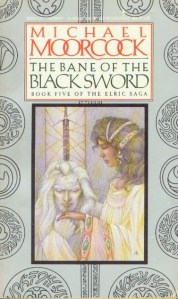
The Bane of the Black Sword The Elric series is part of a much larger cycle of books known as The Eternal Champion, the idea being that Elric is just one incarnation of a hero who has existed in many different times and on different planes. There are other books and series featuring other incarnations of the Eternal Champion and at times their stories cross or intersect – for example, in the second Elric book, The Sailor on the Seas of Fate, Elric briefly meets three of his other selves, Corum, Erekose and Hawkmoon. I have read a few of the books featuring these other characters, but the only ones I enjoyed were the Corum books – a more straightforward fantasy series than Elric, but with a less interesting protagonist.

If I’ve convinced anyone to give Michael Moorcock a try (and I know these are entirely different from the books I usually write about on this blog) Elric of Melniboné, in my opinion, is the best place to start!

The Herbalist by Niamh Boyce

The Herbalist by Niamh Boyce The Herbalist is set in a small unnamed town in Ireland in the 1930s and tells the story of four women whose lives are affected by the arrival of a stranger – a travelling herbalist who appears from nowhere one day and begins selling his lotions and tonics in the marketplace. Nobody knows anything about the herbalist or his history and initially they are suspicious, but slowly he starts to cast a spell over the women of the town, including sixteen-year-old Emily. Lonely and vulnerable after losing her mother, Emily convinces herself that she and the herbalist are in love, but when she makes a shocking discovery she finds herself with a difficult decision to make.

Another of our main characters is Carmel, who runs a small shop in the town. Having suffered a recent tragedy, Carmel is depressed and insecure and she feels that the only person who understands is the herbalist. Her brother, a teacher, suggests she should find an assistant to help her in the shop and recommends a former student, Sarah, for the job – but how will Carmel react to Sarah’s arrival?

We also follow Sarah, who is having problems of her own. The night before she leaves home to start her new job, her beloved aunt Mai throws a party for her and something that happens at that party will have a big impact on Sarah’s future. Finally, there’s Aggie, a ‘woman of ill repute’ and a fortune-teller. Aggie is an outsider, but through watching and listening to what is going on around her she seems to know more about the herbalist than anyone else in the town. The stories of Emily, Carmel and Sarah are told in alternating chapters, with occasional contributions from Aggie, and gradually the truth about the herbalist is revealed.

I was very impressed with this book and found it hard to believe that it’s Niamh Boyce’s first novel! The writing is beautiful, the setting and the characters feel completely believable and the story itself is fascinating – inspired by true events, according to the author’s note at the front of the book.

Something I found particularly intriguing was the fact that two of the women’s stories are told in the third person (Carmel’s and Sarah’s) and two in the first person (Emily’s and – in question and answer format – Aggie’s). The only problem with this was that while Emily and Aggie both have distinctive narrative voices of their own, the other two feel very similar. One way in which the use of multiple viewpoints works very well in this novel, though, is that it allows us an opportunity to see things from the perspectives of women from different social backgrounds whose lives are confined by the class system of their small, narrow-minded community.

The herbalist himself remains a mysterious, shadowy figure and although he is at the centre of everything that is happening throughout the novel, the focus is always on the female characters and the various ordeals they are going through. I should mention that this is not a happy story and really delves deeply into the darker side of life in 1930s Ireland. I would like to be able to tell you more about some of the issues the book raises, but then I would be giving away the herbalist’s secrets!

I loved The Herbalist and hope there will be more books from Niamh Boyce in the future.

I received a copy of this book from Penguin Ireland for review.

The Enchantress of Florence by Salman Rushdie

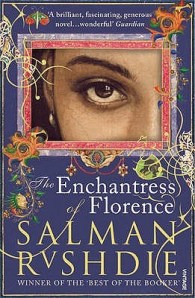
A More Diverse Universe I’ve never read anything by Salman Rushdie before and have always felt slightly intimidated by him, but when I was looking for something to read for the A More Diverse Universe blog tour (hosted by Aarti of Booklust) I came across this title on Aarti’s list of suggestions and thought it sounded intriguing.

The Enchantress of Florence is a very imaginative mixture of history and fantasy, with a plot that is almost impossible to describe – though I’ll do my best! The story begins in 16th century India when a mysterious yellow-haired stranger calling himself the Mogor dell’Amore arrives by bullock-cart at the court of the Emperor Akbar in Sikri. Claiming to be related to Akbar, he begins to tell the Emperor the story of the lost Mughal princess, Qara Köz, or Lady Black Eyes, who is captured and after a series of adventures ends up in Florence where she falls in love with the soldier Antonino Argalia. Qara Köz is the enchantress of the title, believed to have powers of sorcery, as well as great beauty, and the entire city of Florence becomes captivated by her presence. In a separate, but connected, storyline we also learn of Argalia’s childhood, growing up in Florence with his friends Ago Vespucci and Il Machia (Niccolò Machiavelli). Will Akbar believe the stories he is told and what effect will they have on the Emperor and his court?

The Enchantress of Florence There are lots of themes and ideas in The Enchantress of Florence and I’m sure I didn’t fully understand all of them. However, one of the main themes, to me, seems to be the power and the magic of storytelling. The novel is made up of lots of separate interlocking stories, not just the three main ones I’ve mentioned above. One character will begin to tell a story and then a character within that story will begin to tell another story and so on, until you almost begin to forget who the original storyteller was and who the listeners are. These stories may or may not be true and all of them are rich in magical realism – we meet the emperor’s favourite wife Jodha, for example, who is imaginary but also seems to have a life of her own; a slave girl who has become a ‘Memory Palace’ (or a device to aid the memory); and an artist hiding inside one of his own paintings.

The fantasy elements and the abundance of princesses, emperors, giants and witches gives the book a fairy tale feel (I was reminded of The Arabian Nights) and there are beautiful, lavish descriptions of both Mughal India and Renaissance Florence, two settings which are very different but also surprisingly alike. I did enjoy this book, especially the sections set in India, and I thought it was beautifully written, but I did find it very complicated and difficult to follow and I think I would probably have needed to read it twice to be able to really appreciate it. People often talk about books having multiple layers, and that’s usually a good thing, but this one has so many layers I was a bit overwhelmed!

I won’t be immediately rushing out to buy the rest of Salman Rushdie’s books but I’m glad I chose to read this one – it was a challenge, but worth the effort, I think.

Thornyhold by Mary Stewart

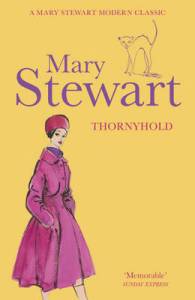
Thornyhold After reading all the reviews and posts during Anbolyn’s recent Mary Stewart Reading Week, I had almost decided that the next Stewart books I read would be her Merlin series, but instead I found myself picking up this one from the library shelf.

Thornyhold starts off differently from the other Mary Stewart books I’ve read. Instead of getting straight into the action, our narrator, Geillis (Gilly) Ramsey, spends the first few chapters looking back on her childhood. As the daughter of a vicar and his cold, distant wife, bullied at school and feeling lonely and isolated, it was not a very happy childhood for Gilly and the one bright spot in her life was her relationship with her mother’s cousin, another Geillis.

Several years go by and both of Gilly’s parents die, leaving her an orphan in her early twenties. Just as she’s wondering what to do with her life, she hears that Geillis has also died, leaving her cottage in the countryside to Gilly. The name of the cottage is Thornyhold and it comes complete with an overgrown garden, a black cat called Hodge and a collection of dusty books of magic spells and herbal remedies. Could Gilly’s cousin Geillis have been a witch? With the help of William, a ten-year-old boy who shares her love of nature, Gilly begins to uncover some of the secrets of Thornyhold.

Thornyhold is one of Mary Stewart’s most recent books, published in 1988 (only Stormy Petrel and Rose Cottage came after that) and I’ve found that these final three books have a different feel from her earlier ones, being a lot gentler with less of the suspense and adventure that are usually associated with her work. In this book, although there are a few mysteries for Gilly to solve and one or two people who try to cause trouble for her (including the housekeeper Agnes Trapp, who seems desperate to get her hands on one of cousin Geillis’ herbology books), I never felt that I needed to worry about Gilly or that there was any danger of there not being a happy ending. But while I do prefer the more exciting, suspenseful books such as Nine Coaches Waiting and The Moonspinners, I enjoyed this one too, for different reasons.

This book may not have the exotic setting that many of her others have, but that doesn’t mean the descriptions aren’t still beautiful. It was a pleasure to watch Gilly exploring her new home, settling into the cottage and discovering the natural beauty of her surroundings. The story is set in the 1940s and has a lovely nostalgic feel with references to rationing and other details of post-war life. I also liked the characters, especially Gilly herself, who blossoms from a lonely child into a confident young woman with a lot to offer in terms of friendship and love (yes, there’s a love story too). Although this hasn’t become a favourite Stewart novel, it was a nice, relaxing read with a magical atmosphere and just what I was in the mood for!

Sleeping Patterns by J.R. Crook

Sleeping Patterns I was lucky enough to win a copy of this book in a giveaway hosted by Charlie of The Worm Hole earlier this year. It’s probably not a book I would have chosen for myself but Charlie’s review (and others) made it sound very intriguing.

To begin with, the book is dedicated to the memory of the author, J.R. Crook, who we are told in the introduction (written by his friend, a fictional character called Annelie Strandli) is dead*. Before he died, Annelie says, he sent her fifteen envelopes each containing one piece of an untitled story and she has put them together to form a book. Annelie received these fifteen story fragments out of order and has presented them in that same order in the book so that Chapter 5 appears first, followed by Chapter 1, then 11.

Annelie herself is a main character in the story. A Finnish student living in London, the story tells of her relationship with Berry Walker, an aspiring writer. Annelie, Berry and Jamie (J.R.) Crook all live in the same student accommodation. Intrigued by the mysterious Berry, who is an insomniac, Annelie begins sneaking into his room and reading his writings, which he keeps in his desk drawer. Hoping for some insights into Berry’s character, Annelie becomes absorbed in the story he is writing – the story of Boy One, who has the habit of falling asleep at the most inappropriate times and entering the world of dreams.

There are so many clever ideas to be found in this book and it has such an unusual, innovative structure! I was impressed by its originality, though a bit disappointed that the actual plot wasn’t more compelling. Due to the fragmented nature of the story, possibly reflecting Berry’s disturbed sleeping patterns and Boy One’s dreams, I found it difficult to follow what was really happening (a story-within-a-story-within-a-story doesn’t even begin to describe it!) However, if you see the book as a sort of puzzle or jigsaw to be solved, then it definitely works in that respect.

When presented with chapters numbered incorrectly, the natural reaction is to want to read them in the correct numerical order, starting with Chapter 1. I managed to resist the temptation and just read the book straight through from cover to cover the way it was presented, but I did wonder whether the story would have made more sense if read in the right order or whether that would have just left me more confused. After spending most of the book feeling lost I was pleased to find that things did start to become clearer towards the end! At just over 100 pages, it would have been short enough to read again if I had wanted to and I’m sure a lot of things would have been clarified on a second read.

This book won the Luke Bitmead Bursary for previously unpublished authors and, having now read it, I can see why, because I can honestly say I’ve never read a book quite like Sleeping Patterns before. My personal preference is for more traditional novels – stories with a beginning, middle and end – but I’m always happy to try something a bit different. And this was certainly different!

* Don’t worry – J.R. Crook is not really dead. He even signed my copy of the book!

The Firebird by Susanna Kearsley

The Firebird Nicola Marter has a special talent, but it’s one that she doesn’t like to admit to – by touching an object she is able to see the history of the other people who have held that same object in the past. When a woman brings a wooden carving of a Russian firebird into the art gallery where Nicola works, asking for a valuation, Nicola is faced with a dilemma. The woman claims that the firebird was given to one of her ancestors by Empress Catherine of Russia and when Nicola holds the carving in her hands she knows that this is the truth, but unless she can find a way to prove it the carving is worth nothing.

Nicola decides to find out all she can about the history of the firebird but as her own psychic abilities are not strong enough, she enlists the help of an old boyfriend, Rob McMorran. Rob shares her special gift of psychometry, but while Nicola tries to keep hers a secret, Rob is happy for everyone to know about his powers. This difference in attitude is the reason they ended their relationship several years earlier, but Nicola knows that Rob is the only person who can help her now. Together they trace the path of the firebird from Slains Castle in Scotland to a convent in Belgium and finally to eighteenth century St Petersburg, and along the way they unravel the story of a young girl called Anna and learn how the Empress’s wooden firebird came to be in her possession.

This book surprised me because based solely on the synopsis, I’d expected to be learning about Russian history, but instead the focus is on Scottish history, particularly the Jacobites (the supporters of the deposed King James VII of Scotland – and II of England – and his heirs). I’ve read other historical fiction novels about the Jacobite Risings and always find it a sad subject to read about; the Jacobites were so devoted to their cause and so hopeful of success, but we know that all their efforts would only end in tragic failure. Yet somehow, in all my previous reading about the Jacobites, I had missed the fact that as well as looking to France and Spain for support, there was also a community of Jacobites working in Russia. It was interesting to read the author’s note at the end of the book and find out a bit more about the historical aspects of the story, including which of the eighteenth century characters really existed and which were fictional.

I often see Susanna Kearsley compared to Mary Stewart and in this book, the telepathic connection between Nicola and Rob reminded me of the one between Bryony and her secret lover in Stewart’s Touch Not the Cat, who could also read each other’s minds and communicate without words – though of course Nicola and Rob have the additional ability of being able to see into the past and watch the actions of people who lived many years ago. I loved following Anna’s story (especially in the earlier chapters set in Scotland and Ypres) but I also enjoyed the contemporary storyline and the interactions between Rob and Nicola. The transitions from one time period to another were smooth and natural and I thought the balance between the two felt right.

The Firebird is a sequel to Sophia’s Secret (or The Winter Sea depending on which country you’re in) and the character of Rob has also appeared in another Kearsley book, The Shadowy Horses. I haven’t read either of those two books yet, though that didn’t seem to be a problem as we are given all the background information we need early in the novel. I’m still looking forward to going back and reading them both, even if I’ve done things in the wrong order!

She reads poetry…Lyrical Ballads 1798 and 1802

Lyrical Ballads 1798 - 1802

It is an ancyent Marinere,
And he stoppeth one of three:
“By thy long grey beard and thy glittering eye
Now wherefore stoppest me?”

I’m not someone who reads a lot of poetry but that’s something I would like to change, so I was pleased to have the opportunity to try this new Oxford World’s Classics edition of Lyrical Ballads, a collaboration by William Wordsworth and Samuel Taylor Coleridge, first published in 1798. This book contains both the original 1798 version and the revised, expanded one from 1802, together with their prefaces and appendices. There’s also an extensive introduction, chronology and notes, though I didn’t personally find the notes particularly helpful – and they were sometimes a distraction when I would have preferred to just concentrate on reading the poem.

From the point of view of a casual reader of poetry I don’t think it was really necessary to have both the 1798 and 1802 versions together in one book. I would have been happy with just the second one, as it seems to include all the poems from the first edition (though in a slightly different order) as well as a large number of new poems. For students of Romantic poetry, though, it will probably be useful to be able to compare the earlier edition with the later one and see how each was originally presented (any significant changes to wording etc are mentioned in the notes).

The only poem in this collection that I was already familiar with was The Rime of the Ancient Mariner by Coleridge. It’s here in two different versions; in the 1802 one the language has been ‘modernised’, replacing some of the archaic spellings used in the original. I’ve liked this poem since the first time I read it at school and it really stands out among the other poems in the book as something special and unique. There are only a few other poems by Coleridge in Lyrical Ballads and the overwhelming majority are by Wordsworth; the most famous of Wordsworth’s is probably Lines written a few miles above Tintern Abbey. I’ve never thought Wordsworth would be a poet that I would like, but there are quite a few of his poems here that I enjoyed, including Goody Blake and Harry Gill, We Are Seven and The Thorn, all of which appear in both volumes, and in the 1802 collection I also liked his anti-hunting poem, Hart-Leap Well.

Whether or not you like William Wordsworth and Samuel Taylor Coleridge, it can’t be denied that their Lyrical Ballads was an important work with an influence on both the Romantic Movement and the development of poetry in general. While there were only a few poems in this book that I thought had any real brilliance, I did enjoy reading most of them and found them all easy enough to read even for someone like myself who isn’t really a fan of poetry. The idea behind Lyrical Ballads was to make poetry accessible to the average person by using simple language that could be understood by everyone, so in this respect I think it was a success.

As this Oxford World’s Classics edition is quite academic it would probably be a good choice for students of Romanticism but I think for the general reader like myself it might be better to look for a collection of the most popular works of Wordsworth or Coleridge.