Review: The Divine Sacrifice by Tony Hays

The Divine Sacrifice is the second in a series of historical mysteries set in Arthurian Britain. Don’t miss my interview with author Tony Hays.

My review:

When an elderly monk is found murdered in his cell at the abbey of Ynys-witrin, King Arthur’s counselor Malgwyn ap Cuneglas is asked to investigate. On their arrival at the abbey, however, Malgwyn and Arthur are surprised to find that St Patrick is also about to arrive from Hibernia in order to root out heresy in the monastery. Is there a connection between the death of old Elafius and the presence of St Patrick at the abbey? As Malgwyn begins to unravel the mystery he discovers something which could threaten not only Arthur but the future of the country.

The Divine Sacrifice can be enjoyed on different levels as an Arthurian story, a historical fiction novel and a murder mystery, although it’s the combination of all three that makes the book so compelling. I have read a lot of mysteries and a lot of historical fiction but this book really stands out as something new and different.

I love the character of Malgwyn, who is one of the most unusual detectives I’ve ever encountered in a book. As one of the other characters in the novel observes, he’s an ‘uncommon man with an uncommon clarity of vision’. We also meet Arthur, Guinevere, Merlin and others who will be familiar to anyone with even a basic knowledge of Arthurian legend, athough they are not depicted in the way you might expect. It’s important to understand that this is not a retelling of the famous Arthur legends – it’s actually an original historical mystery with elements of the legends cleverly woven into the story. Arthur is shown here as a powerful leader who is working to unite the warring tribes of post-Roman Britain.
The mystery unfolds at just the right pace and there are enough twists in the story to keep the reader guessing all the way to the end. Tony Hays has obviously done a lot of research on his subject and is able to portray life in 5th century Britain in a realistic and convincing manner, meaning that I came away from the book feeling I knew a little bit more about the time period than I did before.

Although I hadn’t read the first book in the series, The Killing Way, the author provided enough background information relating to the events of the first book that I was quickly able to pick up the threads of the story and understand what was going on. However, I enjoyed The Divine Sacrifice so much I now want to go back and read The Killing Way and I’ll look forward to more books in this series in the future.

Recommended

Genre: Historical Mystery/Pages: 304/Publisher: Forge/Year: 2010/Source: Won ARC in giveaway

Review: The End of the Alphabet by CS Richardson

When Ambrose Zephyr is diagnosed with an unidentified terminal illness and given only a month to live, he decides to make the most of his final days. Accompanied by his wife Zappora Ashkenazi (also known as Zipper) he sets off on a journey round the world, visiting each city on his list in alphabetical order. Will they make it to the end of the alphabet before time runs out for Ambrose?

At 128 pages, this is more of a novella than a novel and could easily be read in one sitting. I think the book might have lost its impact had it been any longer; I felt that the shortness of the book and the shortness of the individual chapters reflected the speed at which Ambrose’s remaining days were slipping away from him.

I loved the alphabetical theme which runs throughout the book from the characters’ initials (AZ and ZA) to the chapter titles (each stage of their journey is headed with the corresponding letter of the alphabet). Each place they visit brings back memories and evokes strong emotions for both Ambrose and Zipper. Richardson has given his characters a surprising amount of depth for such a short book; it was interesting to see how they each coped with the news of Ambrose’s illness in their own different ways.

Although there is quite a lot of dialogue in the book, the author has decided not to use quotation marks which made following the conversations unnecessarily confusing. I also sometimes found it hard to tell whether certain scenes were happening in the present or in a flashback. However, other readers will probably love his writing style.

Despite the tragic subject matter, I thought it was a warm, charming story and although I probably would never have chosen to read it if I hadn’t won a copy in a competition, it’s an impressive debut novel by CS Richardson.

Genre: General fiction/Pages: 128/Publisher: Portobello Books/Year: 2009/Source: won in a contest

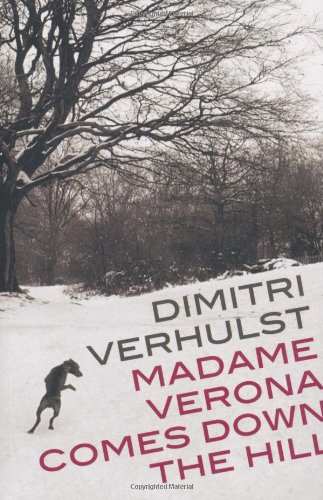
Review: Madame Verona Comes Down The Hill by Dimitri Verhulst

I’ve read good reviews of this book and really wanted to like it, but I just couldn’t. Although it’s very short (only 145 pages) it took me almost a week to finish it because I found it difficult to get interested in the story.

The book is set in the tiny and remote village of Oucwegne, a place that is slowly dying due to the lack of girls being born in recent generations. Madame Verona and her musician husband Monsieur Potter live in an isolated house at the top of a steep hill overlooking the village. As they get older, it becomes more and more difficult to walk up and down the hill. When Monsieur Potter hangs himself from a tree after being diagnosed with cancer, he leaves his wife enough firewood to last another twenty years. During those twenty years, Madame Verona lives alone with only an assortment of stray dogs for company, waiting for a luthier (cello-maker) to build her a cello using the wood of the tree from which her husband hanged himself. Eventually she places the last log on the fire and, as the title suggests, comes down the hill, knowing she won’t have the strength to go back up ever again.

The problem I had with the book is that there’s very little action, there’s no suspense as we know what’s going to happen right from the beginning, and there’s almost no dialogue. However, this is more to do with my own personal reading preferences rather than a criticism of the book itself – it’s not supposed to be a thriller after all. Most of the 145 pages are devoted to a string of humorous anecdotes describing life in an isolated village where only six people attend church, the men are obsessed with playing games of table football and a cow was once elected mayor. Most of the characters Verhulst describes are portrayed as eccentric and not particularly likeable. It’s easy to see why Madame Verona was in no hurry to rejoin the community, preferring to stay on the hill with her memories of her husband. The final few chapters, though, were poignant and moving and will be understood by anyone who has lost someone they love.

This book has been translated from the original Dutch, but even in translation Dimitri Verhulst’s writing is poetic and thought-provoking. If you can appreciate the beautiful writing for its own sake and are happy to read a book where nothing really happens, then you would probably enjoy Madame Verona. I would be prepared to try more of Verhulst’s books because he does have a very nice style, but this one just didn’t appeal to me.

Genre: General Fiction/Pages: 145/Publisher: Portobello Books (translated by David Colmer)/Year: 2009/Source: Won a copy in contest

Review: The White Queen by Philippa Gregory

Philippa Gregory is best known for her Tudor court novels, but with The White Queen she moves further back in time to the Plantagenets and the Wars of the Roses.

Elizabeth Woodville is twenty seven when she meets and falls in love with King Edward IV. Following a private wedding, Elizabeth becomes Queen of England and finds herself caught up in the ongoing battles between the House of Lancaster and the House of York. Amidst all the politics, intrigue and betrayal, Elizabeth’s concern is for the future of her children – in particular her two royal sons who will become the famous ‘Princes in the Tower’, a mystery which remains unsolved to this day.

The book is written in the first person present tense which I found slightly irritating, though not enough to stop me from enjoying the book. The use of present tense does help the reader to feel as if they are experiencing events along with Elizabeth, so it works in that sense, but my personal preference is definitely for past tense. There are a few passages where the viewpoint temporarily changes to the third person in order to describe battles which Elizabeth doesn’t witness but which are an important part of the storyline. I often find battle scenes boring, but these are well written and go into just the right amount of detail.

I found the story itself quite suspenseful and exciting – it probably helped that although I read a lot of historical fiction novels, I haven’t read many about the War of the Roses, so only had a vague idea of what was going to happen. Of course, this meant that I wasn’t sure exactly which parts of the book were based on fact and which parts were the invention of the author. In her note at the end of the book, Gregory mentions that there’s not much information available about the period, therefore there are some areas where she felt free to use her imagination.

If you’re not very familiar with the historical background, you’ll need to concentrate to be able to keep track of all the battles, changes of allegiances and numerous claimants to the throne. The family tree provided at the front of the book is not very helpful – it’s incomplete and really needed to show at least one more generation, as it ends before some of the important characters in the story were even born.

I found it difficult to warm to the character of Elizabeth but could feel sympathy for her, especially towards the end of the book. Richard III was also portrayed quite sympathetically – nothing like the evil hunchback in Shakespeare’s play! I would have liked to have seen his relationship with Elizabeth more thoroughly explored in the book – there was no real explanation for why she distrusts him so much, other than that she’s had dreams and premonitions that something bad will happen to her sons in the Tower. On the subject of the Princes in the Tower, the book explores an interesting theory, which may or may not be true – it would be nice to think that it was.

Interspersed with the main story is the tale of Melusina, the water goddess, from whom Elizabeth and the female members of her family are said to have descended and from whom they claim to have inherited magical powers.
Magic and mythology are recurring themes throughout the book. Elizabeth and her mother Jacquetta’s witchcraft skills are used as an explanation for several key historical events – for example, they whistle up storms to defeat their enemies at sea. This aspect of the story became quite repetitive and just didn’t appeal to me much. Sometimes it felt as if there were references to Melusina, water, rivers, the sea etc on almost every page!

The book ends abruptly, but that’s not surprising since The White Queen is the first in a trilogy called The Cousins’ War and will be followed by The Red Queen and The White Princess which will focus on Margaret Beaufort and Elizabeth of York respectively.

I would recommend The White Queen if, like me, you don’t have much knowledge of the Wars of the Roses and are looking for an enjoyable and relatively easy to understand introduction to the period. For those of you with a lot of background knowledge, I think there should still be enough new ideas to keep you interested.

Recommended

Genre: Historical Fiction/Pages: 417/Publisher: Simon & Schuster/Year: 2009/Source: My own copy bought new
Review: The Christmas Mystery by Jostein Gaarder

“They were going to Bethlehem, to Bethlehem- because that’s where the Christ-child was born.”

The Christmas Mystery begins in Norway on 30th November when a boy named Joachim discovers a hand-made Advent calendar in a book shop. The next day, when Joachim opens the first door, he finds a tiny piece of paper telling the story of a little girl called Elisabet who spots a lamb in a department store. The lamb begins to run away, but Elisabet is determined to stroke it and chases after it. The lamb leads her outside and into the woods where she meets the angel Ephiriel, who explains to her that she is now part of a very special pilgrimage to Bethlehem – not only will they be travelling across land, they will also be travelling back through time to the day when Jesus was born.

As Elisabet, Ephiriel and the lamb move closer to Bethlehem and further back in time, they are joined by an assortment of other Biblical characters including shepherds and Wise Men. A little more of their story is revealed every day through the pieces of paper hidden in Joachim’s advent calendar, but as the tale of Elisabet’s journey unfolds, Joachim and his parents become involved in another mystery: the mystery of John, the mysterious flower-seller who made the magic Advent calendar and the real-life Elisabet who disappeared on Christmas Eve in 1948.

The book is divided into 24 chapters, with each chapter representing one door on the Advent calendar. If you have children, the structure of the book would make it perfect for reading aloud, one chapter per day in the weeks leading up to Christmas. This is not really a ‘children’s book’ though – it’s one of those books that can be enjoyed on different levels by people of all ages. As with all of Jostein Gaarder’s books the story introduces us to a large number of philosophical ideas. We also learn some interesting historical and geographical facts about the countries Elisabet passes through on her way to Bethlehem.
Although this is not as good as some of Gaarder’s other books such as Sophie’s World or The Solitaire Mystery, it has to be one of the most unusual and imaginative Christmas stories I’ve ever read.

Genre: General Fiction/Pages: 247/Publisher: Phoenix – Translated by Elizabeth Rokkan & Illustrated by Rosemary Wells/Year: 1996/Source: Bought new

Review: A Warrior’s Life: A Biography of Paulo Coelho by Fernando Morais

Biographies are difficult to review – no matter how good the biographer’s writing might be, the success of the book really depends on how interesting the subject of the biography is. Fortunately for Fernando Morais and the reader, Paulo Coelho has evidently had a far more eventful life than the average person. The first half of the book, which dealt with Coelho’s early life, was fascinating although I found I started to lose interest nearer the end.

Paulo Coelho was born in Rio de Janeiro, Brazil, in 1947. As a teenager he was a rebel who performed badly at school and was constantly getting into trouble, insisting that all he wanted to do was read and write. His parents, not knowing what else to do with him, sent him to a psychiatric clinic where he was given electroshock therapy. Paulo later began experimenting with drugs and became involved in black magic. In 1974, he was arrested and imprisoned after being accused of subversive activities against the Brazilian government. His life reached a turning point in 1986, when he went on a pilgrimage to Santiago de Compostela, a journey that inspired one of his first major books, The Pilgrimage. Today, Coelho is one of the world’s most popular authors and has sold over 100 million copies worldwide.

Many biographers (particularly the authors of unauthorised biographies) allow their own opinions and speculations to get in the way of the facts – Fernando Morais does not do this. The book was written with the full cooperation of Paulo Coelho and Morais writes in a professional, factual style. He was given full access to Coelho’s diaries which date back to his teenage years, though he repeatedly points out that Coelho tended to fantasize in his diary entries and therefore we can’t place too much reliance on them. However, the inclusion of the diary entries, along with other fragments of Coelho’s writing, gives us a better insight into his mind.

Morais looks at every stage of Coelho’s life in so much depth it’s obvious that he spent a lot of time researching the book thoroughly. He provides a complete list of all the people he interviewed during his research including some of Paulo’s friends, family members and former girfriends. Some of Coelho’s fans may be disappointed and disillusioned as he is often portrayed in a bad light, but as the biography was published with Coelho’s blessing, he was obviously happy for us to read about the negative aspects of his character as well as the positive.

A Warrior’s Life was an interesting book to read, despite the fact that before beginning it I knew almost nothing about Paulo Coelho. I received a review copy from LibraryThing Early Reviewers and was glad to have an opportunity to read a biography I would probably never have read otherwise.

Genre: Non-Fiction (Biography)/Pages: 496/Publisher: Harper Collins/Year: 2009/Source: Received from LibraryThing Early Reviewers

Review: A Christmas Carol by Charles Dickens

“Men’s courses will foreshadow certain ends, to which, if perservered in, they must lead,” said Scrooge. “But if the courses be departed from, the ends will change…”

A Christmas Carol is the one classic that almost everyone knows, even if they’ve never read the book. It’s the story of an old, money-obsessed miser called Ebenezer Scrooge who is given the chance of redemption one Christmas Eve when he is visited by the ghost of his deceased business partner, Jacob Marley. Marley warns Scrooge that unless he changes his ways, he will end up like Marley himself, doomed to wander the earth bound by heavy chains of his own making. During the night Scrooge is visited by three more spirits – the Ghosts of Christmas Past, Christmas Present and Christmas Yet to Come – who help him to understand that there are more important things in life than money: things such as generosity, compassion and kindness. The scenes Scrooge witnesses that Christmas Eve are to change his life forever and transform him into a different person.

A Christmas Carol is shorter and easier to read than most of Dickens’ other books and really is suitable for people of all ages. I loved it as a child and after re-reading it this week for the first time in years, I loved it as an adult too. No matter how many movies, cartoons or TV adaptations you may have seen, it’s still worth reading the book for the richness and humour of Dickens’ writing and for his wonderful descriptions and imagery. For example when describing the location of Scrooge’s home, hidden away in a gloomy yard, he says:

 “…one could scarcely help fancying it must have run there when it was a young house, playing at hide-and-seek with other houses, and have forgotten the way out again”.

There are great lines like this one throughout the entire book. I also loved his portrayal of a Victorian Christmas in 19th century London.

Although some readers might find it too sentimental at times, it’s easy to see why this book has become a timeless classic, as it is everything a good Christmas story should be – heartwarming, inspirational and with an important message for us all.

Recommended

Genre: Classics/Pages: 147/Publisher: Chancellor Press/Year: 1985 (originally published 1843)/Illustrations by Arthur Rackham/Source: My own copy