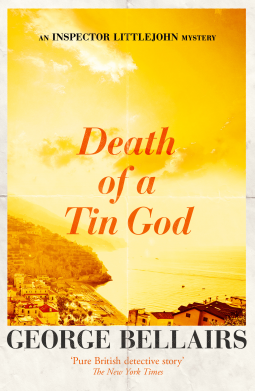
Death of a Tin God by George Bellairs

This is the fourth book I’ve read from George Bellairs’ Inspector Littlejohn series and although I haven’t been reading them in order, it doesn’t seem to matter at all. Each novel works as a standalone mystery and there’s very little focus on Littlejohn’s personal life so you can easily jump around from an early book to a later one and back again without feeling that you’ve missed anything important.

Death of a Tin God was first published in 1961 and begins with Thomas Littlejohn (now a Superintendent rather than an Inspector) flying from Dublin to the Isle of Man to visit his friend, Caesar Kinrade, the Archdeacon of Man. Littlejohn is looking forward to a quiet break, but his arrival coincides with the death of Hal Vale, a Hollywood star who has been filming on the island. Hal is found electrocuted in the bath in his hotel room and the circumstances suggest that it was not an accident. Littlejohn finds himself assisting the local police with their investigations and as the mystery deepens, he travels to the South of France to look for the answers.

I enjoyed this book but found the solution a bit predictable as the murderer turned out to be the person I had suspected from the beginning. There were some clever twists and red herrings along the way that did put some doubt into my mind, but I still wasn’t at all surprised when the truth was revealed. However, I very rarely manage to solve a mystery before the detective does, so I don’t mind too much when it occasionally happens! And I do like spending time with Littlejohn and watching him carry out his investigations; he’s not the most memorable of fictional detectives, but that means the focus stays firmly on the plot without his own personality getting in the way. His usual sidekick Sergeant Cromwell is absent for most of the book, but instead he teams up with Inspector Knell of the Manx police and Inspector Dorange in Nice who I believe are also recurring characters in the series and have good working relationships with Littlejohn.

One of the things I’ve loved about the other Bellairs novels I’ve read is the way he creates such a strong cast of supporting characters and suspects. In Dead March for Penelope Blow and A Knife for Harry Dodd in particular, there are some very colourful, larger than life characters who could almost have jumped straight out of the pages of a Dickens novel. In this book, I found the characterisation more bland and less interesting, but maybe that was a reflection of the shallow, vapid celebrity world Bellairs has chosen as the setting for this particular novel. Littlejohn is described several times as feeling slightly out of his depth amongst this assortment of glamorous film stars, ruthless publicity agents and millionaire bankers with yachts, so perhaps the reader is intended to feel the same.

I liked the idea of the book being set on the Isle of Man, as it’s not a common setting for mystery novels (or fiction in general), but it turned out that half of the story actually took place in Aix-en-Provence in France – and neither setting was described as vividly as I would have liked. I know Bellairs set some of the other Littlejohn books on the Isle of Man too, so maybe some of those have more local colour than this one. Although this is not one of my favourite books in the series so far, I’m still looking forward to reading more of them.

Thanks to Agora Books for providing a copy of this book for review via NetGalley.

Book 5 for R.I.P. XVI

The Grey King by Susan Cooper

This is the fourth book in Susan Cooper’s five-volume sequence, The Dark is Rising, and I feel as though things are starting to fall nicely into place ahead of the fifth and final book, Silver on the Tree. I’m beginning to form a better understanding of the opposing forces of the Light and the Dark and how the various characters and elements of the series have their roots in Arthurian legend and British folklore. However, this book also raises new questions and explores issues and topics not yet touched upon in the earlier novels, so there’s still a long way to go before the end!

The Grey King begins with Will Stanton, the eleven-year-old boy – and ‘Old One’ – we met in The Dark is Rising and Greenwitch, going to stay with an aunt and uncle in Wales while recuperating from hepatitis. His parents hope it will be a nice, relaxing break for him, but it turns out to be just the opposite! During Will’s illness, he has forgotten the details of the quest begun in the previous novels, but as his memories slowly return he remembers that his next task is to find the golden harp that will awaken six sleepers who will join the final battle between Dark and Light.

The three Drew children, who played such important roles in Over Sea, Under Stone and Greenwitch, don’t appear in this book, but Will receives help this time from a new friend, Bran, a boy he meets in the Welsh hills. With his white hair and pale skin, as well as a mystery surrounding the disappearance of his mother, Bran has never fitted in with other children and leads a lonely, solitary life with only his beloved dog, Cafall, for company. When Will learns that Bran is ready to help him with the next stage of the quest, a bond forms between the two and they set out together to find the harp and wake the sleepers.

The villain this time is the Brenin Llwyd, or the ‘Grey King’, an ancient and powerful Lord of the Dark who lives high in the mountains, his breath forming a ragged grey mist that can be seen for miles around. Although Will and Bran have little direct contact with the Grey King for most of the book, they are aware of his presence all around them and of the work of his agents, the bitter and spiteful farmer, Caradog Prichard, and the powerful grey foxes known as the Milgwn. Like the other books in the series, this one is wonderfully eerie and atmospheric, and while the Dark continues to feel evil and malevolent, we are again made to question how ‘good’ the Light really is:

Those men who know anything at all about the Light also know that there is a fierceness to its power, like the bare sword of the law, or the white burning of the sun…Other things, like humanity, and mercy, and charity, that most good men hold more precious than all else, they do not come first for the Light…At the centre of the Light there is a cold white flame, just as at the centre of the Dark there is a great black pit bottomless as the Universe.

As with The Dark is Rising, I felt that the mission was completed much too easily (I was particularly disappointed with a game of riddles, as very little effort went into solving them). The tasks that have faced the Drew children seem to be more difficult and dangerous somehow, maybe because they are ‘ordinary’ children and don’t have the powers that Will has. However, the quest is only one aspect of the novel and there are other elements that interested me as much or more. I particularly loved the Welsh setting – and was grateful for the lesson in Welsh pronunciation Will receives early in the novel! I also enjoyed getting to know Bran and discovering how he fits into the overall story.

I’m looking forward to reading Silver on the Tree and finding out how it all ends!

Book 4 for R.I.P. XVI

A Marriage of Lions by Elizabeth Chadwick

When I read Carol McGrath’s The Silken Rose last year I remarked on the lack of books about Henry III and Eleanor of Provence, so I was pleased to find that they are also major characters in Elizabeth Chadwick’s new novel, A Marriage of Lions. The main focus of the story, however, is Henry’s younger half-brother, William de Valence, and his wife, Joanna de Munchensy of Swanscombe. Those of you who are avid readers of Chadwick’s novels will know that she has a particular interest in William Marshal, hero of The Greatest Knight, and that many of her recent books have featured various members of the Marshal family. This is another, as Joanna de Munchensy is one of William Marshal’s grandchildren.

The novel opens in 1238 with the eight-year-old Joanna serving as a chamber lady at the court of Henry III and Eleanor of Provence (or Alienor as Chadwick spells the name). With several older male relatives, Joanna is seen as an insignificant member of the Marshal family until a sudden change in circumstances leaves her a very wealthy young woman with lands and titles of her own. In 1247, the King’s half-brothers – the sons of his mother Isabella of Angoulême’s second marriage to Hugh of Lusignan – arrive from France to take up positions at Henry’s court. The King becomes particularly fond of his youngest half-brother, William de Valence, and rewards him with marriage to Joanna, now one of the richest heiresses in England.

Although it’s an arranged marriage, it turns out to be a very happy one – but there are many at court who are not at all pleased with the favour being shown to William and his brothers. The powerful Simon de Montfort and his wife, the King’s sister, believe that part of the Marshal inheritance belongs to them and they set out to make life as difficult for William and Joanna as they possibly can. Meanwhile Queen Eleanor becomes resentful of the influence William and the other Lusignans wield over her young son, Prince Edward, and her previously good relationship with Joanna grows tense and strained. As the atmosphere becomes more and more hostile and the King’s power begins to weaken, Simon de Montfort and his barons see their chance to seize control of the throne and suddenly William and Joanna find themselves driven away from court as the country heads towards civil war.

I always enjoy Elizabeth Chadwick’s novels and this is another great one. Although I found it a bit slow to start with – the first half of the book is devoted mainly to the early days of Joanna’s marriage to William and the domestic details of their lives together – once the tension starts to build between the different factions surrounding the throne and the events leading to the Second Barons’ War get underway, it quickly became difficult to put down. I have read about this war before but only from the points of view of de Montfort and the King and Queen, so it was interesting to see things from the Lusignan/Marshal perspective. Simon de Montfort is very much the villain here (the lack of nuance in his characterisation was one of the few things that disappointed me about this book) and there’s a sense that the Lusignans are unfairly targeted because they are ‘foreign newcomers’ and because of the preferential treatment they are believed to receive from Henry. The King himself is caught in the middle and it’s quite sad to see how weak and ineffective he eventually becomes.

I loved Joanna and William and the way their marriage is depicted. Their relationship is a close and affectionate one, based on trust and love, but the sensible, practical Joanna often finds herself frustrated by her husband’s more impulsive nature which leads him to make mistakes and damage both of their reputations at court. There’s not much information available on the real historical figures, particularly Joanna, but Chadwick’s portrayal feels convincing and believable and I enjoyed getting to know them both.

Among the secondary characters in this book, my favourite was Leonora (Eleanor) of Castile, the young wife of the future Edward I. She’s such a strong and vivid character, I wondered whether Elizabeth Chadwick might have her in mind as the subject of a future novel – and it seems that I was right, so that’s something to look forward to!

Thanks to Sphere for providing a copy of this book for review via NetGalley.

Book 44/50 read for the 2021 Historical Fiction Reading Challenge.

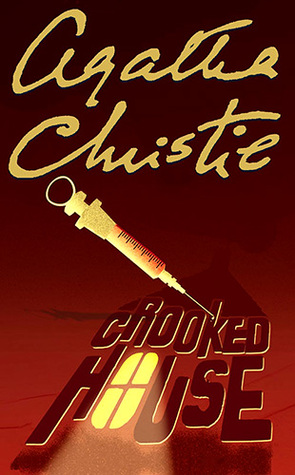
Crooked House by Agatha Christie

September’s topic for the Read Christie 2021 challenge is ‘a story featuring a school’. I’ve already read the obvious choice, Cat Among the Pigeons, so I was grateful to the challenge hosts for providing a list of alternative suggestions. Crooked House doesn’t involve an actual school, but it does fit the general theme as it features two children who are being home-schooled.

First published in 1949, this was apparently one of Christie’s own favourites; in the foreword, she says that ‘practically everybody has liked Crooked House, so I am justified in my own belief that it is one of my best’. Now that I’ve read it, I can say that although it’s not one of my absolute favourites, it would definitely be in my top ten so far. It’s one of her standalones – with no Poirot, Marple or other famous detective – and, like several of her other novels, has a title inspired by a children’s nursery rhyme:

There was a crooked man, and he went a crooked mile,
He found a crooked sixpence against a crooked stile;
He bought a crooked cat, which caught a crooked mouse,
And they all lived together in a little crooked house.

The ‘crooked house’ of the title is a mansion in the quiet London suburb of Swinley Dean and the people who ‘all live together’ there are ten members of the Leonides family. When the family patriarch, old Aristide Leonides, a Greek businessman, is found poisoned by his own eye medicine, suspicion immediately falls on his second wife, the much younger Brenda. It would certainly be more convenient for the rest of the family if Brenda could be proved to be the murderer – none of them like her and believe her to have married Aristide for his money – but so far there is no real evidence against her. Aristide’s eldest granddaughter, Sophia, is desperate to know the truth as she feels it won’t be fair to marry her fiancé, Charles Hayward, while a scandal is hanging over her family. As it happens, Charles is the son of the Assistant Commissioner of Scotland Yard so, joining forces with Chief Inspector Taverner, the detective assigned to the crime, he sets out to solve the mystery so that he and Sophia will be free to marry.

One of the things I loved about this book was that the murderer really could have been anybody. Brenda is initially the main suspect as there are hints that she has been having an affair with Laurence Brown, tutor to Sophia’s younger siblings Eustace and Josephine, and would therefore need Aristide out of the way. However, Aristide’s eldest son Roger also appears to have a clear motive involving money and the company business, while his younger son Philip could have committed the murder out of jealousy. Then there are the brothers’ two wives, Clemency and Magda, and a spinster aunt, Edith de Haviland. Any of these people could have had reasons for wanting the old man dead, as well as the knowledge and opportunity to carry out the crime. At no point does Christie become too concerned with the technical details of the murder or get bogged down with discussions of alibis and timings, concentrating instead on motives, personalities and relationships – my favourite kind of mystery novel!

I didn’t guess who did it, of course. The correct solution did cross my mind once or twice, but I dismissed it as unlikely because I was so convinced that it was somebody else. I’m annoyed with myself for not working it out as I can see now that the clues were all there in plain sight!

Next month’s Read Christie theme, if anyone wants to join in, is ‘a story set on a mode of transport’. I’m probably going to read Death on the Nile, but there are plenty of others you could choose, including Murder on the Orient Express, Death in the Clouds or The Mystery of the Blue Train.

Book 3 read for R.I.P. XVI

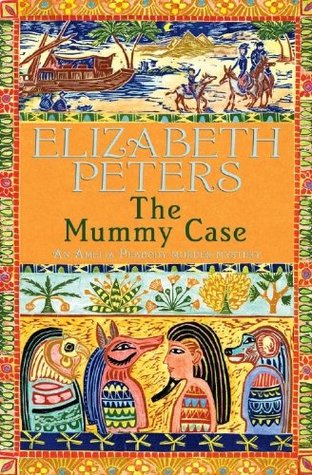
The Mummy Case by Elizabeth Peters

It’s been years since I last read an Amelia Peabody mystery and when I picked up The Mummy Case, the third in the series, I was concerned that I had left too big a gap between books. Luckily, this seems to be a series you can easily return to after a long absence as each book, at least so far, has worked as a standalone mystery.

The Mummy Case is set in 1894 and opens with married Egyptologists Amelia Peabody and Radcliffe Emerson at home in England planning their next trip to Egypt. Amelia dreams of exploring the pyramids of Dahshoor on this visit, but her hopes are shattered with the discovery that her husband has left it too late to submit their application and permission has already been granted to another archaeologist. Amelia and Emerson are offered Mazghunah instead – a barren and uninspiring site believed to be of little historical significance – and they reluctantly accept.

Despite their lack of enthusiasm, the expedition proves to be much more exciting than either of them had expected. Before they even reach their destination, they become caught up in the murder of an antiquities dealer in Cairo who is found dead in his own shop – and when they eventually arrive at Mazghunah, Amelia becomes convinced that somebody connected with the murder has followed them there. When a scrap of papyrus is stolen from their camp and an entire mummy case belonging to a visiting tourist also disappears, even Emerson has to agree that they have stumbled onto the trail of a clever and ruthless Master Criminal!

Unlike their first two mysteries (described in Crocodile on the Sandbank and The Curse of the Pharaohs), Amelia and Emerson have help in solving this one. For the first time, their young son Ramses has accompanied them on a dig and while he often proves to be more of a hindrance, getting into trouble at every opportunity, he also manages to appear at several crucial moments to save the day. Described as ‘catastrophically precocious’ by Amelia, he sounds more like a seventy-year-old professor with a speech impediment than a seven-year-old child and although I’ve been told that he improves as a character later in the series, in this book I found him extremely irritating. However, he’s clearly not meant to be taken too seriously – and to be fair, Amelia finds him irritating too:

The old woman’s cacodemonic laughter broke out again…”The wisdom of the Prophet is yours, great lady. Accept an old woman’s blessing. May you have many sons – many, many sons…”

The idea was so appalling I think I turned pale.

I enjoyed this book, despite Ramses, but I don’t think it was as strong as the previous two in the series. The plot seemed to meander all over the place and it was easy to lose sight of what the central mystery was that the characters were trying to solve. I do still love Amelia and Emerson, though – their good-natured bickering is always entertaining! It was also interesting to learn a little bit about Mazghunah and its disappointingly incomplete ‘pyramids’ and to meet the real-life archaeologist Jacques de Morgan – although seeing him only through Amelia’s eyes gives us a slightly biased impression as he is their rival and the man who is excavating the much more attractive site of Dahshoor!

I am looking forward to continuing with the fourth book in the series, Lion in the Valley.

Book 43/50 read for the 2021 Historical Fiction Reading Challenge.

Book 2 read for R.I.P. XVI

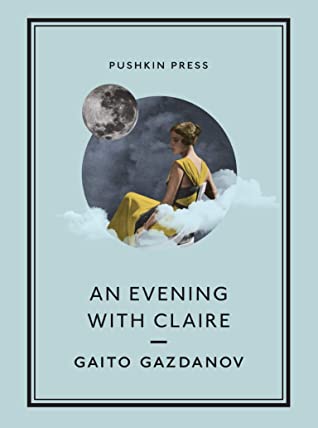
An Evening with Claire by Gaito Gazdanov – Translated by Bryan Karetnyk

When An Evening with Claire was originally published in 1930, Russian author Gaito Gazdanov was living in Paris and hadn’t seen his home country for nearly a decade. This, his first novel, was a success for Gazdanov, bringing him to the attention of other émigré writers, and now that I’ve read it I can understand why. It’s not my usual sort of book but I was drawn to it because I’ve enjoyed other books which have been reissued by Pushkin Press recently and because, apart from Mikhail Bulgakov and Boris Pasternak, I can’t think of any other 20th century Russian authors that I’ve read. This new edition has an introduction by Bryan Karetnyk, who is also responsible for the excellent English translation, which I found very readable.

The novel opens with our narrator, Kolya, in Paris spending an evening with Claire while her husband is away from home. Although we know very little about Kolya’s relationship with Claire at this stage, we do learn that he first met her ten years ago and has been in love with her ever since. However, they have spent most of that time apart and have only now been reunited. Later that evening, while Claire is asleep, Kolya remembers their first meeting, along with many of the other significant moments in his past. As he continues to remember and reminisce, the story of his life begins to take shape: his childhood, his schooldays, his relationships with family members and his experiences during the Russian Revolution and the Civil War that followed.

We actually see very little of Claire herself and I never really felt that I knew her or understood the sort of person she was, but that didn’t matter too much because the main part of the novel concentrates on Kolya’s own history as it unfolds through a chain of memories. His love for the absent Claire is always there and can be seen as a symbol of hope as he dreams of meeting her again one day. I enjoyed the first half of the novel, which includes anecdotes from Kolya’s childhood and his education at a strict military school and gymnasium, but the second half is more interesting as he begins to remember his time serving with the White Army in the Russian Civil War. It all feels very autobiographical and although I don’t know much about Gaito Gazdanov, I’m sure he must have been drawing on some of his own personal experiences and feelings in the writing of this novel.

At just over 200 pages in this edition, An Evening with Claire is a very short novel, but I thought it was the right length for the story being told. In general, I prefer books with more plot and this one has very little, but while this might have been a problem for me in a longer novel, there was just enough here to interest me and hold my attention throughout those 200 pages. This may sound like a strange comparison, but I was reminded of one of my other recent reads, Goodbye Mr Chips, another short book published in the same decade in which a man is looking back on episodes from earlier in his life. They share a focus on the power of memory, recollections of better days and regret for a disappearing world – which are also the reasons why I think An Evening with Claire would have resonated so much with other Russian émigrés of the 1930s. I would be happy to read more by Gazdanov and I see there are four of his other books available in English from the same publisher.

Thanks to Pushkin Press for providing a copy of this book for review via NetGalley.

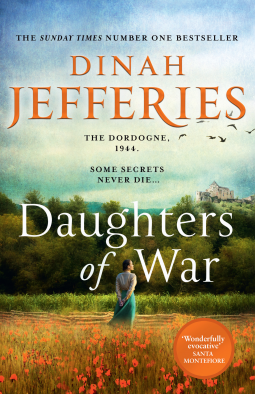
Daughters of War by Dinah Jefferies

After six novels set in Asia, all of which I’ve read and enjoyed, Dinah Jefferies has recently switched her focus to Europe during World War II. Last year’s The Tuscan Contessa was set in 1940s Italy; her new book, Daughters of War, is the first in a new trilogy set in wartime France.

It’s 1944 and France is occupied by the Nazis. In a cottage in the Dordogne live three sisters, all in their twenties, who are each doing their best to protect themselves and their friends and neighbours and to ensure that they all survive the war. Hélène, the eldest, took on the responsibility of caring for the other two after their father died and their mother departed for England, and as well as trying to look after her little family, she also works as a nurse alongside the village doctor. Élise is the rebellious and daring sister, the one who is determined to do whatever she can to help the Resistance, whether that is hiding weapons in the cottage grounds or intercepting and passing on messages. Finally there’s Florence, the innocent and kind-hearted dreamer, who is always happiest when she is at home, spending time in the kitchen or the garden.

As the Occupation continues and liberation still seems like a distant dream, the sisters are faced with a series of important decisions to make. Should they give shelter to Tomas, a deserter from the German army? Can they trust Jack, a British SOE soldier who arrives injured at the cottage one night, asking for help? All they can do is follow their instincts and try to find a balance between keeping themselves safe and working to regain France’s freedom. Along the way, each of the sisters has her own set of personal challenges to overcome, family secrets are exposed and the bonds between the three of them are tested. As the first in a trilogy, not everything is resolved in this book, but the foundations are laid for the characters and ideas to be developed further in the second and third novels.

The book is written from the perspectives of all three sisters; we spend a few chapters with one, then a few chapters with another. I felt the closest to Hélène, although each of the sisters is a strongly drawn character with a distinct personality of her own. Élise has potentially the most exciting storylines, but I would have liked to have read about her activities with the Resistance in more detail – they are skimmed over quite quickly and I thought this was a missed opportunity. I also found it unconvincing that the sisters are so ready to trust and confide in everyone they meet, even when it appears that someone around them might be a traitor; I would have expected them to have shown more caution.

Those are the negatives, but there were also plenty of positives; I particularly loved the descriptions of the beautiful countryside and villages of the Périgord Noir, the region of France where the story is set. I’m sure I’ll be reading the other two books in the trilogy, whenever they are available.

Thanks to HarperCollins UK for providing a copy of this book for review via NetGalley.

Book 42/50 read for the 2021 Historical Fiction Reading Challenge.