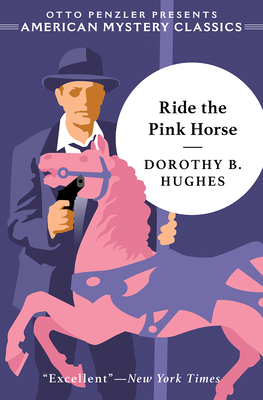
Ride the Pink Horse by Dorothy B Hughes

Ride the Pink Horse was the book chosen for me in the last Classics Club Spin and I have finished it just in time to write about it by the Spin deadline, which is this weekend. There were two reasons why I added this book to my Classics Club list in the first place. One was that I loved Dorothy B Hughes’ The Expendable Man and wanted to read more of her work; the other, I have to admit, was that I liked the title. Otherwise, I would probably never have picked this book up based on the description alone as it didn’t really sound like my usual sort of read. And that would have been a shame, as I thoroughly enjoyed it!

Ride the Pink Horse was published in 1946 and is set in Santa Fe during Fiesta, a festival commemorating the reconquest of New Mexico by the Spanish. The central character, known only as Sailor, was once ‘confidential secretary’ to Senator Willis Douglass (in reality, his job involved carrying out the corrupt senator’s dirty work for him) until the day the senator’s wife was murdered during what appeared to be an attempted robbery. Only Sailor and the Sen, as he calls him, know what really happened that day and Sailor is determined that if the Sen wants him to keep quiet then he will have to pay him for his silence. Sailor has followed the Sen to the Fiesta, planning to get as much money out of him as possible and then cross the border into Mexico to start a new life – but he hasn’t bargained for the appearance of McIntyre, a Chicago detective who is also on the senator’s trail in search of answers.

The first thing I should tell you about Ride the Pink Horse is that it’s not really a mystery, even though it’s currently being published as part of the Otto Penzler American Mystery Classics series. There’s a detective, but we don’t actually watch him doing any detecting because we see everything solely from Sailor’s perspective and Sailor already knows how the Sen’s wife was murdered. However, there’s still plenty of suspense as we are kept wondering whether Sailor will get what he wants from the Sen or whether he will drop his attempt at blackmail and tell McIntyre what he knows instead. The way in which the novel is written meant I honestly had no idea what would happen and which choices Sailor would make, so I found the ending both surprising and realistic.

The next thing I want to mention is the setting, which is wonderfully atmospheric. Santa Fe is not actually mentioned by name – Sailor, who is from Chicago, just refers to it as a ‘hick town’ – but it can be identified by the descriptions of the Fiesta and the festival traditions such as the burning of Zozobra, the wooden effigy of ‘Old Man Gloom’. Hughes creates an amazing sense of place and a feeling that, for Sailor, Fiesta is not a fun or exciting experience but a stifling, claustrophobic one – a trap from which there is no escape:

The whole town was a trap. He’d been trapped from the moment he stepped off the bus at the dirty station. Trapped by the unknown, by a foreign town and foreign tongues and the ways of alien men. Trapped by the evil these people had burned and the ash had entered into their flesh.

Sailor himself is not a very appealing or pleasant character, but as we learn more about his past – and his unhappy childhood, growing up in poverty with an alcoholic father – it becomes easier to have sympathy for him. One of his least attractive traits is his racism, so be warned that he uses offensive language to describe the Mexican and Native American people he meets during Fiesta. However, as he gradually befriends Pancho, a good-natured merry-go-round owner, and Pila, the young girl who rides the ‘pink horse’ of the title, there are signs that his attitude is beginning to change, as seen here in this conversation with McIntyre:

“…they don’t shove you around. They give you a smile. Even if you don’t talk their language they don’t shove you around. The way we shove them around when they come up to our town.”

“I know,” Mac said. “I’ve thought sort of along that line myself. We’re the strangers and they don’t treat us as strangers. They’re tolerant. Only they’re more than tolerant. Like you say, they’re friendly. They give you a smile not scorn.”

I loved this book and am so pleased it came up for me in the Classics Club Spin! I think The Expendable Man is still my favourite of the two, but I’m looking forward to reading more by Dorothy B Hughes; In a Lonely Place will probably be next.

This is book 25/50 read from my second Classics Club list
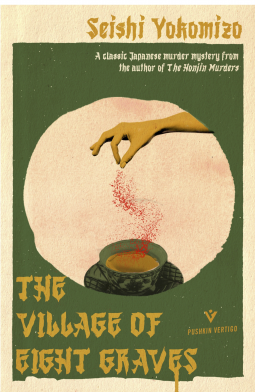
The Village of Eight Graves by Seishi Yokomizo – trans. Bryan Karetnyk

Over the last few years I have discovered several Japanese crime authors – including Soji Shimada and Yukito Ayatsuji – thanks to Pushkin Press making them available in English translations, but the one who has impressed me the most is Seishi Yokomizo. I really enjoyed The Honjin Murders, one of his many books to feature the detective Kosuke Kindaichi; I didn’t like The Village of Eight Graves, another from the same series, quite as much, but it’s still an entertaining read.

First published in 1950, the novel is set in the small Japanese village of Eight Graves where, centuries earlier, eight samurai were brutally murdered, bringing down a curse upon the village and giving it its sinister-sounding name. In the 1920s the curse struck again when a village leader went on a violent killing spree. Now, twenty-five years later, our narrator Tatsuya Terada, a young man who has been raised in Kobe by his mother and stepfather, is informed by a lawyer that his real father was the man responsible for those terrible murders. It seems that Tatsuya is now the heir to the family estate and must return to Eight Graves to claim his inheritance – but before he has even left Kobe he receives an anonymous letter warning him to stay away.

On his arrival in Eight Graves, Tatsuya finds that most of the other villagers are hostile and unwelcoming, believing that his presence will bring bad luck and tragedy to the village yet again. And so, when more murders begin to take place, suspicion immediately falls on Tatsuya – but as he is our narrator, we know that he is innocent. Or is he? Kosuke Kindaichi is called in to investigate, but at the same time Tatsuya is carrying out investigations of his own to find the real culprit and clear his own name.

Unlike in The Honjin Murders, where the untidy and unassuming Kindaichi plays a big role in the story, in this book we hardly see him at all. Almost as soon as he arrives in Eight Graves he disappears into the background again. We know that he is working on solving the mystery, but we don’t actually watch him doing it because we stick exclusively with Tatsuya’s narration and he and Kindaichi have very little interaction until nearer the end of the book. This makes this one less of a detective novel and more of a thriller or adventure novel, as Tatsuya explores the village alone looking for clues and stumbling into danger.

Yokomizo creates a wonderful atmosphere in this book with Tatsuya’s investigations leading him into networks of tunnels, caves with stalactites, and underground lakes and caverns. The legend of the eight murdered samurai is also incorporated into the story, along with a search for hidden treasure said to be buried somewhere within the village and a rivalry between two branches of Tatsuya’s family: the ‘House of the East’ and the ‘House of the West’. It’s an entertaining novel and there’s always something happening – but I did think the parts where Tatsuya is wandering around in the caves and tunnels became a little bit tedious. The absence of Kosuke Kindaichi for most of the book was also disappointing and I think I would have preferred a more conventional detective novel with the focus on solving the mystery rather than on treasure hunting.

Still, this book was fun to read and I loved the setting. Now I need to read the other Yokomizo novel currently available in English: The Inugami Curse.

Thanks to Pushkin Vertigo for providing a copy of this book for review via NetGalley.

Six Degrees of Separation: From Ethan Frome to Murder Under the Christmas Tree

It’s the first Saturday of the month which means it’s time for another Six Degrees of Separation, hosted by Kate of Books are my Favourite and Best. The idea is that Kate chooses a book to use as a starting point and then we have to link it to six other books of our choice to form a chain. A book doesn’t have to be connected to all of the others on the list – only to the one next to it in the chain.

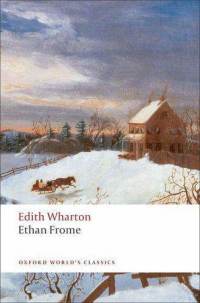
This month we are beginning with the classic novella Ethan Frome by Edith Wharton. I’ve read this one and liked it, although it’s still the only book I’ve read by Wharton. Here’s what it’s about:

Ethan Frome works his unproductive farm and struggles to maintain a bearable existence with his difficult, suspicious and hypochondriac wife, Zeena. But when Zeena’s vivacious cousin enters their household as a ‘hired girl’, Ethan finds himself obsessed with her and with the possibilities for happiness she comes to represent. In one of American fiction’s finest and most intense narratives, Edith Wharton moves this ill-starred trio towards their tragic destinies.

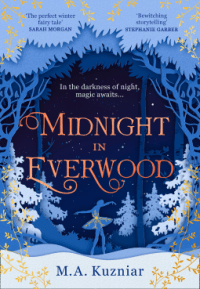
It’s been ten years since I read Ethan Frome, but I still remember the atmospheric setting of Starkfield, Massachusetts with its cold, harsh winters. My first link, then, is to a recent read which is also set in winter, Midnight in Everwood by MA Kuzniar (1). This is a retelling of ETA Hoffmann’s The Nutcracker and follows aspiring ballerina Marietta as she hides inside a grandfather clock on Christmas Eve and steps out into the enchanting world of Everwood. The descriptions of snow-covered landscapes are lovely, but I was disappointed with the writing style and the general lack of depth.

Another book with a very strong sense of place – and another wintry setting – is Touch by Alexi Zentner (2). This is a beautifully written novel about three generations of a family who live in a Canadian gold mining and logging town. There are elements of the supernatural and we meet lots of creatures from Canadian and Inuit folklore – sea witches, golden caribou, wood spirits and water monsters – but although I’m not always a fan of magical realism, I thought it worked well here.

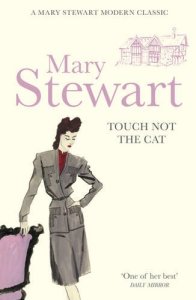
I could easily have continued with the winter theme, but I like to have some variety in my chains so I’m going to link instead to another book with the word ‘touch’ in the title: Touch Not the Cat by Mary Stewart. This is one of Stewart’s later novels, published in 1976, and tells the story of Bryony Ashley who returns to her ancestral home, Ashley Court, to investigate after her father dies under suspicious circumstances leaving her a cryptic message warning her of danger. I enjoyed this book, although it’s not one of my favourites by Stewart.

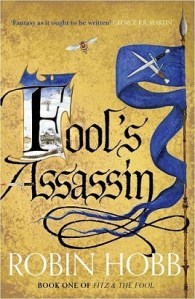
Bryony Ashley, the heroine of Touch Not the Cat is able to communicate with an unidentified secret lover using telepathy. In Robin Hobb’s fantasy novel Fool’s Assassin (4), the characters use two forms of magic known as the Skill and the Wit in order to form telepathic connections with other people and animals. It’s a great book, but if you’re new to Robin Hobb don’t start with this one – it’s part of a much longer series and you really need to start at the beginning with Assassin’s Apprentice.

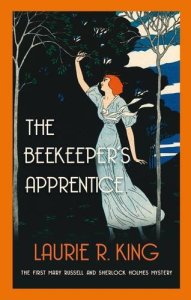
Although Fool’s Assassin is the fourteenth book in the sequence and therefore reacquaints us with lots of old friends, it also introduces a fascinating new character, Bee, and a large part of the story is written from her perspective. Her name makes me think of The Beekeeper’s Apprentice by Laurie R King (5). This mystery novel teams up a teenage orphan, Mary Russell, with Arthur Conan Doyle’s famous detective, Sherlock Holmes, who has retired to the countryside to keep bees. It’s the first in a series, of which I’ve still only read two!

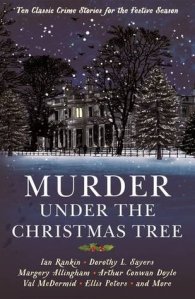
There’s a Sherlock Holmes story included in the anthology Murder Under the Christmas Tree edited by Cecily Gayford (6). This Christmas-themed collection features stories by classic crime authors including Dorothy L Sayers, Edmund Crispin and Margery Allingham, as well as more recent authors such as Val McDermid and Ian Rankin. I think this book brings my chain to an appropriate end!

~

And that’s my chain for December. My links have included wintry settings, the word ‘touch’, telepathic connections, bees and Sherlock Holmes!

Next month we’ll be starting with Rules of Civility by Amor Towles.

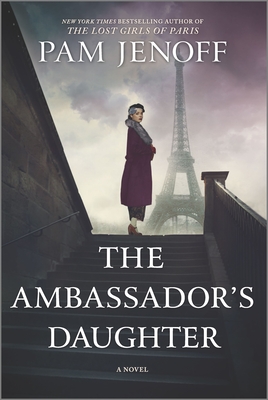
The Ambassador’s Daughter by Pam Jenoff

It’s 1919 and twenty-year-old Margot Rosenthal has accompanied her father, a German diplomat, to Paris for the Peace Conference that has been arranged following the end of the First World War. At first Margot is unhappy in the French capital – even though the war is over, she and her father are still thought of by the Allies as ‘the enemy’, while their Jewish background means they are viewed with suspicion by their fellow Germans – but the alternative is to return to Berlin, where her wounded fiancé Stefan awaits. Margot had agreed to marry Stefan before he went away to fight in the war, but now that he is back she’s no longer sure whether she wants to go ahead with the wedding.

Life in Paris becomes more interesting for Margot when she makes two new friends. One is Georg Richwalder, a former naval officer who has arrived with the German delegation; the other is Krysia Smok, a Polish pianist who introduces her to a group of political activists. When one of Krysia’s radical friends starts to put pressure on Margot to obtain information on Germany’s plans from Georg, suddenly Stefan and the wedding seem the least of her problems!

The Ambassador’s Daughter is a prequel to The Kommandant’s Girl and The Diplomat’s Wife, neither of which I have read, but that didn’t matter at all as this one works as a standalone novel. In fact, I suspect it’s probably better to start with this book anyway as it comes first chronologically. I do wish authors and publishers would move away from ‘wife’ and ‘daughter’ titles (which I discussed in one of my Historical Musings posts), but this series was written before that seemed to become such a popular trend, so I can be more forgiving!

Although I have read a lot of novels set during and just after World War I, I don’t think I’ve ever read anything specifically about the Paris Peace Conference, so I found that aspect of the book interesting. The German delegation was kept on the sidelines during the negotiations and excluded from decision-making, not being officially called to the conference until the details of the treaty had already been agreed upon. Because the Germans played such a minor role in all of this, it doesn’t form a big part of the novel, but I think Jenoff does a good job of showing how frustrating it was for diplomats such as Margot’s father to be kept out of making the important decisions that would affect their own country’s future.

The espionage element of the story is also well done, as we wait to see whether Margot will really betray Georg and Germany – and if so, whether she will be caught? However, a twist that comes near the end of the book is very obvious and because I had predicted it so quickly, it took away some of the suspense. The main focus of the novel, though, is not the conference or the spying, but Margot’s personal story and her relationships with Georg and Stefan, so if you’re not interested in romance, this probably isn’t the book for you. Overall, I found it quite enjoyable, but I’m not sure whether I would read anything else by Pam Jenoff – although I was intrigued by the character of Krysia and it seems she also appears in The Kommandant’s Girl, so maybe I could be tempted.

My Commonplace Book: November 2021

A selection of words and pictures to represent November’s reading:

commonplace book
noun
a book into which notable extracts from other works are copied for personal use.

~

He wanted to know in order to get closer to the group, to become part of it. Not that the group meant anything! It was merely an order of things, a life within life, almost a town within the town, a certain way of thinking and feeling, a tiny handful of humans who, as some planets do in the sky, followed their own mysterious orbit heedless of the great universal order.

The Strangers in the House by Georges Simenon (1940)

~

Liam would say no good ever came of blame. The national curse, he called it. Always the pointing finger, the excuse. He’d rather find solutions.

Fallen by Lia Mills (2014)

~

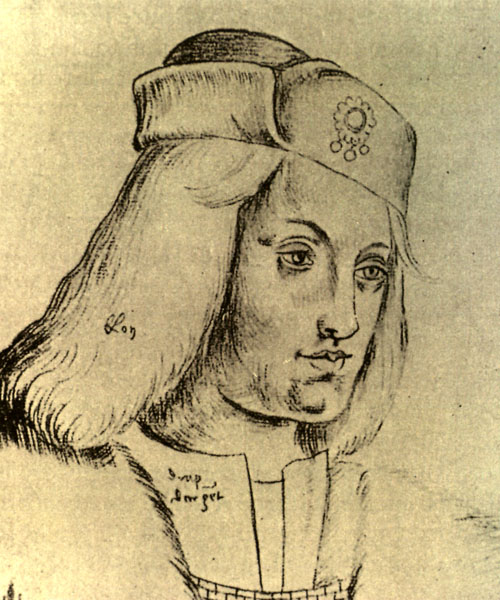
The only known contemporary portrait of Perkin Warbeck, pretender to the English throne

“Whatever his birth,” shrugged the cardinal, “he has his dreams. And dreams, your grace, make dangerous enemies. Swords cannot slay them nor torture exorcise them.”

A Princely Knave by Philip Lindsay (1956)

~

And he thought to himself: What a start! Things always turn out differently from what you expect. What you think is going to be hard is often easy, and something you don’t even think about turns out to be difficult.

Nightmare in Berlin by Hans Fallada (1947)

~

One of the things I have come to know most surely in my work is that the belief system acquired in childhood is never fully escaped; it may submerge itself for a while, but it always returns in times of need to lay claim to the soul it shaped.

The Secret Keeper by Kate Morton (2012)

~

“The Signing of Peace in the Hall of Mirrors” by William Orpen

“Self-determination isn’t just some abstract political notion, intended for the masses. Each of us must decide whom she will be, what we want for ourselves.”

The Ambassador’s Daughter by Pam Jenoff (2013)

~

I didn’t believe myself to be so cowardly, but it was impossible to reason with these people, and it could never have ended well. Nothing is more frightening in this world than ignorance and stupidity.

The Village of Eight Graves by Seishi Yokomizo (1949)

~

Sakura petals fall before they’ve withered, like the samurai who were destined to die young. Why do we neglect to revel in life when it can end at any moment? We are so often blessed, but fail to see it. The sakura remind us to pay attention.

I am the Mask Maker by Rhiannon Lewis (2021)

~

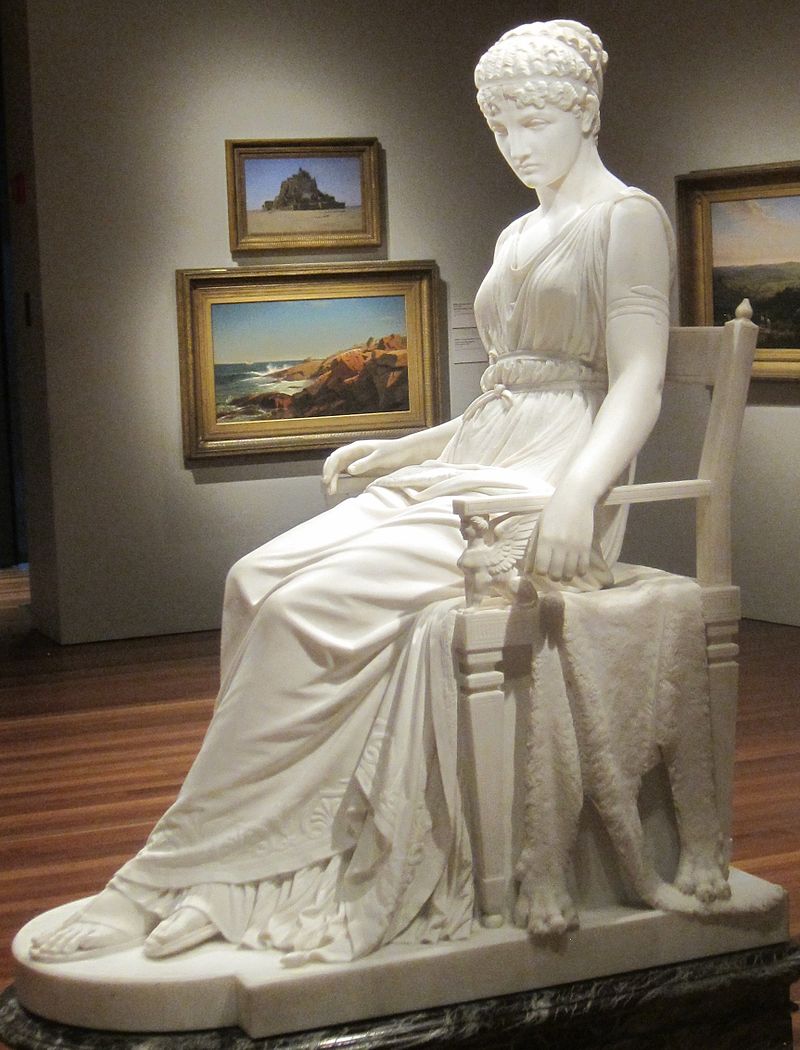
Penelope by Franklin Simmons (1896), marble

He told me once that everyone had a hidden door, which was the way into the heart, and that it was a point of honour with him to be able to find the handles to those doors. For the heart was both key and lock, and he who could master the hearts of men and learn their secrets was well on the way to mastering the Fates and controlling the thread of his own destiny.

The Penelopiad by Margaret Atwood (2005)

~

Something peculiar happens when you set out to recount the past…It is as though the memory is a series of interconnecting rooms, each leading to the next, less-visited one, if only you’ll try the door.

The Girl in the Photograph by Kate Riordan (2015)

~

“I hope,” he said, “that you are not feeling the worse for the shock. To be at close quarters with what is undoubtedly murder must be a great strain on anyone who has not come in contact with such a thing before.”

Modesty forbade Miss Marple to reply that she was, by now, quite at home with murder. She merely said that life in St. Mary Mead was not quite so sheltered as outside people believed.

They Do It with Mirrors by Agatha Christie (1952)

~

Favourite books read in November:

The Secret Keeper and I am the Mask Maker

Authors read for the first time in November:

Lia Mills, Pam Jenoff, Kate Riordan

Places visited in my November reading:

France, Ireland, England, Germany, Australia, Japan, Italy, Wales, Ancient Greece

The Penelopiad by Margaret Atwood

I wanted to join in with this year’s Margaret Atwood Reading Month (hosted by Buried in Print) but knew I wouldn’t have time for one of her longer novels; The Penelopiad, at 199 pages, seemed the perfect choice as it would also count for the Novellas in November event (hosted by 746 Books and Bookish Beck). The Penelopiad was published in 2005 as part of the Canongate Myths series, of which I’ve previously read Baba Yaga Laid an Egg by Dubravka Ugrešić and Ragnarok by AS Byatt. It’s a retelling of the events of the Odyssey from the perspectives of Penelope and the twelve maids who were hanged by her son, Telemachus.

Penelope narrates her story from a modern day underworld where she wanders through the fields of asphodel occasionally encountering the spirits of other characters from Greek mythology. With little to do in the afterlife other than to think and remember, Penelope recalls her childhood in Sparta, her marriage to Odysseus and, particularly, the events that followed her husband’s departure to fight in the Trojan War. Left behind in Ithaca to raise baby Telemachus, Penelope awaits news of Odysseus but as the years go by it looks less and less likely that he is going to return.

Many of you will already know how the story progresses from there – the suitors, the shroud, the fate of the twelve maids, the bed carved from an olive tree – so I won’t go into the plot in any more detail. However, Atwood doesn’t just use Homer’s Odyssey as a source; she also draws upon other works including Robert Graves’ The Greek Myths to help fill in the gaps and provide a different view of Penelope’s character and story. Penelope is usually associated with faithfulness and patience and seen as perhaps a less interesting woman than Helen of Troy or Clytemnestra; in The Penelopiad, Penelope tells us how frustrated she is with the way she has been portrayed and how she really feels about rivals such as Helen.

Penelope’s own narrative is interrupted now and then by her twelve maids, who speak with one voice in a Greek chorus. As well as giving their own version of the events that build up to Odysseus ordering Telemachus to kill them, they also comment on Penelope’s account, leading us to question her motives and to wonder what exactly was and was not true. The sections narrated by the maids are written in a different style every time – a poem, a ballad, a lecture and even a court trial – but although I understood the need for a second perspective other than Penelope’s, these were my least favourite parts of the book. I found the modern language used by Penelope and the maids a bit jarring too and I think overall, I would have just preferred a more straightforward and conventional retelling of Penelope’s story.

I didn’t find this as satisfying as the other Margaret Atwood books I’ve read, but it was a quick, witty and entertaining read and it’s always good to see women from Greek myth given voices of their own.

They Do It with Mirrors by Agatha Christie

This month’s theme for the Read Christie 2021 challenge is ‘a story set after WWII’. There were plenty of options for this one – any book published after 1945 would count – and I eventually decided on They Do It with Mirrors, a 1952 Miss Marple novel.

The story begins with Miss Marple meeting an old friend, Ruth, who tells her that she’s worried about her sister, Carrie Louise, although she doesn’t give any specific reasons for her concern. Carrie Louise, like Ruth, has had several husbands and her latest, Lewis Serrocold, has established a rehabilitation centre for juvenile criminals at their home, Stonygates. Miss Marple agrees to go and visit Stonygates to see if she can find out what’s going on and, on her arrival, she finds a large number of people assembled at the house, including Carrie Louise’s daughter, granddaughter and stepson, as well as several other family members and servants.

As Miss Marple gets to know the various members of the household, she also begins to feel that something is not quite right – and she is proved to be correct when Christian Gulbrandsen, the son of Carrie Louise’s first husband, is found shot dead in his room. At the same time, Lewis Serrocold is shot at in his study by one of the ‘juvenile delinquents’, a young man who claims to be Winston Churchill’s son. Lewis is unharmed, but as one of the other characters remarks, “you don’t expect murder and attempted murder in the same house on the same night!” The police, led by Inspector Curry, soon arrive on the scene and begin their investigations, but it’s Miss Marple, of course, who eventually solves the mystery.

I don’t think this is one of Christie’s best, but I did still enjoy it – and unlike my last Christie novel, Death on the Nile, where I guessed the solution almost immediately, I didn’t manage to solve this one before the culprit was revealed. The title of the book refers to the fact that things and people are not always what they seem and sometimes, like a magician, ‘they do it with mirrors’ to cause confusion and misdirection. Well, I certainly allowed myself to be misdirected, but I do think it would have been possible to work it out if I’d been paying more attention.

This book has an interesting setting which gives Christie a chance to explore Lewis Serrocold’s work with the young offenders and the way in which these young men were viewed by 1950s society. This doesn’t really play a big part in the story and it could have worked just as well as a conventional country house mystery without this element, but it does provide some extra interest.

December’s theme for Read Christie 2021 is ‘a story set during bad weather’. The suggested title is The Sittaford Mystery, which is one I haven’t read yet.