John Saturnall’s Feast by Lawrence Norfolk

This book has been on my TBR since it was published in 2012; I couldn’t get into it at the time, so put it aside to try again later, not really intending ‘later’ to be nearly ten years later! Anyway, although I had one or two problems with it I’m pleased to have read it at last and am now interested in reading more of Lawrence Norfolk’s novels, all of which sound intriguing.

John Saturnall’s Feast begins in a place called Buckland, a small village where John Sandall lives with his mother, a herbalist and midwife. It’s the early 17th century, a time when women with skills like these risk being accused of witchcraft – and this is what happens to John’s mother. Finding themselves the target of their Puritan neighbours and the fanatical preacher Marpot, they flee to the safety of nearby Buccla’s Wood. Here, John continues to receive an education from his mother, who teaches him to read from a book of ancient recipes and reveals to him the secrets of a traditional Feast which have been passed down through the generations.

When John’s mother dies, leaving him an orphan, he is taken into the kitchens of Buckland Manor, where he impresses the other cooks with his knowledge of food. At the Manor, we meet Lady Lucretia, the young daughter of Sir William Fremantle. A marriage has been arranged for Lucretia, in order for her to inherit the estate, but she has chosen to defy her father by refusing to eat. Can John Sandall – now known as John Saturnall, Master Cook – create a dish that will tempt her from her fast?

This is an unusual and complex novel; I have simplified the plot in the paragraphs above, but there is a lot more to it than that and I would probably need to read the book again to fully appreciate all the different layers of the story. I don’t think I quite understood the significance of the ritual of the Feast, for example – was it intended as a myth, an allegory or something real? I felt that important plot points and details were sometimes getting lost beneath the overwhelming descriptions of ingredients, smells, tastes and colours that filled almost every page. I also struggled to keep track of the characters; there are so many of them, particularly working in the kitchens, and none of them are very strongly drawn, so I found it difficult to distinguish one from another.

I did really enjoy the first half of the book, which describes John’s childhood in Buckland and the events that lead to his arrival at the Manor. The portrayal of his life in the kitchens – the huge, subterranean network of rooms, the heat, the smells, the sounds, and the complex social hierarchy that exists between the cooks and the humble kitchen hands – is vivid and fascinating. I was reminded very strongly of Abiatha Swelter’s kitchens in Mervyn Peake’s Gormenghast books! In the second half of the novel, though, there’s a change of scene and pace as civil war breaks out in England and John and his friends exchange the kitchen for the battlefield. There seemed to be very little build up to this and I felt that the war chapters didn’t really add much to the overall story.

Although not every aspect of this book was a success with me, the wonderful atmosphere and the imaginative plot still kept me turning the pages. I would like to try one of Lawrence Norfolk’s other three books, so if you have read any of them please let me know what you thought!
Book 19/50 read for the 2021 Historical Fiction Reading Challenge.
Classics Club Spin #26: The Result

The result of the latest Classics Club Spin has been revealed today.

The idea of the Spin was to list twenty books from my Classics Club list, number them 1 to 20, and the number announced by the Classics Club represents the book I have to read before 31st May. The number that has been selected is…

11

And this means the book I need to read is…

Germinal by Émile Zola

The thirteenth novel in Émile Zola’s great Rougon-Macquart sequence, Germinal expresses outrage at the exploitation of the many by the few, but also shows humanity’s capacity for compassion and hope.

Etienne Lantier, an unemployed railway worker, is a clever but uneducated young man with a dangerous temper. Forced to take a back-breaking job at Le Voreux mine when he cannot get other work, he discovers that his fellow miners are ill, hungry, in debt, and unable to feed and clothe their families. When conditions in the mining community deteriorate even further, Lantier finds himself leading a strike that could mean starvation or salvation for all.

~

I’m happy with this result as I’ve been wanting to read Germinal for such a long time. I enjoyed the other two books I’ve read by Zola (The Ladies’ Paradise and Thérèse Raquin) and I know this one is usually considered to be his best, so I’m really looking forward to it.

If you took part in the spin too, I hope you got a good result!

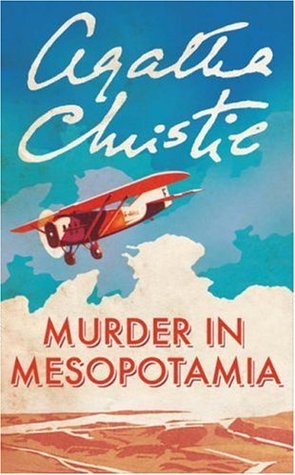
Murder in Mesopotamia by Agatha Christie – #1936Club

This is the second book I’ve read for the 1936 Club (hosted by Karen and Simon) and an obvious one for me as I’m also taking part in Read Christie 2021 this year. The monthly prompt for Read Christie is ‘a story set before WWII’, which makes Murder in Mesopotamia, published in 1936, the perfect choice!

Murder in Mesopotamia is a Poirot mystery and one of several to feature a first person narrator – usually Captain Hastings, but in this case Nurse Amy Leatheran. At the beginning of the novel she agrees to travel to the site of an archaeological dig near Hassanieh in Iraq to nurse the wife of the expedition leader, Dr Leidner. Louise Leidner is being blamed by some of the other archaeologists for causing tension on this year’s dig, but when Nurse Leatheran arrives at the site what she finds is a nervous, frightened woman who claims to be receiving threatening letters from a former husband. A few days later, Louise is found dead in her bedroom, having been hit on the head by a blunt object. It seems impossible that a stranger could have entered the site without being seen, therefore the murderer must be someone on the dig…but who?

When I first began to read, I couldn’t help making comparisons with They Came to Baghdad, one of my favourite Christie novels, which features lots of colourful descriptions of Iraq. The sense of place in this one isn’t quite as strong – and in fact, we see very little of Iraq beyond the confines of the dig site – but there’s still plenty of atmosphere. The descriptions we do get of the dig and the various roles of the members of the expedition are fascinating and feel authentic, which is to be expected as Christie herself was married to an archaeologist, Max Mallowan, and often accompanied him on digs. Not only could she draw on her own personal knowledge and experience in the writing of this novel, she also apparently based some of the characters on people she knew.

Nurse Leatheran is a very opinionated narrator who doesn’t hold back on her views of ‘Foreigners’ (including Poirot), but apart from that I quite enjoyed her narration. We get to know the other participants in the dig through her eyes and, because she is an outsider, meeting all of these people for the first time, we can never be completely sure whether or not she is giving us an accurate impression of them. Poirot himself appears halfway through the novel, conveniently passing through Hassanieh after working on a case in Syria – and we are told that a week later, after solving this mystery, he will go on to investigate the Murder on the Orient Express.

As usual, I didn’t manage to solve the mystery myself. I came up with a few theories, but none of them were correct, which isn’t surprising as the final solution is so far-fetched I don’t think I would ever have thought of it! The method by which the murder is carried out seems unlikely, if not impossible, but the motive relies on us accepting something which I found impossible to believe. Still, this was an entertaining read and another great 1936 book.

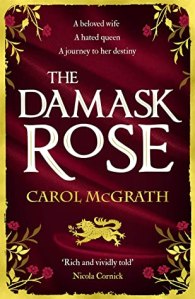
The Damask Rose by Carol McGrath

This is the second book in Carol McGrath’s She-Wolves trilogy, telling the story of three medieval queens of England who have all been given the label ‘she-wolf’ at various times. I enjoyed the first novel, The Silken Rose, about Henry III’s wife, Eleanor of Provence, so I was looking forward to this one, which moves on to Eleanor of Castile, the first wife of Edward I.

I’ve read other books set during Edward I’s reign, so presumably I’ve come across Eleanor of Castile before, but I mustn’t have been paying attention as I couldn’t have told you much about her before reading The Damask Rose (except that she was commemorated by the Eleanor Crosses which were erected in several English towns in her memory). It’s always good when you can learn something new from historical fiction and in this case, almost the entire story was new to me.

The novel begins in 1264 when Henry III is still alive and on the throne of England, but only just – he and his son, Prince Edward, have been captured by the forces of Simon de Montfort at the Battle of Lewes. Edward’s wife, Lady Eleanor, is at Windsor Castle awaiting news of her husband when Gilbert de Clare, one of de Montfort’s supporters, arrives and forces her to relinquish the castle. This traumatic incident instils in Eleanor a lifelong hatred of de Clare as well as a determination that she will never put herself in such a vulnerable position again. Once the threat of Simon de Montfort has been removed at the Battle of Evesham, Edward and Eleanor travel to the Holy Land on crusade. It is during this journey that they learn of the death of Henry III and return to England to take their place as king and queen.

I enjoyed learning more about Eleanor, but although I don’t think she deserved to be described as a ‘she-wolf’ (the term seems to have mainly referred to her unpopular methods of acquiring land and properties, which were seen as greedy and ruthless), she’s not a character I liked or managed to warm to either. It seems that the real Eleanor was also accused of being ‘unmaternal’, which McGrath suggests could be due to the fact that she lost so many children she was afraid to get too close to the ones who survived, but it still irritated me that Eleanor complained constantly about her children’s relationships with other adults while at the same time saying she was far too busy to spend time with them herself.

Part of the novel is written from the perspective of Olwen, a herbalist whom Eleanor introduces into the royal household to provide advice on plants and healing. Olwen is a fictional character but her story complements Eleanor’s very well; in fact, I think I preferred her sections of the book as I found her much easier to like and I enjoyed the different point of view she brings to the novel. I cared about Olwen and wanted her to be happy, whereas I felt that some parts of Eleanor’s story, particularly towards the end, became too factual, too concerned with just describing things that had happened rather than providing any real emotional depth.

The third book in the series is going to be about Isabella of France; I am much more familiar with Isabella than with the previous two queens and I think she will be a fascinating subject to bring the trilogy to an end!

Thanks to Headline for providing a copy of this book for review via NetGalley.

Book 18/50 read for the 2021 Historical Fiction Reading Challenge.
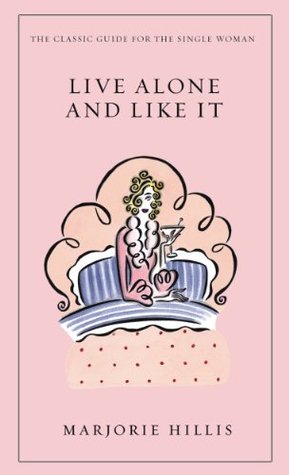
Live Alone and Like It by Marjorie Hillis – #1936Club

This week Karen and Simon are hosting another of their clubs where we all read and write about books published in the same year – and I think this particular year, 1936, is one of the best so far. I’ve already read a lot of great 1936 books and there are many more that I considered reading for the club.

Live Alone and Like It by Vogue editor Marjorie Hillis, is a self-help book for single women who, either intentionally or unintentionally, find themselves living alone. I’m not someone who normally reads self-help books, but I thought it might be fun to read one published in 1936 and, as I do live alone, to see if Hillis has any good advice for me!

As nice, perhaps, as any other way of living, and infinitely nicer than living with too many people (often meaning two or more others) or with the wrong single individual. You can live alone gaily, graciously, ostentatiously, dully, stolidly. Or you can just exist in sullen loneliness, feeling sorry for yourself and arousing no feeling whatever in anybody else.

As you can probably tell from the quote above, Hillis has very little patience with women who indulge in self-pity and sit around complaining about their living arrangements. Her view is that single women can easily become a burden to other people and should avoid doing so at all costs: ‘Remember that nothing is so damaging to self-esteem as waiting for a telephone or door-bell that doesn’t ring.’ Instead, in her brisk, no-nonsense style she urges us to take control of our own lives and raise our self-esteem by giving ourselves little treats, cooking nice meals, wearing new clothes, and not telling ourselves that it ‘doesn’t matter because nobody sees you’.

There are some amusing question and answer sections, with questions like ‘How late is it proper for a woman living alone to entertain a man friend, and how can she get him to go at the correct time?’ and each chapter ends with a selection of case studies, showing how some women have perfectly mastered the art of successfully living alone while others unfortunately haven’t. She devotes a whole chapter to the pleasures of sleeping in a single bed, pointing out that ‘most people have more fun in bed than anywhere else, and we are not being vulgar’ and another takes us step-by-step through the correct preparation, cooking and serving of meals for one person:

Very well, then, have your orange juice and black coffee and toast…Our plea is merely for plenty of orange juice, coffee and toast; really good orange juice, coffee and toast; and orange juice, coffee and toast attractively served.

There’s no doubt that Hillis’ target audience were women of a certain class; she seems to take it for granted that you will probably have a maid – and if you don’t, you’re very unfortunate as you’ll have to do everything yourself – and she provides lots of tips on hosting the perfect cocktail party or bridge night. There’s also an assumption that you will be living in a large city like New York with plenty of clubs, theatres and exhibitions to go to; women who live alone in a small town or in the countryside aren’t given as much attention, except in a few of the case studies. However, a lot of her advice is still relevant today and to everyone, such as how to meet people and make new friends. I will leave you with a quote that I think applies to all of us live-aloners, whatever our personal circumstances:

Living alone, you can – within your own walls – do as you like. The trick is to arrange your life so that you really do like it.

Classics Club Spin #26: My List

It’s time for another Classics Club Spin! I’m looking forward to this one as I haven’t read anything from my Classics Club list since I finished my book from the previous spin, The Manuscript Found in Saragossa, in January.

If you’re not sure what a Classics Spin is, here’s a reminder:

The rules for Spin #26:

* List any twenty books you have left to read from your Classics Club list.
* Number them from 1 to 20.
* On Sunday 18th April the Classics Club will announce a number.
* This is the book you need to read by 31st May 2021.

And here is my list:

1. Goodbye Mr Chips by James Hilton
2. The Chrysalids by John Wyndham
3. A Laodicean by Thomas Hardy
4. I Will Repay by Baroness Emmuska Orczy
5. Daniel Deronda by George Eliot
6. Shadows on the Rock by Willa Cather
7. La Reine Margot by Alexandre Dumas
8. The White Guard by Mikhail Bulgakov
9. Jane and Prudence by Barbara Pym
10. Armadale by Wilkie Collins (re-read)
11. Germinal by Emile Zola
12. Nicholas Nickleby by Charles Dickens
13. The Duke’s Children by Anthony Trollope
14. The Brothers Karamazov by Fyodor Dostoevsky
15. Fire from Heaven by Mary Renault
16. The Grapes of Wrath by John Steinbeck
17. Pied Piper by Nevil Shute
18. Eugene Onegin by Alexander Pushkin
19. The Turquoise by Anya Seton
20. The Trumpet-Major by Thomas Hardy

Have you read any of these? Which number should I be hoping for on Sunday?

River of Stars by Guy Gavriel Kay

River of Stars is a sequel to an earlier novel by Guy Gavriel Kay, Under Heaven, but being set several centuries apart, the two books stand alone and it’s not essential to read them in order. However, the world Kay creates in this novel has been shaped by the events of the previous one, so that’s something worth bearing in mind.

The world to which I’m referring is a thinly disguised version of China during the time of the Song Dynasty – or Twelfth Dynasty, as it is called in the novel. Since the fall of the glorious Ninth Dynasty, described in Under Heaven, Kitai (the name given to China) has been in decline; their Fourteen Prefectures have been lost to barbarians from the northern steppes, and their once mighty empire is no more. With the army greatly weakened, military decisions are now made by government ministers while bad news is hidden from the emperor who immerses himself in poetry, calligraphy and the creation of a magnificent garden.

As the story of this fallen empire unfolds, we are introduced to a large number of characters. Two of the most prominent are Ren Daiyan, who believes his purpose in life is to reclaim the lost Fourteen Prefectures and restore Kitai to its former glory, and Lin Shan, a woman who writes poetry and thinks for herself, at a time when women are not expected to do either of those things. The paths of Ren Daiyan and Lin Shan cross now and then and their actions carry the story towards its conclusion, but along the way we meet an assortment of emperors and barbarians, prime ministers and war-leaders, diplomats and poets, some of whom have a big part to play in the story and some a small one, but all are significant in one way or another.

Although Kay’s novels are usually described as historical fantasy, most of them have very few traditional elements of fantasy – in this particular book I only noticed two or three, including an encounter with a fox-woman and a few mentions of ghosts. His books are much closer to historical fiction, which is probably one of the reasons why I enjoy them so much (along with the beautiful, lyrical writing). Before starting this one, I knew nothing at all about the Song Dynasty, so despite Kay’s renaming of people and places, it’s good to know that I now have at least a small amount of knowledge of the period, of the Disaster of Jingkang and the Jin-Song Wars.

River of Stars is a fascinating novel and one that requires some patience; it’s not a book that you can rush through, as every character, every conversation, every decision could be important later on. In case we might be in danger of forgetting this, Kay gives us frequent reminders:

It was possible for people to enter your life, play a role, and then be gone. Although if you could sit on a horse in a wood under dripping leaves years after and think about them, about things they’d said, were they really lost?

And:

He ought to feel sympathy. He didn’t. You said certain things, damaged someone’s life, and your own fate might take a different course because of it.

However, although this is an impressive novel and I did enjoy it, I think his two books set in China are my least favourites so far. The characters in them just didn’t seem to come to life for me the way they did in books like Tigana and The Lions of Al-Rassan and I think the constant foreshadowing and discussions of fate and consequences made me too aware of the structure of the novel rather than allowing me to become completely immersed in the story. At least I still have plenty of Kay’s earlier books left to look forward to: The Fionavar Tapestry trilogy, Ysabel, The Sarantine Mosaic duology and A Song for Arbonne.