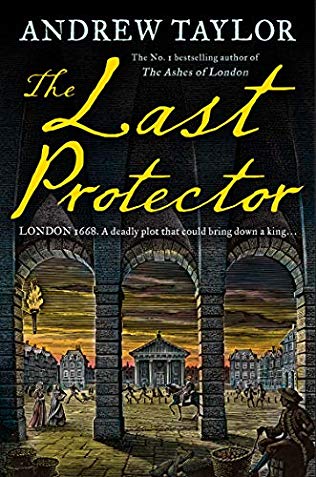
The Last Protector by Andrew Taylor

The Last Protector is the latest addition to Andrew Taylor’s wonderful Marwood and Lovett series set in England during the Restoration. It’s now 1668, and Charles II, restored to his throne eight years earlier, is beginning to lose the support of the people due to the extravagance of his lifestyle and the immoral behaviour of his courtiers. Many are starting to long for the days of the Lord Protector Oliver Cromwell and his son, Richard – and when Richard returns (in disguise) from exile, he becomes the centre of a conspiracy into which James Marwood and Cat Lovett are drawn.

At the beginning of the novel, government agent Marwood, still working for Joseph Williamson, Under-Secretary of State to Lord Arlington, is sent to spy on a duel between Lord Shrewsbury and the Duke of Buckingham, who is believed to be plotting against the king. Unfortunately, Marwood is seen by Buckingham’s men, making him a target of the Duke. Meanwhile, Cat, now married to the elderly architect Simon Hakesby (and not really enjoying the experience) has a chance encounter with a young woman she hasn’t seen for years. The woman’s name is Elizabeth Cromwell, the daughter of Richard, the last Protector. Richard has become caught up in Buckingham’s plans to gain power and he wants Cat and Simon to help him. In this way, Cat and Marwood are both pulled, via different routes, into the same circle of events and their two separate storylines become entwined.

This is the fourth book in the series and I would recommend reading them all in order if you can (the previous books are The Ashes of London, The Fire Court and The King’s Evil). It’s not really essential as the novels do all stand alone to a certain extent, but Marwood and Cat have a complex relationship and I think it’s best to follow their stories from the beginning. They don’t seem to have as many opportunities to interact in this book as they do in the earlier ones, but the occasions when their paths do cross are always worth looking forward to.

As usual, there’s also an interesting collection of secondary characters to get to know. One of the many things I enjoy about this series is the way the books incorporate both the lives of the nobility and the lower classes and there are two characters in particular who stand out this time: Ferrus, the ‘mazer-scourer’, a tall, skinny man whose job it is to squeeze himself down sewers to clear blockages underground, and Chloris, a kind-hearted prostitute who does her best to help Marwood despite her humble position in life.

Compared with the previous three novels, this book is more of a thriller than a mystery, still with plenty of twists and turns to the plot. And of course, the atmosphere and attention to detail are excellent, bringing to life the London of the period as the city continues to rebuild following the Great Fire of 1666. I hope there’s going to be a fifth book, especially as there’s a certain development towards the end of this one that has left me wondering what the future might hold for Cat and Marwood.

Thanks to HarperCollins for providing a copy of this book for review via NetGalley.
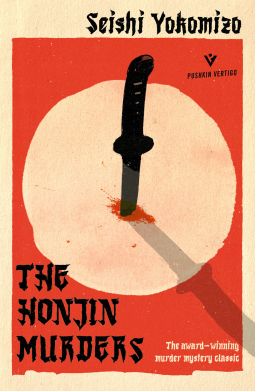
The Honjin Murders by Seishi Yokomizo

A three-fingered man. A room painted all in red. The eerie music of a Japanese koto. A katana – a sword – standing blade-first in the snow. These all form part of this classic murder mystery, originally published in Japanese in 1946 and now available from Pushkin Press in an English translation by Louise Heal Kawai.

The Honjin Murders is set in November 1937 in the village of Okamura, home to the Ichiyanagi family, whose ancestors once ran a honjin – an inn where noble travellers would stay during the Edo period. Those times are long gone, but the Ichiyanagis are still proud of their illustrious lineage. At the beginning of the novel, the various members of the family are gathering for the wedding of the eldest son and heir, Kenzo, to a young schoolteacher, Katsuko. Kenzo’s family are not very happy about the bride’s humble origins, but the marriage goes ahead and everyone retires to bed for the night. A few hours later, screams are heard from the newlyweds’ room and the pair are found inside stabbed to death.

With the doors locked and no fresh footprints in the snow surrounding the building, it seems that the perfect locked room murder has been committed. Luckily, Katsuko’s uncle Ginzo knows just the man who will be able to solve it: his friend, the private detective Kosuke Kindaichi. Ginzo sends for Kindaichi who arrives in the village looking dishevelled, unassuming and unimpressive (it’s difficult not to make comparisons with that other famously untidy detective, Columbo, although this book was published decades earlier) but appearances can be deceptive and it quickly becomes clear that Kindaichi has the sort of sharp mind and powers of deduction that are necessary to solve such a complex crime.

I won’t say any more about the plot of the novel or the mystery itself. I didn’t work out how the murder was committed or who the culprit was and I was happy just to watch the solution unfold – although like another Japanese mystery novel I read last year, Murder in the Crooked House by Soji Shimada, I felt that there seemed to be more focus on puzzle solving and providing an ingenious technical explanation for the crime rather than on character and motivation. Maybe that is a common feature of Japanese crime fiction; I haven’t read enough of it yet to know.

What I particularly loved about this book was the style in which it was written, with the narrator (presumably meant to be Yokomizo himself) speaking directly to the reader and breaking off from the story now and then to discuss other classic mystery novels, especially of the locked room variety, and their similarities to the Honjin case:

The first that came to mind were Gaston Leroux’s The Mystery of the Yellow Room and Maurice Leblanc’s The Teeth of the Tiger; then there’s The Canary Murder Case and The Kennel Murder Case, both by S.S. Van Dine; and finally, Dickson Carr’s The Plague Court Murders…But this real-life case wasn’t quite like any of the above-mentioned. Maybe, just maybe, the killer had read a selection of stories like these, dissected all of the different devices used, then picked out the elements that he needed, constructing his own device. At least that’s one theory.

Yokomizo may have drawn inspiration from some of those earlier mysteries, but The Honjin Murders itself feels original and different, as well as being a very clever and entertaining novel. Although I hadn’t heard of Kosuke Kindaichi until I read this book, it seems that he appears in over seventy novels (one of which, The Inugami Curse, is also available in English from Pushkin Press). I will look forward to meeting him again!

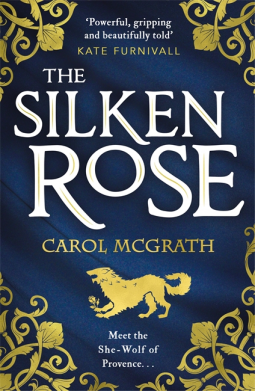
The Silken Rose by Carol McGrath

The Silken Rose is the first in a new trilogy of novels telling the stories of three medieval queens who have been referred to at one time or another as ‘she-wolves’ because of their unpopularity or because they managed to wield power or influence in a period dominated by men. The second and third books in the series are going to focus on Eleanor of Castile and Isabella of France, but this first novel is about Eleanor of Provence. Carol McGrath uses the alternative spelling of Ailenor, so I will do the same throughout the rest of this post.

Ailenor of Provence is not a queen I’ve ever read much about; I think it’s safe to say that she and her husband, King Henry III of England, are not the most popular subjects for historical fiction! They appear in Sharon Penman’s Falls the Shadow, but otherwise I’m struggling to think of other books I’ve read about them and that’s a good thing because it means that the story which unfolds in The Silken Rose feels fresh and different. It begins in 1236 with Ailenor, at the age of only thirteen, arriving in England from France for her wedding to Henry, a man more than twice her age. Although her new husband treats her with kindness and their marriage is not an unhappy one, Ailenor finds it difficult adjusting to life in a strange country and values the friendships she forms with two very different women.

One of these women is Henry’s sister, Eleanor, known as Nell, who has taken a vow of chastity after being widowed. Ailenor quickly discovers that Nell is in love with Simon de Montfort, one of the most powerful noblemen at Henry’s court, and she decides to help her sister-in-law break free from her oath and marry Simon. However, this marriage will eventually have serious repercussions for Henry and for England. The other friend Ailenor makes is Rosalind, a talented embroideress who is brought to court to teach Ailenor and her ladies to embroider intricate new patterns. Unlike most of the other characters in the novel, Rosalind is a fictional character, but she plays an important part in the story, providing a link between the nobility and the merchant classes.

Although Ailenor is the main focus of the novel, there are some sections written from Rosalind’s perspective (and occasionally from Nell’s), which helps to build up a full picture of the events that take place during this period, rather than only being limited to things that Ailenor experiences herself. The story Carol McGrath builds around Rosalind feels believable and fits seamlessly into Ailenor’s story – but despite this, I didn’t find her as interesting or engaging to read about as Ailenor and although I did understand the reasons for her inclusion in the book, I would have preferred it if the novel had stuck solely to the real historical characters. Apart from that, I really enjoyed The Silken Rose; there’s not a huge amount of drama, but I was never bored.

You may be wondering why Ailenor has been described as a ‘she-wolf’; well, it seems that this was partly due to the fact that she brought a large number of her relatives to England with her, where they were given positions of power and were able to influence the king. These included several of her uncles (the ‘Savoyards’), one of whom was made Archbishop of Canterbury, and her sister, Sanchia, who married the king’s younger brother. This and some of the other reasons for Ailenor’s unpopularity are explored in the novel, yet she remains a sympathetic character and one I very much enjoyed getting to know. I am looking forward to reading the other two books in the trilogy.

Thanks to Headline for providing a copy of this book for review via NetGalley.
This is book 3/20 from my 20 Books of Summer list.

Six Degrees of Separation: From What I Loved to Britannia Mews

It’s the first Saturday of the month which means it’s time for another Six Degrees of Separation, hosted by Kate of Books are my Favourite and Best. The idea is that Kate chooses a book to use as a starting point and then we have to link it to six other books of our choice to form a chain. A book doesn’t have to be connected to all of the others on the list – only to the one next to it in the chain.

This month we are starting with What I Loved by Siri Hustvedt. It’s not a book that I’ve read, but here’s the blurb:

In 1975 art historian Leo Hertzberg discovers an extraordinary painting by an unknown artist in a New York gallery. He buys the work, tracks down its creator, Bill Weschler, and the two men embark on a life-long friendship.

This is the story of their intense and trouble relationship, of the women in their lives and their work, of art and hysteria, love and seduction and their sons – born the same year but whose lives take very different paths.

Like Leo, the heroine of Nicola Cornick’s supernatural time-slip novel, The Phantom Tree (1) finds a painting in a gallery which changes her life. The painting is of Mary Seymour, the daughter of Henry VIII’s sixth wife, Katherine Parr, and Thomas Seymour, whom Katherine married following Henry’s death.

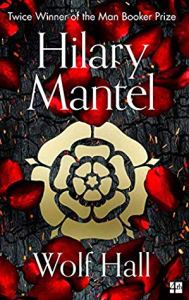
Mary Seymour, born in 1548, disappears from historical records after 1550, but in The Phantom Tree, Cornick imagines that she was raised at Wolf Hall with her Seymour cousins. This provides an obvious link to Wolf Hall (2), the first book in Hilary Mantel’s trilogy of Tudor novels about Thomas Cromwell.

The word ‘wolf’ makes me think of Wolf Among Wolves by Hans Fallada (3), a novel first published in 1937. Set in Germany, it follows a group of people struggling to survive in the aftermath of the First World War with hyperinflation leaving the economy in ruins.

Wolf Among Wolves is translated from the original German. Another German novel I’ve read in translation is The Beggar King by Oliver Pötzsch (4), the third in a series of historical mysteries following the adventures of a 17th century Bavarian hangman and his daughter.

This leads me to The Weed that Strings the Hangman’s Bag (5), one of Alan Bradley’s Flavia de Luce novels, starring an eleven-year-old detective and chemistry genius. In this book, Flavia is investigating a murder which takes place during a puppet show.

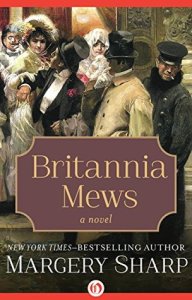
In Britannia Mews by Margery Sharp (6), our heroine marries a man who creates wonderful hand-made puppets and she later opens a successful puppet theatre in a coach house in her street, Britannia Mews. I highly recommend this book; I loved watching the changing nature of Britannia Mews and its inhabitants over the course of the novel.

And that’s my chain for July. My links have included paintings in galleries, the Seymours of Wolf Hall, the word ‘wolf’, German translations, hangmen and puppets.

In August we will be starting with How To Do Nothing by Jenny Odell.

My Commonplace Book: June 2020

A selection of words and pictures to represent June’s reading:

commonplace book
noun
a book into which notable extracts from other works are copied for personal use.

~

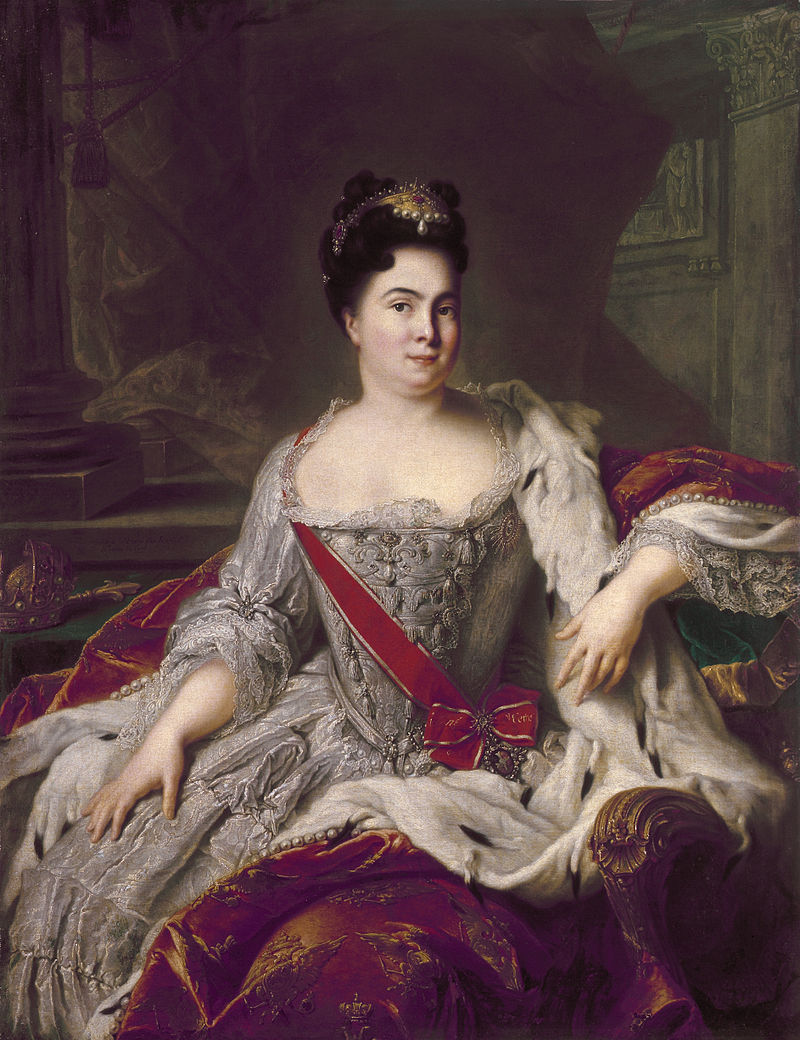
Catherine I of Russia

Sometimes I’d linger outside the door to listen: how could a single man know as much as he did? Every day he received a dozen or so letters, and when I cleaned the room I spotted scroll upon scroll filled with his tiny, neat handwriting. The sheer number of books on his shelves made me despair; by the time I had finished dusting them, they were ready for me to start all over again.

Tsarina by Ellen Alpsten (2020)

~

‘Have you had a pleasant time?’ Hugh asked.

‘A most instructive week. The roads here are remarkable. Allow me to point out to your notice, Leon, that an insignificant pawn lies under that chair. It is never wise to disregard the pawn.’

Hugh looked at him. ‘What may that mean?’ he inquired.

‘It is merely advice, my dear. I should have made an excellent father.’

These Old Shades by Georgette Heyer (1926)

~

Main Street sweltered. Creeping pedestrians hugged the narrow line of shade cast by hot brick walls. The usual custom of greeting friends, locally known as “passing the time of day,” was suspended. Two dogs, father and son, snarled at each other when they came face to face, and halfway down the block a man with an ice-cream cart sank to the kerbstone and devoured his livelihood.

A Time to Die by Hilda Lawrence (1945)

~

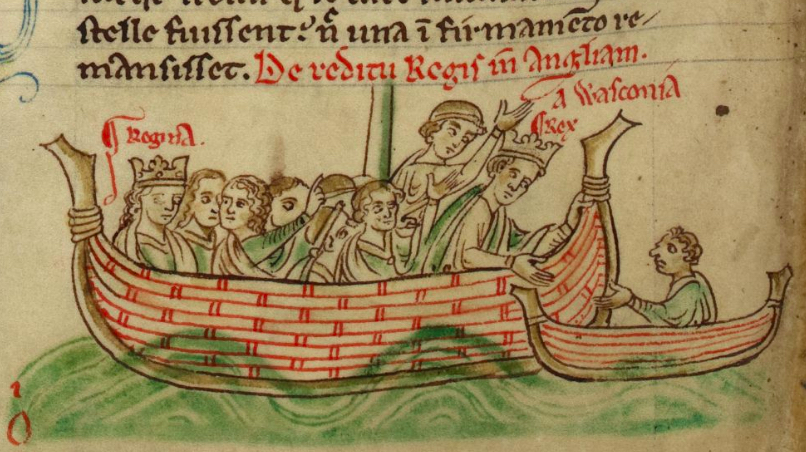
Eleanor of Provence and Henry III

Alienor wanted everyone else to share her happiness. Two uncles in England, two healthy babies in her nursery, the possibility that her sister might come to England with her mother, a summer adventure ahead with three ladies whose company she enjoyed, and a generous, if stubborn husband whom she loved. But above all, she loved being a great queen who was, she imagined, loved by all.

The Silken Rose by Carol McGrath (2020)

~

There’s a certain comfort in rules. You know if you’re good or if you’re bad. And even if you’re bad, you know where you fit. You belong. But I don’t want other folk’s rules to say if I belong anymore. I want to say for myself.

The Sin Eater by Megan Campisi (2020)

~

Favourite books read in June:

The Silken Rose and These Old Shades

New authors read in June:

Ellen Alpsten, Carol McGrath, Megan Campisi

Countries visited in my June reading:

Russia, France, England, USA

~

Have you read any of these books? Which books did you enjoy reading in June?

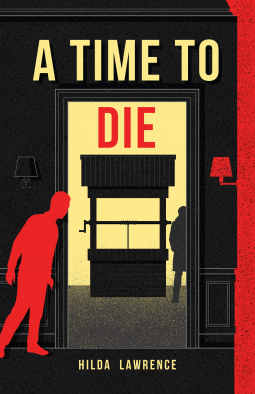
A Time to Die by Hilda Lawrence

This is the second of Hilda Lawrence’s three mystery novels featuring the private detective Mark East, but the last one I have read. Having previously enjoyed the first book, Blood Upon the Snow, and the third, Death of a Doll, I was hoping that this one would be just as good. It was originally published in 1945 and has been reissued by Agora Books as part of their Uncrowned Queens of Crime series.

Like Blood Upon the Snow, A Time to Die is set in the small town of Crestwood, near Bear River. Mark East, having solved a crime there the winter before, has returned in the summer to spend a few weeks with the friends he made during his previous visit. He’s looking forward to a nice relaxing break this time, but on the evening of his arrival he is invited to a charity supper at the church where two fellow guests – a child and an old woman – are struck by arrows during an archery contest. When, later that night, the Beacham family’s governess goes missing, it seems that the two incidents could be related. Aware that his peaceful holiday is quickly becoming much more eventful than he’d anticipated, Mark is reluctant to take on the case, but changes his mind when a body is discovered…

Of the three books in the Mark East series, I think this one is the weakest, but I did still find it entertaining. The plot is quite complex, or at least it seems to be at the beginning when I felt I was wading through a jumble of confusing and unconnected events and struggling to follow what was happening, but once things begin to fall into place and we learn a little bit more about the background of the missing governess, the story becomes much more compelling. The novel has a huge cast of characters (more than necessary really; a lot of them could probably have been left out without having any impact on the story), which means there are plenty of suspects and I didn’t guess who the murderer was before the solution was revealed.

If you haven’t read any of Hilda Lawrence’s novels yet, I would recommend reading Blood Upon the Snow before this one if you can. Many of the characters we meet in this book were introduced in the previous one and it’s also interesting to revisit the same community in two different seasons and see how life in the town has changed now that the cold, snowy winter weather has been exchanged for blazing summer heat. One thing that disappointed me, though, was that Beulah and Bessy, the two elderly spinsters who play important roles in solving the mysteries in the other two books, hardly appear at all in this one – I think we only see Bessy once or twice. It’s a shame because seeing them carrying out their own amateur detective work in parallel with Mark had been one of the highlights of this series.

Not my favourite by Hilda Lawrence, then, but I’m glad I discovered this series and I just wish she had written more than three of these books!

Thanks to Agora Books for providing a copy for review via NetGalley.

This is book 2/20 from my 20 Books of Summer list.

Mrs Whistler by Matthew Plampin

Thanks to everyone who commented on my post earlier this month asking for recommendations of novels about artists; I now have a whole list of titles and authors to investigate – and as promised, here are my thoughts on one of my recent reads, Mrs Whistler by Matthew Plampin. The Whistler the title refers to is, of course, the American painter James Abbott McNeill Whistler, and ‘Mrs Whistler’ is his model, muse and mistress, Maud Franklin. Although I was familiar with a few of his most famous paintings, such as Arrangement in Grey and Black No.1 (known as Whistler’s Mother), I knew nothing about his personal life or what sort of man he was, and I’m sorry to say that I hadn’t even heard of Maud.

The story of Maud’s relationship with Whistler is played out against a backdrop of some of the significant events that occurred in their lives between 1876 and 1880. The first part of the novel concentrates on the controversial Peacock Room, a decorative interior Whistler creates in the dining room of Frederick Richards Leyland’s London townhouse. Leyland is not at all happy when he sees what Whistler has done and a bitter feud follows. Later, the novel explores Whistler’s decision to sue the art critic John Ruskin for libel after he describes Whistler’s painting Nocturne in Black and Gold as ‘flinging a pot of paint in the public’s face’.

These two incidents form the basis of the plot and as I had no prior knowledge of any of this, I found that I was learning a lot about Whistler, his paintings and his life. But this is not so much a book about Whistler as a book about what it was like to know Whistler, to be near him and to share both his triumphs and his troubles. Maud Franklin must have known him as well as anyone – she was with him for around fifteen years and they had two children together (whom she had to see raised by foster parents), which makes her a logical choice of character to focus on. However, according to Plampin’s author’s note the real Maud had refused to talk to Whistler’s biographers who complained that ‘Maud could tell the whole story, but she will not’. This means Plampin has had to use his imagination to decide how Maud felt about Whistler and the other people in his life and how she may have thought, spoken and reacted.

Whistler, at least as seen through the fictional Maud’s eyes, does not come across as a very pleasant man. He’s self-absorbed, he treats Maud badly at times and often lacks awareness and judgement, which is particularly illustrated by his relationship with his friend Charles Augustus Howell, known as Owl. It is obvious to the reader that Owl cannot be trusted, but Whistler remains irritatingly loyal to him, not able to see what we and (eventually) Maud can see. I did have sympathy for Maud and wouldn’t have blamed her if she had left Whistler, but she stayed with him, I suppose, through a combination of love and a need for security. It’s a sad and often frustrating story, but told in a way that I found believable and convincing.

This is the first book I have read by Matthew Plampin, but I know he has written four others. If you’ve read any of them, maybe you can help me decide which one I should read next.