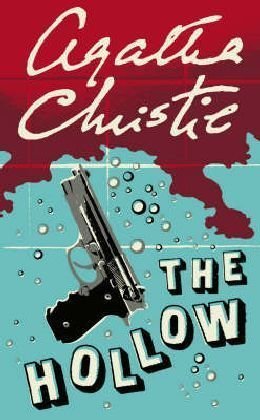
 March’s theme for the Read Christie 2020 Challenge was ‘a Christie story adapted for the stage’ and with several unread options to choose from, I settled on The Hollow, a Poirot novel first published in 1946. Christie herself said this book was “the one I ruined by the introduction of Poirot” and in fact, her famous detective doesn’t appear in the stage version at all.
The novel begins with the eccentric Lucy Angkatell preparing to welcome several friends and family members to her home, The Hollow, for the weekend. These include John Christow, a successful London doctor, and his timid, downtrodden wife, Gerda, who seems unable to do anything right. With Henrietta Savernake, a talented sculptor with whom John has been having an affair, also attending the house party, it’s clear that tensions will be running high – and to complicate things further, the beautiful actress Veronica Cray, a former girlfriend of John’s, just happens to be staying in a cottage nearby.
Christie takes her time setting the scene and introducing us to the people who are gathering at The Hollow, rounding out each character and exploring the complex relationships between them. As well as those I’ve already mentioned above, there’s also Sir Henry, Lucy Angkatell’s husband, and three younger cousins: Edward, who has hopes of marrying Henrietta; David, a sullen and humourless young student; and Midge, the ‘poor relation’ who works for a living. The characterisation is excellent and by the time another guest – Hercule Poirot – arrives for Sunday lunch, we have been given a good understanding of all the undercurrents and resentments simmering beneath the surface.
As Poirot reaches the house, he witnesses what appears to be an artificially staged murder: John Christow lies bleeding to death at the edge of a swimming pool, while his wife, Gerda, stands over him with a gun in her hand and several of the other characters approach from different directions. At first assuming this is a game designed to test his skills as a detective, Poirot quickly discovers that it is all too real and that John is dying. But surely there is more to the scene that meets the eye? Has Gerda really murdered her husband or could there be another culprit?
I always enjoy reading Christie, but this particular book hasn’t become a favourite. Not all of them can, I suppose. There was nothing that I actually disliked about it and as I’ve said, the characters are excellent, very strongly drawn with plenty of depth and complexity – I just felt that, as a mystery, it doesn’t have quite the ingenuity and originality of some of her others. Apparently Christie describes this book in her autobiography as “in some ways rather more of a novel than a detective story” and I understand what she means. And while I don’t agree that Poirot ruins the book, I don’t think he adds a lot to it either. He doesn’t make his first appearance until a third of the way through and most of the investigating is actually done by Inspector Grange anyway, so I think the story could have worked just as well without Poirot.
But Poirot, of course, is the one who finally brings the investigation to its conclusion and leads us to the murderer. I wish I could say that I had solved the mystery too, but I didn’t – there were at least four characters I suspected and I couldn’t make up my mind between them. Maybe I will have more success in solving the next Christie mystery I read: the April topic for the challenge is ‘a story Christie disguised’, which sounds intriguing, doesn’t it?




 She Reads Novels