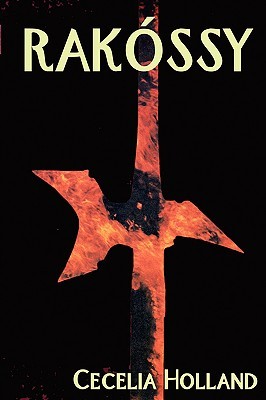
 Cecelia Holland’s many historical novels cover a wide range of time periods and settings. So far I have only read two of them: City of God, a story of Rome and the Borgias, and Hammer for Princes, set in 12th century England in the period known as the Anarchy. My third Holland novel, Rákossy, takes place in Hungary during the Ottoman Wars of the 1520s. Not having read many books set in Hungary, I was looking forward to something different and to learning something new.
The title character is János Rákossy, a Magyar border lord trying to protect his lands from the threat of Turkish invasion. He is disappointed with the lack of help from the rest of Europe whom he feels are leaving Hungary to fend for itself and he knows he can’t rely on the support of his neighbouring barons either. All he can do is continue to negotiate treaties, train his knights, carry out raids, try to build alliances, and do whatever else is necessary to defend his castle and his people.
Rákossy is not the sort of man who is easy to like. He is ruthless, cold, cynical and violent towards both men and women. As another character says of him:
“The people in the village think that he sold his soul to the Devil for a charmed life and fortune in battle. The Turks, I’m told, believe so too. I think it’s possibly the only point of agreement between them.”
He does have some good qualities – he’s clever and shrewd and his courage is not in question – but he is certainly not someone I could consider to be a hero. This seems to be normal for a Cecelia Holland protagonist, though; I had similar feelings about Nicholas in City of God and Fulk in Hammer for Princes. She seems to excel at deliberately creating characters who are unappealing, morally ambiguous and whose motives are not always clear. But at least if her central characters are not very likeable, they are still interesting and complex.
Of the other characters in the novel, two stand out. One is Denis, Rákossy’s brother, a sensitive man who prefers books to warfare and doesn’t always approve of or agree with Rákossy’s actions. The other is Catharine de Buñez, believed to be an illegitimate daughter of the King of Aragon, who marries Rákossy early in the novel. As far as I can tell, most of the major characters in the book are fictional, although the story is based on fact, giving us an idea of the situation on the Hungary-Turkey border leading up to the Battle of Mohács in 1526. If you know what the outcome of that battle is going to be, it does affect how you might view Rákossy’s negotiations and military preparations throughout the novel, but either way you can admire what he is trying to do for his country.
I didn’t find this book particularly enjoyable, mainly because I thought it was very bleak and also because it didn’t seem to have any sort of plot beyond a string of raids and battles. It was one of Cecelia Holland’s earliest novels, though – published in 1967 – and based on the others I’ve read I think they do get better. I don’t think she’ll ever become a favourite author as her writing lacks the warmth and emotion I prefer, but I’m still looking forward to reading more of her books because her subjects and settings all sound so intriguing. I have a NetGalley copy of The Soul Thief, which is about to be reissued by Canelo, so I will be reading that one next.










 She Reads Novels