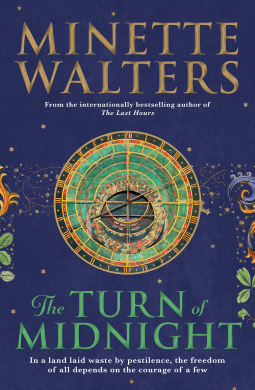
 This is the sequel to The Last Hours, which followed the fortunes of a group of people during the Black Death which reached England in 1348. When I finished the first novel last year, I wasn’t sure whether I had liked it enough to want to read any more, but in the end I couldn’t resist finding out how the story would conclude.
The Turn of Midnight picks up where The Last Hours left off, with the people of Develish in Dorsetshire living in quarantine while the plague rages across the land. The reason their community has survived largely intact while others around them have been wiped out is because of the precautions taken by Lady Anne, who gathered her people within the moat that surrounds her manor house and burned the bridges, cutting them off from contact with the outside world. Now that winter has come and food supplies are running low, Lady Anne’s loyal serf Thaddeus Thurkell, accompanied by several other young men from Develish, has crossed the moat and ventured into the countryside to see what he can find.
Despite the strong leadership skills of Lady Anne and the intelligence and courage of Thaddeus, Develish has no lord, Lady Anne’s husband Sir Richard having succumbed to the plague early in the previous novel. This has left the demesne in a vulnerable position, so together Thaddeus and Lady Anne come up with a plan to protect the people of Develish…but if they fail Thaddeus could find himself in serious danger.
I’m glad I decided to read this book because I enjoyed it quite a bit more than The Last Hours. It feels faster paced, with more going on, and of course, being the second of a pair of two novels, it has a much more satisfying ending. Where the previous novel was set mainly in and around the manor of Develish, this one has a wider scope, concentrating less on Lady Anne and her family and more on Thaddeus. Towards the end of The Last Hours I felt that Thaddeus and his companions were wandering aimlessly in the countryside without much happening, but this time they have adventure after adventure as they explore desolate towns and villages, make new friends and new enemies, and carry out charades and deceptions.
My main criticism of this book is that I still couldn’t really believe in either Thaddeus or Lady Anne as realistic 14th century characters. As I mentioned in my review of The Last Hours, I found their attitudes and thought processes far too modern and wasn’t at all convinced that they, unlike the rest of the population, could have had such an accurate understanding of how the Black Death was spread and how to protect themselves from it. I was also disappointed that Lady Anne’s stepdaughter, Lady Eleanor, is reduced to such a minor role in this book. Eleanor was very much the villain of the previous novel, but near the end some reasons were given for her terrible behaviour and there were hints that she might have been about to turn a corner. She is certainly much more likeable in this second book, but sadly the transformation of her character is not explored in any depth which I thought was a wasted opportunity.
This is such an interesting period of history to read about, though, and I did find the portrayal of a country devastated by plague vivid and convincing, even if the characters were not. Minette Walters is much better known as a crime author and has moved into new territory with these two novels; I’ll be curious to see whether she writes any more historical fiction in the future.
Thanks to Allen & Unwin for providing a copy of this book for review via NetGalley.






 She Reads Novels