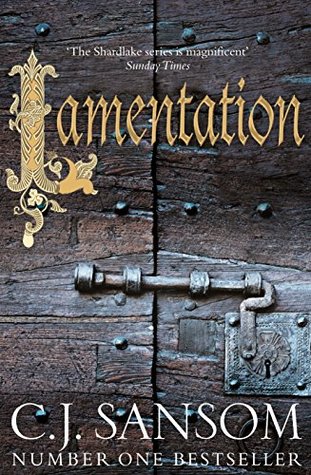
Lamentation by CJ Sansom

When I heard the exciting news that there was a new Shardlake novel – Tombland – coming in October, I remembered that I still needed to read Lamentation, the sixth book in the series, so I put it on my 20 Books of Summer list to ensure that I would read it sooner rather than later and be up to date in time for the new one.

Lamentation is set in London in 1546, about a year after the previous novel, Heartstone, ended. Henry VIII is in poor health and although it is treason to predict the death of a king, it is obvious to everyone who sees him that he can’t have much longer to live. Having broken away from the Roman Catholic Church several years earlier, it now seems that Henry is slowly moving England back towards Rome. A power struggle is taking place at court between the religious traditionalists and the reformers, while those suspected of heresy are being hunted down, tortured and burned at the stake. Even the Queen herself – Henry’s sixth wife, Catherine Parr – is not above suspicion, and when a book she has written on the subject of her faith, titled The Lamentation of a Sinner, is stolen, she knows her life could be at risk.

Our narrator, the lawyer Matthew Shardlake, has worked for the Queen before, and it is to Shardlake that she turns again to ask for assistance in finding the missing book. Despite having vowed to stay out of politics following the events of Heartstone, Matthew can’t resist a request from his Queen, but when the first page of the manuscript is found clutched in the hand of a murdered printer, the danger involved in the mission becomes clear.

I’ve enjoyed all of the Shardlake novels, but I think this is one of the best in the series. It’s a long book, with over six hundred pages, but at no point does it ever start to feel slow or repetitive. The plot is complex and does require some concentration – it’s important to try to remember the religious and political backgrounds of various characters and which are allies and which are rivals, especially as various groups of suspects begin to emerge – but in my case I was so absorbed in the story my concentration never wavered for a moment anyway. I always find Sansom’s portrayal of Tudor England very immersive; he manages to make the history of the period easy to understand, but without simplifying things too much, and shows us how the decisions made by those in power affect the lives of ordinary people who are just trying to survive from day to day.

As well as the search for Catherine’s stolen book, there is also a secondary mystery taking place in which Shardlake is representing a client who is locked in a feud with her brother over the wording of their mother’s will. Most of the Shardlake novels have multiple storylines and sometimes they feel a bit unconnected, but everything in this book comes together very effectively. The two feuding siblings are on opposite sides of the religious divide and this eventually has implications for Matthew.

Of course, Matthew doesn’t have to deal with all of this alone. His friend and legal assistant, Jack Barak, is there for him as usual and always ready for an adventure – although with Jack’s wife expecting another baby, Matthew is reluctant to let him get involved. He also has a new assistant – Nicholas Overton, a young man who has been sent to London to study law – and over the course of the novel he comes to value Nicholas’s courage and loyalty. Another old friend, the doctor and former monk, Guy, is back too, but their friendship is put under strain by Guy’s disapproval of Matthew’s mission and the very different religious views they each have. Nobody, including Shardlake, ever comes out of a Shardlake novel entirely unscathed and this is why, although it would be possible to treat the books as standalones, I still recommend reading the series in order. That way, you’ll be able to watch the characters develop and see how the things that happen in one book affect their lives in the next.

By the end of this book Henry VIII is dead, to be succeeded by his son, the young Edward VI. The change of monarch – and the consequences this will have for the country – is sure to bring new challenges for Shardlake but we will have to wait for the publication of Tombland to find out what they are.

This is book 11/20 of my 20 Books of Summer.

Historical Musings #41: Reading Georgette Heyer

Welcome to my monthly post on all things historical fiction!

The author I have chosen to feature this month is one who, I’m sure, has the widest appeal of any I have written about so far in this series of posts. I know there are plenty of readers who don’t usually read other types of historical fiction but love her Regency and Georgian romances, which are so distinctive they belong in a sub-genre of their own. She is, of course, Georgette Heyer.

Heyer was born in London in 1902 and died in 1974, having published over fifty novels, including the romances I’ve already mentioned, six straight historical novels, four contemporary novels and twelve detective stories. I only started reading Heyer relatively recently (in 2010) so I haven’t read all of her books, or even most of them; I know there will be people reading this post who have read – and re-read – a lot more of them than I have, so I certainly don’t claim to be an expert on her work. However, I have read enough to be able to say that, whichever Heyer novel you pick up (of the Regency/Georgian ones, anyway), you can expect historical accuracy, witty, sparkling dialogue, engaging characters and an entertaining plot.

Here are the Heyer books I have read so far, with links to my reviews:

Romances

The Black Moth
Powder and Patch
The Masqueraders
The Convenient Marriage
Regency Buck
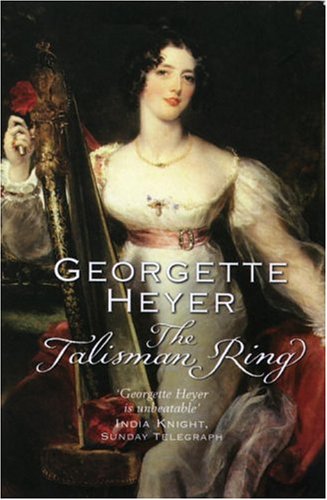
The Talisman Ring
The Corinthian
Friday’s Child
The Quiet Gentleman
April Lady
Snowdrift and Other Stories
Black Sheep
Cousin Kate
Charity Girl
Faro’s Daughter – review coming soon

Mysteries

Footsteps in the Dark
Envious Casca
Duplicate Death

If you’ve never read Heyer before, you may be wondering which of her books would be a good one to start with. Well, the first one I read was The Talisman Ring, and although I’ve read others since that I enjoyed more, it was obviously a very successful starting point for me! I also loved The Quiet Gentleman for the sense of mystery, The Masqueraders and The Corinthian for the adventure, The Convenient Marriage for the humour and Black Sheep for the hero and heroine! Really, I would recommend any that I’ve read, apart from maybe Powder and Patch.

You can find out more about Heyer and her work at Georgette-Heyer.com.

I will be looking at more historical fiction authors in future posts, but for now I would like to hear your thoughts on Georgette Heyer.

Have you read any of her books? Which are your favourites – and which would you recommend to readers who are new to her work?

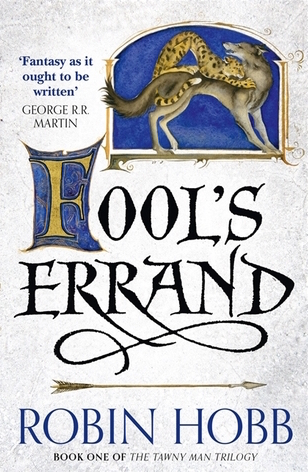
Fool’s Errand by Robin Hobb

As regular readers of my blog will know, it’s not very often that I read fantasy, yet Robin Hobb’s books have been some of my favourite reads of the last few years. In 2014 I discovered the Farseer Trilogy and then, last year, I moved on to her second trilogy, the Liveship Traders – set in the same world, the Realm of the Elderlings, but in a different part of that world and with different characters and storylines. Fool’s Errand is the first book in yet another trilogy – The Tawny Man – which leaves the liveships behind and returns to the story of FitzChivalry Farseer.

If you haven’t read the Farseer trilogy yet, you really need to do so before starting Fool’s Errand. It’s important to understand Fitz’s background, his relationships with other characters, and the magic and history of the world he inhabits, otherwise I think you’ll be very confused!

Anyway, Fool’s Errand begins fifteen years after the events of Assassin’s Quest, with Fitz living in a remote cottage in the countryside, far away from his former home in Buckkeep, having made the decision to stay out of the politics and intrigues which continue to surround the Farseer family. He has taken the name Tom Badgerlock and is leading a quiet life with his adopted son, Hap, and his wolf Nighteyes, with whom he shares a special bond, as his only companions. Then, unexpectedly, he receives a visit from Chade, his old mentor and instructor in the art of assassination. Chade tries, but fails, to persuade Fitz to return to Buckkeep to teach the magic known as the Skill to the young Prince Dutiful.

This visit is closely followed by another: this time from the Fool, who has matured from the pale boy of fifteen years ago into an elegant young man with golden hair and skin. The two quickly settle back into their old friendship, but even the Fool is unable to convince Fitz to come back with him to Buckkeep. It is only when Fitz receives shocking news regarding Prince Dutiful that he agrees to return to court and offer his assistance. The Prince has disappeared, just days before his betrothal ceremony, and Chade believes that Fitz is the only person who can find him. Did Dutiful run away or was he kidnapped? Could he have become the target of a carefully planned plot? And how is all of this connected with the little hunting-cat the Prince received recently as a gift?

Although I did enjoy the three Liveship Traders novels I read last year, it was wonderful to be reacquainted with Fitz and the other Farseer characters again. I don’t regret having taken the time to read the Liveship Traders, as it means I picked up on a few things in Fool’s Errand – such as the name of the Fool’s horse and a visit to a certain island – which wouldn’t have meant much to me otherwise, but I definitely prefer the world of the Six Duchies. I think this particular novel might even by my favourite by Robin Hobb so far. It feels more tightly plotted than any of the others, with the focus on one mission – to find Prince Dutiful and return him to Buckkeep – and with a slightly smaller cast of characters too, concentrating mainly on the very close relationships Fitz has with the Fool and with Nighteyes. It’s also a very moving book, with one particular scene that made me cry – even though I’d known from the beginning that it was going to happen sooner or later, I still wasn’t prepared for it!

Now that I’ve remembered how much I love reading about Fitz and his friends, I’m sure it won’t be long before I pick up the second book in the trilogy, The Golden Fool.

This is book 10/20 of my 20 Books of Summer.

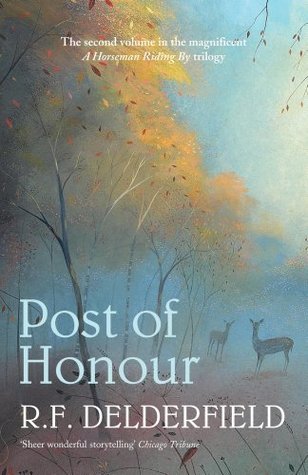
Post of Honour by RF Delderfield

Post of Honour is the second book in RF Delderfield’s A Horseman Riding By trilogy which begins with Long Summer Day, one of my favourite reads of last year. For me, this second novel is not as good as the first, but still very readable.

As this book and the first one were originally published in 1966 as one very long volume, Post of Honour picks up the story just after Long Summer Day ends in 1911, dropping us straight back into the daily lives of the people of the Sorrel Valley. A few years go by with small dramas taking place – weddings, funerals, births, deaths, new friendships being formed and new romances beginning to blossom. And then, in 1914, war breaks out in Europe and life in the Valley will never be the same again.

Although I had allowed a whole year to pass between finishing the first book and picking up this one, I found that I had no problem remembering the characters and storylines. It was lovely to be reacquainted with old friends like the former street-urchin Ikey Palfrey, the wild, untameable Hazel Potter, suffragette Grace Lovell and, of course, our hero Paul Craddock, the squire of Shallowford. The first part of the book is devoted to the First World War, showing us how these characters and many others are affected, either directly or indirectly. One of the Valley men becomes a conscientious objector while others fight in the trenches and those left at home wait for news of their loved ones. It would be unrealistic for all of our much-loved characters to return from war unscathed – so, inevitably, there are some deaths and the next section of the novel looks at how the inhabitants of Shallowford and the Sorrel Valley recover from their losses and try to move on over the next two decades.

This book covers a much longer time span than the previous one and this, in addition to the number of deaths during the wartime chapters, means the introduction of lots of new characters from the second and third generations. One of the things I remember loving about Long Summer Day was the way Delderfield brought each character, even the minor ones, fully to life. However, I don’t think he does that quite as successfully in Post of Honour and I felt that many of the new characters were little more than names on the page. With the exceptions of two of Paul’s children – Simon and Mary – and Ikey’s son, the strangely named Rumble Patrick, I simply wasn’t very interested in any of the others.

By the end of the book, another world war has begun, and I do want to see how Paul and his friends and family will fare. I will be reading the third book in the trilogy, The Green Gauntlet, but after that I’m looking forward to leaving the Sorrel Valley behind and trying some of Delderfield’s other novels – probably beginning with the one I already have on my shelf, Farewell the Tranquil Mind.

This is book 9/20 of my 20 Books of Summer.

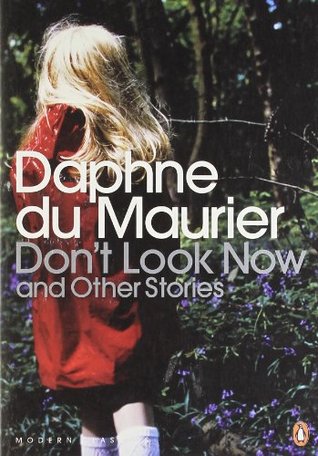
Don’t Look Now and Other Stories by Daphne du Maurier

Daphne du Maurier is one of my favourite authors and I now only have one of her novels left to read (Castle Dor, which was partly written by Arthur Quiller-Couch). However, I also still need to read several of her short story collections, having previously only read The Birds and The Rendezvous, so I decided to put this one, Don’t Look Now and Other Stories on my 20 Books of Summer list.

This particular collection is from 1971 and has been published as both Don’t Look Now and Not After Midnight. It contains five stories which are all about fifty or sixty pages long – the perfect length, in my opinion, as it means they are long enough to allow for some development of characters and plot, while still being short enough to read in one or two sittings.

The title story, the dark and atmospheric Don’t Look Now, is a strong opening to the book. John and his wife Laura are on holiday in Venice following the recent death of their young daughter, Christine. John has been doing his best to move on, but Laura is still grieving and, when they meet a pair of elderly twin sisters in a restaurant one evening, it comforts her to be told that one of the twins, who claims to be psychic, can ‘see’ Christine sitting beside her parents. When more strange occurrences follow – including the sighting of a little girl in a red hood jumping over the boats moored in a canal – it seems that something sinister is going on. Could he and Laura be in danger? This is a great story, and if you haven’t read it perhaps you have seen the 1973 film with Julie Christie and Donald Sutherland?

Not After Midnight comes next and is another good one. Our narrator, schoolmaster and artist Timothy Grey, is visiting Crete where he hopes to find some inspiration for his paintings. Staying in a little chalet in a picturesque resort by the sea, Timothy is enjoying the peace and quiet – until he encounters an American couple, the Stolls, who are staying in one of the nearby chalets. The couple invite him to visit them in their chalet – as long as it’s ‘not after midnight’ – but Timothy feels uneasy. Why do the Stolls spend so much time out at sea, supposedly fishing? And what really happened to the last occupant of Timothy’s chalet? This is another dark and suspenseful story and I really enjoyed it – until I reached the ending, which I’ll confess to not really understanding at all.

I think the middle story, A Border-Line Case, was my favourite. A nineteen-year-old actress, Shelagh Money, has just lost her beloved father and heads to Ireland to track down his old friend, Nick. The two men had lost contact years earlier after Nick was injured in a car accident and became a recluse, living on an island in the middle of an Irish lough. On her arrival at Nick’s island home, Shelagh begins to feel uneasy and decides not to admit who she is or why she is there…but Nick is hiding a secret of his own – and not the sort of secret either I or Shelagh was expecting. Although I didn’t see that particular twist coming, there is another twist at the end which I found much more predictable, but I still found this the most enjoyable of the five stories.

I didn’t like The Way of the Cross quite as much as the first three stories. It’s about a group of people from the same little village who are on a tour of Jersualem, led by the Rev. Edward Babcock. Babcock has stepped in at the last minute to replace another vicar who has fallen ill, and he doesn’t know – or particularly like – any of the people in the group. They include a retired colonel and his self-obsessed wife, a young newly married couple, a wealthy middle-aged couple, an elderly spinster, and a precocious nine-year-old boy who is enjoying showing off his knowledge of the historical and religious sites they are visiting. Unlike the previous stories, there is nothing dark, supernatural or shocking about this one – the focus is on the tourists and the discoveries they make about themselves and their companions.

The last story, The Breakthrough, was my least favourite in the book. It’s a science fiction story which explores some of the ethical questions surrounding scientific progress and whether there should be a limit to how far it should go. The narrator, Stephen Saunders, is a scientist who has been transferred to a research facility in rural England where the eccentric Mac and his assistants are working on an experiment so controversial it must be kept completely secret. This is a disturbing story with the sort of unsettling atmosphere du Maurier is so good at creating. It wasn’t entirely to my taste, as I’m not much of a science fiction fan, but it is still an interesting story to bring the collection to an end.

Five very different stories with very different settings. I enjoyed reading all of them, some more than others, and I’m looking forward to reading the other du Maurier short story collections on my TBR: The Doll and The Breaking Point.

This is book 8/20 of my 20 Books of Summer.

It is also book 7/50 from my second Classics Club list.

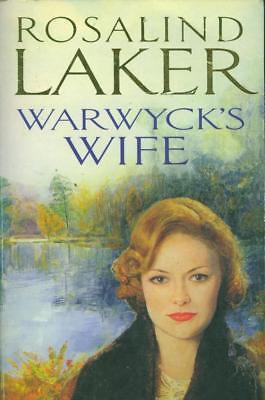
Rosalind Laker: Warwyck’s Wife and Claudine’s Daughter

At the beginning of Thomas Hardy’s The Mayor of Casterbridge, Michael Henchard sells his wife at an auction, an impulsive act which he later regrets and which haunts him for the rest of his life. This horribly cruel and barbaric custom really did take place in England between the 17th and 19th centuries. Rosalind Laker’s 1978 novel Warwyck’s Wife – the first in a trilogy – opens with a similar scene in which a farmer puts his unwanted wife Kate up for auction at a market in Brighton, parading her in front of the crowd with a halter round her neck like an animal.

Among the men who decide to bid for Kate are nineteen-year-old Harry Warwyck and his older brother Daniel. Harry has the best of motives – he has fallen in love at first sight and wants to prevent Kate from being bought by someone who will treat her badly – but Daniel has seen an opportunity to obtain the wife he needs in order to claim his inheritance, Warwyck Manor. To Harry’s disappointment, it is Daniel who is successful…but will he be happy with his new purchase? It’s not the most pleasant or uplifting start to a novel, but Rosalind Laker does a good job of conveying the shame and degradation Kate feels because of her husband’s actions combined with relief at being released from her unhappy marriage and given the chance to start a new life.

Warwyck’s Wife is described as a romance, but there’s certainly nothing very romantic, in my opinion, about the relationship between Daniel and Kate. Daniel makes it clear at the beginning that he wants Kate only because he believes she can be useful to him, and although his feelings for her do begin to change, he is too obsessed with another woman – Claudine Clayton – to appreciate what he has in Kate. Daniel is a thoroughly unlikeable character, actually: he uses and discards Kate as it suits him; he hides the truth from Claudine; and the way he behaves towards Harry is hardly very brotherly either. Not my idea of a romantic hero – not that every book really needs a hero, of course. Kate, on the other hand, is a lovely person, although her devotion to the undeserving Daniel really frustrated me and I couldn’t understand how she could possibly have preferred him to Harry!

Luckily, there is a lot more to this novel than the ‘romance’. Another major part of the plot involves Daniel’s career as a boxer and his ambition to become a champion prize-fighter. The novel is set in 1826, during the reign of George IV, and although I have no interest in boxing in its modern form, I did find it interesting to read about Daniel’s preparation for his fights (or ‘mills’ as they were called), the hours of practice he puts in with his trainer, Jem Pierce, and the spectacle of the mills themselves, which attracted large crowds and were sometimes held illegally, at risk of being stopped by the local magistrate. It seemed a much more violent and chaotic sport than its modern equivalent too, unsurprisingly with little regard for the health and safety of the participants.

There is also a storyline involving Daniel’s plans to develop the little coastal village of Easthampton into a seaside resort similar to Brighton. As you can imagine, this causes a lot of conflict as the scheme meets support from some of the villagers but fierce opposition from others as new workers are brought in to carry out the construction work while existing businesses find themselves under threat. This subplot gives the author a chance to highlight social injustices and the difference in attitude between Kate and Daniel, as Kate does everything she can to improve the working conditions of the builders, masons and labourers while Daniel cares only about money and productivity.

Warwyck’s Wife is not a perfect novel but I found more to like than to dislike and went straight on to read the sequel, Claudine’s Daughter.

~

Claudine’s Daughter begins about twenty years after the previous book ends and introduces us to Lucy di Castelloni, Claudine Clayton’s daughter. Lucy has lived in Italy all her life and was married off at an early age to a much older man. Now, following her husband’s death, she has decided to come to England to see where her parents grew up and to find out whatever she can about her family and her origins. Arriving in the town of Easthampton, she quickly catches the eye of three very different men. The first is Richard Warwyck, Daniel’s son; the second is Timothy Attwood, who is distantly related to Lucy’s family; and the third is Josh Barton, who has ambitious plans that could affect the future of everyone in Easthampton.

Although this is very much the story of Lucy and the other ‘second generation’ characters, some of the characters from Warwyck’s Wife appear again too, including Daniel, Kate, and (very briefly) Harry. There’s also a new set of secondary characters: Emmie, the landlady of the house where Lucy takes lodgings; her daughter Meg; and Meg’s lover, a local fisherman. Lucy’s romantic entanglements form a large part of the novel but, like the first book, it is more than just a romance. It’s also a story about the uncovering of family secrets – and while the reader already knows what these secrets are (assuming we have read the first book in the trilogy), Lucy and most of the other characters do not. This means the plot is quite predictable, but the interest is in waiting to see how and when the truth will be revealed.

The most interesting aspect of the book, for me, was seeing how Easthampton, which was only a small village in Warwyck’s Wife, has grown into a thriving resort with piers, pavilions, hotels and theatres. A source of conflict throughout the novel is the question of whether or not the town should be connected to the railway network. Richard Warwyck is in favour as it will allow the area to develop further, but Daniel (whom I still found impossible to warm to) doesn’t like the idea of opening up access to the resort to large numbers of working class people and destroying the select atmosphere.

There is a third novel about the family – The Warwycks of Easthampton – but I don’t own a copy of that one yet and I think I’ve read enough about the Warwycks for now. Maybe I will read it at some point, but there are other books by Rosalind Laker that sound more appealing to me at the moment.

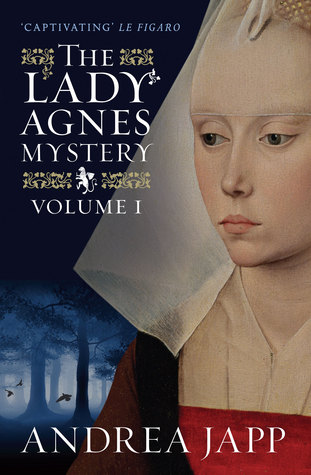
The Lady Agnès Mystery Volume 1 by Andrea Japp – #WITMonth

I hadn’t made any plans for taking part in Women in Translation Month, but when I came across this book which had almost disappeared into the black hole of my Kindle, I decided to join in. Andrea Japp is a French crime novelist and this, the first volume of her Lady Agnès Mystery (originally published in 2006), has been translated into English by Lorenza Garcia. Japp herself is also a translator and produced the French translations of Patricia Cornwell’s Kay Scarpetta novels, which I think makes her a perfect choice for Women in Translation.

There are actually two books included in this volume – The Season of the Beast and The Breath of the Rose – but they do not stand alone and although they can be bought separately, there is not much point in reading one without the other. Together, the two books tell the story of Lady Agnès de Souarcy, a young widow living in 14th century France with her eleven-year-old daughter Mathilde and ten-year-old Clément, a servant’s child whom she has raised as her own son. Left with only a small dowry to live on, Agnès is struggling financially and reliant on the support of her half-brother, Eudes de Larnay. Unfortunately she and Eudes have always had a difficult relationship and when Inquisitors arrive in the area to hunt down heretics, Eudes sees this as the perfect opportunity to rid himself of his troublesome sister.

Agnès may have some powerful enemies but, unknown to her, she also has some powerful friends who are prepared to do everything they can to protect her from the horrors of the Inquisition. But is there any connection with the murders that have been carried out on Agnès’s land – dead bodies which have been discovered with the letter A marked on the ground beside them – and with the poisoning of several nuns at nearby Clairets Abbey? It seems that all of these things must be linked..but how?

The Lady Agnès Mystery is a book with many layers. First, there’s the richness of the historical setting. Set in the Perche region of France in 1304, the story takes places at a time of religious conflict and of power struggles between King Philip IV the Fair, his various advisers and their rivals, and the two religious orders, the Knights Templar and the Knights Hospitaller. We meet characters who belong to each of these groups and are given a range of different views and perspectives. It’s exactly the same period of history as I’ve previously read about in Maurice Druon’s Accursed Kings series and I loved revisiting it here. If you’re not familiar with this period, though, it shouldn’t be a problem; everything you need to know to understand the story is clearly explained in the text – and if you do want to know more, there are several appendices at the back of the book which provide definitions, explanations and brief biographies of historical figures.

This is not a dry, heavy read, though. There’s always something happening – a clandestine meeting in a dark tavern, a coded message being deciphered or a hidden room being explored, not to mention the vivid scenes depicting Agnès’s ordeals at the hands of the Inquisitors. My favourite aspect of the book was the mystery surrounding the deaths of the nuns…I particularly enjoyed watching the apothecary nun Sister Annelette using her knowledge of plants and herbs to try to catch the murderer.

So far so good. However, there is another storyline involving the Knights Templar, a secret prophecy and a missing manuscript which didn’t really interest me at all. I thought there was already enough going on with Agnès’s personal story and the murder mystery…and I’m sure I’m not the only one who finds it difficult to read this sort of storyline without making comparisons with The Da Vinci Code.

Volume 1 ends, not on a cliffhanger exactly, but with some of the many plot threads still unresolved. I would like to know what happens next to Lady Agnès and her family, and I would love to see more of the nuns of Clairets Abbey, but I have a feeling Volume 2 will be dominated by the prophecy storyline. Will I read it? At the moment I don’t think so, but I could change my mind.