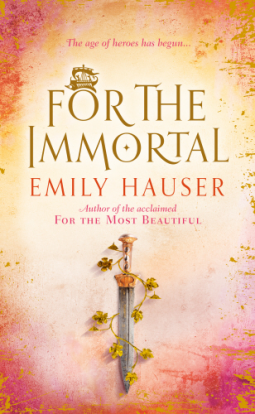
For the Immortal by Emily Hauser

This is the third book in Emily Hauser’s Golden Apple trilogy, which gives a voice to some of the women from Greek mythology. The three books are connected but also work as standalone stories so it is not essential to read them in order. Having enjoyed the first two novels, For the Most Beautiful (the story of Briseis and Krisayis during the Trojan War) and For the Winner (about Atalanta, who joined Jason and the Argonauts on their quest for the Golden Fleece), I was pleased to be offered the chance to take part in the blog tour for the third and final novel, For the Immortal.

At the beginning of the novel, we learn that Alexander, the heir of the King of Tiryns, is dying. His sister, Admete, has some knowledge of healing, but her skills alone are not enough to save Alexander; the only possible cure will be found far away in the Garden of the Hesperides. And so Admete persuades her father to let her accompany her friend Alcides on his upcoming journey to the land of the Amazons, where he has been given the task of obtaining the belt of the Amazon queen, Hippolyta – one of twelve labours he must complete if he is to achieve his goal of becoming immortal. Admete hopes that the Amazons will be able to help her find the cure – the golden apple – that she seeks, but she also has another reason of her own for wanting to meet this legendary tribe of female warriors.

For the Immortal is written from the perspectives of both Admete and Hippolyta, alternating between the two. They initially seem like unrelated stories, but after a while they begin to come together very effectively. The two women are very different people, with different backgrounds and ways of life, but they encounter similar obstacles and attitudes as they each try to succeed in a world very much dominated by men. At first I was slightly disappointed by the negative portrayal of the male characters who are central to the novel, but looking back I think it made sense in the context of the story.

As with the first two books in the trilogy, we also spend some time with the gods as they look down on the mortal world, observing, interfering or trying to help, depending on the outcome they are hoping for. I loved this aspect of the book; the conversations between the gods gave me a lot to think about regarding the differences between fate and personal choice, and what it truly means to be immortal.

The novel combines elements of several myths: the Labours of Hercules (you will have guessed that Alcides is another name for Hercules); the story of Hippolyta, Queen of the Amazons; and the adventures of Theseus, who joins Hercules on his voyage. I was fascinated by Emily Hauser’s notes at the end of the book where she explains the choices she made in deciding which myths and characters to include and how to interpret them – I was particularly interested in what she had to say about Hippolyta and her two sisters. Although I only have quite a basic knowledge of Greek mythology, I’m finding that one of the most intriguing things about it is that there are so many different versions of the myths that no two authors or historians will interpret them in exactly the same way.

I really enjoyed this book; it brings the trilogy to a satisfying close and, although I’ve said that you can certainly read it without having read the first two books, I do recommend reading all three. I think my favourite was the middle one, For the Winner, but I liked them all.

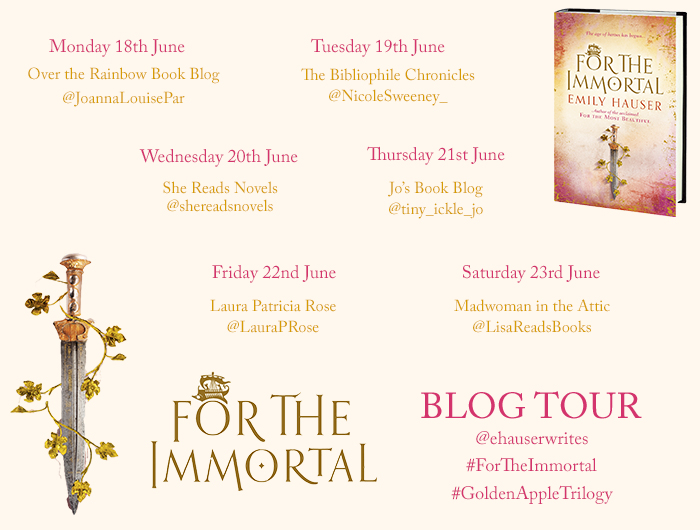
You can find out more about this book by visiting the other stops on the blog tour. Here is the schedule:

Thanks to Transworld for providing a copy of this book for review via NetGalley and for arranging the tour.

This is also book 1/20 from my 20 Books of Summer list.

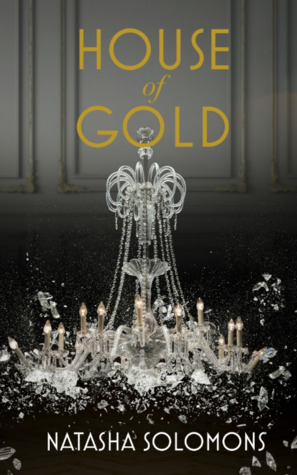
House of Gold by Natasha Solomons

It’s been a long time since I read my first Natasha Solomons book, The Novel in the Viola. Although I enjoyed it, for some inexplicable reason I had never really thought about reading any of her other books until I spotted her new one, House of Gold, which was published in the UK last month. I think it was the simple, elegant cover that caught my attention, at a time when covers in general are becoming increasingly intricate and brightly coloured, but the story sounded appealing too…and it was. I loved it.

House of Gold tells the story of a fictional banking family, the Goldbaums, who are loosely based on the real-life Rothschilds. When we first meet the family in 1911, they are fabulously wealthy and hugely influential, with branches in five European capital cities. In a move intended to strengthen the ties between the Austrian and the British branches, a marriage has been arranged between Greta Goldbaum and her cousin Albert. This is nothing new – Greta has grown up with the knowledge that “the Goldbaum men were bankers, while the Goldbaum women married Goldbaum men and produced Goldbaum children”, but she has no desire to marry Albert and is sure they won’t be compatible. Of course, the wedding must go ahead anyway and Greta is forced to leave her parents’ home in Vienna to start a new life as a married woman in England.

The relationship between Greta and Albert is at the heart of the novel and I enjoyed watching them get to know each other, trying each in their own way to make their marriage work but not always succeeding. It’s not always easy, especially not for Greta, but even when things are at their worst she finds some fulfilment in transforming the gardens of Temple Court, the British Goldbaums’ estate in Hampshire, and as a result of taking on new responsibilities and developing new interests, she is able to grow as a person.

There is much more to the novel than this, though. Within a few short years of Greta’s marriage to Albert, the First World War begins, bringing with it new challenges, new difficulties but also new opportunities. With European governments desperate for money to fund their war efforts, the services of the Goldbaums are as much in demand as ever, but as a Jewish family they find that their position is no longer as secure as it has been in the past. For Greta, there is the additional problem of being stuck in the middle, with different branches of her family on opposite sides of the conflict.

Natasha Solomons takes us right to the centre of the action, with characters such as Greta’s beloved brother Otto and her French cousin Henri becoming directly caught up in the war that is tearing Europe apart. We also learn a lot about the role of money in war; to quote Otto, “Money has no passport and every passport…it has little respect for borders. Money, like water, finds a way.”

There’s so much going on in this novel…so many characters to meet and so many interesting stories to follow. Maybe that’s why, after being completely gripped by the lives and adventures of the Goldbaums, I was slightly disappointed by the unexpectedly abrupt ending and by subplots which seemed to lack a proper resolution. I hope that means Natasha Solomons might be planning a sequel. It would certainly be possible, but if not I will just have to go back and read her earlier novels. I have Mr Rosenblum’s List, The Gallery of Vanished Husbands and The Song Collector to choose from.

After the Sunday Papers #17

“She had read novels while other people perused the Sunday papers” ~ Mary Elizabeth Braddon, The Doctor’s Wife

With several pieces of bookish news to share with you today, I decided it was time to bring back, after a four year absence, my After the Sunday Papers posts, which were always very useful when I had a few book-related things to mention but didn’t need to devote a whole separate post to each of them. I’m not intending to make this a weekly feature again (not that it ever really was) but I will put a post together as and when I feel that I have something to talk about.

First of all, I want to congratulate author Benjamin Myers on winning this year’s Walter Scott Prize for Historical Fiction, which was awarded at the Borders Book Festival last night. As some of you will know, I am currently attempting to work my way through all of the shortlisted titles since 2010, so I have a particular interest in following this prize.

The six books on the 2018 shortlist were:

Jennifer Egan – Manhattan Beach
Jane Harris – Sugar Money [My review]
Paul Lynch – Grace
Patrick McGrath – The Wardrobe Mistress
Rachel Malik – Miss Boston and Miss Hargreaves
Benjamin Myers – The Gallows Pole

I haven’t read The Gallows Pole yet (in fact I haven’t made much progress at all with this year’s list, as you can see) but I’m looking forward to reading it and finding out why it impressed the judges so much.

This is what the book is about:

From his remote moorland home David Hartley assembles a gang of weavers and land workers to embark upon a criminal enterprise that will capsize the economy and become the biggest fraud in British history.They are the Cragg Vale Coiners and their business is clipping – the forging of coins, a treasonous offence punishable by death.

Have you read it? Do you think it is a deserving winner?

~

Last week also saw the launch of this year’s Reader Survey hosted by M.K. Tod, Heather Burch and Patricia Sands. This annual survey used to be specific to historical fiction, but this year it has been expanded to cover all genres. The results, when they are made available, are always interesting to see, so I definitely think it’s worth participating in this survey.

This is what the survey hosts have to say about it:

What do readers want? What constitutes a compelling story? How do men and women differ in their preferences? Where do readers find recommendations? How do readers share their book experiences?

ANNOUNCING A 2018 READER SURVEY designed to solicit input on these topics and others.

Please take the survey and share the link https://www.surveymonkey.com/r/68HL6F2 
with friends and family via email or your favourite social media. Robust participation across age groups, genders, and countries will make this year’s survey – the 4th – even more significant.

The Corinthian by Georgette Heyer

When I posted my review of Friday’s Child a few weeks ago, I mentioned that I had a choice of three Heyer novels to read next and asked for some help in deciding which one to choose. The Corinthian received more recommendations than Faro’s Daughter and An Infamous Army so I knew it would have to be my next Heyer…and what a great choice it was! Published in 1940, it’s one of her earliest Regency novels and although I think she wrote better books, I did find this one thoroughly entertaining and fun to read.

Are you wondering what a Corinthian is? Well, it is defined in the dictionary as “a man about town, especially one who lives luxuriously or, sometimes, dissolutely”. The Corinthian of the title is Sir Richard Wyndham, a twenty-nine-year-old ‘Man of Fashion’ who, at the beginning of the novel, is under pressure from his mother and sister to marry the Honourable Melissa Brandon. Despite their insistence that she will make the ideal wife, Sir Richard knows that Melissa is only interested in his money – a thought which makes him so depressed he goes out and gets drunk (or ‘a trifle disguised’ as Heyer likes to call it).

On his way home, he looks up to see a young man attempting to descend from a window down a rope of knotted bed-sheets. Going to offer his assistance, Richard makes the discovery that the young man is actually a young woman: seventeen-year-old Penelope – or Pen – Creed. Like himself, Pen is being forced into a marriage not of her own choosing and has decided to escape by dressing as a boy and running away to the home of her childhood friend in Somerset. Because he is drunk and because it gives him an excuse to avoid Melissa, Richard finds himself volunteering to accompany her – but he is not prepared for the drama and adventure that awaits them on the journey!

I won’t say too much more about the plot, but you can expect a wonderful blend of comedy, action and mystery as Richard and Pen stumble from one farcical situation to another. Not only do they become entangled with jewel thieves, murderers and Bow Street Runners, they also have several encounters with various members of Pen’s family, as well as Melissa’s brother, the hilarious Cedric. As for Pen and Richard themselves, I found them both very likeable. Richard is sophisticated, bored and cynical, but also kind hearted, intelligent and competent, while Pen may be young and innocent but she’s not lacking in courage and is less silly than some of Heyer’s other very young heroines.

One of the great things about Heyer’s Regency novels is how fully they immerse us in the period. This one is no exception but it does have a different feel from the last Heyer Regency I read, Friday’s Child – that one was set mainly in London, in a whirlwind of masquerade balls, high-stakes card games, visits to the theatre and evenings at Almack’s Assembly Rooms, but this one takes us out of the city, with a lot of time spent on the road travelling towards Somerset. I loved the descriptions of what it was like to undertake a long journey by public stagecoach and the various coaching inns Pen and Richard stayed at along the way.

Having enjoyed this book so much, I am now about to start Faro’s Daughter and hoping it’s going to be another good one!

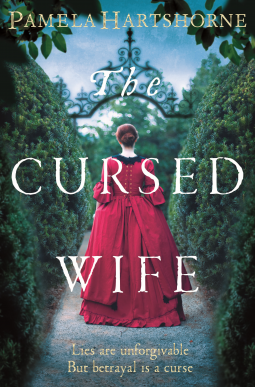
The Cursed Wife by Pamela Hartshorne

Having previously read Pamela Hartshorne’s time-slip novel The Edge of Dark, I found her latest book, The Cursed Wife, both similar and different. Similar in that they both explore the lives of women in Elizabethan England; different because this one is set entirely in the past, with no modern day storyline and no form of time travel.

The Cursed Wife is written from the perspectives of two women, Mary and Cat, who are both friends and rivals. When we first meet Mary in 1590 she appears to be leading a happy and contented life; she is married to the merchant Gabriel Thorne, and lives with him, their children and their servants in a comfortable house in London. Mary is devoted to her family and her household and has almost – but not quite – managed to forget that she was cursed as a child and predicted to die by hanging.

However, Mary’s whole life is built around lies and deception and she knows that if the truth is ever revealed she could lose everything. One rainy day she sets out to do some shopping in Sopers Lane to replenish her stocks of herbs and medicines, and is shocked to see a face from her past – a face she had expected never to see again. It’s Cat, her childhood friend, who was once as close to her as a sister, but who now possesses the secrets that could ruin Mary’s life…

As I’ve said, I found this a very different sort of book from The Edge of Dark; it doesn’t have such an eerie atmosphere and lacks the touches of the supernatural – although Mary does have a very creepy one-armed wooden doll called Peg. Instead the focus is on the relationship between Mary and Cat. It’s a relationship which changes and transforms itself over the years as the roles of the two women in each other’s lives are reversed, but the links between them are seemingly unbreakable and their stories are very closely entwined.

Cat and Mary take turns to narrate in alternating chapters and although their narrative voices are very similar, the author does use a few techniques to distinguish between the two – for example, Cat’s thoughts are often aimed directly at Mary (‘you say this’ and ‘you do that’). Cat is also a more bitter person than Mary, who can often seem quite naive and slow to understand things that are obvious to the reader. Neither woman is very likeable and although Cat is nastier, I can’t really say that my sympathies were with Mary either.

Pamela Hartshorne has written about the Elizabethan period before, not just in The Edge of Dark, but in other novels too, and she obviously knows it well. We are given lots of little details on domestic life in the late 16th century – the food people ate, the clothes they wore, the tasks carried out by servants in the home – and although historical events happening in the wider world have little direct effect on the story, there’s a sense of how precarious life could be in this period when hanging is a punishment for crime and when the most minor of illnesses can result in death. The novel also looks at the roles of women and the expectations that were placed on them regarding marriage.

The Cursed Wife is an interesting read and the storyline was compelling enough to hold my attention until the end, but I did prefer The Edge of Dark and as her earlier books all seem to be time-slip novels like that one I think I’ll have to investigate them at some point.

Thanks to Pan Macmillan for providing a copy of this book for review via NetGalley.

Historical Musings #39: I Spy Historical-Style

Welcome to my monthly post on all things historical fiction. I noticed this I Spy challenge appearing on lots of other blogs a month or two ago and wanted to give it a try, but didn’t get round to it at the time when everyone else was doing it. When I was thinking of a topic for this month’s Historical Musings post I thought it might be fun to put together a historical fiction (and non-fiction) version of the I Spy game which would give me an opportunity to highlight twenty books from my shelves, some of which I’ve read and some that I haven’t.

I’m not sure where this challenge first originated but these are the rules:

Find a book that contains (either on the cover or in the title) an example for each category. You must have a separate book for all 20, get as creative as you want and do it within five minutes!

I decided to ignore the five minutes rule and add a new rule of my own – that all twenty books must be from the historical fiction or non-fiction genres. And here are the results:

1. Food

The Lives of Tudor Women by Elizabeth Norton

I was nearly defeated before I’d even started. I couldn’t find a single historical fiction novel on my shelves with food either on the cover or in the title. Surely, I thought, I would be able to spot an apple or a cake or a plate on a table in the background…but no, nothing. Finally, I discovered some food on the cover of The Lives of Tudor Women by Elizabeth Norton, hence why I had to expand the scope of this challenge to include historical non-fiction as well as fiction! I haven’t read this book yet, but I will think about picking it up next time I’m in a non-fiction mood.

2. Transport

To Lie with Lions by Dorothy Dunnett

This one was also more difficult than I’d expected. I was sure I must have a book with a train on the cover or maybe a plane on a World War II cover, but when I started searching for them I couldn’t find any. There were plenty of pictures of ships, though! To Lie with Lions, set mainly in Scotland and Iceland, is a wonderful book (as are all of Dunnett’s historical novels), but be aware that it is the sixth in her House of Niccolò series and I would strongly recommend beginning with the first.

3. Weapon

The Sunne in Splendour by Sharon Penman

For ‘weapon’ there were a few books with swords on the cover that I could have chosen. I decided to feature The Sunne in Splendour, Penman’s fictional account of the life of Richard III, because it’s another book that I loved and the one that sparked my interest in the Wars of the Roses, which is now one of my favourite periods in English history. The picture on the cover shows, as well as a sword on the ground, what is obviously supposed to be the crown in the hawthorn bush, which is one of the legends surrounding the Battle of Bosworth.

4. Animal

The Fortune Hunter by Daisy Goodwin

I started seeing some overlap between categories at this point. I could have used To Lie with Lions for the animal book, but instead I decided to choose one with a picture of an animal on the cover – in this case, a horse. Horses play an important role in The Fortune Hunter, which tells the story of the 19th century horseman Bay Middleton and his relationships with the heiress Charlotte Baird and the Empress Sisi of Austria.

5. Number

Twenty Years After by Alexandre Dumas

This is the sequel to The Three Musketeers and the ‘twenty years’ in the title refers to the time that has passed between the events of the first book and the second. In this book, d’Artagnan, Athos, Porthos and Aramis become caught up in the conflict between the supporters and opponents of Cardinal Mazarin, are involved in the execution of Charles I in England, and face a new enemy, the sinister Mordaunt. I enjoyed this one as much as The Three Musketeers and went on to read the rest of the series.

6. Something you read

The Story Keeper by Anna Mazzola

You read stories, of course, and the stories in the title of Anna Mazzola’s new novel are folktales from the Isle of Skye which are collected by a young woman who visits the island in 1857. I haven’t read this book yet but it is on my 20 Books of Summer list and I am looking forward to it, having read her first novel, The Unseeing, last year.

7. Body of water

Sea of Poppies by Amitav Ghosh

Another ship on the cover of this book, but also a body of water and the word ‘sea’ in the title. The novel – the first in a trilogy – follows a diverse group of characters who come together on a voyage from India to Mauritius in the 1830s, just before the First Opium War. The second book in the trilogy, River of Smoke, could have been used for this category too and also for the next one…

8. Product of fire

The Fatal Flame by Lyndsay Faye

A surprising number of books to choose from here, with ‘smoke’, ‘ashes’ and even ‘soot’ in the title. I decided on this one because it gives me an opportunity to mention how much I enjoyed Lyndsay Faye’s Timothy Wilde novels, a trilogy of mysteries set in 19th century New York. I particularly loved the relationship between Tim and his brother Valentine. This is the last book, so read The Gods of Gotham and Seven for a Secret first.

9. Royalty

Edwin: High King of Britain by Edoardo Albert

As you might expect, there are many, many historical novels with references to royalty in the title or pictures of royalty on the cover. I simply picked up the first one that caught my eye on my shelf, which happened to be Edoardo Albert’s Edwin: High King of Britain. I loved this book about Edwin, the 7th century King of Northumbria, and the sequel Oswald: Return of the King. There is also now a third book on Oswiu, King of Bernicia, but I haven’t read that one yet.

10. Architecture

Larkswood by Valerie Mendes

I have plenty of books with houses, castles and other architectural structures on the cover too. Again, I just picked up one of the first I came to. Larkswood is the name of an English country house in which family secrets unfold over a period of forty years, taking us up to the beginning of the Second World War. I can’t remember very much about this book, but I know I liked it.

11. Clothing

Fingersmith by Sarah Waters

For ‘clothing’, it was tempting to choose one of the ‘faceless woman in pretty dress’ covers that are used so often by publishers of historical novels, but then I remembered my copy of Fingersmith with its picture of a pair of white gloves. I didn’t love this book quite as much as most people seem to, possibly because the plot reminded me so strongly of a certain Victorian novel, but I did enjoy it, as I have all of Sarah Waters’ books.

12. Family member

Daughter of Siena by Marina Fiorato

Lots of daughter, wife and sister titles – but few, if any, that mention male family members, which could be a discussion for a future Historical Musings post, do you think? Anyway, I haven’t read Daughter of Siena yet. I’ve enjoyed some of Marina Fiorato’s books but had problems with some of her others, so I wonder what I’ll think of this one, set in 18th century Italy.

13. Time of day

The Midnight Rose by Lucinda Riley

Like many of Lucinda Riley’s novels this one is set in two time periods – one historical and the other in the modern day. The historical storyline takes us to India in 1911, where a young girl is befriended by Princess Indira, the daughter of the Maharaja and Maharani of Cooch Behar. I have read most of Lucinda Riley’s books now – I would particularly recommend her Seven Sisters series – and am looking forward to the others.

14. Music

The Long Song by Andrea Levy

I was torn between this book and Songs of Willow Frost by Jamie Ford, but eventually settled on this one. There’s not much of a music connection, apart from the title, though…this is a novel about a girl born as a slave on a Jamaican sugar plantation who lives through the abolition of slavery in the 1830s.

15. Paranormal being

Ghost Light by Joseph O’Connor

This book may have a paranormal being in the title, but it’s not a paranormal story…it’s actually the story of the Irish actress Molly Allgood and her relationship with the playwright John Millington Synge. I’ve forgotten the plot but I remember the beautiful writing – and the unusual second person narration.

16. Occupation

Gutenberg’s Apprentice by Alix Christie

Peter Schoeffer, the protagonist of this novel, is originally a scribe but his father has other plans for him and arranges for him to become apprenticed to Johann Gutenberg, who is working to produce the first printed copy of the Bible. I remember feeling slightly disappointed with the story and characters, but as a book lover I did enjoy learning about the history of the printed word. The conflict between the new and the traditional is a theme I always find interesting too.

17. Season

The Spring of the Ram by Dorothy Dunnett

After I took my photograph I remembered Drums of Autumn by Diana Gabaldon and The Winter Palace by Eva Stachniak, but by then it was too late and I had already chosen this one. Anyway, it gives me another excuse (not that I needed one) to highlight Dunnett’s House of Niccolò series. This book has one of my favourite settings in the series: Trebizond in 1461.

18. Colour

Red Sky at Night by Jane Aiken Hodge

All book covers have a colour on them, I suppose, so I selected one with a colour in the title for this category instead. I have read a few Jane Aiken Hodge books and enjoyed them but haven’t read this one, set in the Regency period, which I found in a second-hand shop a while ago. I have one of her other novels on my NetGalley shelf, though, so I will really need to read that one first.

19. Celestial body

Shadow of the Moon by MM Kaye

This was the first book that came to mind here. I read it last year as part of a readalong and loved it – not quite as much as Kaye’s The Far Pavilions, but almost! I really like the way she writes about India in both of those books, with such a deep understanding, lack of bias and obvious love for the country. Her mystery novels are great too, but I’m really looking forward to reading her other historical novel, Trade Wind.

20. Something that grows

The Rose of Sebastopol by Katharine McMahon

This book has been on my TBR for a long time now, so I will really have to read it soon. It is set during the Crimean War, which is not a setting I have read very much about. It’s also the second book I have mentioned here which has ‘rose’ in the title – another example of books counting towards more than one category.

~

Well, those are my twenty I Spy books. Have you read any of them?
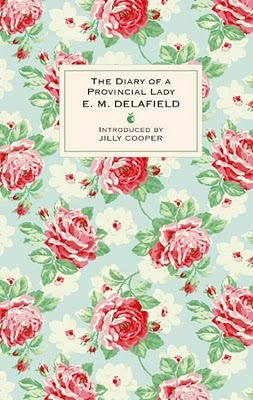
Diary of a Provincial Lady by E M Delafield

Today would have been E M Delafield’s birthday – and she is the next author to be featured in Jane at Beyond Eden Rock’s Birthday Book of Underappreciated Lady Authors. I wasn’t planning to join in with this one but, during last weekend’s Mini Persephone Readathon, having finished Monica Dickens’ The Winds of Heaven, I wanted something else to read and remembered that Diary of a Provincial Lady is also published by Persephone. My copy is not the dove-grey Persephone edition, but I was still pleased to have found a book that would count for both the Readathon and today’s celebrations!

Diary of a Provincial Lady, first published in 1930, is exactly what you would expect from the title: a novel written in the form of the diary of a ‘Provincial Lady’. The Lady, whose name we never learn, lives with her husband Robert in a village in the south of England. Their young son, Robin, is away at school much of the time, but there is also a daughter, Vicky, who is educated at home by Mademoiselle, her French governess. Several more servants, including a temperamental cook and a series of dissatisfied parlourmaids, complete the household.

The Provincial Lady’s days are always busy and varied. As well as being responsible for managing the servants, there are tea parties and garden fetes to attend, dinners to host and visitors to entertain – including the formidable and snobbish Lady Boxe, and Our Vicar’s Wife who, once she arrives, often forgets to leave again! The Provincial Lady records all of these things in her diary over a period of about a year, writing in short, concise sentences interspersed with notes, queries and memos to herself.

I have been putting off reading Diary of a Provincial Lady for a long time, because I wasn’t convinced that it sounded like my sort of book, but I was actually very pleasantly surprised. One of the things that surprised me was how often I found I was able to relate to the Provincial Lady and her problems. In fact, I think a lot of the situations she describes are things that most of us would probably identify with…saying something stupid and then wondering why on earth we said it; pretending we understand what somebody is talking about and then being caught out later in the conversation; agreeing to do something and immediately wishing we hadn’t!

I couldn’t relate to everything, of course. The Lady’s lifestyle is entirely different from my own – I don’t have servants to worry about, for example, and if I found myself in financial trouble my solution wouldn’t be to buy myself some expensive new dresses then go off to the South of France for a holiday. I can appreciate, though, that she belonged to a certain time and a certain class and that her position in society meant that she was expected to behave in a particular way.

I was also surprised by how funny the book was! A sense of humour is often a personal, individual thing and sometimes when someone else says that a book is hilarious I’m disappointed when I don’t find it very funny at all (and I’m sure this probably happens the other way around too). But the Provincial Lady’s observations are so witty and the things that happen to her are so amusing I couldn’t help but laugh.

I am aware that there are more books in the Provincial Lady series. A question to those who have read them – are they as good as this one or is there another E M Delafield book you think I should read instead?