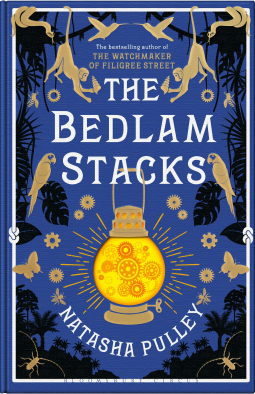
 This is Natasha Pulley’s second novel. I remember seeing lots of very positive reviews of her first, The Watchmaker of Filigree Street, a year or two ago and thinking it sounded interesting. I never got round to reading that book, but when I heard about her new one, The Bedlam Stacks – which sounded just as intriguing – I decided to give it a try.
Set mainly in Peru in 1860, The Bedlam Stacks is narrated by Merrick Tremayne, a former opium smuggler and an expert in botany. Confined to his family estate in Cornwall due to a leg injury, Merrick is trying to come to terms with the fact that he will now have to put his adventuring days behind him and find something else to do with his life. Just as he is beginning to lose hope, his old friend Clem Markham arrives with a request from Merrick’s former employers, the East India Company. To tackle the problem of treating malaria in India, a supply of quinine is urgently needed – and Merrick’s expertise with plants makes him the ideal person to travel with Clem to Peru to take cuttings of the quinine-rich cinchona tree.
At first Merrick is reluctant to agree, knowing that his disability will make it difficult for him to travel through dangerous terrain – not to mention the fact that the Peruvians have a monopoly on the trees and are not about to let anyone else steal them. The alternative, though, is to stay at home and follow his brother’s suggestion of becoming a parson, so it doesn’t take him long to reach a decision! Venturing into the uncharted depths of Peru, Merrick and Clem finally arrive in the holy town of Bedlam, a place where the boundaries between magic and reality begin to merge.
The magical realism elements in The Bedlam Stacks are much more dominant than I had expected. There are moving statues, exploding trees and several other surprises which I will leave you to discover for yourself! This wasn’t really to my taste – I think I would have found it just as enjoyable to read a novel about an expedition to Peru that was based entirely on fact, without the touches of fantasy – but it was certainly imaginative and original. I did love the concept of the Markayuq statues, which apparently really exist and are still found in the countryside in Peru, originally thought to be guarding the villages. Natasha Pulley finds a clever and fascinating way to incorporate these into the story, but again I don’t want to say too much.
The sense of place is very strong – there are some wonderful descriptions of the Peruvian landscape as well as vivid accounts of more practical considerations such as the altitude sickness experienced during the journey – but I was slightly disappointed that there wasn’t a stronger sense of the time period. Neither Merrick’s narrative voice nor the dialogue between the characters felt convincingly Victorian to me; the choice of words and phrases, the grammar and the structure of sentences just weren’t right for the 19th century. I’m aware, though, that I can be a bit pedantic about anachronistic language used in historical novels and I know it’s not something that bothers everyone!
I did find a lot to enjoy in The Bedlam Stacks, although I’m sorry that I couldn’t quite manage to love it. Maybe I’m just not the right reader for Natasha Pulley’s books, but I’m still glad I’ve tried this one – even if not everything worked for me, I can understand the appeal!
Thanks to Bloomsbury Publishing for providing a copy of this book for review via NetGalley.




 She Reads Novels