Having read Kate Atkinson’s two most recent books, Life After Life and A God in Ruins, as well as some of her Jackson Brodie mysteries, I’ve been curious about her earlier novels and was pleased to see this one from 1997 on the library shelf. I knew nothing about this novel before I started to read it and I think that was a good thing because this is a story packed with surprises, plot twists and weird and wonderful occurrences. I have done my best here to give you an idea of what the book is about without giving too much away.
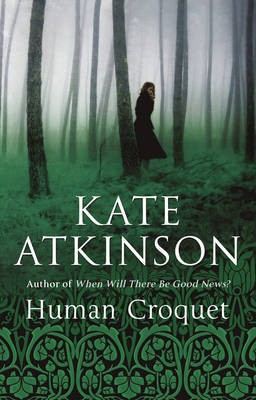 Human Croquet is narrated by sixteen-year-old Isobel Fairfax who lives with her family in a house called Arden in a small town somewhere in the north of England. Isobel’s family consists of her brother, Charles, their Aunt Vinny, and their father Gordon, who has recently returned after a long absence, bringing with him a new wife, Debbie. Gordon’s first wife, Eliza – mother of Isobel and Charles – disappeared years ago, although her presence at Arden can still be felt in small and unexpected ways. Throughout the novel we move between the Present (Isobel’s life in the 1960s) and the Past (in which we learn more about the early days of Gordon’s marriage to Eliza and the events leading up to her disappearance).
Now, this might all sound quite straightforward so far, but I’ve promised some surprises, plot twists and weird and wonderful occurrences – and yes, there are plenty of those! One of the first indications we get that something is not right in Isobel’s world comes when she finds herself suddenly slipping through time, briefly emerging in another period before just as suddenly returning to her own time. Charles, who is obsessed with the paranormal, is envious, telling her she must have experienced a time warp. But this is only the beginning of a series of increasingly bizarre things which happen to Isobel and her family. Things also become darker and darker as Isobel tries to make sense of what is going on and the truth about Eliza is slowly revealed.
Human Croquet is a wonderfully creative and imaginative story in which Atkinson plays with time and with our perceptions of what is real and what is unreal. The novel is rich in literary references and allusions; the name of Isobel’s home, Arden, brings to mind the Forest of Arden in Shakespeare’s As You Like It, and both the Shakespearean theme and the forest/tree symbolism continue throughout the book. Even the title, Human Croquet, has a meaning which only really becomes clear right at the end of the novel and which made me think again about Isobel’s role in the story.
My favourite thing, though, about this – and all of Atkinson’s books – is the characterisation. Isobel’s narrative voice is very strong and distinctive, sometimes funny, sometimes sad, and peppered with witty observations, self-deprecating humour and clever wordplay. Through Isobel’s eyes the rest of the Fairfax family, as well as their friends and neighbours, come to life in vivid detail. Among the most memorable are the people next door, timid Mrs Baxter and her daughter Audrey, both of whom live in fear of the sinister ‘Daddy’. The Fairfaxes are not the only troubled family in Human Croquet; this is definitely not a happy story, so I was pleased to find that there are some lighter moments to alleviate the darkness.
I haven’t read anything by Kate Atkinson yet that hasn’t impressed me; I’m looking forward to reading the rest of her earlier books, as well as Started Early, Took My Dog, the only Jackson Brodie novel I haven’t read yet. What is your favourite Kate Atkinson book?





 She Reads Novels