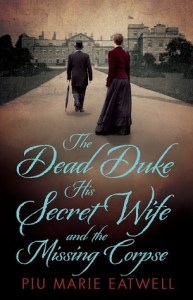
The Dead Duke, His Secret Wife and the Missing Corpse by Piu Marie Eatwell

the dead duke How could I resist reading a book with a title like that? Luckily, the story between the covers proved to be as intriguing as the title; I was completely engrossed in The Dead Duke, His Secret Wife and the Missing Corpse from beginning to end. I don’t often choose to read non-fiction but I’m very glad I decided to read this one!

In The Dead Duke, Piu Marie Eatwell gives a thoroughly researched account of one of the most bizarre legal cases of the Victorian and Edwardian eras. In 1897, Anna Maria Druce approached the courts to request the exhumation of her father-in-law’s grave. She sensationally claimed that her father-in-law, T.C. Druce, was actually the 5th Duke of Portland and had been leading a double life until deciding to kill off his alter ego. Druce had faked his own death, she said, and if his coffin was opened it would be found to be empty. This would leave Anna Maria’s son as the true heir to the Portland fortune.

This was only the beginning of a fascinating legal battle that would continue for years, attracting a huge amount of media attention and capturing the imaginations of the public. Of course, I’m not going to spoil any of the book’s surprises by telling you whether the grave was ever opened or whether Anna Maria’s claims were proved to be true, but along the way some shocking revelations were made and some dark secrets were uncovered!

With tales of secret wives and illegitimate children, fraud and forgery, stolen evidence and unreliable witnesses, lies and deception and double identities, this could have been the storyline of a Wilkie Collins or Mary Elizabeth Braddon novel (and Eatwell does draw some parallels with the lives and works of these authors and others). As a fan of Victorian sensation novels, it’s not surprising that I enjoyed this book so much.

I particularly loved reading about the eccentric lifestyle of the 5th Duke of Portland. Becoming increasingly reclusive in his later years, he rarely went out in daylight and constructed a labyrinth of underground tunnels beneath his estate. He often wore six coats at the same time, had a large collection of wigs and only ate in the mornings and evenings. His alleged alter ego, T.C. Druce, who ran a London department store, was said to have some similar habits, which added some support to the theory that the two men were one and the same.

I was impressed with the huge amount of research the author must have carried out while she was writing this book, drawing on newspaper articles, letters, photographs, census records and other documents to build up a full and balanced picture of the case. Every time a new character is introduced we are given details of their family history, personal background, appearance and personality, all of which helps to bring them to life rather than being just names on the page. Further notes are provided at the back of the book, along with a list of primary and secondary sources.

In the final three chapters, set in 2013, Piu Marie Eatwell describe some of the new evidence she was able to discover during her investigations and her enthusiasm for the subject really shines through here. It must have been a fascinating book to research and it was certainly a fascinating book to read!

Thanks to Midas PR for providing a review copy of this book.

April reading summary

April-clip-Art I read six books in April which is fewer than I usually read, but as two of them were very long books and April was another busy and stressful month for me at work, I’m happy with that! I’m glad May is here because I have lots to look forward to this month: two Bank Holidays (the first one this Monday), my birthday and a trip to Dubrovnik!

Looking back at my April reads, I started the month with The Edge of Dark by Pamela Hartshorne, a time slip novel set in York and telling the stories of two women in two different centuries whose lives are linked by a recently restored Elizabethan building. I loved the combination of history, suspense and the supernatural. While I was reading this I was also dipping into a non-fiction book, The Gothic by Nick Groom, part of the Very Short Introduction series. I particularly enjoyed Groom’s discussion of Gothic literature, but the book also covers many other aspects of Gothic culture.

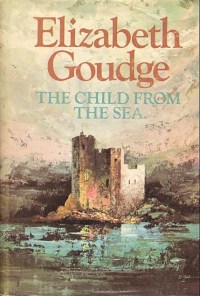
The Eustace Diamonds The two very long books I read in April were both for reading events. The first was The Eustace Diamonds, which I read for Karen’s Anthony Trollope Bicentennial Celebration. I’m slowly working through Trollope’s Palliser novels and this is the third in the series. I did like it but found it quite repetitive and at 800 pages I thought it would never end! The second very long book was my choice for Lory’s Elizabeth Goudge Reading Week: The Child from the Sea, a historical novel based on the life of Charles II’s mistress, Lucy Walter. My first experience of Goudge’s work was a good one and I’m looking forward to trying more of her books.

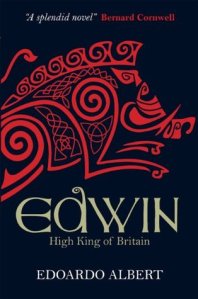
After spending some time in the 17th century with Lucy Walter, I then went back to a much earlier period – to the 7th century, in fact – and met Edwin: High King of Britain. This is the first in a trilogy by Edoardo Albert called Northumbrian Thrones and I found it both a fascinating and an educational read.

The Fatal Flame The final book I read in April – and the only one I haven’t had time to write about yet – was The Fatal Flame, Lyndsay Faye’s third Timothy Wilde mystery novel set in 19th century New York City. I enjoyed it as much as I enjoyed her previous two, The Gods of Gotham and Seven for a Secret, so I was sad to discover that it’s the last in a trilogy (I had been hoping she would go on to write more books in the series).

As we move into May I have three books on the go (I wish I could go back to the days when I only read one book at a time, but that just doesn’t seem possible any more). I’m reading Piu Marie Eatwell’s intriguingly titled The Dead Duke, His Secret Wife And The Missing Corpse, Kate Atkinson’s third Jackson Brodie book, When Will There Be Good News?, and The Invention of Fire, Bruce Holsinger’s second historical mystery novel. As soon as I finish one or two of those I will be starting my book for the Classics Club Spin and I also want to read at least one book for the Once Upon a Time Challenge.

Did you have a good April? What are you hoping to read in May?

Edwin: High King of Britain by Edoardo Albert

Edwin High King of Britain He attempted to unite the warring tribes of Britain under one crown. He converted to Christianity in 627 and many others followed his example. After his death he became a saint. These are some of the achievements of Edwin, the 7th century King of Northumbria, but how many of you, without having read the title of this post, would have known who I was talking about? I always think it’s a shame that so much is written about some historical figures and so little about others, but in this, the first of the Northumbrian Thrones trilogy, Edoardo Albert gives Edwin the attention he deserves.

Edwin: High King of Britain is a fictional account of Edwin’s life. The story begins with Edwin in exile at the court of King Rædwald of East Anglia and follows him as he attempts to regain the throne of Northumbria. With his kingdom secure again, Edwin goes on to conquer several of his neighbouring kingdoms, believing that strength lies in unity. To secure an alliance in the south of the country, he marries Æthelburh, daughter of the King of Kent, but when his new bride heads north accompanied by her two Christian priests, Paulinus and James, Edwin has an important decision to make both for himself and for his people.

This is a fascinating novel and I feel that I’ve learned a lot from it, but it’s also a gripping, entertaining story. My description above might make it sound a bit dry, but it’s really not dry at all. In the first chapter alone, while seeking refuge at King Rædwald’s court, Edwin learns that his Northumbrian rival Æthelfrith has bribed Rædwald to assassinate him, and later that same day he has a moonlight encounter with a mysterious stranger who predicts that he will become a great and powerful king.

In the pages that follow there are battles and duels, feasts and feuds, and lots of political intrigue; there’s always something interesting happening or something new to learn and I was never bored. One very important thread that runs throughout the novel involves the coming of Christianity to Northumbria and the choice Edwin and his people are forced to make between the old pagan gods and the Christian God. This religious conflict is portrayed particularly well through the characters of Paulinus, the Italian missionary, and Coifi, Edwin’s chief pagan priest.

Writing a novel set so far into the distant past means that there is obviously a limit as to how much information is available, but Albert does seem to stick to the known facts as far as possible; his author’s note at the end explains where it was necessary to change things. The main sources he acknowledges are the Anglo-Saxon Chronicle and the Ecclesiastical History of the English People by the Venerable Bede. He also includes some riddles and poetry from the Exeter Book (one of the few remaining works of Anglo-Saxon literature), which I thought was a nice touch.

I have read about this time period only once before, in Nicola Griffith’s beautifully written Hild, but while Hild gives us a female perspective, this is more of a male-dominated story so the two books complement each other very well. It was nice to be able to begin this book with some familiarity with the period, however slight, but I didn’t really need it because the author makes Edwin’s story easy enough to follow even if you have no previous knowledge at all. He also provides a list of characters and a glossary at the front of the book – and a map, which is very useful if you’re not sure where the various kingdoms that make up 7th century Britain are located.

Edwin: High King of Britain is one of the most enjoyable historical fiction novels I’ve read so far this year. I’m now looking forward to reading the sequel, Oswald: Return of the King.

The Child from the Sea by Elizabeth Goudge

The Child from the Sea “To show you Roch would be such happiness,” she said. “I would show you the bay where the seals come, and perhaps they would sing to you, and the Valley of Roses at St Davids, where the stream is so cool. We would stand on the cliffs when the wind was blowing and hear the gulls screaming and the waves roaring all along the coast.”

“You love the sea?”

“I belong to it.”

Elizabeth Goudge is an author I would probably never have thought about trying if it hadn’t been for Lory of The Emerald City Book Review who is hosting a reading week devoted to Goudge’s work this week. Not knowing much about Elizabeth Goudge’s novels, I read the descriptions of some of them and The Child from the Sea sounded the most appealing to me. Although it seems to be out of print at the moment, I was able to borrow a copy from Open Library.

Goudge wrote a mixture of contemporary novels, short stories, children’s books and historical fiction; The Child from the Sea, published in 1970, is one of her historical fiction novels. It tells the story of Lucy Walter, a mistress – and possibly secret wife – of King Charles II and mother of his eldest son, the Duke of Monmouth.

The novel begins in Wales and introduces us to a young Lucy who is growing up at Roch Castle, the home of the Walter family near the Pembrokeshire coast. The story gets off to a slow start, with lots of descriptions of the scenery and countryside, Welsh customs and traditions, and some of the old myths and legends Lucy learns as a child. We also meet some of the people who live in and around Roch Castle: Lucy’s brothers, the handsome, aloof Richard and the loyal, warm-hearted Justus; her beloved nurse Nan-Nan; and Old Parson and his friend, the mysterious Sin Eater.

This first section of the book could probably have been cut a lot shorter without losing anything important, but it does all add to our understanding of who Lucy is and what a 17th century Welsh childhood may have been like. The story really picks up, though, when the action switches to London on the eve of Civil War and Lucy has her first encounter with the young Charles. Fate brings Lucy and Charles together again several years later and they fall in love, marrying secretly, but it’s not long before they are separated once more by the war raging around them.

The rest of the novel is set during Charles’s period of exile in The Hague following the Parliamentarian victory and the execution of his father, Charles I. We follow Lucy as she travels around Europe awaiting the restoration of the monarchy and hoping that one day she will be acknowledged as Charles’s wife.

Lucy Walter is a woman who really existed and really was one of Charles II’s mistresses, but very little is known about her and there doesn’t appear to be any evidence to prove whether or not she and Charles were legally married. Doing some quick research after finishing this book, it seems that the real Lucy is generally considered by historians to be a very different type of character to the gentle, loving woman portrayed in the novel. But even if this is a romanticised version of her life and her relationship with Charles, and even if it isn’t accurate in every detail, I still found it a very moving, emotional story.

Not knowing anything about Lucy before I read this book meant that I was kept in suspense wondering how the story would play out and what her eventual fate would be. I had a feeling this wasn’t going to be a book with a happy ending, and I was right. There were some heartbreaking moments in the final chapters of Lucy’s story and I had tears in my eyes at the end of the book.

I’m pleased that I gave myself plenty of time to finish this book in time for the reading week! The writing is lovely but the pace of the story is very slow and this is not a book you can rush through in a few days. You need to take your time to be able to appreciate the beauty of the writing and the insights the author is giving us into history and life in general. For this reason, and because it is quite a romantic, sentimental story, The Child from the Sea probably isn’t a book I would recommend to everyone. There’s also a spiritual aspect to the book that grows stronger as the story progresses and may not be to every reader’s taste.

I loved The Child from the Sea, though, and am pleased I chose this one as my first Elizabeth Goudge book. I will definitely be reading more!

The Eustace Diamonds by Anthony Trollope

The Eustace Diamonds Today is Anthony Trollope’s 200th birthday! When I saw that Karen of Books and Chocolate was hosting a special Trollope Bicentennial Celebration this month, I knew I wanted to take part and I knew exactly what I would be reading. Having read and enjoyed Trollope’s first two Palliser novels, Can You Forgive Her? and Phineas Finn, it made sense to continue with the third in the series – The Eustace Diamonds.

Unlike Trollope’s other set of six novels, the Chronicles of Barsetshire, which revolve around a cathedral town and the lives of the clergy, the Palliser novels have plots involving politics and featuring the Palliser family – the politician Plantagenet Palliser, his wife Lady Glencora, and his uncle, the Duke of Omnium. In The Eustace Diamonds, though, these three characters are pushed into the background. Our heroine this time (although, as Trollope himself tells us at the beginning of the book, ‘heroine’ is maybe not the right way to describe her) is Lizzie Greystock, who quickly becomes Lady Eustace when she marries the wealthy Sir Florian.

After less than a year of marriage, Sir Florian dies, leaving Lizzie a rich widow in possession of a valuable diamond necklace which she claims her husband had given to her before his death. However, the Eustace family lawyer, Mr Camperdown, insists that the diamonds belong to the Eustace estate and that Lizzie has no legal right to them. The question of the ownership of the necklace forms the central plot of the novel, as the people around Lizzie are forced to take sides. Her cousin Frank vows to support her no matter what, while Lord Fawn, who has recently proposed to her, is horrified by the scandal surrounding his fiancée and searches for a way out of the marriage.

Lizzie is selfish, she tells lies, she manipulates people and situations to her own advantage and her own aunt describes her as “false, dishonest, heartless, cruel, irreligious, ungrateful, mean, ignorant, greedy, and vile”. She is a difficult character to like (and I was sorry that Trollope doesn’t give her more redeeming features) but she is a fascinating character to read about and I loved following the twists and turns of her story.

But The Eustace Diamonds also follows other characters and other storylines. There’s Lucy Morris, a governess in the service of Lord Fawn’s mother, who is love with Lizzie’s cousin, Frank Greystock. Frank, however, is preoccupied with Lizzie and her ordeals, and it seems he is unable to give Lucy the commitment she deserves. And there’s also Lucinda Roanoke, a young woman with strong views of her own on the subject of marriage – views which don’t always agree with those of her aunt, Mrs Carbuncle.

I’m finding it difficult to decide exactly what I thought of The Eustace Diamonds. In some ways I loved it even more than the previous two Pallisers, but in others I found it the weakest of the three. I struggled a little bit with the amount of political detail in Phineas Finn, but in this book there is far less focus on politics. Instead, Trollope concentrates on relationships, on marriage, on the law, and on attitudes towards money, property and reputation. In the middle of the book, the dispute surrounding the jewels begins to go in a more sensational direction, which I did find interesting, but I couldn’t help thinking that this type of plot might have been better suited to an author like Wilkie Collins rather than Trollope.

At 800 pages I did think the book felt too long for the story that was being told. Most of Trollope’s novels are long, of course, but I’m not usually conscious of the length while I’m actually reading; this time I was. Despite being absorbed in the story, I found the plot very repetitive at times and the controversy over the ownership of the diamonds seemed to go round in circles for a while – maybe a result of the novel originally being published as a serial and needing to be drawn out over a long period of time.

I did enjoy The Eustace Diamonds overall, though – and can honestly say I haven’t read a Trollope novel yet that I haven’t enjoyed. Now I’m looking forward to catching up with Phineas Finn again in the fourth Palliser novel, Phineas Redux.

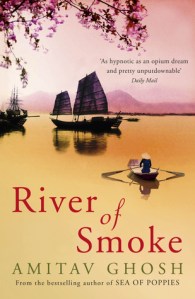
River of Smoke by Amitav Ghosh

River of Smoke This is the second novel in Amitav Ghosh’s Ibis Trilogy. The first, Sea of Poppies, was set just before the First Opium War and introduced us to a group of people who were brought together on a voyage from India to Mauritius aboard a former slaving ship. The book ended on a cliffhanger so I was pleased that I had a copy of River of Smoke to hand and wouldn’t have long to wait to find out how the story continued.

River of Smoke was not quite what I’d expected. It does continue the story, but only for two or three of the characters. The rest of them – even the ones we spent so much time with in Sea of Poppies, such as the Indian widow Deeti and the American sailor Zachary Reid – are barely mentioned in this book. The characters who do reappear are Paulette Lambert, the orphaned daughter of a French botanist, Neel Rattan Halder, the deposed Raja of Raskhali, and his Chinese friend, Ah Fatt.

In one thread of the novel, we follow Paulette as she joins forces with Fitcher Penrose, an Englishman whom she meets in the neglected botanical garden of Pamplemousses. Together, Penrose and Paulette head for Canton where, with the help of Paulette’s childhood friend, the artist Robin Chinnery, they begin a search for the mythical golden camellia.

In a separate storyline which runs parallel with the first (and quickly begins to dominate the novel), we meet Ah Fatt’s father, Bahram Modi, an opium trader from Bombay. Bahram is transporting a large cargo of opium to China and agrees to take Neel with him as his munshi, or secretary. However, when a new commissioner arrives in Canton and the opium trade is banned, Bahram and his fellow merchants face financial ruin.

Like the first novel, River of Smoke provides us with a huge amount of historical and geographical detail. As someone who previously knew almost nothing about the Opium Wars, I now have a much better knowledge of what led to the conflict and the arguments that were used by both sides. Ghosh also brings to life the sights and sounds of Fanqui-town, the Canton settlement which was home to the foreign merchants. Unfortunately one of the devices he uses to do this involves beginning each chapter with a long letter sent by Robin Chinnery to Paulette, and this was one aspect of the book that I didn’t like at all. I had no interest in Robin as a character and it felt that his sole purpose in the novel was to write these letters, giving us pages and pages of exposition that did very little to move the story forward.

I have enjoyed both of the first two books in this trilogy, but I think I liked this one slightly more than the first. I was a bit disappointed when I discovered that River of Smoke wasn’t going to be a direct continuation of Sea of Poppies, but once I had settled into the story, I found it easier to follow because it concentrated on fewer main characters. Paulette and Neel had been two of my favourites from the previous book, anyway, and of the new ones, I found Bahram Modi a particularly well written and complex character. I couldn’t help but have some sympathy for him even though what he was doing was clearly morally wrong.

The final book in the trilogy, Flood of Fire, is due to be published soon and I’m looking forward to reading it. I’m hoping we’ll be able to catch up with the other characters from Sea of Poppies who didn’t feature in this one!

The Goddess and the Thief by Essie Fox

The Goddess and the Thief “A diamond. A curse. An obsession.” These are the words on the front cover of Essie Fox’s third novel and they give us a good idea of the type of story we can expect to find inside. The Goddess and the Thief is a Victorian Gothic novel (like the previous two books by this author – The Somnambulist, which I’ve read, and Elijah’s Mermaid, which I haven’t) and combines a complex plot with an atmospheric setting and a sense of mystery.

The novel begins in colonial India, where a little girl called Alice Willoughby is growing up in the care of her beloved ayah, Mini, having lost her mother in childbirth. Alice loves India – she loves the warmth, the vivid colours, the stories Mini tells of Parvati and Shiva – and is heartbroken when her father decides to take her back to England to live with her Aunt Mercy. Alice is lonely and miserable in her new home and finds Mercy cold and uncaring. Things become even worse when she discovers that her aunt is a medium and that she will be forced to take part in Mercy’s fraudulent séances and other spiritualist activities.

Alice’s life reaches another turning point when she and Mercy meet the mysterious Lucian Tilsbury, a man who has recently returned from India and is planning to involve the two women in an elaborate scheme…a scheme revolving around the Koh-i-Noor diamond, the famous jewel claimed by the British at the end of the Anglo-Sikh war. Some say the diamond is cursed and others that it is blessed, but one thing that is certain is that it exerts a strange power over everyone who comes into contact with it.

You may be thinking that this sounds like The Moonstone, but while there are some similarities with the Wilkie Collins mystery, this is a very different book and the story surrounding the diamond took some surprising twists and turns which I definitely wasn’t expecting! I was particularly intrigued by the occasional appearances of Queen Victoria and the Maharajah Duleep Singh, two people for whom the Koh-i-Noor has a very important significance.

The scenes set in India at the beginning of the book were among my favourites and I was sorry when we left India behind for the gloom of Aunt Mercy’s house in Windsor. The mood of the novel then becomes increasingly dark and oppressive and I was pleased that tales of the Hindu gods and of Alice’s life in Lahore continued to be woven into the plot. I liked Alice as a central character and enjoyed following her adventures, while also feeling afraid and worried for her as she found herself betrayed, badly treated and unsure of whom to trust.

My only problem with The Goddess and the Thief was that there were certain passages which I found confusing and difficult to follow, partly because the use of opium played a role in the story, which meant that the boundaries between reality and unreality often became blurred. I appreciate that this was done intentionally, to make Alice’s situation even more frightening, but it was the one aspect of the novel that didn’t work very well for me. Of course, it could have been my own fault for not concentrating hard enough!

Having enjoyed both this book and The Somnambulist (this one slightly more than the first, I think), I will have to read Elijah’s Mermaid soon!