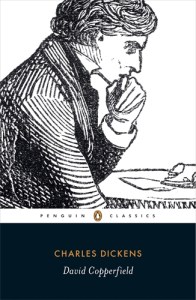
 Since I started blogging I have been trying to read at least one Dickens novel a year – I read A Christmas Carol in 2009, Bleak House in 2010, Our Mutual Friend and The Mystery of Edwin Drood in 2011, Great Expectations in 2012 and A Tale of Two Cities in 2013. Unfortunately I didn’t manage to read any Dickens at all in 2014 so decided to make him a priority this year. With plenty of his books still to choose from, I picked up David Copperfield on the first day of January. It took me most of the month to read it – it’s a long book – and it has taken me almost as long to decide what to say about it!
How do you begin to write about a book like this? The plot is not the sort that you can sum up adequately in a paragraph or two. In fact, there really isn’t a central plot at all, but rather, lots of subplots all circling around the narrator, David Copperfield – or Trotwood, Trot, Daisy or Doady as he is called at various points in the novel…usually anything but David!
At the time of David’s birth, his father has already been dead for six months. Growing up in the small Suffolk town of Blunderstone, his early years are relatively peaceful and uneventful, until his mother marries again and David is sent away to boarding school. As he progresses through school and on into adulthood, a host of fascinating and eccentric characters pass in and out of David’s life. These include:
- Betsey Trotwood, David’s formidable but kind-hearted great-aunt, who never quite recovers from the disappointment of David being a boy instead of the little girl she’d set her heart on.
- Mr Murdstone, David’s cruel and brutal stepfather.
- David’s beloved childhood nurse, Peggotty, her brother Daniel and his nephew and niece, Ham and Little Em’ly.
- James Steerforth, a handsome, charming and manipulative schoolfriend of David’s.
- The villainous ‘humble clerk’, Uriah Heep.
- Wilkins Micawber, with whom David lodges in London, always in debt but never giving up hope that ‘something will turn up’.
- And Dora Spenlow and Agnes Wickfield, two very different young women who enter David’s life.
All of these characters, as well as many others, have an important role to play in David’s story, helping to shape the man he grows up to be.
Of all of Dickens’ novels David Copperfield was apparently the author’s own favourite. In his own words, “like many fond parents, I have in my heart of hearts a favourite child. And his name is David Copperfield.” It’s also supposedly the most autobiographical of his novels – and having read Claire Tomalin’s Charles Dickens: A Life, I can see where he drew on some of his own personal experiences in writing David’s story. Even the style of David Copperfield is autobiographical, with David himself narrating the events of his life, sometimes in retrospect from an unspecified point in the future.
Although, as I’ve explained, the story is made up of a set of complex and closely linked subplots, this is very much a novel that is driven by the characters. As with any book with such a large cast of characters, there were some that I loved (such as Betsey Trotwood and Peggotty), and some I disliked (such as Steerforth and the Murdstones) but all were so well-drawn they seemed to jump out of the pages. The one character I really couldn’t stand, though, was Dora Spenlow! Dickens gets a lot of criticism for his female characters, but Dora is the worst I’ve encountered in any of his books so far: a woman who happily calls herself a ‘silly little thing’ and asks to be thought of as a ‘child-wife’. Thank goodness for Agnes Wickfield – I suppose she could also be criticised for representing the Victorian ideal, but I found her a much more likeable and far less infuriating character than Dora!
David Copperfield, as I mentioned at the start of this post, is a very long book. My edition had more than 900 pages, which seemed quite daunting at first, and I fully expected it to take much longer than a month to read, especially as I like to have one or two other books on the go at the same time. Once I started reading, though, I found it surprisingly addictive and it was actually a much quicker read than I imagined it would be. Of the seven Dickens novels I’ve now read, A Tale of Two Cities is still my favourite, but I think this one ties with Our Mutual Friend for second place.




 She Reads Novels