Songs of Willow Frost by Jamie Ford

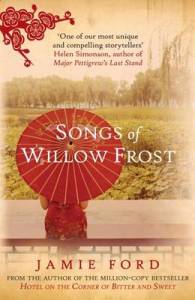
Songs of Willow Frost William Eng has spent the last five years of his life in the care of the nuns at Seattle’s Sacred Heart Orphanage. It’s 1934 and living conditions at the orphanage are very poor, particularly for William who is Chinese-American and considered inferior to most of the other children. But William is not at all sure that he is actually an orphan – although he has never known his father, the last time he saw his mother she was being carried out of their apartment by a doctor, promising that she’d be coming back soon.

On William’s twelfth birthday he and the other boys are taken to see a film as a special treat and William becomes convinced that one of the actresses he sees on the screen, Willow Frost, is his mother. With the help of his best friend, a blind girl called Charlotte, he sets out to find Willow Frost in the hope that she can answer the question that has been troubling him for five years – what can lead a mother to abandon her child?

Having loved Jamie Ford’s previous novel, Hotel on the Corner of Bitter and Sweet, I was looking forward to reading this one. If anything, this book was even more ‘bitter and sweet’ than the first! At times it was so sad that I wasn’t sure if I could bear to continue reading, but even while my heart was breaking for William and his mother it was obvious that they loved each other and that gave me a glimmer of hope. I wanted them to find the happiness they deserved and that was what kept me turning the pages.

Although we begin in 1934 with William in search of Willow Frost, at least half of the novel is actually set several years earlier in 1921 and follows the story of the young Willow – or Liu Song as she was originally known. It was the 1921 section of the story that I found particularly upsetting to read; being Chinese, a woman and unmarried, life is not easy for Liu Song and it seems that every bad thing that could possibly happen to her does happen. While her stepfather, Uncle Leo, is the villain of the book, I was equally furious with the attitude of a social worker who supposedly had William’s best interests at heart but was clearly only concerned with punishing his mother for what she claimed was immoral behaviour.

Despite the overwhelming sadness, I enjoyed Songs of Willow Frost. There are some great descriptions of Seattle in the 1920s and 1930s and we are given some fascinating insights into the city’s Chinese community and the lives of people struggling to survive during the Depression. I didn’t find this book quite as satisfying as Hotel on the Corner of Bitter and Sweet and there were one or two aspects of the plot that didn’t resolve the way I would have liked them to but overall I thought this was a wonderfully poignant and moving story.

Thanks to Lovereading for the review copy

Kingmaker: Winter Pilgrims by Toby Clements

Winter Pilgrims On a cold winter’s morning in 1460, a band of armed horsemen approach the Priory of St Mary near Lincoln. One of the monks, Thomas Everingham, is outside the priory walls that morning, having been sent out to kill a fox that has been caught in a trap, and when he notices that the soldiers are about to attack two nuns (one of whom is Sister Katherine, a young woman who has spent most of her life in the priory) he decides to intervene. In the scuffle that follows, Thomas seriously injures one of the men, who happens to be the son of the nobleman Sir Giles Riven. With the furious Sir Giles seeking revenge, Thomas and Katherine (disguised as a boy called Kit) are forced to flee the priory.

After living for so many years in their isolated religious community, Thomas and Katherine have little knowledge of the world beyond and are surprised to find that England is in the midst of war. Henry VI is still on the throne but is under threat from the Duke of York and Earl of Warwick, whose armies are gathering in Calais in preparation for the next stage of what will become known as the Wars of the Roses.

With the help of pardoner Robert Daud, who leaves them a bag containing a mysterious book, Thomas and Katherine reach Calais and join the company of two of Warwick’s men, Sir John Fakenham and his son, Richard. Here Thomas learns to use a bow and Katherine increases her knowledge of healing, skills they will need when they return to England to face their enemy, Sir Giles Riven, and to play their part in the bloody battles of Northampton and Towton.

Although this book has already received lots of glowing reviews, I’ll admit that I had my doubts about it before I started reading. I thought it might be too similar to Conn Iggulden’s Wars of the Roses novel, Stormbird, which I read last year and struggled with. Luckily, while there were some similarities and I suspect that most people who did love Stormbird will love this book too, I did enjoy this one quite a bit more.

This is one of my favourite historical periods but I never get bored with reading about it; each book I pick up offers something new and adds to my knowledge of the subject. This novel is slightly different from most of the others I’ve read that are set during the Wars of the Roses, because instead of concentrating on the kings and queens, the rich noblemen and powerful battle commanders, the focus here is always on the ordinary people – people like Thomas, Katherine and their friends who have no involvement in politics and decision-making, but are risking their lives for York or for Lancaster.

I was interested to learn that Toby Clements had attended re-enactments and living history camps and even tried using a longbow, all as part of his research for this novel. The research has really paid off because his writing has a feel of authenticity that is sometimes lacking in other books. I could almost imagine that I really was standing in the middle of a muddy battlefield with arrows flying around me, walking through a smelly, bustling market place or watching Katherine performing surgery without the benefits of modern medicine. There’s certainly nothing glamorous about this story!

I only have two minor complaints about the book – and both are entirely a matter of personal taste. First, it is written in present tense which is something I almost always find slightly irritating. It seems to be an increasingly common choice of authors these days and is becoming difficult to avoid, but I still don’t like it and find past tense much easier to read. Clements also devotes more time to the battles (and fights, brawls, archery sessions etc) than I would have liked, but although I didn’t particularly enjoy reading these scenes I can appreciate that they were written very well, especially the Battle of Towton. As I said, though, other readers will not necessarily have a problem with either of these things.

Kingmaker: Winter Pilgrims is the first in a series. At the moment I’m undecided as to whether I want to continue with the second book, but I did end up enjoying this one for the different perspective it offered on a period I love.

I received a copy of this book from the publisher for review via NetGalley

The Summer Queen by Elizabeth Chadwick

The Summer Queen The Summer Queen is the first in a trilogy of novels telling the story of the medieval queen, Eleanor of Aquitaine. Eleanor (or Alienor as she is referred to throughout the book) is a thirteen-year-old girl when the novel begins in 1137. Following the death of her father, the Duke of Aquitaine, Alienor is married to King Louis VII of France. At first the marriage is a happier one than either Alienor or Louis had expected, but as the years go by Louis begins to change and their relationship disintegrates. During a crusade to Jerusalem, Alienor makes an important decision regarding her future and with the young Henry, Duke of Normandy – the future Henry II of England – waiting in the background, the scene is set for the next two books in the trilogy, The Winter Crown and The Autumn Throne.

I have read other novels in which Eleanor of Aquitaine has been a character, but in most books the focus is on her relationship with Henry II and their sons (who included two more future kings, Richard I and King John). This is the first time I’ve read about her early life in so much detail, so I found this book fascinating and informative as well as being an enjoyable read.

As usual, Chadwick’s characters feel like people who really could have lived and breathed during the 12th century, rather than modern day characters dropped into a medieval setting. Alienor herself is shown to be a strong and intelligent woman with ambitions of her own, who really cares about the future of her own lands of Aquitaine and the welfare of the people who live there. She is frustrated by her husband’s lack of leadership skills and reliance on his advisers, particularly when she believes they are advising him to make incorrect decisions.

Alienor (or Eleanor) is not always shown in such a positive light as she is in this book and I liked this version of her character. In her author’s note, Elizabeth Chadwick explains some of the choices she made in writing Alienor’s story, particularly how to tackle the questions of whether Alienor may have had an affair with her uncle Raymond, Prince of Antioch, or with one of her own Aquitaine vassals, Geoffrey de Rancon (Chadwick’s answer is no to the first and yes to the second). She also tells us why she chose to use this particular spelling of Alienor’s name and how she decided what Alienor may have looked like.

I thought the breakdown of Alienor’s marriage to Louis was described in a way that felt realistic and believable. As a second son raised for a career in the church, only becoming heir to the throne after the death of his elder brother, Louis proves to be a weak leader and too easily influenced by the stronger personalities around him, particularly the Templar knight Thierry de Galeran. It was sad to see Alienor watch as the young, attractive husband she had once liked and cared for turned into a grim and humourless man, ready to blame his wife for all of his misfortunes (such as her failure to produce the male heir he so desperately wanted). However, Louis is never quite a villain and it’s possible to have some sympathy for the person he has become.

I also loved the portrayal of Henry, although he only really comes into the story towards the end. Being confident, self-assured and ambitious, he is the opposite of Louis in many ways and I was pleased to see Alienor find some happiness after so many wasted years, even though history tells us that this happiness isn’t going to last forever.

As well as being an entertaining story and providing a huge amount of information on Alienor’s early life, The Summer Queen is also a great introduction to the history and geography of medieval Europe and beyond. The route of Louis and Alienor’s crusade can be followed using a map at the front of the book and takes us through Hungary, Constantinople, Antioch and into Jerusalem encountering some of the most important historical figures of the period along the way.

I loved this book and am looking forward to seeing how Alienor’s story continues in The Winter Crown.

The Convenient Marriage by Georgette Heyer

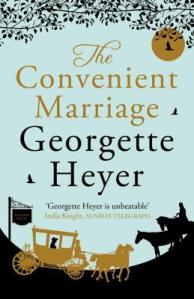
The Convenient Marriage My library has very few Georgette Heyer books and I’ve read most of the titles they do have, so on a recent visit I was delighted to see this one on the shelf – one that I hadn’t read and in such a pretty edition. I think I still prefer the older Arrow covers with the historical portraits, but this one does look very attractive and I’m pleased to say that I thought the story inside lived up to the promise of the cover. Heyer’s novels are always fun to read and this one was no exception.

When the Earl of Rule proposes marriage to the eldest Winwood daughter, Elizabeth, she is faced with a dilemma. Her brother Pelham’s gambling debts are mounting up and she knows that the Winwoods are in need of Rule’s money. However, the man she really loves is Edward Heron, a humble soldier, and the thought of having to marry Rule instead breaks her heart. It is left to Elizabeth’s youngest sister, Horatia, to come up with the perfect solution – she’ll propose to Rule herself, leaving Elizabeth free to marry Edward.

Surprisingly, the Earl agrees to marry Horatia, not put off by her stammer, lack of height and eyebrows that won’t arch. But will the seventeen-year-old Horry and the thirty-five-year-old Rule be happy with their marriage of convenience or will the age difference prove too great to overcome? With a trio of enemies (Rule’s cousin and heir-presumptive, a jealous former mistress, and the vengeful Lord Lethbridge) determined to cause trouble and Horry’s brother Pelham equally determined to defend his sister’s honour, the plot soon descends into a series of farcical misunderstandings and moments of comedy.

Although I have read better Heyer novels and this one hasn’t become a favourite, I did really enjoy it. It was so entertaining, with never a dull moment – there are card games, duels, balls and masquerades, trips to the opera and to the circus, and encounters with highwaymen. This book is set in the Georgian period rather than the slightly later Regency and I loved the descriptions of the flamboyant Georgian fashions – powdered wigs, patches, silk stockings, blue velvet and puce satin, not to mention Crosby Drelincourt’s ill-fated straw hat with pink roses!

My only problem with the book, really, was that I didn’t like Horatia very much. I loved her opening encounter with the Earl of Rule and I warmed to her again by the end, but throughout the middle of the book she irritated me with her stubbornness and immature behaviour. I had to keep reminding myself that she was only seventeen after all.

I did love Rule. He’s one of my favourite Heyer heroes so far. He kept reminding me of the Scarlet Pimpernel, with his ‘sleepy eyes’ and lazy manner hiding a shrewd brain and quick wit. I loved the way he stayed so calm and patient with Horry, always trusting that she would do the right thing in the end. Horry’s brother Pelham, Viscount Winwood, was another great character. Some of the scenes involving the drunken Pel and his friend, Sir Roland Pommeroy were absolutely hilarious. I would have loved to include some examples here, but they really need to be read in context to be able to appreciate how funny they are!

Reading this book has reminded me of how much I love Georgette Heyer and how many of her books I still haven’t read yet!

Kindred by Octavia E. Butler

Kindred Kindred begins in 1976 with our narrator, Dana, celebrating her twenty-sixth birthday with her husband, Kevin. Suddenly Dana begins to feel dizzy and disappears from the room, finding herself kneeling by a river watching a young boy drowning in the water. She manages to rescue the boy before the scene in front of her vanishes and she is back in her own home, wet and muddy. After another similar experience, Dana becomes aware that she is somehow being drawn back in time to the early 1800s and that the boy she has saved is Rufus Weylin, one of her own ancestors.

Dana is transported back to the past again and again to find that on each occasion several years have gone by and Rufus is growing from a man to a boy. It seems that the purpose of Dana’s time travel is to rescue Rufus every time he finds himself in danger – but she quickly discovers that as a black woman in Maryland in 1815, her own life could also be at risk. To make things worse, Rufus is white and the son of a slave-owner. She’s not sure whether she can trust him, but she knows that she must continue to protect him if she wants to ensure her own future survival.

This is the first time I’ve read any of Octavia E. Butler’s work, though I’ve heard a lot about her and knowing that she was one of very few black female authors of science fiction made me even more interested in trying her books. I was particularly interested in reading Kindred, as it’s such a well-loved, highly regarded novel, and I’m pleased to have finally had an opportunity to read it because it was excellent.

At first, with her knowledge of the future and the freedom and independence she has there, Dana feels very different from the slaves she meets on the plantation. But the longer she spends in the past, the more she discovers “how easily people could be trained to accept slavery” and is horrified to find herself adapting to her new life and becoming increasingly reluctant to resist, knowing that it’s the only way to avoid punishment. On one of her journeys back in time, her husband, Kevin, is able to accompany her. This adds another angle to the story as Kevin is just as outraged by slavery as Dana is, but being both white and male he finds himself in an entirely different social position.

The relationship between Dana and Rufus is particularly interesting (as Dana herself muses, “slavery fosters strange relationships”). Although both Rufus and his father before him commit some acts of appalling cruelty, they are not portrayed as completely evil people. There are indications, particularly in the younger Rufus, that he has the potential to be a good person but as the years go by he finds it more and more difficult to think and behave any differently than he has been brought up to think and behave. Even the special bond he shares with Dana is strained as he becomes corrupted by the power he has, as a white man, over those he considers inferior.

I don’t know what Butler’s other novels are like, but this one is as much historical fiction as science fiction. We learn very little about the actual technicalities of Dana’s time travel and are never given a scientific explanation as to why it might be happening. The time travel is really just a device to get Dana into the past and explore what it was like to be a slave from the point of view of a modern day black woman. I have read other novels that deal with the subject of slavery but never from this perspective. It was fascinating and really helped me to understand what slavery was like (as far as it’s possible to understand without actually experiencing it yourself). I loved this book!

I received a review copy from Headline via Bookbridgr

The Moon in the Water by Pamela Belle

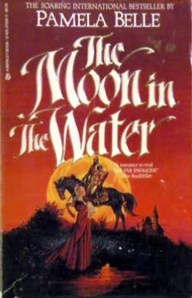
The Moon in the Water Pamela Belle’s name first came to my attention two or three years ago when I was looking for lists of novels about Richard III and saw a mention of one of her books, The Lodestar. After discovering that it was out of print, I never actually got round to looking for a copy and forgot about it…until a few weeks ago when I came across one of her other novels, The Moon in the Water. Not the one I had originally wanted to read – and set in an entirely different period – but it sounded good so I decided to try it anyway. And I can’t say that I regret reading this one instead of The Lodestar, as I loved it from the first page to the last!

First published in 1983, The Moon in the Water is the kind of historical family saga I used to love reading – books like Colleen McCullough’s The Thorn Birds, Susan Howatch’s Penmarric or John Jakes’ North and South trilogy come to mind – but haven’t read very often in recent years. It was a joy to discover this one and to know that I have many more Pamela Belle books still to look forward to. The Moon in the Water is the first of her Heron series, following the story of Thomazine Heron and her family, and is set during the English Civil War.

When Thomazine, our narrator, is orphaned at the age of ten, her father’s cousin, Sir Simon Heron, becomes her guardian. Arriving at Sir Simon’s estate of Goldhayes in Suffolk, Thomazine settles into her new life and gets to know the other Heron children – Simon, the eldest and the heir; Edward, who wants to become a soldier; the rebellious, quick-witted Francis; Lucy, an avid reader of stage plays; and six year-old Jamie, the baby of the family. Thomazine soon forms friendships with each of her five cousins, but it’s Francis with whom she feels the closest connection. When a marriage is arranged between Thomazine and another cousin, Dominic Drakelon, Thomazine is horrified but consoles herself with the knowledge that the wedding won’t take place until she is sixteen and a lot can happen in six years.

As time passes and the Heron children grow up, Thomazine discovers that she has fallen in love – not with Dominic, but with her cousin Francis. With Sir Simon now dead, his eldest son, Simon, has become head of the family, but unfortunately he distrusts and disapproves of his younger brother; if Thomazine is to have any chance of escaping from her betrothal to Dominic, she must first find a way to repair the relationship between Simon and Francis. Meanwhile, tensions between King Charles I and his Parliament intensify and the Herons, who choose to support the King, find themselves facing a host of new challenges as civil war breaks out in England.

The Moon in the Water is a romance, but not a silly, bodice-ripping one. There is so much more to this book than just the central love story. Music and poetry are shared interests of several of the characters and we are given fragments of song and verse. The historical background is well researched and there are descriptions of battles, sieges and the ways in which civil war affects not just the people at the heart of the action but also those who have stayed at home. And while it’s sometimes too easy to predict what is going to happen, the story is gripping enough to make this a difficult book to put down.

But going back to that central love story, it’s a great one. Rather than coming out of nowhere, the relationship between Thomazine and Francis develops slowly from friendship to romantic love and it feels believable – although it’s obvious to the reader long before the characters themselves start to become aware of how they feel! It also helps that they are both such great characters. I had a look at some of the other reviews on Goodreads after finishing the book and was intrigued by the fact that several reviewers mentioned that Francis Heron is very like Francis Crawford of Lymond from Dorothy Dunnett’s Lymond Chronicles, which is exactly what I kept thinking too, to the point where I started to find it distracting and wished the author had chosen a different name! The intelligent, imaginative young Francis Heron is very much as I would imagine Francis Crawford as a child and as an adult his relationship with his brother Simon is similar in some ways to Lymond’s relationship with his brother Richard.

I also loved Thomazine, which is fortunate as this is really her story, narrated in the first person, which means her personality comes through on every page. Another favourite character was Grainne, the Irish girl who marries a friend of the Herons and becomes almost one of the family. The villains were maybe a bit disappointing – and it was easy to guess who they were going to be, even before they committed any villainous acts – but that’s just a small criticism of such an enjoyable book.

It’s frustrating that these books and so many others that I want to read are out of print, but at least in this age of the internet it’s a lot easier to find copies of them than it used to be! I’m very excited about reading Pamela Belle’s other novels, beginning with the next in the Heron series, The Chains of Fate. With this one ending on a big cliffhanger, I can’t wait to see what the future holds for the Heron family – although I’m sure things aren’t going to go smoothly for them!

The Burgess Boys by Elizabeth Strout

The Burgess Boys Although the title of this novel is The Burgess Boys, there are actually three Burgess siblings – Jim, Bob and their sister Susan. Jim and Bob live in New York, while Susan is the only one to have remained in Shirley Falls, Maine – the town where they grew up. Jim is an ambitious and successful lawyer, whose defence of the singer Wally Packer has made him a household name. His younger brother, Bob, also has a career in the law but has never matched Jim’s achievements; he has spent his whole life blaming himself for an accident which killed his father, and as a result he doesn’t have a lot of confidence. Susan, Bob’s twin, is a single mother living in Shirley Falls with her troubled teenage son, Zach.

Shirley Falls, predominantly a white community, has recently become home to large numbers of Somali immigrants. Racial tensions in the town are already high and when Zach throws a frozen pig’s head through the door of a mosque during Ramadan, it causes a national scandal. Jim and Bob return to the town of their childhood to support their sister and find out why their nephew has done something so terrible, but in the process they make some surprising discoveries about themselves and about each other.

I received a review copy of this book from the publisher last year but didn’t read it as it didn’t sound very appealing to me and as I hadn’t requested it I didn’t feel under any obligation to read it if I didn’t want to. I do remember reading some positive reviews of it, though, and when I noticed it was named on the shortlist for the Baileys Women’s Prize for Fiction I decided to give it a try. Now that I’ve read it I think my initial reaction was correct because it really wasn’t my type of book at all; I was interested enough to keep reading right to the end and I appreciated the quality of Elizabeth Strout’s writing, but this was a book that I could admire without particularly enjoying.

I found this quite a subdued and depressing novel. All of the characters, even the secondary ones, seem to be such unhappy people, dissatisfied with their lives, their marriages and their jobs. With the possible exception of the good-natured Bob Burgess and one of the Somali characters, Abdikarim Ahmed, I didn’t like any of them. I thought Susan was cold and bitter, Jim was over-confident and insensitive, and Helen (Jim’s wife) was shallow and self-absorbed. There’s certainly a lot of character development and by the end of the book it’s obvious that there is more to each person than originally meets the eye – but they are simply not people that I had much interest in getting to know.

I do think it was a good idea to write part of the novel from the perspective of the Somali immigrants. I was struck by the way so many of the non-Muslim people in Shirley Falls, while not necessarily racist, seem to have almost no knowledge of Islamic culture or the customs of the Somali people who are living among them (they incorrectly refer to them as Somalians, for example, and in some cases have never heard of Ramadan and don’t know why a pig’s head might be offensive to a Muslim). However, I never felt I completely understood Zach and why he did what he did, although the author does her best to make us feel sympathetic towards him by portraying him as a shy, awkward teenager who (slightly unbelievably) was unaware of the implications of his actions.

The Burgess Boys is a thought-provoking read and a good portrayal of a dysfunctional family, but I found the story disappointingly flat and boring, lacking any sort of drama or interesting plot developments. However, despite not enjoying this book very much I haven’t ruled out trying one of Elizabeth Strout’s other books at some point, particularly Olive Kitteridge which sounds much better than this one.