Far from the Madding Crowd by Thomas Hardy

Far from the Madding Crowd Far from the Madding Crowd is set in Thomas Hardy’s fictional Wessex and tells the story of Bathsheba Everdene and her relationships with three very different men. Near the beginning of the book, Bathsheba inherits her uncle’s farm and, being confident in her ability to make a success of the business, decides to run it herself. This is not a conventional thing for a woman to do in Victorian England and it’s not suprising that Bathsheba attracts a lot of attention.

Soon she has two men in love with her: the first is the shepherd, Gabriel Oak, who had already proposed to Bathsheba before she inherited the farm and had been turned down. Despite being rejected, Gabriel remains quietly devoted to Bathsheba and as time goes by she comes to rely on him more than she realises. Her second suitor, Mr Boldwood, is a well-respected neighbouring farmer. When Bathsheba sends him a valentine saying “Marry me”, Farmer Boldwood becomes determined to make her his wife, unaware that the valentine was intended as a joke. But neither Gabriel nor Boldwood can hope to compete with the handsome but untrustworthy Sergeant Troy who seems set to succeed where they have both failed.

I loved Far from the Madding Crowd. Thomas Hardy is one of my favourite Victorian authors and having read five of his books now, none of them have disappointed me. I read the beautiful Penguin English Library edition of this book which I won in a giveaway from Heavenali last year, and I would like to say how much I appreciated the fact that the ‘introduction’ is at the back of the book instead of the front! I wish all publishers would do that, as it would reduce the risk of an unsuspecting reader having the story spoiled for them (I have never understood why it’s apparently considered acceptable to give away the entire plot of a novel in the introduction or on the back cover just because the book is a classic).

Hardy is often criticised for being too depressing, but this one isn’t really a tragic, heartbreaking book like Tess of the d’Urbervilles or Jude the Obscure – although it does still have its moments of sadness. Things do go wrong, bad things happen and not every character gets a happy ending. However, it also has some humour, which is maybe not something usually associated with Hardy. Most of this is provided by the wonderful collection of secondary characters – the eccentric villagers and rustic farm workers who gather at the Buck’s Head Inn in the evenings to discuss the day’s news. Their conversations are so funny and give some relief from the darker parts of the central storyline.

I found Bathsheba very frustrating, although it’s her flaws – her vanity and her impulsive nature – that make her such a fascinating character. There’s a lot to admire about her, such as her desire to run the farm and be successful at it, despite farm management still being very much a man’s world, but after seeming to be such a strong, independent person at the start of the book, she begins to make one mistake after another. Gabriel Oak, though, I loved. I loved him for his patience and devotion, for the way he coped with rejection, and the fact that he didn’t judge too harshly. Like the oak tree his name suggests, he is a constant, reassuring presence throughout the story and certainly my favourite character in any of the Hardy novels I’ve read so far.

Of all the Hardy novels that I’ve read, with the possible exception of Under the Greenwood Tree, this is the most pastoral, with lots of beautiful descriptions of the countryside and lots of information on farming and agriculture. I should now be able to shear sheep, hive bees, forecast the weather by watching the movements of slugs and toads, and deal with a fire in a hayrick! (Well, maybe not.)

I need to choose my next Thomas Hardy book now so any recommendations are welcome. I’ve already read Tess of the d’Urbervilles, Jude the Obscure, Under the Greenwood Tree and A Pair of Blue Eyes.
Queen’s Gambit by Elizabeth Fremantle

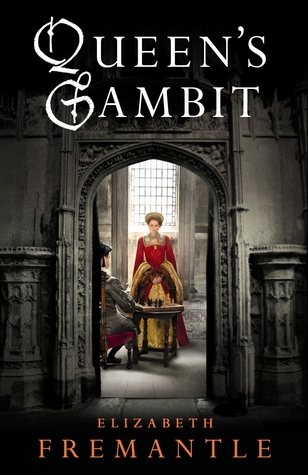
Queen's Gambit So many novels have been written about the six wives of Henry VIII I wasn’t sure if I really wanted to read another one. Queen’s Gambit seemed to be getting such good reviews, though, so I thought I would give it a chance. I was intrigued by the comparisons to both Philippa Gregory and Hilary Mantel, two very different authors, (though now that I’ve read it, I can tell you I found it more similar to the former than the latter) and I also liked the fact that, at least with this edition, the publisher has avoided the usual front cover image of a ‘headless/faceless woman in a pretty dress’ which most recent Tudor court novels seem to have.

Queen’s Gambit tells the story of Katherine Parr. If you’re familiar with the rhyme used to remember the fates of Henry VIII’s six wives (Divorced, beheaded, died; divorced, beheaded, survived), Katherine Parr was the sixth and final wife – the one who ‘survived’. While Katherine’s story may not have been covered in historical fiction as often as some of the other wives, particularly Anne Boleyn, I have read about her before so already knew the basic facts about her life.

Katherine comes to the court of Henry VIII after her husband Lord Latimer dies leaving her a widow for the second time at the age of thirty-one. Soon after her arrival, she falls in love with Thomas Seymour, one of the brothers of the late queen, Jane Seymour. However, Katherine has also caught the eye of the King, who plans to make her his sixth wife. By this stage of his life, Henry is no longer the handsome prince he once was: he has grown fat, he’s suffering from an ulcerated leg, and added to the fact that his previous wives have met such unhappy fates, Katherine has no desire to marry him. She doesn’t dare defy the King’s wishes and accepts his proposal of marriage, but during the years that follow she is unable to forget Thomas Seymour, even after he is sent away from court on a diplomatic mission. Meanwhile, life at court is growing increasingly dangerous for Katherine and as she becomes more deeply involved in the reformed religion she realises that she needs to be very careful if she’s going to survive.

This story is told from two very different perspectives: one is Katherine’s and the other is Dorothy Fownten’s. Katherine is a dignified, mature and intelligent person which makes her easy to like and sympathise with as she learns to cope with life in the treacherous, unpredictable Tudor court, never being sure who can and cannot be trusted, and knowing that two of her predecessors have already lost their heads. Dorothy, known as Dot, is Katherine’s maid and while Katherine moves in the innermost circles at court, Dot is on the outside and can take a more observant and unbiased view of things. I liked both women but I found Dot a more engaging character. Having read a few books about Katherine now, I don’t think she’s really a great subject for historical fiction – there are a lot of other queens’ lives that are much more dramatic and interesting to read about – so some of my favourite parts of the book were actually those that concentrated on Dot’s personal story rather than Katherine’s. When I read the author’s note at the end I was surprised to discover that there really was a maid of that name who served Katherine Parr, though the way she is portrayed in the book is largely fictional.

Another character I enjoyed reading about was Dr Robert Huicke, the King’s physician who becomes a good friend of Katherine’s. Through Huicke we also meet Nicholas Udall, the playwright most famous for writing one of the first English comedies, Ralph Roister Doister. Huicke’s relationship with Udall, as well as his friendship with Katherine, adds another interesting angle to the story.

As I mentioned at the start of this post, I thought this book felt more like a Philippa Gregory novel than a Hilary Mantel and I don’t think the comparisons with Wolf Hall are justified, but I did still enjoy it. Queen’s Gambit is apparently the first in a Tudor trilogy – the second one will explore the lives of Lady Jane Grey’s two sisters, Catherine and Mary, and the third is going to be set in the Elizabethan court. I’m looking forward to reading both.

I received a copy of this book through Netgalley for review.

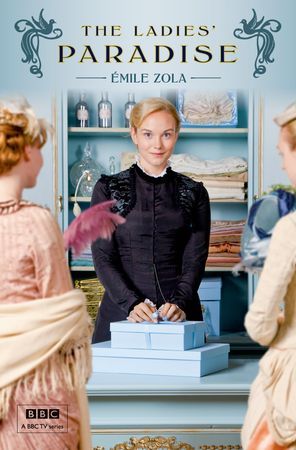
The Ladies’ Paradise by Émile Zola

The Ladies' Paradise The Ladies’ Paradise is only the second book I’ve read by Zola; my first was Thérèse Raquin and the two are very, very different. Au Bonheur des Dames, to give it its French title, was published in 1883 and is the story of a Paris department store, based on the real-life Le Bon Marché.

At the beginning of the novel, Denise Baudu arrives in Paris with her two younger brothers, hoping to find work in her uncle’s draper’s shop. She is disappointed to discover that he is unable to offer her a job because his shop, along with the other small shops in the street, is losing business to a new department store, the Ladies’ Paradise. The new store is able to offer a larger selection of products at cheaper prices all under one roof, and none of the smaller traders can hope to compete. Still, Denise desperately needs to earn money to support her brothers so although she understands how her uncle feels, she is pleased when she is offered a job at the Paradise.

Denise quickly finds that life as a salesgirl at the Paradise is not easy but she’s determined to succeed and overcome whatever obstacles are put in her way. And when she catches the eye of the owner of the Paradise, Octave Mouret, he soon discovers that she is a woman with morals and principles; it’s obvious that she is not going to give him any encouragement – but this only makes him want her more.

I was hoping to love this book as much as Thérèse Raquin but that didn’t happen. The Ladies’ Paradise is a book that I enjoyed, but not one that I loved. It offers some fascinating insights into both Parisian life and the rise of the department store in the late 19th century – and of course, the idea of a larger, cheaper store putting all the small, independent shops out of business is still very relevant today – but I disliked most of the characters and while the long descriptions of the silks, satins and other fabrics sold at the Paradise were beautifully detailed I did get a bit bored after a while. Maybe I just don’t like shopping enough!

However, I did find it fascinating to read about the way the Paradise was run and what it was like to work there. In some ways working at the Paradise was a very different experience from working in retail today, one of the biggest differences being that the salesgirls employed by the Paradise lived and ate on the premises and were treated almost like servants. But from a selling and marketing perspective, I was surprised to learn how modern and sophisticated Mouret’s methods were; a lot of the ideas he had for running the store, advertising its products and attracting customers are still used today (though I didn’t really like the implication that women are so easy to trick and tempt into parting with their money).

The only character I really liked was Denise. I had sympathy with all the ordeals she faced after starting her new job: having trouble fitting in with the other women, feeling that her clothes and hair weren’t right, being bullied by other employees, and worrying about making enough money to take care of her two younger brothers. I found it harder to like or care about any of the other characters (Denise’s brother, Jean, particularly annoyed me – surely he was old enough to take more responsibility for himself and his actions), though I did admire what Mouret had achieved in making the Paradise such a success.

I don’t want to sound too negative about this book because I still found a lot of things to enjoy about it, but I’m hoping the next Zola novel I read will be more to my taste than this one. Any suggestions are welcome!

The Doctor of Thessaly by Anne Zouroudi

The Doctor of Thessaly This is the third in Anne Zouroudi’s ‘Mysteries of the Greek Detective’ series following the investigations of Hermes Diaktoros, also known as ‘the fat man’. This appears to be a series that can be read in any order – I read the sixth book, The Bull of Mithros, first and then this one and haven’t had any problems; each novel is a complete story in itself. What the books do have in common is the character of the fat man, a theme based on one of the seven deadly sins and a beautiful Greek setting.

The Doctor of Thessaly is set in Morfi, a village on one of the Greek islands. The story begins with the discovery that the village doctor, Louis Chabrol, has been blinded in an attack that took place the night before his marriage to Chrissa Kaligi, the younger of two middle-aged sisters. This crime couldn’t have happened at a worse time, as the people of Morfi and their ambitious new mayor are preparing for a visit from a government minister.

Luckily, our hero, the enigmatic Hermes Diaktoros of Athens, has just arrived in Morfi and when he learns of the attack he begins to investigate. As he moves around the village speaking to witnesses, listening to gossip and collecting evidence he starts to build up a clearer picture of what has happened – and when he eventually discovers who is responsible for the crime, he dispenses his own form of justice.

I thought this was a better book than The Bull of Mithros, though I did like them both. I loved the atmospheric setting of Morfi, a quiet Greek village untouched by tourism or modern technology (it’s not clear when these books are supposed to be set, which I’m sure is intentional – it could be any time in the second half of the 20th century) and I enjoyed meeting the people who live there. I mentioned that each of the books in this series is based around one of the seven deadly sins. This one has a theme of ‘envy’ which is very appropriate as there are many people in Morfi who could be accused of this sin, from Chrissa’s bitter and resentful sister, Noula, to the group of four jealous, spiteful men who are determined to spoil things for the new mayor.

The fat man continues to be a mysterious, elusive character. Is it a coincidence that he has the name of a Greek god? Who are the higher authorities he claims to represent? And why is he so obsessed with keeping his white tennis shoes clean? These things were as much a mystery when I read the sixth book as they were reading this third book, so unless the truth about his identity and background are going to be revealed at the end of the series it seems that we are going to be left to make up our own minds about Hermes Diaktoros. I do like him though; not only is he concerned with making criminals pay for what they have done, he also wants to help the people he meets along the way and leave the village behind in a better, happier state than when he arrived.

I will continue to read the other books in the series, though I think they are the type of books that would start to feel repetitive if read too close together so I’ll probably wait a while before starting another one!

Less Than Angels by Barbara Pym

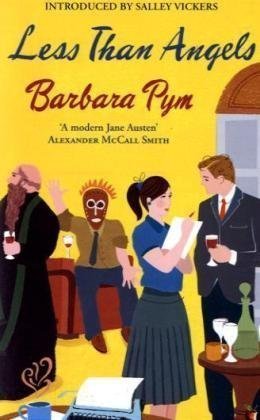
Less Than Angels I’ve never read anything by Barbara Pym until now, despite feeling sure that I would enjoy her books, so Barbara Pym Reading Week seemed a good time to start. Less than Angels is not a book that I’ve heard much about so I was worried that it might not be a good one to begin with, but it’s the only one I actually own so it made sense to read it first. Luckily I did enjoy it and it has left me wanting to read more of Pym’s books as soon as I can!

Less than Angels revolves around a group of anthropology students, their professors, families and neighbours. Catherine Oliphant is a writer of romantic fiction and articles for women’s magazines. Her boyfriend, Tom Mallow, is an anthropology student who has recently returned home from being ‘in the field’ in Africa and is now working on finishing his thesis. Despite having very different personalities and not really understanding each other’s work, Tom and Catherine seem to have settled into life together – until Tom meets Deirdre Swan, a younger student who is just beginning to study anthropology.

While the relationships between Tom, Catherine and Deirdre form the central thread of the novel, another storyline centres around money for research grants which the rich widow Minnie Foresight has promised to give to Professor Mainwaring’s department. Among the students hoping to receive these grants are Deirdre’s friends, Mark and Digby, who provide a lot of the book’s humour. We meet lots of other great characters too, including Deirdre’s mother, Mabel, and her unmarried Aunt Rhoda. And there’s also Alaric Lydgate, an eccentric anthropologist who lives next door and can often be seen wearing an African mask around the house (and secretly wishes he could wear it all the time).

My first impression after reading Chapter One was that I liked Barbara Pym’s writing but was completely overwhelmed by the number of characters we were introduced to in that first chapter and the way the viewpoints changed from one to another so rapidly. Fortunately, after a couple of chapters things settled down and we could concentrate on getting to know one character at a time.

I thought Catherine was a lovely person and although she and Deirdre could be seen as rivals, Catherine’s mature attitude to the whole situation made it easy for me to like Deirdre too. It was interesting to read the contrasting descriptions of Catherine’s solitary but independent life in London, and Deirdre’s life in a middle-class suburban household, living with her mother, brother and aunt. I thought it was funny when one of Deirdre’s fellow students, a Frenchman called Jean-Pierre, visits the family to study a typical English Sunday! I liked the idea that there’s as much for an anthropologist to study in English habits and traditions as there is in the customs of African tribes, and I was also interested in the comparison of the insights writers have into human life as opposed to the views anthropologists have.

I loved Mark and Digby too. One of my favourite scenes was the one where they take Miss Clovis and Miss Lydgate to a restaurant and spend the whole time worrying about the cost and trying to choose the cheapest things on the menu. I also liked the part where Professor Mainwaring invites four of the competing research grant applicants to his house in the countryside for the weekend. Near the end of the book, the story takes a more dramatic turn which I thought felt a bit out of place with the rest of the novel. Apart from this, I enjoyed Less than Angels and am excited about reading more of her books.

Barbara Pym Reading Week

King Hereafter by Dorothy Dunnett

King Hereafter “Then she said, ‘Thorfinn!’ quickly, and moved to him; but had hardly got to his side before he loosed his fingers and thumbs and plunged them down to the mattress like spear-points.
‘No! Macbeth. Macbeth. Macbeth!’ The name reached her like sling-shot.
Groa said, ‘They are the same man. I should know. I married both.’”

I couldn’t wait to read this book having loved Dorothy Dunnett’s Lymond Chronicles and House of Niccolo series so much when I read them last year. King Hereafter, her only standalone historical novel, is set in eleventh-century Orkney and Scotland (known at that time as Alba) and is based around the idea that Macbeth, the historical King of Alba, and Thorfinn, Earl of Orkney, were the same person – Macbeth being Thorfinn’s baptismal name. Whether that might be true or not, the case she puts forward in this book is very convincing and obviously the result of an enormous amount of research. The novel follows Thorfinn throughout his entire life and along the way there are battles, both on land and at sea, fires, storms, births, deaths, political intrigue and even a race across the oars of a longboat. We also meet other historical figures of the time including King Canute and Lady Godiva – but at the heart of the story, for me, is Thorfinn’s love for his wife, Groa.

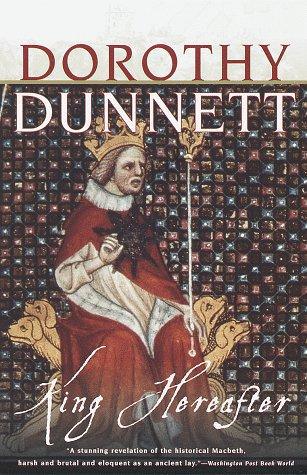
I loved this book, although the combination of unfamiliar history, complex politics and intricate relationships between the characters meant that it required a huge amount of concentration and a lot of referring to the centre pages of the book which contained three maps of Orkney, Alba and England, and two family trees. I would have been completely lost without these maps and charts; I found myself consulting them constantly – and even then there were some relationships that still weren’t quite clear to me. Added to the fact that my edition of the book had 880 pages (not the same as the one pictured here, by the way), it seemed to take me nearly as long to read this one book as it did to read the entire Lymond Chronicles! That’s not necessarily a bad thing, though, when a book is as good as this one is.

Before I go any further I should point out that King Hereafter is not a retelling of Shakespeare’s Macbeth and there is really very little resemblance between Dunnett’s story and Shakespeare’s, although she does quote from the play in the section headings and there are some references to events that are also in the play, such as ‘Birnam Wood coming to Dunsinane’. Some of the basic plot points are the same – yes, Thorfinn/Macbeth becomes King of Alba after the death of King Duncan, for example, but the circumstances surrounding Duncan’s death are very different from the murder Shakespeare describes. And thankfully, Groa is a far more likeable character than Lady Macbeth. The three witches don’t appear either, though instead we have Groa’s son, Lulach, and his prophecies (I suspect that to really be able to make any sense of most of Lulach’s cryptic comments you need to know how the rest of the story is going to play out and to be familiar with some of the historical sources too).

I loved Thorfinn from his very first appearance. I could see some similarities between Thorfinn and Dunnett’s other heroes, Lymond and Nicholas, but in other ways he is quite different. This is the moment we meet him for the first time as a child, seen through the eyes of his foster father, Thorkel Fostri:

“Not the complaining Earl Brusi. Not the lovely young Rognvald his son. But a scowling juvenile, thin as a half-knotted thong, with a monstrous brow topped by a whisk of black hair over two watering eyes, thick as acorns.
It raised one arm and called. Its voice had not even started to break.

‘Thorfinn,’ said Thorkel, and the word itself was a groan. Here in Norway, here in Nídarós, here on King Olaf’s jetty was the child-Earl of Caithness and Orkney. His foster-son.”

We soon see that Thorfinn’s unattractive exterior hides a shrewd brain, great physical ability, wit, courage and, although we are told that he never laughs, a wry sense of humour too. He is capable of all the plotting, scheming and negotiating that is necessary to keep up with the ever-changing rivalries and alliances between various leaders, while also dealing with the threats from England, Norway and Denmark and trying to do what is best for his people of Orkney, Caithness, Moray and the rest of Alba. As with Lymond and Nicholas we are rarely given the privilege of getting inside Thorfinn’s head; instead we see him mostly from the perspective of the people around him, which can be either insightful or misleading depending on how well these viewpoint characters understand him.

Groa is a great character too and is now one of my favourite female characters in all of Dunnett’s novels. The story of how she and Thorfinn come to love and understand each other is beautifully written and it was wonderful to watch their relationship develop over the course of the novel. Apart from the relationship between Thorfinn and Groa, the other one I found particularly fascinating and complex was the relationship between Thorfinn and his nephew, Rognvald. The encounters between the two of them throughout the first half of the book provided what, for me, were some of the most dramatic and exciting scenes in the book.

Thorfinn does have a lot of ambition, but unlike Shakespeare’s Macbeth, it’s not because he’s looking for personal glory or has been encouraged by his ruthless Lady; his ambition is to improve life in his lands and give his people a strong ruler, uniting the disparate, diverse tribes of Orkney and Alba under a common religion and common laws. On the subject of religion, I did get very confused somewhere in Part 3, where Thorfinn visits Pope Leo in Rome. Actually, a lot of the religious aspects of the story in general confused me and that’s something I would attempt to understand better on a re-read. I tried not to worry too much about the things I couldn’t understand on this first read and instead concentrated on getting to know Thorfinn, Groa and the other characters, and enjoying the beautiful writing. The descriptions of the landscapes of Orkney and Alba are so vivid and evocative. This is one that I particularly loved:

They entered Loch Bracadale with the sunrise, rose-coloured oars laying darkling folds on the rose-tinted pool of the fjord. A dusting of guillemots, asleep on the water, roused and dived with almost no sound, leaving pink and verdigris rings on the surface. A charcoal rock needled with cormorants became suddenly bare, and from the shore came the scalloped cry of an oyster-catcher, joined after a moment by others. Then the longships slid past, and the sounds died away.

Although the Lymond Chronicles are still my favourites, I can definitely see why some people would consider this Dorothy Dunnett’s best book. It’s amazingly detailed and well-researched, as well as being a very powerful and emotional story. The only problem with reading a book like this is that when you know there can only be one outcome to the story and that there’s no chance of a happy ending, it makes the build-up to the conclusion difficult to read. The end of Thorfinn’s story was inevitable but still heartbreakingly sad.

I’m sorry I don’t have any more of Dunnett’s historical novels to look forward to, but I will try her Johnson Johnson mystery series at some point – and like all of Dunnett’s books I’m sure re-reading King Hereafter in the future will also be a rewarding experience!

Doctor Zhivago by Boris Pasternak

Doctor Zhivago Do you ever find that after finishing a book you’re still not sure what you thought of it and couldn’t even say whether you had actually enjoyed it or not? That’s the way I felt about Doctor Zhivago. I’m glad I’ve finally read it as it’s a book I’ve been curious about for a long time, but while I didn’t dislike it I didn’t love it either. Thankfully I don’t even attempt to rate books on my blog but I do on Goodreads and wavered between three and four stars for a long time before settling on three. Doctor Zhivago is a long book and definitely not a light, easy read, so I was disappointed that I couldn’t rate it more highly after investing so much time and effort in it.

Doctor Zhivago was published in 1957 and Pasternak was awarded the Nobel Prize for Literature a year later. The novel is set in Russia and follows the life of Yuri Zhivago, a doctor and poet. Yuri’s mother dies when he is still a young child and he is raised by his Uncle Kolya. After studying medicine at university, he marries his childhood friend, Tonya, and they have a son together but Yuri and Tonya are separated when Yuri joins the army as a doctor. Recovering in a field hospital after being wounded, he is drawn to another woman, Lara, who is working there as a nurse and over the years that follow he is torn between his loyalty to Tonya and his love for Lara. But this is more than just Yuri’s story…it’s also the story of Russia itself and the events that shaped the country throughout the first half of the twentieth century.

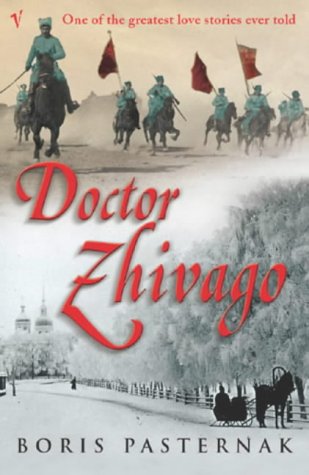
I have to admit that before I started reading this book I had absolutely no idea what it was about, though I think I must have had the impression it was a romantic historical epic set against a backdrop of beautiful snowy landscapes. Although I’ve never actually watched any of the film or television adaptations of this book it seems that they have chosen to focus more on the love story aspect, which is probably why I had this misconception of what the book would be like. This particular edition of the book does nothing to dispel that idea, with the claim on the cover that this is “one of the greatest love stories ever told”. It isn’t. Not in my opinion, anyway. After reaching the end of the book it seemed to me that the romance had only formed a minor part of the story, taking second place to the Russian history and politics, though whether this is a good thing or a bad thing depends on your personal preference, of course!

Doctor Zhivago was originally written in Russian and the translators of this edition are Max Hayward and Manya Harari. I hadn’t looked into which other translations are available – I just picked the book up on a whim when I noticed it on the library shelf because I’ve been interested in reading it for a while. Maybe there are other translations that are better, but I didn’t have any problems with this one; I thought the writing flowed well and was easy enough to read (although the story itself is disjointed, almost episodic). There are some beautiful, moving passages, and yes, some wonderful descriptions of snowy Russian landscapes too. But what did make this book very challenging for me was my complete lack of knowledge of most of the history involved: the February and October Revolutions, for example, and the Civil War between the Reds and the Whites. If you’re planning to read Doctor Zhivago and know nothing about the historical context I would strongly recommend doing some background reading first – I wish I had as I’m sure it would have made the story a lot easier to understand and follow!

The parts of the book that I did enjoy were excellent – I particularly loved the penultimate chapter, Again Varykino, and its atmospheric descriptions of a deserted town surrounded by howling wolves – but I was disappointed that I never managed to form any kind of emotional connection with any of the characters. Although Yuri, Lara and Tonya found themselves in situations that I could sympathise with, I thought their characters felt underdeveloped. They never felt like real people to me, so their stories didn’t affect me as much as they should have done.

I wish I had been able to write a more intelligent, articulate review but I think I’ll have to leave that to other people as I’m aware that a lot of the political and philosophical aspects of the story just went over my head. To fully appreciate this book I would have to read it again and I don’t think that’s something I’ll ever want to do! I do usually like Russian literature in general – I loved Mikhail Bulgakov’s The Master and Margarita, I enjoyed Anna Karenina and am currently taking part in a group read of War and Peace – so I have to conclude that Pasternak and Doctor Zhivago are just not for me.