The Memory of Lost Senses by Judith Kinghorn

The Memory of Lost Senses The Memory of Lost Senses begins in 1911 in the peaceful country village of Bramley when the Countess Cora de Chevalier de Saint Leger moves into the big house on the hill known as Temple Hill. The countess is a mysterious and secretive person; she’s an elderly woman now but there are hints that she has led an exciting and eventful life.

Two other people have come to spend the summer with Cora at Temple Hill – one is her grandson, Jack, and the other is Sylvia, a novelist who is planning to write Cora’s biography. But despite having been Cora’s friend for many years, Sylvia finds it harder than she expected to get the countess to confide in her. Instead it’s their young neighbour, Cecily Chadwick, who comes closest to discovering the truth about Cora’s past – and in the process she is able to help Jack make sense of his own family history.

Having enjoyed The Last Summer, Judith Kinghorn’s first novel, I was really looking forward to reading this one. When it arrived with its beautiful cover image and promise of a story involving “a house on a hill, a woman with a past, and a lifetime of secrets waiting to be told” I was even more excited.

I was pleased to find that this second book was as beautifully written as her first. Kinghorn is so good at writing about this era and bringing a bygone age back to life. I loved her descriptions of long, hot summer days in the Hampshire village of Bramley and the glimpses we get of the expatriate communities of Paris and Rome where Cora spent much of her life are vividly described too.

And yet I didn’t love this book the way I loved The Last Summer. I think the problem I had was that I found the first half of the book difficult to follow; there was so much moving back and forth in time and I struggled to keep track of the names of Cora’s various husbands and children. I appreciate that the nature of the novel meant that the details of Cora’s past could only be revealed very gradually, but I felt that too much was being kept hidden from the reader for too long and unfortunately this made the story too slow for me.

Although I found The Memory of Lost Senses a bit disappointing in comparison to The Last Summer I still think Judith Kinghorn is a great writer and I’ll be looking out for more books from her in the future.

Lady of the English by Elizabeth Chadwick

Lady of the English Despite my love of historical fiction and interest in medieval history, I only discovered that I liked Elizabeth Chadwick’s books relatively recently. I had previously tried one of her books and couldn’t get into it, so had dismissed her as not for me, but decided to give her another chance a couple of years ago and am glad I did as I’ve loved everything I’ve read by her since then. When it comes to the medieval period, she and Sharon Penman are two of the best authors I’ve found.

Lady of the English is the story of two women: Empress Matilda, the daughter and heir of King Henry I, and her stepmother, Queen Adeliza of Louvain. In 1125, following the death of her husband, the German Emperor, Matilda returns to England where she sees her father again after an absence of many years and meets his second wife, Adeliza, for the first time. Adeliza is about the same age as Matilda and the two soon become close friends despite their very different characters – Matilda is a strong, proud woman while Adeliza has a warmer, gentler personality.

Then Matilda’s father arranges for her to marry Geoffrey, Count of Anjou and she has to leave England behind again. It’s not a happy marriage – with Matilda being more than ten years older than the fourteen year old Geoffrey, they have little in common and Geoffrey is resentful and violent – but they do have three sons together. When Henry I dies with no other heirs (his only legitimate son had died in the sinking of the White Ship in 1120), his nephew Stephen of Blois claims the throne, ignoring the fact that before his death the King had made his barons swear to support Matilda as their queen. With Matilda and Geoffrey vowing to win back both England and Normandy for their eldest son, the future Henry II, civil war breaks out – and for Adeliza, whose second husband William d’Albini, 1st Earl of Arundel, is a loyal supporter of Stephen’s, life is about to become very complicated.

Lady of the English is possibly my favourite Elizabeth Chadwick novel so far. I was already familiar with some of the basic facts surrounding Matilda, Stephen and this period of history, but most of the story was new to me. Chadwick includes enough information on politics and battles to give you a good understanding of what’s going on, but the focus is always on the characters and the complex relationships between them. I’ve never read about Adeliza before and I thought it was a good idea to tell part of the story from her perspective as well as from Matilda’s, particularly as the two women were so different.

I really liked Adeliza and could sympathise with her position, torn between love for her second husband and loyalty to her stepdaughter, who she believes to be the rightful ruler of England. Chadwick also does a good job of showing how Adeliza becomes frustrated and heartbroken at her inability to have children with the King and her failure to fulfil what she sees as her duty to provide him with a male heir. I imagine there probably isn’t as much factual information available on Adeliza’s life as there is on Matilda’s, so I think Chadwick has done well to fill in the gaps and create such a believable, well-developed character. Matilda was not as easy to like, though I think that was probably the point, and despite her sharp tongue and often hard exterior, there was something about Matilda’s personality that inspired loyalty and made powerful men (not only her half-brother, Robert of Gloucester but also men such as Brian Fitzcount of Wallingford) decide to support her claim rather than Stephen’s.

I loved this book and enjoyed getting to know both of these fascinating ‘ladies of the English’! This is only the fourth Elizabeth Chadwick book I’ve read and I’m pleased I still have lots of her older books to explore as well as looking forward to her forthcoming trilogy on Eleanor of Aquitaine.

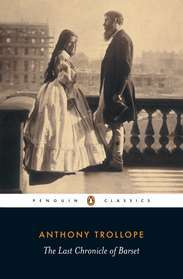
The Last Chronicle of Barset by Anthony Trollope

The Last Chronicle of Barset In April 2010 I read my first Anthony Trollope novel, The Warden, and now here I am, three years and six books later, at the end of the Chronicles of Barsetshire at last!

Being the final book in this series, characters from all five previous novels are brought together in this one, so if you have yet to start reading the Chronicles I would strongly recommend leaving this one until last. If you approach this book having already read the first five, you will be as excited as I was to discover how many old friends reappear in The Last Chronicle…Archdeacon Grantly, Mr Harding (probably my favourite Trollope character) and his daughter Eleanor, Mark Robarts, Bishop and Mrs Proudie, Dr Thorne and too many others to list here!

The main storyline follows the Reverend Josiah Crawley, a poor clergyman who has been accused of stealing a cheque for twenty pounds from Lord Lufton to pay his debts to the butcher. Crawley is unable to explain how it came into his possession but he insists that he didn’t steal it. As news of the scandal begins to spread through Barsetshire, some people believe that Crawley is guilty while others are convinced that he is innocent.

Most of Trollope’s characters are fully developed, three-dimensional people with believable motivations and emotions, but I thought Mr Crawley was particularly complex and fascinating. He did appear earlier in the series, in Framley Parsonage, but we get to know him much better here, with all his conflicting flaws and virtues. He has a lot of admirable qualities but at the same time he is very frustrating; he’s too proud to accept help from anyone, he insists on walking all the way from Hogglestock to Barchester rather than letting a friend drive him (even though it nearly kills him), and stubbornly refuses to have a lawyer defend him. This is what Trollope has to say about him:

“I think that at this time nobody saw clearly the working of his mind,—not even his wife, who studied it very closely, who gave him credit for all his high qualities, and who had gradually learned to acknowledge to herself that she must distrust his judgment in many things. She knew that he was good and yet weak, that he was afflicted by false pride and supported by true pride, that his intellect was still very bright, yet so dismally obscured on many sides as almost to justify people in saying that he was mad. She knew that he was almost a saint, and yet almost a castaway through vanity and hatred of those above him. But she did not know that he knew all this of himself also. She did not comprehend that he should be hourly telling himself that people were calling him mad and were so calling him with truth. It did not occur to her that he could see her insight into him.”

I won’t tell you whether or not Crawley really was guilty of stealing the money, but as the story progresses it starts to look less and less likely that the truth will ever be discovered. To make things worse, his daughter Grace is romantically involved with Major Henry Grantly, the son of Archdeacon Grantly. While Crawley is suspected of theft, the Archdeacon is opposed to the idea of his son marrying Grace – and although Grace is sure her father is innocent, she doesn’t want to damage Henry’s reputation through association with her family. Two other people with an interest in Mr Crawley’s fate are the long-suffering Bishop Proudie and his formidable wife. Mrs Proudie is a real masterpiece of characterisation and their conversations continue to be hilarious.

“Under these circumstances,” continued the bishop, “looking to the welfare of your parish, to the welfare of the diocese, and allow me to say, Mr. Crawley, to the welfare of yourself also—”

“And especially to the souls of the people,” said Mrs. Proudie.

The bishop shook his head. It is hard to be impressively eloquent when one is interrupted at every best turned period, even by a supporting voice.

Lily Dale and Johnny Eames, who we first met in The Small House at Allington, also return in this book. Their storyline was left unresolved at the end of The Small House and is picked up again here several years later. Will Lily agree to marry Johnny at last or will she stick to her decision to remain single forever? And although Johnny does still seem to love Lily, he also becomes involved with another woman in London, Madalina Demolines, while his friend, the painter Conway Dalrymple, begins an affair with the married Mrs Dobbs Broughton. My only criticism of this book is that I felt some of these subplots were unnecessary. I didn’t have much interest in the new characters such as Miss Demolines or Mrs Dobbs Broughton and their storylines were a distraction from the much more absorbing storylines involving the Crawleys, Grantlys and Proudies.

Looking back at the series, my favourites are still Barchester Towers and Doctor Thorne, but I can honestly say I’ve enjoyed all of them. I’m looking forward to starting the Palliser novels next, but I’m sure I’ll be returning to Barsetshire again in the future!

And the Mountains Echoed by Khaled Hosseini

And the Mountains Echoed Having read both of Khaled Hosseini’s previous novels, The Kite Runner and A Thousand Splendid Suns, I was excited when I discovered that he had written a new book. It’s been a long time since A Thousand Splendid Suns but his third novel, And the Mountains Echoed, was worth waiting for. It’s a gentler book than the previous two and much less harrowing. I didn’t learn as much about life in Afghanistan as I did from the other two books and this one doesn’t go into much depth on the Soviet invasion or the horrifying events of the Taliban years, but it’s still a very powerful and emotional novel. It’s a story about families, about the relationships between brothers and sisters, parents and children, and husbands and wives.

In 1952, Saboor and his young children, Abdullah and Pari, set out on a journey from their small village in rural Afghanistan to the capital city of Kabul. The two children have a very close and loving relationship; Abdullah has taken on the role of a parent to his little sister since their mother died when Pari was a baby. They are happy to have the chance to spend some time together on the journey, but what they don’t know is that when they reach Kabul something is going to happen that will change both of their lives forever.

As the story moves through the generations and across continents, we also get to know a variety of other characters, all of whom are connected in one way or another to the family we met at the beginning of the book. These include Uncle Nabi, who leaves home to work for a rich family in Kabul, and his employer’s wife, Nila Wahdati, a poet. Then there’s Markos, a plastic surgeon from Greece who is working for a charity in Kabul, and Adel, son of a famous Afghan warlord who slowly discovers that his father may not be as heroic as he seems. A whole chapter is devoted to each character’s story, which made the novel feel almost like a collection of short stories. Some of them are more interesting than others, but they all share the same themes: the effects of years of conflict on a country and its people, and the suffering of families torn apart by war or poverty.

I found this book to be much wider in scope than either The Kite Runner or A Thousand Splendid Suns; it begins with one family in Afghanistan but over the course of the novel we are taken to America, Paris and the Greek Islands and meet a huge number of characters. This was not necessarily a good thing, though; sometimes I felt that the focus had moved too far away from the storylines I was most interested in and the novel started to lose some of its magic and become less compelling. One of my favourite chapters was actually the first one, in which Saboor tells Abdullah and Pari a fairytale about Baba Ayub, whose son is stolen away by a div (a type of monster). Ideas and metaphors introduced in this opening chapter run through the entire novel, which I thought was very clever.

Early in the book someone mentions that a story can be like a train – you can jump onboard anywhere but will get to the same destination eventually. That’s a good description of And the Mountains Echoed, as the story is not told in strict chronological order – as well as moving from one character to another, we also jumps backwards and forwards in time within each chapter – but when we do finally reach the end, everything comes together to bring the novel to a beautiful and moving conclusion.

And the Classics Club Spin number is…

Number 6!

classicsclub

Last week I decided to take part in the Classics Club Spin. The rules were simple – list twenty books from your Classics Club list, number them 1 to 20, and the number announced today (Monday) represents the book you have to read during May and June.

The book at #6 on my list is:

Cold Comfort Farm

Cold Comfort Farm by Stella Gibbons

There were other books on my list that I was looking forward to more, but I’m quite happy with this one, I think. I haven’t read anything by Stella Gibbons yet and have been wanting to for years!

Have you read it? Did you enjoy it?

If you participated too, I hope the Spin has selected a great book for you.

The River of No Return by Bee Ridgway

The River of No Return If you met Nick Davenant you would probably think he was a normal, unremarkable young man, enjoying life in 2013 as the owner of a dairy farm in Vermont, whose biggest worry is a visit from the cheese inspector. But once, Nick Davenant was Lord Nicholas Falcott, Marquess of Blackdown, an English aristocrat who fought in the Napoleonic Wars.

With an enemy soldier about to kill him on a Spanish battlefield one fateful day in 1812, Nick jumps forward almost two hundred years into the future and finds himself waking up in the twenty-first century. Here he learns that he is now a member of ‘the Guild’, a secret society of time travellers like himself. With the help of the Guild, Nick is able to adapt to modern life and accepts that there can be “no return”. Then one day Nick receives a letter from the Guild summoning him to London, where he is informed that they are going to break their own rules and send him back to his own time on a very special mission…

Back in the nineteenth century again, Nick meets his old friend, Julia Percy, who lives at nearby Dar Castle. In Nick’s absence Julia’s grandfather, the fifth Earl of Darchester, has died and her greedy, brutal cousin Eamon has become the new Earl. Grandfather had a very unusual ability: he could manipulate time, and Julia appears to have inherited this special gift. And when she discovers that Eamon is searching for the Talisman, an object he believes will give him the power to control time, Julia decides not to tell anybody about her secret talent.

I’ve always enjoyed books with a time travel element and The River of No Return is one of the most original and imaginative I’ve read for a long time. This is a time travel novel where the manipulation of time forms a big part of the plot – jumping forwards in time, jumping backwards in time, freezing time, speeding time up and slowing time down. However, after Nick’s initial jump into the future and then back again, which all takes place during the first third of the novel, we don’t actually see much movement between the centuries. The majority of the story is set in Regency England, a world where people travel by horse and carriage, where girls look forward to going to London for the Season, and where the Corn Bill is being debated in Parliament. As a fan of historical fiction who enjoys reading about the Regency period, I was very happy about this and in fact, it wasn’t until Nick left the modern day behind and returned to the past that I really found myself being pulled into the story.

The book did feel a bit too long and I thought there were too many lengthy conversations about the mechanisms of time travel, but overall, after a slow start, I thought this was a great debut novel – not purely science fiction, fantasy, romance or historical fiction, but a mixture of all four. The ending felt very abrupt and left me wanting to know more, so I hope Bee Ridgway is planning a sequel. I would happily read more of Nick and Julia’s adventures.

I received a copy of this book from the publisher via Netgalley for review.

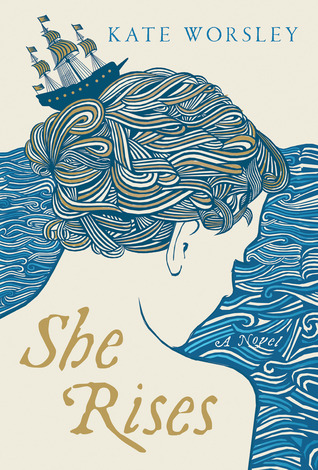
She Rises by Kate Worsley

She Rises She Rises begins in 1740 when Louise Fletcher, a young dairymaid from Essex, is offered a position as lady’s maid in a sea captain’s house in Harwich. Louise has never been more than a few miles away from home, so arriving at the Handleys’ prosperous household in the busy port town is like entering a different world. As Louise settles into her new job and gets to know her selfish, spoiled young mistress Rebecca Handley, she also decides to see if she can find out what happened to her brother, Luke, who went away to sea and has never been seen or heard from again.

In the other main thread of the story we learn how Luke was pressed into the Royal Navy from a tavern in Harwich and found himself taken aboard the warship, the Essex. Luke has never been on a ship this size before and soon discovers that life at sea is harsh and dangerous. Things improve when he is befriended by an older, more experienced seaman, Nick Stavenger, but still Luke wants nothing more than to escape and get back home to the girl he loves.

Louise’s story and Luke’s are told in alternating chapters and both narratives have a distinctive voice and style of their own. Luke’s is in the present tense and is filled with nautical terminology and slang; Louise’s is addressed to a mysterious ‘you’ – though we don’t have to wait long before we learn who ‘you’ is. Having finished the book, I think I can see why Kate Worsley chose to write the story in this way, but I’m not a fan of unusual or experimental writing styles in general and couldn’t help thinking that it made the book harder to read than it really needed to be!

The book was so atmospheric, though! The chapters set at sea felt realistic and gave me a good idea of how hard life could be for a pressed man in the navy, though as usual I struggled with all the references to mizen yards, main-topsails and other seafaring terms. But the descriptions of eighteenth century Harwich were particularly vivid: the labyrinths of dark alleys and smugglers’ tunnels, the smell of fish, the sailors standing in tavern doorways, the way the streets become flooded with sea water when the tide rises.

So, there were some aspects of this book that I loved and others that I didn’t like very much. I found it too slow at the beginning, but when Louise’s and Luke’s stories finally come together, the effect is amazing. I had been starting to get impatient, wondering how the two of them would be linked, but when it happened it was definitely worth waiting for! Things that had confused me earlier suddenly made perfect sense and some of the revelations in the final section of the book made me want to go back and read earlier chapters again.

She Rises reminded me of Sarah Waters, particularly Tipping the Velvet, due to the way both authors deal with themes such as gender and identity within a historical setting – so I wasn’t surprised to read that Sarah Waters was Kate Worsley’s mentor. As a first novel this was a very clever and ambitious book and although I had too many problems with it to be able to say that I loved it, I will be hoping for more books from Kate Worsley in the future.