To Defy a King by Elizabeth Chadwick

Why are some reviews so much easier to write than others? This one has been sitting half-finished in my drafts folder since the end of July, waiting for inspiration which has never really arrived. This is no reflection on the quality of the book, which I enjoyed as much as all the other Elizabeth Chadwick books I’ve read, but for some reason I’ve had trouble thinking of what I want to say about it.

Anyway, To Defy a King is the story of Mahelt Marshal, the daughter of William Marshal, Earl of Pembroke and hero of two of Chadwick’s previous novels, The Greatest Knight and The Scarlet Lion. At the age of fourteen Mahelt is married to Hugh Bigod, the son of the Earl of Norfolk, and goes to live with her new family at Framlingham Castle. The Bigods have connections with King John through Hugh’s half-brother, William Longespée, who is also a half-brother of the King. As King John’s relationship with his noblemen slowly worsens and the country descends into war and political turmoil, the Bigod and Marshal families find themselves on opposite sides of the conflict. Mahelt must try to decide where her allegiances lie – with the family she was born into or with the Bigods and the husband she loves?

A few weeks before reading this book, I had read Here Be Dragons by Sharon Penman which covers much of the same period and this was useful as it meant I already had an understanding of some of the history. But where Here Be Dragons gives us a more balanced view of King John, seen through the eyes of his daughter Joanna as well as from the perspective of his many enemies, with this book we are given a very negative portrayal of the King. Anyone who tries to defy him, as Mahelt Marshal does, could be putting themselves and their family in serious danger.

Mahelt is a strong and independent person, who sometimes refuses to behave in the way a woman might be expected to behave during this period, yet she doesn’t feel too ‘modern’ or out of place in her medieval setting. Longespée is another great character and one of my favourites. He is in a difficult position, torn between his loyalty to the King and his relationship with his Bigod family. His rivalry with his half-brother Hugh leads him to do some cruel and insensitive things, but by the end of the book we see that he is not completely beyond redemption and I was happy with the way his character developed.

Although this book is set after The Greatest Knight (which I read last year and can recommend) I don’t think it’s necessary to have read that one first. I haven’t read the sequel to The Greatest Knight, The Scarlet Lion, yet but didn’t feel I had missed anything that was essential to my understanding of this book. There are also two other books I haven’t read, The Time of Singing, which tells the story of Roger Bigod, Hugh’s father, and A Place Beyond Courage, the story of William Marshal’s father, John. While reading the previous novels would help you become more familiar with the backgrounds of some of the characters, To Defy a King is easy enough to follow as a stand-alone novel and is one of my favourite Elizabeth Chadwick books so far.

The Princess of Cleves by Madame de Lafayette

First published in French in 1678, The Princess of Cleves (or La Princesse de Clèves to give it its French title) is considered to be one of the first psychological novels. The story is set in the previous century (between 1558 and 1559), which also makes it an early example of the historical fiction novel.

Newly arrived at the court of Henri II, the beautiful Mademoiselle de Chartres catches the eye of the Prince of Cleves and they are soon married. The new Princess of Cleves does not love her husband, but she likes and respects him and for a while it seems that might be enough…until she meets and falls in love with the Duc de Nemours. The rest of the book explores the Princess’s conflicting emotions, as she becomes torn between her passionate love for the Duc and her desire to stick to her morals and do what she believes is right. Eventually the Princess faces an important decision, but the choice she makes is maybe not what you would expect and it’s left to the reader to make up their own mind whether they agree with her actions or not.

This book was of particular interest to me because earlier this year I read Queens’ Play by Dorothy Dunnett, which is set at the French court in the middle of the 16th century. The Princess of Cleves is set at the same court during the same period and so it was filled with names I recognised. The title character and her mother are fictional but the others are real historical figures: Henri II and his wife Catherine de’ Medici, Diane de Poitiers (the Duchess de Valentinois), the Constable de Montmorency, the Mareschal de St. Andre, the Prince of Conde, the Vidame of Chartres, the Duke de Guise and his brothers, as well as the Dauphin and his wife, Mary Queen of Scots. I think the fact that I was already familiar with these characters made the opening pages of this book slightly less overwhelming than they might otherwise have been! And luckily, only a few of the people mentioned play an important part in the story, so it’s not necessary to keep track of all of them.

If you can get past the first section, which is little more than a long list of names and descriptions of the relationships between the various courtiers, the story does start to pick up. It all appears to be very accurate historically, although not much attention is given to the important historical events of the period – this is a character driven story with the focus on the actions of the Princess, her husband and the Duc de Nemours. The court of France at that time was known for being frivolous, decadent and rife with romantic intrigue and gossip, and the author manages to capture these aspects of court life. However, having read about the background to the novel, it seems Madame de Lafayette was also commenting on the behaviour and structure of the court of her own time, Louis XIV, which I know less about so am not sure how similar or different the two courts were.

The Princess of Cleves is not a book I would recommend if you’re looking for an entertaining read with an exciting plot, but if you enjoy French literature and history or if you’re interested in the development of the early novel then I think it’s definitely worth reading. It’s a short novel and doesn’t take too long to read, though it does require some concentration, especially at the beginning. I found the writing very dry, though maybe that’s my own fault for reading the free version from Project Gutenberg rather than searching for a better translation. As I’m not able to read it in its original French, which would obviously be the best option, I’d appreciate any opinions as to which translation I should try if I decide to re-read the book at some point in the future.

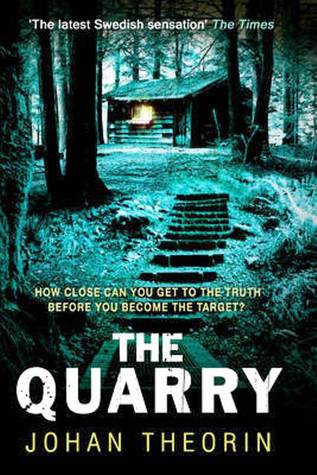
The Quarry by Johan Theorin

This is the third in Johan Theorin’s Öland Quartet, a series of four crime novels set on the Swedish island of Öland. Each book in the series is set during a different season, with the changes in weather and landscape affecting the mood and atmosphere of the story. I loved the first two books, Echoes from the Dead and The Darkest Room, so I was looking forward to my third visit to Öland. I couldn’t wait to meet my favourite character, Gerlof Davidsson, again and to find out what life on the island was like during the spring months.

In The Quarry, Gerlof is now eighty-three years old and, deciding he doesn’t want to spend the remainder of his life in the residential care home he’s been living in, he moves out and returns to his old cottage in the village of Stenvik. Once back in his own home, he finds some of his late wife’s old diaries written while he was away at sea many years earlier. What he discovers in the diaries could be connected to the story of Vendela Larsson, who has recently moved into a luxury house nearby with her husband, Max. Vendela grew up on the island listening to her father’s tales of myths and legends, and returning to Öland as an adult she finds herself wondering whether the elves and trolls she believed in as a child might really exist.

Meanwhile, Gerlof and Vendela also have another new neighbour: Per Mörner, a divorced father, who has inherited his uncle’s cottage beside an abandoned quarry. Per is looking forward to spending the Easter holidays there with his two children, but he has to change his plans when his daughter becomes seriously ill and his father, Jerry, is almost killed in an arson attempt. Per has barely spoken to Jerry for years but feels obliged to help him, and when he begins to investigate he becomes drawn into his father’s sordid past.

“If you like Stieg Larsson, try a much better Swedish writer” it says on the back cover of this book. I can’t comment on that as I’ve never read Stieg Larsson and am not an expert on Swedish crime fiction, but I would certainly be happy to recommend Theorin’s Öland novels. They are all standalone stories and with the exception of Gerlof, they have different characters so can be read in any order, though I would suggest leaving The Quarry until you’ve read the previous two as I found this one the weakest book of the three.

I still love Gerlof and enjoyed being reacquainted with him. I can only hope that I’m as independent, alert and intelligent as he is when I’m in my eighties! I also liked Per, who was doing his best to deal with his various problems including his daughter Nilla’s illness and his difficult relationship with Jerry. And as usual, the descriptions of the island of Öland are beautifully written. This book is set in the spring, as the last of the winter snows are melting away, so the story is not quite as dark as the first two but there’s still a feeling of loneliness and isolation. The translator, Marlaine Delargy, deserves a word of praise for not losing any of the atmosphere or sense of place.

So why didn’t I enjoy this book as much as the others in the series? The reason, I think, was that Vendela’s story, filled with folklore and magical stories of battles between elves and trolls, didn’t really work very well with the other main storyline. Although I was interested in the fates of both Vendela and Per, I thought their stories could have been the subjects of separate books rather than being combined in the same novel and because of this, I found The Quarry less satisfying than Echoes from the Dead and The Darkest Room (the best of the three, in my opinion). I was disappointed after loving the first two so much, but that won’t stop me reading more Johan Theorin books in the future.

September Reading Summary

I never know how to begin writing these monthly posts, so without further ado I’ll just go straight into my summary of September’s reading.

I started the month with the new Philippa Gregory book, The Kingmaker’s Daughter, fourth in her Cousins’ War series, telling the story of the Wars of the Roses through the eyes of some of the important female figures from the period. This one is narrated by Anne Neville, daughter of the Earl of Warwick and wife of Richard III. Not my favourite book in the series, but still one that I enjoyed reading.

I was already familiar with Anne Neville’s story before reading The Kingmaker’s Daughter, but I also read two books in September that introduced me to some historical figures I knew little or nothing about. In The Conductor by Sarah Quigley I met the Russian composer Dmitri Shostakovich and learned about the circumstances that surrounded the composition of his Leningrad Symphony. And in Melanie Benjamin’s The Autobiography of Mrs Tom Thumb I found out what life was like for Mercy Lavinia Warren Bump, who measured only two feet eight inches tall.

I also read three books for R.I.P. VII. The first was The Strange Case of Dr Jekyll and Mr Hyde by Robert Louis Stevenson. I haven’t had time to write about the other two yet: The Quarry by Johan Theorin and The Seance by John Harwood. The Seance, which felt like a Victorian sensation novel, was a book I had expected to enjoy and I did, though I didn’t like it quite as much as John Harwood’s other book, The Ghost Writer. The Quarry is the third in a planned quartet of crime novels set on the Swedish island of Oland, but although I loved the first two in the series, this one was a slight disappointment – I’ll explain why when I post my review.

Back to historical fiction, and another book I still need to post my thoughts on is Wolf Hall by Hilary Mantel. I started reading it in August as part of a readalong, but fell behind with the schedule after the first couple of weeks. I did still manage to finish it before the end of September and was very impressed. I can see exactly why it has been so successful. Finally, anyone who has been following my blog for a while will know that I’m currently working my way through Dorothy Dunnett’s House of Niccolo series. Yesterday I finished the fourth in the series, Scales of Gold, and although I did enjoy the previous three, this one was the best so far for many reasons, not least the wonderful Timbuktu setting and the shocking cliffhanger ending!

Newly acquired books

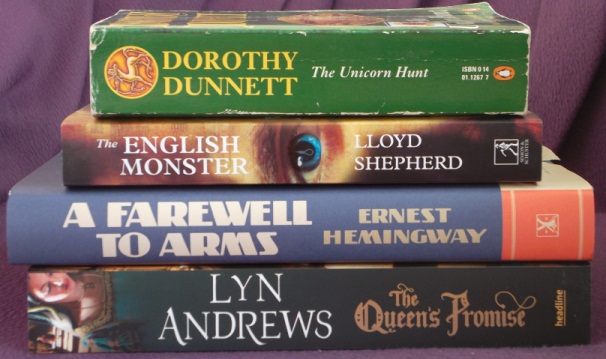
The Unicorn Hunt by Dorothy Dunnett
The English Monster by Lloyd Shepherd
A Farewell to Arms by Ernest Hemingway
The Queen’s Promise by Lyn Andrews

Apart from the top one, which I bought myself so I can continue with the House of Niccolo, the other three are review copies.

Clarissa Group Read

I haven’t posted any updates on my progress with the group read of Samuel Richardson’s Clarissa since March, but I am still reading it and am finally beginning to catch up after coming close to abandoning it earlier in the year. I’m reading the Kindle version which is in nine volumes and have just started volume seven, so I think I will probably be able to finish it before the end of December as scheduled.

I hope you all had a good September and enjoy your reading in October!

The Autobiography of Mrs Tom Thumb by Melanie Benjamin

Despite the title, this is not a real autobiography, but a fictional account of the life of Mercy Lavinia Warren Bump. Measuring only two feet eight inches tall, Vinnie is described as ‘a perfect woman in miniature’. Not content to spend her life living on her family’s farm in Middleborough, Massachusetts, she works briefly as a schoolteacher before leaving home to perform with Colonel Wood’s riverboat show. Wood, who claims to be a cousin, promises to make Vinnie famous as an entertainer but it soon becomes obvious that he has other plans for her and she returns home disillusioned.

Determined not to give up on her dreams, Vinnie contacts the great showman P.T. Barnum and soon becomes a celebrity, travelling the world and meeting presidents and royalty. Her wedding in 1863 to another small person, Charles Stratton, known as General Tom Thumb, captures the imagination of both the press and the public. But when her younger sister Minnie, who is even smaller than herself, is also drawn into the world of show business, Vinnie fears it could all end in tragedy.

I enjoyed Melanie Benjamin’s previous novel, Alice I Have Been, which told the story of the girl who inspired Lewis Carroll’s Alice’s Adventures in Wonderland, so I’ve been looking forward to reading more of her work. And I enjoyed this book too. There were plenty of things to admire about Vinnie – she had lots of courage, lots of confidence and dignity, and lots of ambition. Instead of staying in the safety of her home which would certainly have been the easiest thing to do, she wanted to get out and see the world, to have new experiences and to build a successful career for herself. I’ve never really stopped to think about how difficult – and even dangerous – everyday life can be for a person smaller than average in a world built for much taller people. Such simple things as opening a door, getting into bed, climbing up stairs and even walking through a crowded room were a challenge for Vinnie and I was impressed with how well she dealt with the situations she found herself in.

However, as the story continued I began to dislike Vinnie more and more. She was obsessed with fame and fortune, she had a very superior attitude and appeared to consider almost everyone else, including her husband and sister, to be less intelligent than herself. I found her relationship with Charles particularly sad to read about as it had the feel of a professional business arrangement rather than a happy marriage and Vinnie seemed to have very little affection or respect for him. Luckily, though, my dislike of Vinnie didn’t stop me from loving the book; it was still one of the most fascinating and original historical fiction novels I’ve read for a long time.

While Vinnie’s personal story is the main focus of this book, there are also lots of interesting facts of American history scattered throughout the novel. Vinnie lived through an eventful period that included the Civil War and the abolition of slavery, as well as the arrival of some exciting new inventions such as the electric light and the telephone. Information on all of these things and many others are provided in the form of short news articles during the ‘Intermissions’ between chapters. Some of these facts are relevant to the chapter that follows, while others are seemingly unrelated pieces of trivia – these don’t do anything to move the story forward, but they all give fascinating insights into the period.

I knew nothing about Lavinia Warren before reading this book so I can’t comment on the historical accuracy of the story, but it did appear to be very well researched. The real Vinnie never actually wrote an autobiography, but she left behind some travelogue-style journals and essays which Melanie Benjamin read as part of her research for the novel. She also includes some interesting photographs in the book, though I was disappointed that there weren’t more pictures illustrating some of the characters who appeared in the story. I was able to find some for myself online and seeing photos of Vinnie, Charles, P.T. Barnum and the others really helped bring the story to life!

The Kingmaker’s Daughter by Philippa Gregory

This is the fourth book in Philippa Gregory’s Cousins’ War series which looks at the Wars of the Roses (the series of conflicts in the 15th century between the House of York and the House of Lancaster) from a female perspective. The others in the series are The White Queen, the story of Edward IV’s wife Elizabeth Woodville, The Red Queen, which follows Margaret Beaufort, the mother of Henry VII, and The Lady of the Rivers, the story of Elizabeth Woodville’s mother, Jacquetta. This one, The Kingmaker’s Daughter, focuses on the life of Anne Neville.

Anne is the daughter of the powerful nobleman Richard Neville, the Earl of Warwick, known as the Kingmaker for the part he played in putting Edward IV on the throne in place of Henry VI. When Edward marries the beautiful Elizabeth Woodville despite Warwick’s attempts to negotiate a marriage for him in France, Warwick changes allegiance and rebels against the King he had once helped raise to power.

Warwick has no male heirs, but he does have two daughters, Isabel and Anne, and is determined to make one of them Queen of England. Anne, our narrator, is only eight years old at the beginning of the book but soon both she and her sister become caught up in their father’s political machinations. Isabel is married to Edward IV’s brother George and Anne to Henry VI’s son, Edward of Lancaster. But after Warwick’s rebellion fails and Anne finds herself widowed, she marries again – this time to the Duke of Gloucester, the man who will become Richard III.

I’m sorry if I’ve made this sound very confusing, but it was a confusing period of history and Philippa Gregory does a good job of presenting the information in a way that is easy for the reader to follow and understand even if you’ve never read about the period before. Although this is the fourth in the series, these books could be read in any order and all four also work as standalone novels as Gregory does not assume that the reader has any knowledge of events that happened in the previous books. However, reading the whole series helps to build up a full and well-balanced picture of the period. I love the way the books overlap, showing us some of the same events but from different perspectives. This book, for example, seen through Anne Neville’s eyes, is extremely biased against Elizabeth Woodville and her family, the Rivers – but if you also read The White Queen you get Elizabeth’s point of view which is obviously very different!

Like The White Queen and The Lady of the Rivers, this book has strong themes of witchcraft and magic. Elizabeth Woodville and her mother Jacquetta were supposedly descended from the water goddess, Melusina, and Gregory suggests that they might have had magical powers. There’s a lot of focus on this in The Kingmaker’s Daughter, with Anne becoming more and more convinced that Elizabeth is using witchcraft to attack her family, to whistle up storms and put curses on people. This is one aspect of the series that just hasn’t been working for me; I feel that this period of history is already interesting enough without needing to bring in an element of fantasy.

Richard III is one of my favourite historical figures and I was happy enough with the way he is portrayed in this book. He’s not perfect, but he’s certainly not the villain of Shakespeare’s play either – he comes across as a loyal brother and husband and a good king who really cares about the future of his country. This book is also more sympathetic towards George, the Duke of Clarence, than any other novel I’ve read and it was refreshing to be shown the good sides of his character as well as the bad. The characterisation of Anne, though, was not quite what I would have expected or hoped for. In other books that I’ve read about her, she has been portrayed as quiet and gentle with a lot of inner strength and dignity, but this version of Anne doesn’t display much strength or courage, while being too ready to blame other people (usually Elizabeth Woodville) when things go wrong. But I did think the relationship between Anne and Isabel was handled well, showing how they were friends one minute, rivals the next – the ‘sisters’ aspect of the book reminded me of Mary and Anne Boleyn in The Other Boleyn Girl.

This was not my favourite of the Cousins’ War books but I’m enjoying the series and will look forward to the next instalment. Apparently the fifth book will be about Elizabeth of York, the sister of the Princes in the Tower and daughter of Edward IV and Elizabeth Woodville.

I received a copy of this book from Simon & Schuster for review

The Conductor by Sarah Quigley

It’s 1941 and Russia is now at war with Germany. As the Nazis surround Leningrad with the aim of starving the city into submission, the composer Dmitri Shostakovich begins work on his Seventh Symphony. While other important musicians are being evacuated, Shostakovich insists on remaining to help defend his city. To his wife, Nina, the real reason he doesn’t want to leave is because he doesn’t want to be disturbed while writing his symphony and it seems to her that he is putting his music before the welfare of his family.

During the siege, the government orders that the Seventh Symphony be performed to raise the morale of the Soviet troops at the front. Since the members of Leningrad’s famous Philharmonic Orchestra and their conductor Mravinsky have already been removed from the city, the job of performing the Seventh Symphony falls to another, less highly regarded conductor, Karl Eliasberg and the second-rate Radio Orchestra. Eliasberg finally has the chance to do something great, but it’s not going to be easy…of the musicians who have stayed in Leningrad through the long, cold Russian winter some of them are dead and the others barely have the strength to lift their instruments.

Alongside the stories of Shostakovich and Eliasberg is the story of a third man, Nikolai Nikolayev, and his beloved nine-year-old daughter, Sonya. Nikolai must make the heartbreaking decision of whether to risk sending Sonya out of Leningrad on her own while he stays behind to continue his work as violinist in the orchestra.

The Siege of Leningrad was surely one of the most horrific episodes of the Second World War. This book was maybe not quite as emotional as other novels I’ve read on the same subject (The Bronze Horseman by Paullina Simons, for example) but it was still very moving. The idea of people being so hungry they’re driven to boiling down leather briefcases for protein or mixing water and hair oil to make soup, while watching as their family and friends die one by one of starvation or cold, is horrible to think about. And yet the story is not too bleak or depressing because it’s not just about war and suffering – it’s also about the power of art and music and how something good can come from even the worst circumstances imaginable.

The characters Sarah Quigley has chosen to focus on in this novel are all interesting, three-dimensional people who each have their own set of problems and obstacles to overcome during the siege. My favourite was Karl Eliasberg, the conductor of the book’s title. Based on a real person but one who we don’t know much about, the author imagines him as a shy, awkward man with low self-esteem, desperate to have his talents recognised and to be accepted by the cultural elite. Shostakovich is his idol but every time he comes face to face with him he finds himself saying the wrong things and failing to give the impression he was hoping to give. Eliasberg’s character is so well-written and believable I felt I could really understand him and empathise with him.

Despite Shostakovich being one of the central characters and the story revolving around one of his compositions, you don’t need any knowledge of classical music to enjoy this novel. However, I would highly recommend listening to the Seventh Symphony after finishing the book – it’s definitely worth it and it really adds to the reading experience. I loved this book and I have a feeling that when I make my list of favourite books of the year in December this might be one of them.